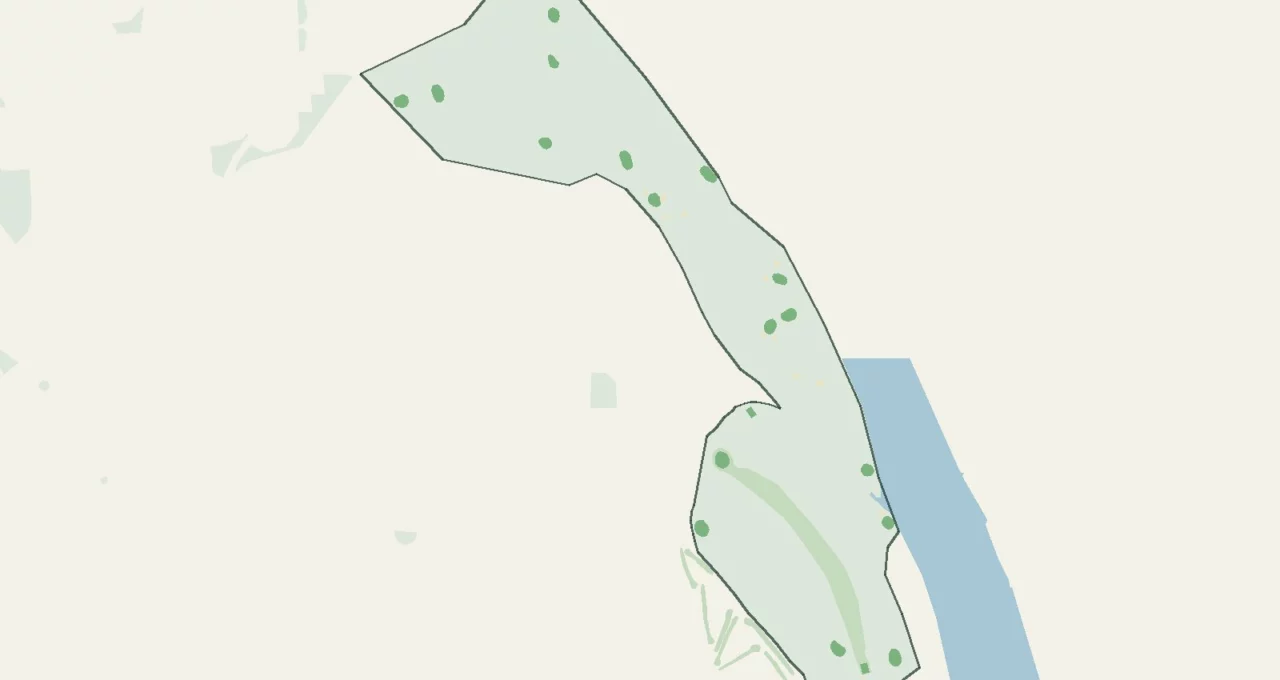
Layout of North Inch Golf Course from OpenStreetMap survey data (ODbL licence).
North Inch Golf Course
Holes
18
By
68 (men's white and yellow); 67 (men's red); 69 (women's white, yellow and red), club rating tables
Length
5,442 yards from the white tees, 5,154 yellow, 4,971 red (GolfPass tee table); the club's hole by hole guide adds up to 5,185 yards from the yellow tees
Green fee
—
Best season
Year-round (GolfPass); in October 2026 the club's course status showed 18 holes open on summer greens
North Inch Golf Course lies inside the North Inch, the larger of Perth’s two riverside parks, on the west bank of the River Tay a short walk north of the city centre. The starter’s box is on Hay Street, postcode PH1 5HS, opposite Bell’s Sports Centre, and the course is owned and run by Perth and Kinross Council as a public, pay and play venue: there is no membership in the usual sense, and visitors are welcome seven days a week. The eighteen holes measure 5,442 yards from the white tees and play to a par of 68, with six par 3s, ten par 4s and only two par 5s, both on the back nine. That is a short card by modern standards, and nobody pretends otherwise. What North Inch has instead is history: the club’s home page dates the first written record of golf on the Inch to 1599, describes it as one of the oldest golfing venues in the world, and credits part of the present layout to Old Tom Morris in 1892.
The park itself is about 57 hectares, according to Wikipedia, and was granted to Perth by King Robert II in 1374, when the city was a royal burgh. Golf shares it with rugby, cricket, walkers, cyclists and dogs, under the eye of Kinnoull Hill across the river. The course is not ranked and does not try to be. It is a municipal course in the oldest sense of the word, used by several of Perth’s historic clubs as their home ground, and it is one of the few places in Scotland where you can play a round over ground with five centuries of golf behind it for the price of a council green fee.
Five centuries on the Inch
The early record is thin and argued over, and the sources do not agree on the first date. The club gives 1599. The Scottish Golf History website, which keeps a careful register of Scotland’s oldest courses, cites kirk prosecutions for playing golf on the North Inch on the Sabbath in 1599 and 1604. Wikipedia mentions a reference to King James IV playing golf in Perth in 1504; the Gazetteer for Scotland suggests he may have played on the Inch in 1502. None of these sources claims a continuous course from that time.
For much of the period golf in Perth was played on the South Inch, from at least 1613 according to Scottish Golf History, until it moved entirely to the North Inch in 1845. The first recognisable layout on the North Inch was a six-hole course at the southern end of the park, recorded in 1803. Beasley’s World Atlas of Golf called it the first recognisable golf course in the world, a claim Scottish Golf History describes as probably mistaken. The Perth Golfing Society was founded in 1824 and, according to the club, became in 1833 the first golf club anywhere to be granted royal status; the Gazetteer for Scotland names King William IV as the patron. The club’s page on the society repeats a tradition that the Royal and Ancient at St Andrews later insisted on its own longer title to mark the difference, and says the two clubs still play an annual match believed to be the oldest continuous team fixture in the game.
In the early 1860s, play moved north across the park. The club says the course grew from six holes to ten, then twelve, before reaching eighteen; Scottish Golf History dates the ten holes to the early 1860s and the twelve to 1865. In April 1864 the Inch staged the first Perth Tournament, a professional event over three rounds of the then twelve-hole course. Old Tom Morris won it, Willie Park Senior played, and Young Tom Morris, a week short of his thirteenth birthday, won his match against a local boy, Willie Greig. The club says the prize fund was larger than that of the Open Championship of the day. Wikipedia records a second open tournament on the Inch in 1866.
The eighteen holes date from 1892. Scottish Golf History says Muirton Field was acquired from Lord Mansfield that year with money from a sponsor of the Perth Artisans club, and that six new holes were laid out by Old Tom Morris, with the first tee and home green still at the south end of the old racecourse. The course did not stay that way. In 1897 a local tenant reclaimed some of the land and the course shrank; the King James VI club, founded in 1858, left for Moncreiffe Island in the Tay, where it still plays. Land given by John Dewar restored eighteen holes in 1927. More recently the Gazetteer for Scotland records disruption from flood protection works around 2005, after which eighteen holes were restored, and in 2016 the council considered closing the course to save money, a proposal reported at the time by Scottish Golf View; Scottish Golf History records that it was rejected.
Several clubs still call the Inch home. The Royal Perth Golfing Society plays its home matches here. The Perth Artisans, founded in 1879, have their clubhouse behind the 2nd tee; among their founders, the club says, was Andrew Forgan, the St Andrews club and ball maker who went on to be greenkeeper at North Inch. Perth Ladies Golf Club, founded in 1928, and the Perth Railway Golf Club also play their competitions here, and the course has its own junior club.
What the course asks of you
The figures below come from the scorecard published on GolfPass and from the club’s own hole by hole guide, which gives yellow tee yardages. From the whites, the front nine is 2,540 yards and par 33, the back nine 2,902 yards and par 35. The club’s current rating tables, dated from 7 July 2026, give a course rating of 66.2 and a slope of 115 from the men’s white tees, and 64.9 and 112 from the men’s yellows, both par 68. For women the course is par 69 from the white, yellow and red tees, with slopes of 124, 121 and 118. The ground is flat, and the club stresses easy walking; what makes the course harder than its length are the trees, the burn, the river and some small, sloping greens.
The opening three holes are long par 4s, and one reviewer notes that they are played over the open, common part of the park before the course proper begins at the 4th. The 1st, Inch Royal, 374 yards from the yellows, has out of bounds on the left and large trees on the right, and the club’s tip is to take an extra club for the approach because the green has no bunkers to frame it and is further away than it looks. The 2nd, Kinnoull Hill, named for the view, asks for a drive down the left to set up the approach into a two-tiered green with a narrow opening and a bunker short and left. The 3rd, The Witches, 446 yards from the yellows and the hole the scorecard rates second hardest, plays into the prevailing wind and is, in the club’s words, a three-shot hole for all but the longer hitters, with a slightly raised green sloping away from front to back and a large tree overhanging its right side.
From the 4th the character changes. Jimmy Thomson, named after a former greenkeeper, is a short par 3 of 117 or 118 yards, depending on which line of the guide you read, from a raised tee over deep bunkers. The 5th, Pond, is a short par 4 with two fairway bunkers about 50 yards short of the green and, from the medal tee, a bank of trees, the pond and out of bounds on the left. The 6th, Cottars, 120 yards, is played over a valley to a plateau green surrounded by steep banks and trees, where anything short runs back down and anything long or right may not be seen again. The 7th, Annie’s Well, is the only blind tee shot on the course: the brave carry the tall firs on the right, the prudent lay up on a slope that kicks the ball onto a flat, wide section of fairway, and players ring a bell once they are clear. The 8th, Palace, doglegs left with trees and out of bounds on that side, to a firm green that slopes sharply from back to front. The 9th, the Wee Dunt, is 91 yards from the yellows and one of the most talked about holes on the course: a narrow green with slopes on every side and cavernous bunkers, where the club warns that a missed green usually means a four.
The 10th, Tremmlin Trees, 152 yards and usually into the wind, needs enough club to carry two deep bunkers in front of a raised green. The 11th, Burnbrae, is the hardest hole on the scorecard, at 411 yards from the whites. The 12th, Bute Drive, starts with a drive over the burn to a tree-lined fairway, and a dip short of the green makes it look closer than it is. The 13th, Lang Whang, is the first of the par 5s, 495 yards from the tips, with out of bounds the whole length of the left, a fairway bunker and overhanging trees on the right and a burn about 70 yards short of one of the largest greens on the course.
The run from the 14th to the 16th is the stretch beside the Tay. The 14th, Sand Hole, 201 yards, is the longest par 3, with two big bunkers either side of the front of a multi-tiered green that slopes away from the player. The 15th, which the club spells Penninsula, runs the whole length of the river bank, and the club’s own advice is simply to play your second shot from dry land; the small green sits a few paces from the water on the left with a burn cutting in on the right. The 16th, Chance, is one of the signature holes: a par 3 of under 80 yards over the burn, with the Tay creeping in on the left and a deep bunker in front of the green. The 17th, The Pines, is a short par 4 crossed by a burn in front of the tee and a diagonal copse of trees in front of the green, which can hide the flag. The 18th, Inch Hame, is a meandering dogleg par 5 of 490 yards from the yellows, with an enormous tree about 40 yards short of a two-tiered green that blocks anything played from the left.
What golfers say
The points below summarise the public reviews posted on GolfPass, which shares its reviews with GolfNow, read in October 2026. They are other people’s opinions, not ours. Nobody from Panxis has played the course, and we name no reviewer.
What comes up in its favour
- Value. Reviewers return again and again to the price, often in the same breath as the words municipal or council, and several describe it as one of the better public courses in Scotland.
- The staff in the starter’s box, described as friendly, helpful and professional, and the free club hire, which visitors without their own set appreciate.
- The holes after the first three. Several reviewers treat the opening stretch as a warm-up and praise the quirky par 3s and the variety from the 4th onwards, with the run along the river from the 14th to the 16th singled out as the most beautiful.
- Greens and fairways described as well kept and running true in many reviews, and a flat, easy walk that suits beginners, juniors and older golfers.
- Pace of play: some report rounds well under four hours, even at weekends.
What comes up against
- Finding your way. First-time visitors report getting lost between holes, especially around the 5th to the 8th, and ask for clearer signs to the next tee and a course map on the card.
- Very limited facilities. There is no clubhouse for visitors, only the starter’s box with basic refreshments, and the club itself says it cannot offer catering for groups.
- Condition when the weather or maintenance intervenes: bare or cored greens at some times of year, fairways marked by flooding, and holes closed after storms brought trees down, sometimes without visitors being told in advance.
- Details at a few tees, including a worn mat on the 4th and a scrappy 13th tee, and the feeling that the first three holes are similar to one another.
- Getting from the car park to the 1st tee, which means crossing the park and its pitches, and sharing a public park with walkers and dogs.
Getting there and when to go
The course is on the northern edge of Perth city centre, and the club describes it as no more than an hour’s drive away for most Scottish golfers and less than an hour from Edinburgh and Glasgow. The nearest parking, according to the club’s visitors page, is Bell’s Sports Centre on Hay Street, opposite the starter’s box. It is a charged car park on weekdays and Saturdays during the day, its machines take cash only, and it can be very busy at weekends; the club suggests Rose Terrace, Carpenter Street, Blackfriars Wynd or the Kinnoull Street multi-storey as alternatives, and asks golfers to park considerately in the residential streets nearby. Perth railway station is a little over a mile from the course in a straight line by our measurement on the map, and the walk runs through the city centre. Reviewers advise leaving time to walk from the car park to the 1st tee.
The starter’s box, on 01738 475478, opens from 8.30am to 6pm on weekdays and 7.30am to 5pm at weekends in summer, though the club warns that the hours can change. Visitors book online through the club’s booking system or by telephone; nine-hole rounds are taken by telephone only. Juniors play free with a paying adult, the dress code is relaxed, clubs are lent free against a deposit and pull trolleys are for hire. There is no general buggy hire: the club keeps one golf buggy for golfers with a medical need. Groups of nine or more book through an enquiry form, and the club can organise nearest the pin and longest drive competitions. Beside the course is a nine-hole footgolf layout, which was closed for the winter when we checked.
The course is open all year, according to GolfPass. On the day we checked in October 2026, the club’s status page read 18 holes open, on summer greens. Being a parkland course on the flood plain of the Tay, it is at its best from late spring to early autumn, and reviewers who played after heavy rain or storms describe soft ground, debris and closed holes. In winter, or after a wet spell, call the starter’s box before setting out.
Green fees
Visitor rates for weekdays and weekends, twilight rounds, seniors, juniors and nine holes are published by the club on its visitors page, and tee times can be booked through its online booking system, where two-ball and four-ball offers are listed. Group rates are on the group bookings page. Check those pages for the current price.
How this page was made
The factual frame comes from public sources: OpenStreetMap for the location; the club’s website, read in October 2026, for the address, the history summary, the hole by hole guide and hole names, the course status, the rating tables, the visitor, parking, contact and group booking information, the footgolf course, the pages on the clubs that play the Inch and the account of the 1864 Perth Tournament; GolfPass for the scorecard, the tee yardages and the user reviews; Scottish Golf History for the dates of the South Inch, the six-hole course of 1803, the extensions of the 1860s, the 1892 extension, the 1897 reduction and the 1927 restoration; the Gazetteer for Scotland for the 1502 date and the flood works; the English Wikipedia article on the North Inch for the park, the 1504 reference and the tournaments of 1864 and 1866; Scottish Golf View for the closure proposal of 2016; where2golf for the Royal Perth Golfing Society’s home matches; Wikidata for the identifiers. The distance to Perth station is our own measurement.
Where sources disagree, we say so. The date of the first golf on the Inch is given as 1599 by the club, 1504 by Wikipedia and possibly 1502 by the Gazetteer for Scotland. The club says Old Tom Morris designed part of the current layout in 1892, Scottish Golf History says he laid out six new holes, and GolfPass lists him as the architect of the course without qualification; the course has changed so much since, through the losses of 1897, the additions of 1927 and the flood works, that we cannot say which of today’s holes, if any, are his. GolfPass gives 1803 as the year the course was built, which is the date of the first recorded six-hole layout. GolfPass gives the yellow tees as 5,154 yards in its tee table, but its own hole by hole yardages add up to 5,054, with an improbable 180 yards on the 17th; the yardages in the club’s guide add up to 5,185. The club’s guide gives the 4th as both 117 and 118 yards and the 16th as both 78 and 79, and its entry for the 11th repeats the yardage and description of the 10th and 12th, so we have used the scorecard for the 11th. The course ratings published by GolfPass are slightly older than the club’s tables of July 2026; we have used the club’s. The club’s rating table for the men’s red tees, which is undated, gives par 67, as does GolfPass. The coordinates in Wikidata place the course about half a kilometre south-east of the point we use, which is taken from the OpenStreetMap outline. The club spells the 15th Penninsula and the island Moncrieff; Scottish Golf History writes Moncrieffe and Wikipedia Moncreiffe.
The opinion section summarises user reviews on GolfPass, read in October 2026. We report recurring themes rather than individual voices, and we reproduce no quotations from reviewers. Nobody from Panxis has played or visited this course, and this page is no substitute for a round.
The course has not paid for this page, has not seen it before publication and has no say over its content. This page contains no commercial link and earns us no commission. If you know the course and something here is wrong or out of date, write to us and we will correct it.
Other courses nearby
Closest to this one in our British directory:
- The Old Course at St Andrews — 24 mi
- Bruntsfield Links Golfing Society — 31 mi
- The Royal Burgess Golfing Society of Edinburgh — 31 mi
- Kingsbarns Golf Links — 31 mi
The hole to know
Chance, a par 3 of under 80 yards over the burn, with the River Tay on the left of the green and a deep bunker in front; the club calls it one of the signature holes of the course.