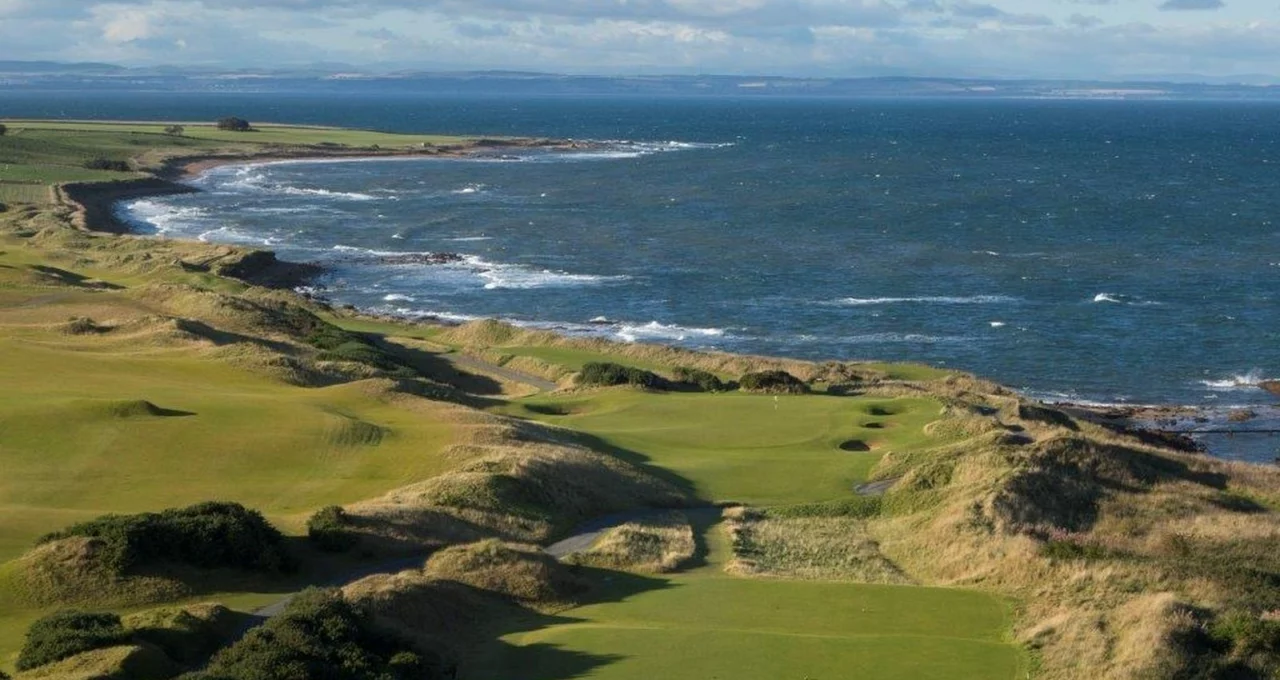
Kingsbarns Golf Links — Photo Iain Lowe / Wikimedia Commons, CC BY-SA 4.0
Kingsbarns Golf Links
Holes
18
By
72
Length
7,224 yards
Green fee
—
Best season
Spring to autumn; the links closes over winter
There was golf at Kingsbarns from 1793 until the Second World War, when the links were mined and the ground returned to farming. The modern course opened in 2000: Mark Parsinen and Art Dunkley assembled the site, Kyle Phillips designed it, and between them they produced the rarest thing in golf architecture, a new links that convinces.
Earth was moved on a large scale to build dune ridges and a tumbling fairway system out of what had been flat arable land, and the result reads as though the sea made it. The course has co-hosted the Alfred Dunhill Links Championship with the Old Course and Carnoustie since 2001, and it now sits inside the world’s top twenty-five in most published rankings.
What it asks of you
Par 72 over 7,224 yards along about a mile and three-quarters of coastline, with the sea visible from every hole and in play on several. Phillips built width into the fairways and then made the correct half of that width matter, which is the oldest idea in links architecture and the hardest to execute on ground that had none of it to begin with.
The routing gives high tees, low fairways and greens set on shelves above the rocks, so the shot is almost never played from a level stance to a target at the same height. The par three fourteenth, played along the shore, is the hole photographers come for and is regularly compared to the sixteenth at Cypress Point.
The wind is the examination, as it is everywhere on this coast. On a still morning the course is generous and scoreable; on a north-easterly the same holes ask for shots most visitors do not own. Caddies are available and are worth taking, less for the yardages than for knowing which side of a fairway is safe on the day.
What players say about it
This is a visitor course with a large review record. The notes below summarise recurring themes across specialist golf sites, traveller review pages and player discussion threads. They are other people’s opinions, not ours: we have not played the course. We report what comes back repeatedly rather than isolated remarks, and we do not name or quote individual reviewers.
What comes up in its favour
- The setting is the first thing in almost every account. A mile and three-quarters along the North Sea, with the water in view from all eighteen holes, is not something the older links on this coast can all offer.
- Conditioning draws exceptional marks. More than one reviewer describes the course as presented to tour standard on an ordinary day.
- Service is praised more consistently here than at most Scottish clubs: the welcome, the caddies and the practice facilities all come up repeatedly.
- Playability is the quieter compliment. The width makes it enjoyable for a mid-handicapper in a way several famous neighbours are not.
What comes up against
- The green fee is the loudest objection by a distance. It is among the highest in Scotland, and the replay rate is not modest either.
- Purists resist it. The phrase that recurs is resort golf, and some accounts describe the manufactured dune system as theatrical rather than authentic.
- The course closes over winter, which narrows the window and concentrates demand into the expensive months.
- Value is where opinion divides most sharply. A large share of reviewers say it is worth every penny; a smaller and equally firm group says nothing is.
Getting there and when to go
Kingsbarns is about fifteen minutes south of St Andrews on the Fife coast road, and around an hour and a half from Edinburgh airport. Almost everybody plays it as part of a St Andrews trip, and the sensible pairing is with the Old Course and Carnoustie, which is exactly what the Dunhill does.
The links plays from spring to autumn and closes over winter. May and September give the best combination of daylight, firm turf and manageable wind. Tee times are booked in advance and go early for the summer months.
Green fees
Rates and tee times are handled by the club and differ between the main season and the shoulder weeks, with a reduced replay rate within a set period. See the club’s own site.
How this page was made
The factual frame comes from public sources: OpenStreetMap for the location, Wikipedia and published architecture coverage for the history and the design, and the club’s own site for access, season and booking. The opinion section summarises public reviews and player discussions read in September 2026; we report recurring themes rather than individual voices, and we do not reproduce or attribute quotes.
We have not played this course, and nothing here is a substitute for that. The club has not paid for this page, has not seen it before publication and has no say in what it says. If you know the course and something here is wrong or out of date, write to us and we will correct it.