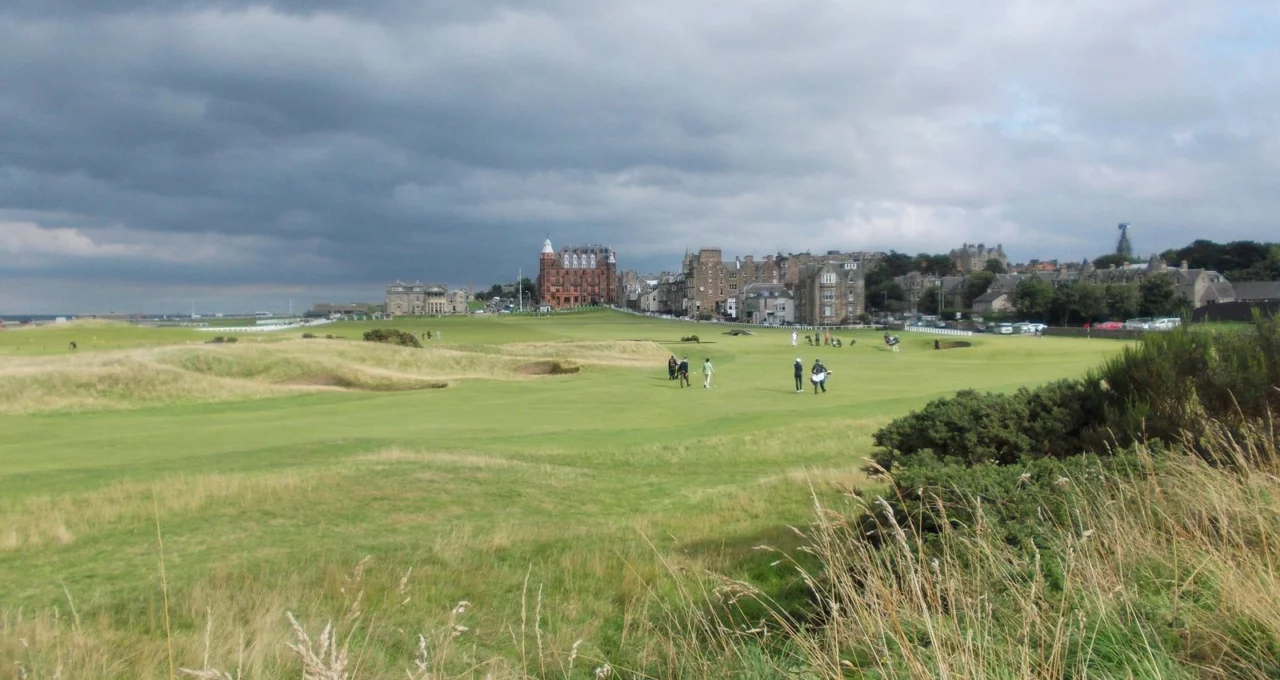
The Old Course, St Andrews — Photo Neil Theasby / Wikimedia Commons, CC BY-SA 2.0
The Old Course at St Andrews
Holes
18
By
72
Length
6,609 yards (medal tees)
Green fee
—
Best season
Open all year, closed to play on Sundays
Golf has been played on the links at St Andrews since the fifteenth century, on ground the town has always held in common. That is the single fact that explains everything else about the Old Course: it was never designed, it was worn into the ground by five centuries of play, and it still belongs to the burgh rather than to a club.
The Royal and Ancient Golf Club of St Andrews, founded in 1754 and for two hundred years the game’s lawmaker, plays here as a tenant like everybody else. The course itself is run by the St Andrews Links Trust, and any golfer with a handicap certificate can get on it. That combination, the most storied course in the game being a public course, has no equivalent anywhere.
What it asks of you
A par of 72 over roughly 6,600 yards from the medal tees, which sounds gentle and is not. The Old Course runs out along the estuary and comes back on itself, so seven greens are shared by two holes apiece, some of them more than an acre in size, with the flags marked in different colours to tell you which is yours.
There is very little water and no trees to speak of. The defences are the bunkers, most of them small, deep, invisible from the tee and placed exactly where a good shot finishes; the ground, which is firm enough that the ball keeps moving long after it lands; and the wind, which decides on any given day which line off the tee is playable. The Road Hole, the seventeenth, is the most discussed hole in golf and deserves the attention.
Local knowledge matters more here than on any other course in Britain. A caddie is not an indulgence; without one, a first-time visitor will spend the round aiming at the wrong things.
What players say about it
This is a public course with an enormous review record, and it divides opinion more than any other famous course in the game. The notes below summarise recurring themes across specialist golf sites, traveller review pages and player discussion threads. They are other people’s opinions, not ours: we have not played the course. We report what comes back repeatedly rather than isolated remarks, and we do not name or quote individual reviewers.
What comes up in its favour
- The greens are singled out more than anything else. The double greens and their scale are routinely described as the most extraordinary and interesting putting surfaces in the world.
- The back nine is generally held to be the stronger half, with the eleventh, twelfth and fourteenth leading into a closing stretch headed by the Road Hole.
- Conditioning and the practical organisation of the Links Trust draw consistent praise, which surprises visitors expecting a municipal experience.
- The history is not treated as sentiment. Reviewers who came sceptical about that generally leave saying the strategic interest justifies the reputation on its own.
What comes up against
- A substantial minority of visitors find it dull to look at. It is flat, brown and urban at the edges, and it is nowhere near the most spectacular setting in Britain.
- Others find it too easy, especially in calm weather, and professional scoring in the Open is regularly cited in support.
- The blind shots and hidden bunkers frustrate players who arrive without a caddie or a local, and that frustration comes through clearly in the negative reviews.
- Access is a lottery in the literal sense. Most tee times go by daily ballot, and a trip built around playing it can end without a round.
Getting there and when to go
St Andrews is about an hour and a quarter from Edinburgh airport by road, and the town is small enough to walk. The course is open all year and closed to play on Sundays, when the links become a public park and anybody can walk across them.
A handicap certificate is required. Most tee times are allocated by a daily ballot entered two days ahead; the alternative is a booking made far in advance or a place in the single queue on the first tee early in the morning. Late spring and early autumn give the best combination of daylight, weather and availability.
Green fees
Rates, the ballot and tee times are handled by the St Andrews Links Trust, with reduced rates outside the main season. See the Links Trust’s own site.
How this page was made
The factual frame comes from public sources: OpenStreetMap for the location, Wikipedia and published architecture and championship coverage for the history and the course, and the Links Trust’s own site for access, the ballot and booking. The opinion section summarises public reviews and player discussions read in September 2026; we report recurring themes rather than individual voices, and we do not reproduce or attribute quotes.
We have not played this course, and nothing here is a substitute for that. The Links Trust has not paid for this page, has not seen it before publication and has no say in what it says. If you know the course and something here is wrong or out of date, write to us and we will correct it.