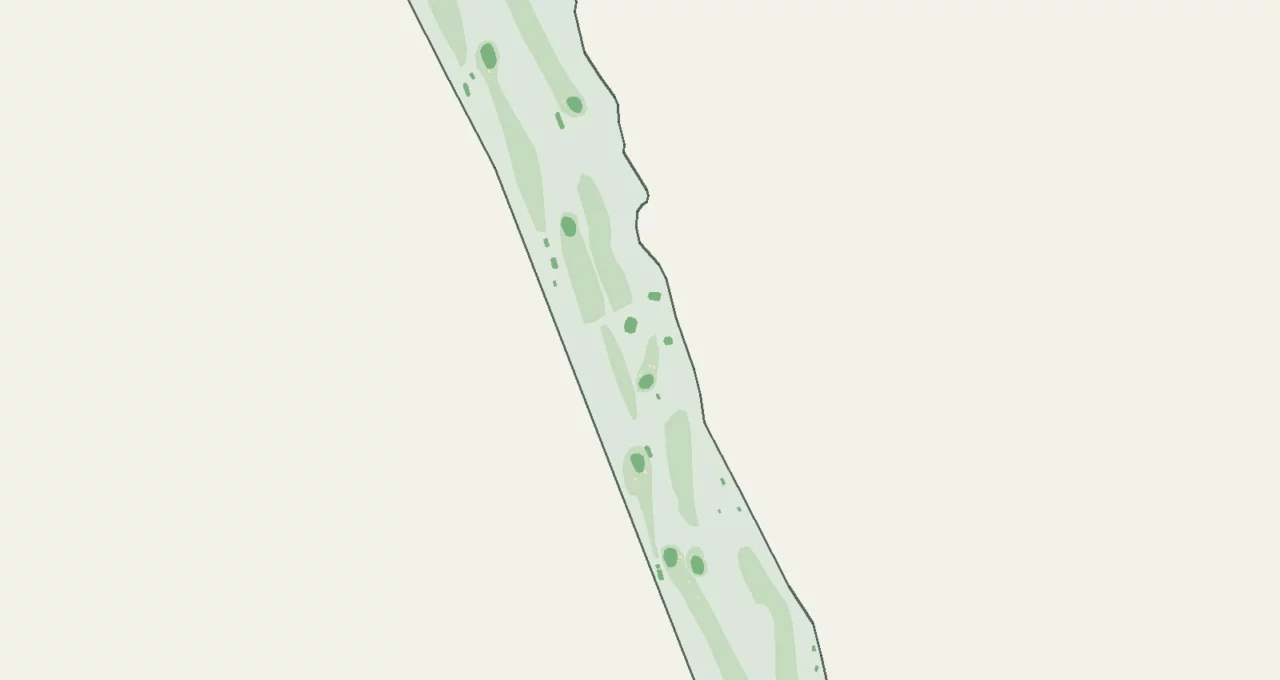
Layout of Wick Golf Club from OpenStreetMap survey data (ODbL licence).
Wick Golf Club
Holes
18
By
69
Length
6,123 yards from the white tees (club hole-by-hole guide); the club's February 2022 scorecard totals 6,039 yards
Green fee
—
Best season
Summer tees in use from near the end of March to the first week of November (club membership page); winter arrangements outside that period
Wick Golf Club plays over Reiss Links, a strip of dunes and flat links ground on the southern shore of Sinclair Bay, about three miles north of the town of Wick in Caithness, at the far north-eastern corner of mainland Scotland. The club gives its address as Reiss, Wick, Caithness, KW1 4RW. It was formally established in September 1870, which makes it, on the club’s own account and on Wikipedia’s, the oldest established golf club in the Highlands; the club now describes itself as the oldest established club on the NC500, the touring route around the north of Scotland. It celebrated its 150th year in 2020.
The course is an 18-hole links laid out in the traditional manner, nine holes going out from the clubhouse along the coast and nine coming back. The holes going out run towards the point where the Loch of Wester drains into the North Sea; the holes coming home run beside the dunes, with views across the bay. On the club’s hole-by-hole guide the white tees measure 6,123 yards and the par is 69, figures that Wikipedia and most golf directories repeat. The club’s printed scorecard gives a slightly different total, which is explained below. The layout is credited to John Sutherland, the long-serving secretary of Royal Dornoch, who extended the course from nine to eighteen holes in 1906 and 1907, with later changes endorsed by the Irish professional Ronan Rafferty. More detail is on the club’s own website.
From South Head to Reiss Links
The club’s history page, which is the main source for this section, says the first competitions were arranged on a six-hole course in Society Park in Wick, now Bignold Park, with a practice area at South Head overlooking Wick Bay. A regional golf guide, Golf Highland, adds that the founders had played informally for about six months on parks at South Head before forming the club, and that local fishermen and farmers called them the “mad gowfers”. The same guide is careful about the claim to age: Wick does not claim to be the first place in the region where golf was played, a distinction it gives to Dornoch, nor the first golf society, which it gives to Fortrose and Rosemarkie; its claim is to be the oldest club still established.
Sheriff Thoms was president for about 25 years and, according to the club, kept up links with the Sutherland Golfing Society and with St Andrews. The early club champions are recorded by name. George Banks won the championship three times running from 1871 to 1873, and D. Warren Gilchrist did the same from 1874 to 1876. Both medals left the county and came back much later: the club says Banks’s was returned from the United States in 2006 and Gilchrist’s from Australia in 2017.
In 1873 the club obtained limited access to Reiss Links and set out a nine-hole course there, with views over Sinclair Bay, its castles and, in the distance, the Pentland Skerries. In the 1890s a small pavilion was built, a better tenancy allowed golf six days a week, women became members, and a professional from St Andrews came north to give ten-day coaching sessions. Golf Highland says several members of the Dunbar family, whose estates surrounded the bay, played a part in developing and sustaining golf at Reiss, and that in November 1906 Lady Louisa Duff Dunbar of Ackergill and Hempriggs offered to pay for the extension to eighteen holes and to contribute to a new clubhouse. The club’s own history page does not mention the funding.
John Sutherland’s eighteen holes
John Sutherland was secretary of Dornoch Golf Club, later Royal Dornoch, and a member at Wick, where the club records that he won the Annual Medal in 1891. In early November 1906 he spent two days walking Reiss Links to assess the options for an extension. Later that month he sent the committee a report confirming that the ground was suitable, with a plan for the new holes and changes to the original nine. The club notes that his final paragraph explained how he had used his own clubs, and his knowledge of how far he hit each one, to measure the approximate length of each hole. The proposal was accepted with minor alterations, the work was done over the winter, and the course was ready for the 1907 season. Top 100 Golf Courses adds that Sutherland also set out the original private course at Skibo Castle for Andrew Carnegie.
Dates differ slightly between the club’s pages. The home page places the redesign in “1907/1908”, under the captaincy of Lt Col Henderson, while the narrative of the report and the work puts it in the winter of 1906 to 1907. The history page also records a new clubhouse with housing for a professional and greenkeeper, and a midnight competition held on the longest day of 1908, which started at 2.30 in the morning and finished at 5.30.
War, mines and later changes
The club says the First World War had little effect on golf at Reiss, but the Second stopped it for four years. After the fall of Norway in 1940 the coast was treated as an invasion risk, the beach at Reiss was heavily mined, and 2,000 land mines had to be cleared in 1945. Military vehicles and grenade practice damaged the course, and by the end of 1946 German prisoners of war from Camp 165 at Watten were helping to repair it under local supervision. In the 1950s and 1960s Sunday golf was allowed, a licensed bar opened in the clubhouse, and the course was extended to keep pace with equipment. The centenary in 1970 was marked by a challenge match at Reiss between the professionals Ronnie Shade and Eric Brown. A larger clubhouse followed in the early 1990s, under the captaincy of John Hunter.
The most recent significant changes are dated differently by different sources. The club’s history page and Golf Highland place them in 2002, with design advice from Ronan Rafferty, to improve safety and the position of tees in the dunes. Top 100 Golf Courses says they date from the end of the 1990s, proposed by John Hunter as former captain and endorsed by Rafferty. It gives the detail: the 2nd became a par 3 instead of a par 4, the 3rd a par 5 instead of a par 4, and on the back nine the 16th and 17th, formerly a par 3 and a par 5, became par 4s. Rafferty told that publication that the 9th green had been rebuilt and the hole lengthened, the 13th lengthened as well, and several new tees added in the dunes on the back nine for the views. One links guide mentions an overall length of 6,200 yards after the work, a figure we found nowhere on the club’s own pages.
What it asks of you
The figures first. The club’s scorecard, dated February 2022 and downloadable from its website, lists three sets of tees. From the whites, the front nine measures 3,071 yards and the back nine 2,968, for 6,039 yards and a par of 69 (35 out, 34 in). From the yellows the total is 5,777 yards, also par 69. From the reds it is 5,329 yards and par 70, because the 5th is a par 5 rather than a par 4 from those tees. The hole-by-hole guide on the club’s website gives the same figures except on two holes from the whites: it puts the 12th at 419 yards and the 13th at 414, where the card has 374 and 375. That accounts for the difference between 6,123 and 6,039 yards. The longer figures fit the lengthening of the 13th that Top 100 reports, but the club does not say which is current.
The club does not publish a course rating or slope on the card. Third-party figures disagree. Golfshake lists a standard scratch score of 71 from the whites and yellows and 72 from the reds, with the red tees at 5,364 yards rather than 5,329. A Scottish golf guide, My Golf Days, and the Links Golf directory give a rating of 69.9 and a slope of 122 for men from the whites, with 68.6 and 120 from the yellows and 66.7 and 114 from the reds. The 18Birdies app gives much higher figures, 72.8 and a slope of 125 for men from the whites, and lists the reds as par 69. We cannot say which set is current; a golfer who needs an exact course handicap should ask the club.
The layout is short by modern standards, and the difficulty comes from elsewhere. Reviewers describe the front nine as flat, with tight lines, gorse and rough that holds the ball, while the back nine climbs into the dunes, with raised tees and more heavily contoured greens. Everything depends on the wind off the North Sea, which several reviews identify as the main defence. The local rules on the card show where the trouble is: out of bounds along the fence on the left going out and the River Wester, ditches parallel to that fence played as red penalty areas, ditches behind the 5th and 11th greens and left of the 13th, and a cable house and telegraph pole by the 16th green treated as obstructions.
The front nine
The club’s hole-by-hole guide names every hole and describes how to play it. Yardages here are from the whites, as given in that guide.
- 1st, First: par 4, 286 yards. A slight dogleg from left to right; the club advises keeping left, away from the bunkers on the right, and warns that bunkers 50 yards short of the green catch drives that come up short downwind.
- 2nd, Hunter’s Joy: par 3, 169 yards, with out of bounds on the left and bunkers short left and long right. The club’s suggestion is to land short and run on.
- 3rd, Quoys: par 5, 559 yards, the longest hole. Two bunkers guard the right of the fairway and another the right of the green, with a small hollow short of it. The club notes that a ditch shown in its video has since been filled in.
- 4th, Knowe: par 3, 200 yards, with bunkers short left and right and a green that slopes from front to back, hard to hold with a low shot.
- 5th, Sleepers: par 4, 418 yards, the second hardest on the card’s stroke index. A cross ditch makes most players lay up and leaves a long second; the green is undulating and slopes from right to left.
- 6th, Warren: par 4, 407 yards. Trouble on both sides, with a warren and a hollow on the right; a bunker protects the front of the green.
- 7th, Wester: par 4, 384 yards, with a wide fairway. The club calls it a birdie chance.
- 8th, River: par 5, 507 yards, fairly straight, to a raised flat green with a bunker on the right.
- 9th, Tern: par 3, 141 yards, to a green with three tiers. The club says a bunker formerly at the front right has been moved to the back right.
The back nine
- 10th, Bay View: par 4, 381 yards, a dogleg to the left from a raised tee, with heavy rough on both sides and a raised green.
- 11th, Shochad: par 3, 172 yards, to a sloping green with a bunker on the right and a ditch behind.
- 12th, March: par 4, 419 yards on the guide, 374 on the card. The tee shot should favour the right; the green has two bunkers short and right, heavy rough left, and slopes from back to front. A bunker to the right of the green has been removed, the club says.
- 13th, Cup: par 4, 414 yards on the guide, 375 on the card, played up a valley to a green on two tiers with a drop of about four feet between them.
- 14th, Plateau: par 3, 151 yards, with bunkers across the front and a green that runs away to the back and right.
- 15th, Desert: par 4, 384 yards, stroke index 1 on the card. The fairway narrows the further the drive goes, and the approach is to another raised green.
- 16th, Cable House: par 4, 394 yards, winding through the dunes, with the cable house to the left of the green as the line, a small bunker on the left and a ditch beyond.
- 17th, Sinclair Bay: par 4, 376 yards, from tees above the beach. A dune pushes the drive to the right, which brings trouble on the right of the green into play.
- 18th, Home: par 4, 361 yards, with views from John o’ Groats in the north round to the lighthouse in the south, out of bounds on the left and a semi-blind second if the drive goes too far that way.
What golfers say
Wick is not heavily reviewed. The points below summarise what recurs across reviews on Golfshake, 18Birdies, All Square, Top 100 Golf Courses, GolfPass and Tripadvisor, in the parts we could read. They are other people’s opinions, not ours, and we name no reviewer.
What comes up in its favour
- The views are the most frequent subject: across Sinclair Bay, the beach and the castles, and particularly from the raised tees of the back nine.
- Several reviewers describe a genuine natural links with some testing holes, especially once the wind gets up.
- The back nine is consistently rated above the front. The 9th, 13th and 14th are the holes most often singled out, for their tiered and contoured greens.
- The welcome in the clubhouse is often praised, as is the sense that a visitor is wanted at a small members’ club.
- Value for money scores well on the platforms that rate it, and reviewers note that the course is usually quiet and the pace of play fast.
- Some recent reviews describe the course as well kept, with firm, true greens.
What comes up against
- The front nine is described by some as flat and repetitive compared with the holes in the dunes.
- At least one detailed review found the fairways soft and spongy rather than firm. That echoes the remark by George Peper and Malcolm Campbell, quoted by Top 100 Golf Courses, that they left Wick out of their book True Links because meadow grass had encroached and the fairways no longer ran hard and fast. Other reviews describe firm, fast-running fairways, so conditions may vary with the season and the year.
- Facilities are limited, as at many small clubs: no pro shop according to several listings, a clubhouse open at set times, and, in older reviews, payment through an honesty box.
- The wind can make the course hard work for higher handicappers.
Getting there and when to go
Reiss lies on the coast road north of Wick towards John o’ Groats, and the club puts the course about three miles from the town. The directions link on the club’s website places the clubhouse just south of the point given for the course in OpenStreetMap, at the southern end of the links. Wick has a railway station at the end of the Far North Line from Inverness, and the town is the nearest base for accommodation; the club’s area page lists hotels and restaurants in Wick and at John o’ Groats, and the town’s whisky distillery, Old Pulteney, gives its name to one of the club’s open competitions.
The course is open to all, according to the club, and visitors book tee times through the club’s online booking system, paying when they book. Some tee times are kept for members’ competitions: on the club’s home page these are Monday and Wednesday evenings, Tuesday and Thursday mornings until 10.30, and Sunday mornings until 11.00, and the tee may also be taken for inter-club matches or private parties. The clubhouse opens on Sundays from 10.00 to 14.30 and from 7.30 on open competition days, and at other times by arrangement. Trolley and club hire are listed. Buggies are less clear: one golf guide lists buggies by pre-booking and electric trolleys, while Golfshake lists neither buggies nor trolleys. Ask the club before relying on either.
The club does not publish a season, but its membership page refers to summer tees coming into use near the end of March, and to a winter period from the first week of November. Visitors outside that window should expect winter tees or temporary greens. The open competitions listed on the club’s events page run from May to September, including the NC500 Open shared with Reay Golf Club, a ladies’ open, a seniors’ open and the 36-hole Donald Lamont Open. This far north, summer evenings are very long, as the midnight competition of 1908 shows.
Green fees
The club lists its visitor fees, and the hire charges for trolleys and clubs, on the home page of its website.
How this page was made
The factual frame comes from public sources: OpenStreetMap for the location of the course; the club’s website for the address, the 1870 foundation, the history from Society Park to the early 1990s, John Sutherland’s report, the hole names and descriptions, the scorecard of February 2022 and its local rules, the visitor arrangements, the reserved tee times, the clubhouse hours, the membership year and the events; Wikipedia and Wikidata for the identification of the club, its date, its par and yardage, and its description as the oldest established club in the Highlands; Golf Highland for the informal play at South Head, the Dunbar family and the 1906 offer of funding; Top 100 Golf Courses for the Rafferty changes, the Skibo Castle attribution and the remark from True Links; Golfshake, My Golf Days, Links Golf and 18Birdies for the ratings, slopes and standard scratch scores; and reviews on Golfshake, 18Birdies, All Square, Top 100 Golf Courses, GolfPass and Tripadvisor for the opinions summarised above. GolfPass, Leading Courses and Tripadvisor blocked direct reading of their pages, so their reviews are represented only by what was publicly visible.
Where sources disagree, we say so. The white tees measure 6,123 yards on the club’s hole-by-hole guide and 6,039 on its scorecard, because of the 12th and 13th; one guide gives 6,200 yards. The red tees are 5,329 yards and par 70 on the card, 5,364 yards on Golfshake, and par 69 on 18Birdies. Ratings and slopes differ markedly between directories. The Rafferty changes are dated 2002 by the club and the end of the 1990s by Top 100 Golf Courses. The club dates the Sutherland redesign 1907/1908 on one page while describing the work being done over the winter of 1906 to 1907. Listings disagree on whether buggies and trolleys are available.
The opinion section summarises reviews on golf platforms and in golf guides, read in October 2026. We report recurring themes rather than individual voices, and we reproduce no quotations from reviewers. Nobody from Panxis has played or visited this course, and this page is no substitute for a round.
The club has not paid for this page, has not seen it before publication and has no say over its content. This page contains no commercial link and earns us no commission. If you know the course and something here is wrong or out of date, write to us and we will correct it.
Other courses nearby
Closest to this one in our British directory:
- Moray Golf Club — 54 mi
- Strathlene Golf Club — 56 mi
- Buckpool Golf Club — 57 mi
- Duff House Royal Golf Club — 62 mi