Golf lessons in Australia: what coaching costs and how to make it stick
Most golf lessons fail in the fortnight after the hour, not during it. Here is what coaching costs at an Australian venue in 2026, where beginners find free or cheap group programs, and how to choose a coach, set a measurable goal, time a swing change around your club calendar and practise so it lasts.
In brief
- Moore Park's Sydney Golf Academy listed A$88 for 30 minutes and A$166 for an hour in September 2026.
- GolfWA runs free beginner clinics; club Get Into Golf courses often run an hour a week for five weeks.
- Choose a coach who answers with a process, and who regularly teaches players at your level.
- Bring a goal in points or shots and your stats from the Golf Australia App or your last cards.
- Book a block of sessions, include a playing lesson, and keep swing changes away from championship week.
The typical Australian golf lesson goes like this: a slice gets out of hand before a club championship, you book half an hour, you hit balls for a week with the new feel, and by the next monthly medal the old swing is back. Money spent, nothing kept. Coaching works far better when you treat it as a short project with a goal, a plan and a follow-up, and when you pick the coach with the same care you would pick a physio.
Where to find coaching, and what it costs in 2026
Prices vary between cities, venues and professionals, so it helps to anchor on one published list. The Sydney Golf Academy at Moore Park Golf, whose coaches the venue describes as PGA accredited, listed these rates in September 2026:
- A 30-minute private lesson: A$88, or A$251 for a pack of three and A$475 for six.
- A one-hour private lesson: A$166.
- A shared one-hour lesson: A$191 for two people, A$216 for three and A$241 for four, in total.
- An Advanced Game Improvement course over four weeks: A$449 per person, with six and a half hours of coaching for no more than four adults, covering green reading, wedge gapping, bunkers, approach strategy and an on-course session.
Put those numbers next to a green fee and the maths is clear. A pack of short lessons costs about the same as a few rounds, and far less than the new driver that usually tempts people instead.
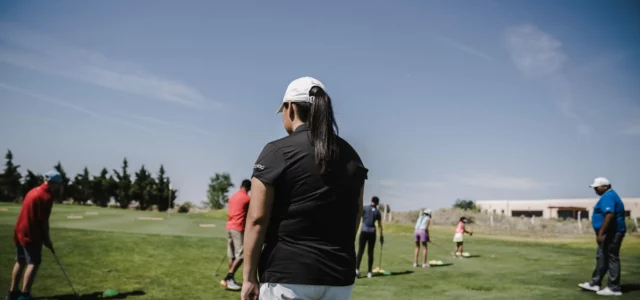
At the other end of the scale, beginner programs can cost little or nothing. GolfWA runs free beginner clinics around Western Australia, funded through partnerships with the state government’s creative industries, tourism and sport department, Play Well and Healthway. Clubs in other states run Get Into Golf programs: at Eastwood Golf Club in Melbourne’s east, for example, a typical course is an hour a week for five weeks in small groups, covering chipping, pitching, full swing, bunkers and putting, with clubs supplied.
Beginner or returning? Start with a group
Group programs have a reputation as the cheap option, but for a new player they are often the better option. Everyone is at the same stage, the coach is teaching basics that do not need to be tailored, and the social side keeps people coming back. Golf Australia’s 2024-2025 participation report found Get Into Golf registrations up 10 per cent, with women making up almost 88 per cent of participants.
Once you can get round a course, the value shifts to one-on-one or small shared lessons, where the coach can work on your particular pattern. A shared lesson with a regular playing partner at a similar level is a good middle ground: at Moore Park’s rates, two people sharing an hour pay less each than one person booking an hour alone.
Pick the coach before the swing change
Before you book, ask three things. How do you assess a new student? What does a typical block of lessons look like with you? How will we know it is working?
A coach who answers with a process (an assessment, a plan, a way to measure progress) is worth booking. A coach who answers with one swing theory for everyone may try to fit you to their model instead of the other way round.
Check that the coach regularly teaches golfers like you. Someone who spends most of the week with elite juniors may not be the best fit for a 22-marker who plays the Saturday comp, and a coach who mostly runs beginner clinics may not be the right person to fine-tune a single-figure player’s wedge distances. Ask around your club, but ask the useful question: not “who is good?” but “who helped you, and what changed?”
Your own club professional has an advantage nobody else does: they know your course, its greens and the holes where your handicap group loses shots. That matters most for a playing lesson.
Turn up with a score problem, not a feeling
“My swing feels off” gives a coach nothing to measure. “I average 30 Stableford points, I lose about five of them to penalty shots from slices off the tee, and I want to get under 18 by the end of summer” gives them a plan and a way to check it.
Bring evidence. The Golf Australia App lets you record statistics such as fairways, greens and putts alongside your rounds; a tally from your last five cards of penalty strokes, lost balls and three-putts works just as well. It saves the first twenty minutes of the lesson.
Be ready for the coach to adjust the goal. Hearing that your target is realistic but will come from your wedge game, not your driver, is worth the fee on its own.
Time the change around the Australian season
A genuine swing change feels strange for a few weeks and often makes your ball flight worse before it gets better. Your old swing, faults and all, was a set of compensations that produced a predictable result. Take one piece away and for a while you have neither the old pattern nor the new one.
That is why timing matters more than the day of the week you book. Look at your club’s calendar first: when the club championship, the major Saturday events and pennant season fall. Start a change at least six to eight weeks before any of them, so the awkward phase happens in rounds that do not matter to you. Start the same change in the fortnight before your championship and you will almost certainly abandon it on the 3rd tee. In the southern states that often points to the cooler months; in Queensland and the north, where golf runs all year, it simply means the quietest stretch of your own club’s year.
Whenever you start, ask the coach up front how long it should feel uncomfortable, and book the second session inside that window.
Leave with three things written down
Before you walk to the car, you should have:
- The change, in one sentence, ideally recorded on your phone in the coach’s own words.
- The drill, with a slow-motion clip of one good repetition to compare against.
- The dose: how many balls, how often, and when to move on.
The feel from a lesson fades within days for almost everyone. Notes and video are what survive, and a season of notes shows you what you were working on in April when the same fault reappears in November.
Practise in small, spread-out sessions
Twenty balls three times a week will usually do more than a hundred balls on a Sunday, because learning a movement responds to repetition spread over time. Start with the same shot over and over while you build the feel, then move sooner than feels natural to changing club and target every ball, because that is what the course asks of you. Ask your coach when to make that switch.
On a Trackman range such as Moore Park’s you can see carry and launch data for every ball, which helps you check the drill is doing what the coach intended rather than just feeling different.
Book a block, and include a playing lesson
Almost nothing worth fixing is fixed in one visit. Three or four sessions across six weeks lets the coach see whether the change is holding and catch the new compensation you invented in between. Many venues price packs below the single-lesson rate: Moore Park’s six-pack of 30-minute lessons works out at about A$79 a session against A$88 for one.
Make one of those sessions a playing lesson. Nine holes with a coach shows up what a range never can: the routine that vanishes under pressure, the driver pulled on a hole that needs a hybrid, the heroic recovery through a gap in the gums. Ask the coach to stay quiet for the first three holes and just watch. Moore Park’s advanced course, for one, ends with an on-course strategy session.
If your coaching includes an equipment question, ask whether a fitting would help before you change anything in your swing to suit clubs that do not suit you.
Panxis Golf has no commercial relationship with any coach, venue, club or association mentioned here and earns no commission.
Checklist before your next lesson
- Write the goal as a number: points, handicap or shots lost to one fault.
- Bring your last five scorecards or your app stats.
- Book a block of three or four, with the second session inside three weeks.
- Leave with the change, the drill and the dose, on your phone.
- Check your club calendar and start any swing change well before the championship, not in the fortnight leading into it.
- Once a season, swap a range hour for a playing lesson over nine holes.
Golfers who get better from lessons are rarely the ones with the best coach. They are the ones who did something with the fortnight after each session.