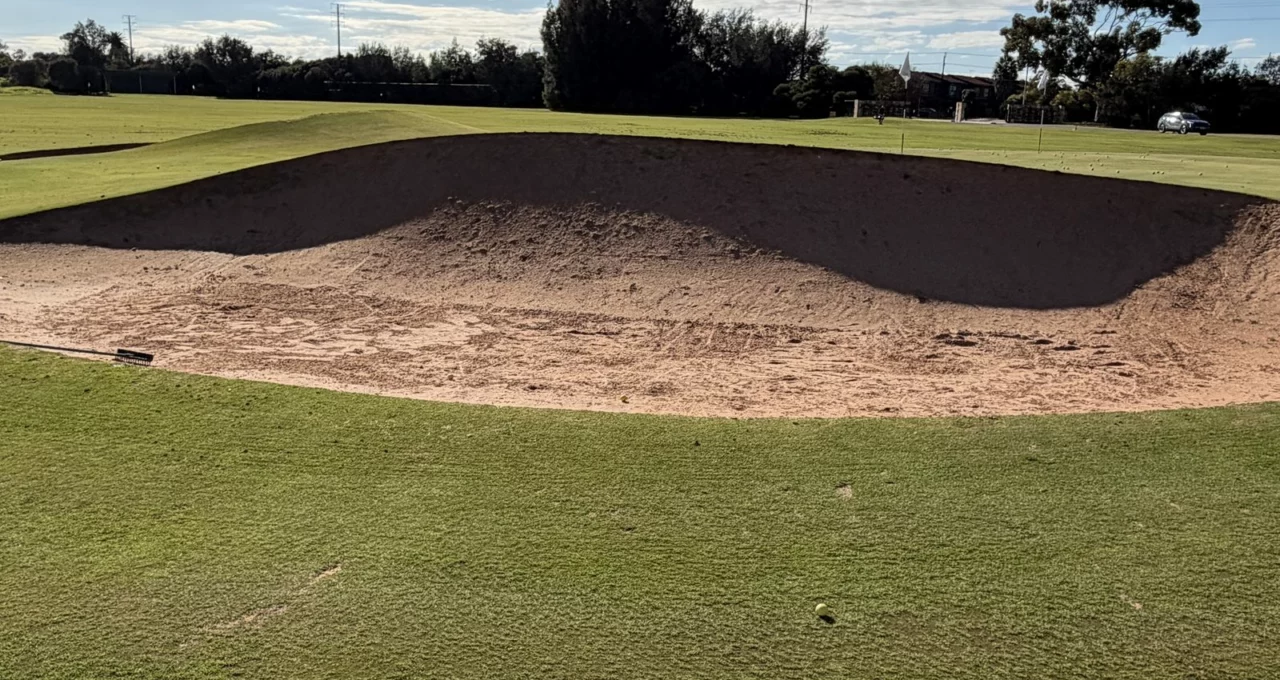
Royal Adelaide Golf Club Bunker — Photo RegionVisitor90 / Wikimedia Commons, CC BY 4.0
Royal Adelaide Golf Club
Holes
18
By
72
Length
6,572 m
Green fee
—
Best season
All year
The club moved to Seaton in 1904, onto a stretch of sand dunes and native pine between the city and the sea, with a course by Harry Swift and H.L. Rymill. Adelaide received its royal title in 1923, and three years later Alister MacKenzie came through on the Australian tour that also produced Royal Melbourne and New South Wales. He advised on a redesign, and the course that resulted is broadly the one played today.
The suburban railway to Grange runs through the property, which is unusual and entirely characteristic: the club was here first. Mike Clayton has worked on the course in recent years, principally through tree removal.
What it asks of you
Par 72 over 6,572 metres on genuine dune land, so the ground moves in a way that inland Australian courses rarely do. It is a comparatively open links, which is not a common thing in this country and is the club’s most distinctive asset.
The width is deceptive. Under benign conditions the course looks generous; in wind it poses far more problems than it appears to, and the fairway bunkering is placed to punish the drive that takes the obvious line.
The eleventh, the crater hole, is the one everyone knows: a par four needing a precise tee shot between fairway bunkers and then a short iron into a green sitting in a natural crater surrounded by high dunes and pines. The long fourteenth is the other hole reviewers single out.
What players say about it
Visitors play by arrangement or member introduction and the review record is reasonable. The notes below summarise recurring themes across specialist golf sites, traveller review pages and player discussion threads. They are other people’s opinions, not ours: we have not played the course, and we do not name or quote individual reviewers.
What comes up in its favour
- The dune land is the headline. An open links on natural sand craters is close to unique in Australia, and reviewers treat it as the course’s real value.
- The eleventh and the fourteenth are singled out again and again as among the best holes in the country.
- The strategic shaping of the natural craters is admired by architecture writers, who rate the course against the best work anywhere.
- The setting, dunes and pine between the city and the sea with a railway running through it, is remembered by everybody who plays it.
What comes up against
- The finish is the recognised weakness. The back nine ends on flat ground and the last hole, a straight mid-length par four across the entrance road, is regularly called forgettable.
- The tree removal divides opinion. Some see the landscape restored, others see a course that no longer looks like the one they knew.
- Conditions vary with the weather more than at the Sandbelt clubs, and heavy rain has forced composite layouts on visitors who travelled a long way.
- Access is by arrangement, and the review record is thinner than for the Melbourne courses.
Getting there and when to go
Seaton is around twenty minutes north-west of central Adelaide and fifteen from the airport, with Grange on the suburban line running through the property. Kooyonga is ten minutes away, which makes a two-course day straightforward.
The course plays all year. Spring and autumn give the most reliable weather; the wind is the variable in any month, and heavy winter rain is what most often disrupts a visit. Visitor access is by arrangement or member introduction.
Green fees
Rates and visitor conditions are set by the club. See the club’s own site.
How this page was made
The factual frame comes from public sources: OpenStreetMap for the location, Wikipedia and published architecture coverage for the history, the MacKenzie visit and the later work, and the club’s own site for access. The opinion section summarises public reviews, guest accounts and architecture writing read in September 2026; we report recurring themes rather than individual voices, and we do not reproduce or attribute quotes.
We have not played this course, and nothing here is a substitute for that. The club has not paid for this page, has not seen it before publication and has no say in what it says. If you know the course and something here is wrong or out of date, write to us and we will correct it.