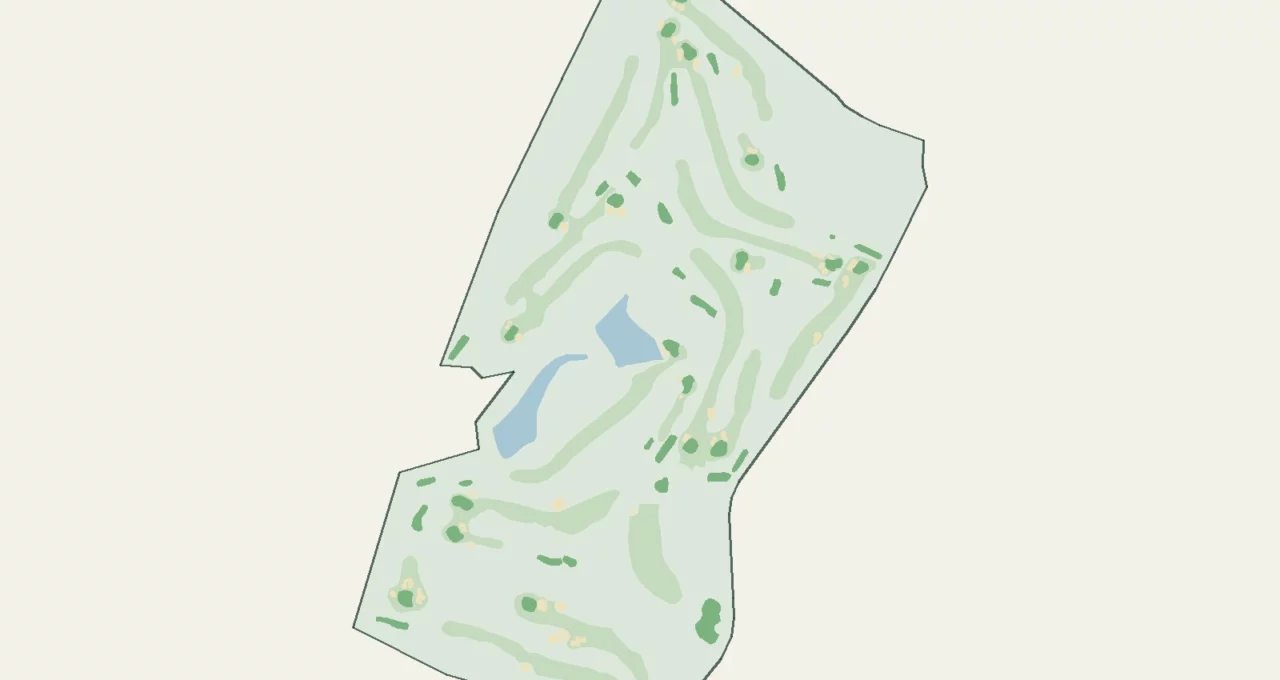
Layout of Blackwood Golf Club from OpenStreetMap survey data (ODbL licence).
Blackwood Golf Club
Holes
18
By
72 (men), 74 (women)
Length
6,073 metres (men's course tour and club history); 5,456 metres (women, sum of the course tour), 5,461 metres in the club history
Green fee
—
Best season
All year; closed on catastrophic fire danger days
Blackwood Golf Club is an eighteen-hole members’ club at 611 Cherry Gardens Road, Cherry Gardens, in the hills on the south-eastern edge of Adelaide. Despite its name, the course is not in the suburb of Blackwood: the club took that name in 1930 from the district where it was founded, and moved to Cherry Gardens in the early 1960s. The club itself says it is about seven minutes by car from the Blackwood roundabout and fifteen minutes from the Tollgate at the foot of the South Eastern Freeway. In a straight line the course lies about 16 kilometres south-east of the centre of Adelaide.
The course is par 72 for men, measured at 6,073 metres from the back markers, and par 74 for women, at a little under 5,500 metres. It was laid out by the Victorian architect Vern Morcom and opened on 2 March 1963; three holes on the back nine were added to a plan by Tony Cashmore and opened in early 1993. The setting is bushland, with tall eucalypts and pines, several dams and a good deal of slope, and the club describes itself, with some local pride, as the most picturesque course in the Adelaide Hills.
Blackwood is a private club, but it takes green fee paying visitors on set days and times, which are explained below. It also has unusually generous practice facilities for a suburban club: two putting greens, two driving ranges, a pitching area and a practice hole. Cherry Gardens itself is a small semi-rural locality in the City of Onkaparinga, named, according to Wikipedia, after the native cherry that once grew there.
How it came to be
The club’s history page records that a public meeting in the Parish Hall at Blackwood on 12 May 1930 resolved to form a golf club for the district, to be called the Blackwood Golf Club. A local landowner offered a ten-year peppercorn lease on part of his property about one and a half kilometres south of Blackwood, at a rental of one shilling a year, and the club played there for almost three decades. That first course closed in 1959.
For the 1960 season the club moved to the course at Belair National Park, a move its own history describes as temporary from the start. On 6 May 1961 it paid a deposit on 100 acres at Cherry Gardens, about 40 hectares, bought for 7,500 pounds. Contractors did the heavy work of building the new course, but the club’s history gives much of the credit to the weekend volunteers, many of whom gave up their own golf at Belair to help. The course opened on 2 March 1963.
Vern Morcom, who designed it, was one of the best known Australian course architects of his generation, and his prediction to the club in October 1961, that it would have one of the prettiest courses in the country, is still quoted in the club’s history.
In the 1980s members complained of a blind shot over a hill on what was then the 11th, a bottleneck near the clubhouse and too little parking. The answer was the land on the southern boundary. The club engaged Tony Cashmore, who had designed the McCracken course at Victor Harbor, and his plans were received in March 1991. Earthworks began late that year, and the three new holes opened in early 1993 as the 11th, 12th and 13th. Of the back nine, only the 16th, 17th and 18th were left untouched.
The club’s history is frank about what followed. Members agreed the course was better and more challenging, but worried about the steep slopes on the new holes, especially the 13th, whose low point proved very wet in winter. The steepest part of the 13th fairway was levelled in 2001 and 2002. The architect Neil Crafter reshaped the right side of the 12th fairway with mounds to stop balls running off it, and in 2004 Mike Clayton was invited to contribute to a long-term master plan. The clubhouse, first opened in 1970, was extended and officially reopened in March 1997.
The club also has a place in the history of women’s golf in the state. According to its history page, in 1986 Blackwood became the first golf club in South Australia to admit women as full members, and in 2001 women were permitted for the first time to play in the Saturday field. Today the club is a signatory to the Women in Golf Charter, and it says that more than a quarter of its current members joined after completing its programmes for beginners and juniors.
The course in figures
The club’s course tour gives a length and par for every hole, for men and for women. On the men’s figures the front nine measures 2,963 metres and the back nine 3,110, for a total of 6,073 metres, par 36 on each nine and 72 in all. That total matches the 6,073 metres given in the club’s published history for the layout since the early 1990s, and the figure given by a golf directory for the blue tees converts to the same distance.
The men’s card has four par 3s and four par 5s. The par 3s are the 3rd (178 metres), the 8th (139), the 11th (139) and the 14th (189). The par 5s are the 2nd (476), the 7th (451), the 15th (475) and the 18th (486). The ten par 4s run from 272 metres at the 13th and 280 at the 9th to 416 metres at the 5th, which the club calls the number one index hole and the most demanding on the course.
The women’s figures are 2,710 metres out and 2,746 home, 5,456 metres in all, par 37 on each nine and 74 in total. The difference in par comes from three holes that are par 4s for men and par 5s for women: the 5th (396 metres), the 12th (385) and the 18th (417, which is a par 5 for both). On the women’s card the 1st, 350 metres, is described as the second hardest hole and the 17th, 326 metres, as the hardest.
The club publishes handicap charts for several sets of tees under the World Handicap System. For men, the blue tees carry a scratch rating of 72 and a slope of 128, the white tees 70 and 125, and the gold tees, which the club says significantly shorten the course for older players, 69 and 119. For women, the red tees are rated 75 with a slope of 129, the white tees 77 with a slope of 135, and the orange tees, a shorter course of par 66, 62 with a slope of 104. These charts were uploaded in 2020; ratings are revised from time to time, so check the current figures at the club before relying on them.
What it asks of you
At just over 6,000 metres, Blackwood is of moderate length, but the hole descriptions on the club’s course tour make clear that length is not the main test. Words like tight, narrow and dogleg recur through them, and on several of the longer holes the club recommends a 3 wood or hybrid from the tee rather than a driver. Out of bounds runs down the right of the 1st, the 4th and the 5th, and tall gums, pines and native yakkas line many fairways. The ground is hilly, particularly on the back nine, so many shots are played up or down a slope and the card distance can mislead.
The opening stretch
The club describes the first five holes as demanding. The 1st, 372 metres, asks for a tight drive between out of bounds on the right and pines on the left, then an uphill approach that plays a club longer. The 2nd, a par 5 of 476 metres, turns sharply right about 220 metres out; find the fairway at the corner and a birdie is possible. The 3rd, 178 metres, is a par 3 to a green the club describes as wide but narrow, with a bunker across the front, and it warns that going over the back makes par very rare.
After the 4th, a dogleg left of 354 metres, comes the 5th, 416 metres for men, with no real place to bail out: a long, straight drive is needed down a narrow fairway with out of bounds on the right and trees and yakkas on the left, and the boundary fence runs within about five metres of the green. The club itself says that a five there is no disgrace.
Short holes that bite
The middle of the round turns on accuracy. The 6th, 297 metres, is a tight par 4 that bends slightly left, with the green tucked partly behind a large eucalypt; the club suggests a long iron or hybrid from the tee. The 7th, a par 5 of 451 metres, doglegs sharply left about 200 metres out and is rarely a driver hole. The 8th, 139 metres, plays slightly uphill and often into the prevailing wind, to a wide but shallow green behind a deep front bunker. The 9th, 280 metres, is a straightaway short par 4 that long hitters can drive, with a deep bunker guarding the front of the green.
The back nine and the water
The back nine is the more dramatic half. The 10th, 388 metres, doglegs right and plays downhill to a large green with a steep slope to its right. The 11th, an uphill 139-metre par 3, is again often played into the wind. The 12th, 410 metres for men, climbs for about 180 metres to a plateau and then drops sharply, so a long drive that carries the crest can run a long way down the hill; a pond protects the front of the green. The 13th is a short uphill par 4 of 272 metres, and the 14th, 189 metres, is downhill but usually into the wind.
The club calls the 15th, a par 5 of 475 metres, its signature hole. The largest dam on the course lies to the left of the drive, and a second dam and a deep bunker guard the front left of a green set into a hill, with a false front on the right that sends short approaches back down the slope. The club’s own verdict is that birdies and eagles are possible but rare, while sevens and worse are possible and not so rare.
The finish is strong. The 16th, 398 metres, is a sharp dogleg left that plays shorter than its length for anyone who can carry the trees on the corner, to a green backed by tall pines. The 17th, 353 metres, climbs all the way and plays longer than the card; a large eucalypt about 90 metres short of the green blocks approaches from the right side of the fairway. The 18th, a par 5 of 486 metres, doglegs from left to right around a group of very large eucalypts and climbs to the clubhouse.
Local rules and conditions
The local rules, which the club prints on the back of the scorecard, define out of bounds by the perimeter of the course and by black-topped stakes, and also treat the clubhouse car park as out of bounds. Garden beds and a turf nursery beside the 4th fairway are no play zones. The club says it has its own water supply, drawn from bores on the property, which allows the greens staff to keep the course in good condition through the dry months. Winter is the opposite problem: the club’s history speaks frankly of wet Cherry Gardens winters and of a long effort to drain water away from wet spots into the dams.
What that means for your game
Leave the driver in the bag more often than usual, especially on the 2nd, 6th and 7th, and keep the ball left of the boundaries on the opening holes. On the par 3s, take enough club when the hole is uphill or into the wind, and avoid going long, which the club warns against again and again. Expect uneven lies on the back nine. And accept that the first round on a course with this many doglegs, blind shots and slopes is partly a lesson in where to aim.
Practice and facilities
The practice facilities are a strength. The club lists two putting greens, a chipping hole, practice nets, a short and a long driving range, one of them on synthetic grass, a pitching area of about 90 metres with its own green and two bunkers, and a practice hole. The renovated pro shop sells equipment, hires clubs, buggies and carts, and offers lessons.
The two-storey clubhouse looks over the course and, according to the club, is open seven days a week for lunch, with dinner on Thursday nights in summer. A mixed nine-hole twilight competition is played on Thursday afternoons in summer, followed by dinner and prize-giving.
The bushland comes with wildlife: the club mentions kangaroos, koalas and kookaburras, and its history notes the masked lapwings that nest near the 14th green every spring.
Competitions and programmes
Blackwood runs competitions every day of the year, some organised by the pro shop and some by the club. Men’s and women’s pennant teams play interclub matches, and Tuesday mornings are reserved for the women’s competition.
For newcomers, the club runs the national Get Into Golf programme for men and women, in courses of five sessions that include a nine-hole outing on the course, and it is a MyGolf centre for juniors. Members have rounds each year at five other Adelaide clubs through the Club Advantage group, and reciprocal rights at clubs around Australia.
What players say about it
Public comment on Blackwood is thinner than for the better known Adelaide courses. Beyond one detailed review on a golf ranking site, there are mostly short comments on golf apps and travel listings. The points below are recurring themes rather than a broad verdict. These are other people’s opinions, not ours: we have not played the course, and we name and quote no one.
What comes up in its favour
- The setting is praised more than anything else: bushland, big trees, dams and views over the hills.
- Course condition is regularly described as very good, with well kept fairways, bunkers and true greens.
- The layout is seen as well balanced, building in challenge through the round, with the run of holes from the 10th to the 15th singled out for its dramatic ground and variety.
- Players like the shorter, tree-lined holes in the middle of the round, which reward placement over power.
- The finishing holes are admired, the 16th in particular, and the clubhouse view over the 9th and 18th greens is appreciated.
- The club is described as friendly and welcoming, and the course as suitable for golfers of any standard.
What comes up against
- The course is hilly, and the back nine in particular is a demanding walk; the club’s own history records members’ concern about the steep gradients on the newer holes.
- Wind is a regular factor, especially on the short par 3s, and adds to the difficulty.
- Many holes punish a wayward drive, with tight fairways, doglegs and plenty of bunkers, which some will find more frustrating than fun.
- First-time visitors say local knowledge helps, given the blind and semi-blind shots.
- Some comments describe the practice facilities as adequate rather than special, in contrast to the club’s own description.
- Visitor access is limited to certain days and times, and with so few written reviews a visitor has little independent information to go on.
Who it suits
Blackwood suits golfers who value a setting and like to think their way round. Long hitters will find some driveable par 4s and reachable par 5s, but also enough trouble to make the driver a gamble. High handicappers can enjoy the course from the forward tees, though the slopes and the bunkering on the par 3s will test them, and they may prefer a cart for the back nine. For a visitor who knows Adelaide’s flat coastal courses, it offers something quite different.
Getting there and when to go
Blackwood is reached by car. The course is on Cherry Gardens Road, south of Coromandel Valley and Blackwood; the club gives travel times of about seven minutes from the Blackwood roundabout and fifteen minutes from the Tollgate. It does not describe any public transport to the course, and we have not found a convenient service, so a car is the practical option.
Green fee paying visitors are welcome on Sundays, Mondays, Tuesdays, Thursdays and Fridays, from 11 am only; Wednesdays and Saturdays are for members and their guests. Bookings are made by telephone with the pro shop, which also handles carts and hire clubs; for a group, the club asks for the names of every player and their Golf Australia identification numbers where they have one. Players must report to the pro shop before teeing off.
The club’s dress code asks for neat golf attire: tailored shorts or trousers, or skirts, with sports socks that are mainly white or match the outfit. Denim, gym wear, T-shirts, tank tops, tracksuits and football shorts are not allowed on the course. Push buggies must be kept off the greens.
The course is open through the year, but the hills climate matters. Winters can be wet underfoot, and summers bring heat and bushfire risk. On days when the Mount Lofty Ranges district has a catastrophic fire danger forecast the evening before, the club closes the course, the clubhouse and the pro shop and locks the front gate; it also publishes hot weather guidelines and a dangerous weather policy for electrical storms. Spring and autumn are the most comfortable seasons.
How this page was made
The factual frame comes from the club’s own website. Its about page provided the address, the setting, the practice facilities and the outline of the club’s history, and the club’s published history covering 1980 to 2005, linked from that page, provided the opening date, the designers, the 1993 holes, the later changes, the layout lengths and the wildlife. The course tour gave every hole’s length, par and description, from which we added up the totals. The visitors page gave the visiting days, the booking arrangements, the clubhouse hours and the links to the handicap charts, the local rules, the dress code and the weather and fire policies. Other club pages gave the competitions and programmes. Wikipedia’s article on Cherry Gardens gave the origin of the name. OpenStreetMap gave the location; the straight-line distance is calculated from coordinates.
Some sources disagree. The club’s men’s golf page says its story goes back to 1920, when three local men made four rough holes at Hawthorndene, and a ranking site gives 1920 as the founding year, while the club’s history page dates the formal founding to the public meeting of 12 May 1930; we use 1930 for the club and mention the earlier start. One directory gives 1961 as the opening year of the course, the year the land was bought; the club’s history gives 2 March 1963. The ranking site places the first course about two kilometres south of Blackwood, the club one and a half. The women’s length is 5,456 metres when the hole lengths in the course tour are added up, and 5,461 metres in the club’s history; we give a rounded figure. The ranking site rates the 1st as the hardest hole, the club gives the number one index to the 5th. The outline of the course in OpenStreetMap covers about 57 hectares, more than the 40 hectares bought in 1961, which is consistent with the later addition of land to the south. OpenStreetMap still lists a website address for the club that no longer works; the club’s site is blackwoodgolf.com.au.
We could not read the Golf Australia and GolfPass pages for the club, which blocked our requests, so the ratings given here come from the club’s own charts. Several reviews on one large review site concern another course of a similar name and have been excluded. In keeping with our rules, we give no prices and name no staff.
The opinion section summarises public reviews and comments read in October 2026 on a golf ranking site, golf apps and travel listings; we report recurring themes rather than individual voices, we reproduce no quotations and we give no ratings or review counts. We have not played this course, and this page is no substitute for a round. The club has not paid for this page, has not seen it before publication and has no say over its content. If you know the course and something here is wrong or out of date, write to us and we will correct it.
Other courses nearby
Closest to this one in our Australian directory:
- North Adelaide Golf Course — 18 km
- Kooyonga Golf Club — 19 km
- Royal Adelaide Golf Club — 23 km
- Blue Lake Public Golf Links — 362 km