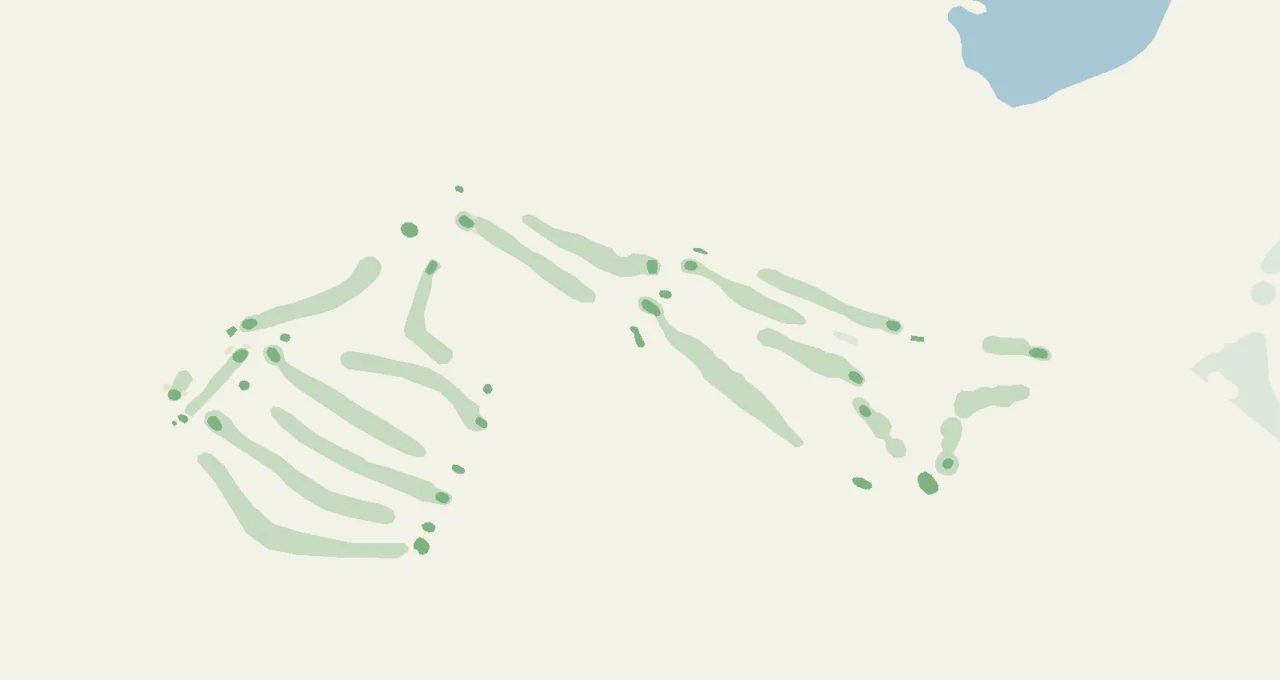
Layout of Blue Lake Public Golf Links from OpenStreetMap survey data (ODbL licence).
Blue Lake Public Golf Links
Holes
18
By
70 (men), 71 (women)
Length
5,440 metres (men's blue card), 5,037 metres (women's red card); 5,638 metres in Golf Australia's listing
Green fee
—
Best season
All year
Blue Lake Public Golf Links is the public eighteen-hole course of Mount Gambier, in the south-east of South Australia. It lies on Grant Avenue, on the southern side of the city, among the volcanic craters that give Mount Gambier its reputation: the Blue Lake, the deep crater lake that turns from steel grey in winter to cobalt blue in summer, is about a kilometre and a half to the east of the middle of the course, and Valley Lake about a kilometre to the north-east. The Blue Lake Holiday Park sits beside the eastern end of the course, and the centre of the city is under three kilometres away in a straight line.
It is a par 70 of 5,440 metres on the men’s card and a par 71 of 5,037 metres on the women’s, open to visitors seven days a week. The land belongs to the City of Mount Gambier, which describes itself as the owner and custodian of the site, and since July 2019 the course has been leased and run by the Blue Lake Golf Club, the members’ club that has used it as its home since 1984. Beside the course the club runs an undercover driving range, an eighteen-hole mini putt putt course and a clubhouse with a bar and bistro looking out over the 1st and 18th holes.
The course has an unusual history for a regional public course. Its first nine holes were built on a disused rubbish tip next to the caravan park, the second nine were added in the 1990s largely by volunteer labour, and the two halves are joined by a tunnel under Grant Avenue. In 2007 and 2008 it hosted the South Australian PGA Championship.
From a rubbish tip to eighteen holes
According to the club’s history, the Mount Gambier Chamber of Commerce approached the City Council in 1961 with a proposal to build a nine-hole golf course beside the Blue Lake Caravan Park. In 1964 the state Minister for Lands approved the removal of trees on the area set aside for it, and the same year the Queen Elizabeth Park Trust was formed. The Trust, made up of council and Chamber of Commerce representatives with one independent member, was set up to turn the caravan park into a tourist facility. A background paper published by the council adds a detail the club leaves out: the nine holes were laid out on a disused rubbish tip next to the caravan park.
The club records that the Trust carried out feasibility and design studies in 1978, that construction began late that year, and that the nine-hole public course was officially opened on 12 January 1980. The council paper gives the same month.
An article published in the Mount Gambier Times in November 2024, for the club’s fortieth anniversary, records that the first competition on the nine-hole course was held on 28 February 1981, by a handful of regulars, and that the club itself was formed at a meeting on 21 November 1984, once about forty people were playing regularly. The members needed the Trust’s permission to form a club, and chose the name Blue Lake Golf Club over a second option, Tower View, a reference to the Centenary Tower on the summit of the volcano above the course. The club then affiliated with the regional and state golf associations.
Growth was quick. The club’s own page says membership reached 136 in the first year; the anniversary article gives 139 members just over twelve months after the founding. The anniversary article records that two new holes were added at the western end of the course in 1988, and that women were invited to join the Saturday competitions in 1993; the club’s page dates the arrival of women members to 1988.
The second nine and the tunnel
Work on a second nine began in the mid-1990s; the club gives 1995 as the starting year. It was a large undertaking for a members’ club: the anniversary article lists the removal of trees, new fences, the rebuilding of burnt-out sheds and the installation of a watering system. The two nines are on either side of Grant Avenue, so the club bought a tunnel from Queensland and had it laid under the road, which meant closing Grant Avenue while the trench was dug. The club says the underpass was paid for by its members with the help of a local earthmoving firm, after whose owner it is named.
The new holes were first played in early 1997, and the extended course and the tunnel were officially opened on 1 February 1998, which matches the council’s date of February 1998 for the second nine.
Who runs it
For most of its life the course was run under an unusual arrangement. The council’s background paper, written while the Trust’s lease ran out on 30 June 2019, describes a hybrid model: the Trust held the lease from the council, was financially responsible for the course and owned the buildings; a private operator ran the bar, bistro and golf shop and collected green fees for the Trust; and the golf club used the course as its headquarters without contributing to its day-to-day running, though it owned a buggy shed and paid for special projects. In 2017 the council consulted the public on a new lease of up to 21 years to the Trust. In the event, according to the club, it was the Blue Lake Golf Club that took over the lease of the public course in July 2019.
The club says it now has more than 300 members, with competitions six days a week. Its two main events of the year are an Easter tournament and a memorial event. In 2007 and 2008 the course hosted the South Australian PGA Championship, then a Von Nida Tour event; Wikipedia’s list of winners shows the 2007 edition decided by a playoff and the 2008 edition, the last before the championship lapsed, won at 20 under par.
The course in figures
The scorecard published on the club’s site gives two sets of figures. The men’s card, headed blue course, totals 5,440 metres and par 70, with 2,758 metres and par 35 out and 2,682 metres and par 35 home, a scratch rating of 69 and a slope of 119. The women’s card, headed red course, totals 5,037 metres and par 71, with 2,580 metres out and 2,457 home, a scratch rating of 72 and a slope of 118.
On the men’s card there are four par 3s, at the 2nd (134 metres), the 5th (136), the 14th (191) and the 16th (167), and two par 5s, at the 3rd (487 metres) and the 17th (433). The other twelve holes are par 4s. The longest is the 4th, at 387 metres, which is also stroke index 1; then come the 6th (357), the 7th (346), the 8th (338), the 13th (336), the 18th (333), the 10th (331) and the 11th (329). At the short end are the 1st (302), the 15th (287), the 12th (275) and the 9th (271).
The women’s card follows the same pattern with one change: the 4th, 371 metres from the red tees, is a par 5 for women rather than a par 4, which is where the extra stroke in the women’s par of 71 comes from. The women’s par 3s measure 129 metres at the 2nd, 116 at the 5th, 147 at the 14th and 141 at the 16th, and the par 5s 407 metres at the 3rd, 371 at the 4th and 398 at the 17th. The women’s stroke index 1 is the 8th, a par 4 of 330 metres.
Other sources give other figures, and it is worth knowing which is which. Golf Australia’s course listing, as reproduced by search engines, gives 5,638 metres, par 70 and a course rating of 68; we could not open the listing itself. That is about 200 metres longer than the club’s card, which may reflect a different set of tees or an older measurement. GolfPass gives the same 5,440 and 5,037 metres and the same slopes as the club’s card. We follow the club’s card, whose hole lengths add up to its totals; it was uploaded to the club’s site in 2021, and we cannot say whether the ratings have been revised since.
OpenStreetMap maps all eighteen holes, with tees, fairways, greens and a few bunkers. Its hole lengths broadly agree with the card, but two of its pars are wrong: it records the 5th, a hole of about 130 metres, as a par 4 and the 13th, of more than 320 metres, as a par 3. The two errors cancel out, which is why the map’s total still comes to 70.
What it asks of you
Two halves, two levels
The most useful thing to know about the layout is that it is in two parts. The clubhouse sits in the middle, where the 1st and 10th start and the 9th and 18th finish. The front nine lies to the west of it and goes back and forth across a compact block of ground; the back nine lies to the east, on the other side of Grant Avenue, and runs out towards the holiday park before turning home.
The two halves are not at the same height. From a satellite elevation model, which is approximate, the front nine sits mostly at around 50 metres above sea level and the back nine on higher ground at 75 to 85 metres. That shapes several holes. The 1st plays downhill from the clubhouse, by something like fifteen to twenty metres; the 9th climbs back up to finish; the 15th drops down from the high eastern end; and the 16th, a par 3 of 167 metres, plays back uphill.
The holes that matter
The front nine opens gently on paper, with a par 4 of 302 metres and a short par 3, but the 3rd, a par 5 of 487 metres and the longest hole on the course, and the 4th, the stroke index 1 at 387 metres, come straight after. The 5th, at 136 metres, is a short iron and the best chance of a birdie on the front nine. The 9th, at 271 metres, is a short par 4, but one that climbs back to the clubhouse.
The back nine has the longest par 3s. The 14th, at 191 metres, will need a fairway wood or a hybrid for many club golfers, and the 16th, at 167 metres and uphill, will often take more club than its length suggests. In between, the 15th is a short par 4 of 287 metres playing downhill, where a long hitter may be tempted. The 17th, at 433 metres, is the shorter of the two par 5s and a genuine birdie chance, before the 18th, at 333 metres and stroke index 3, brings the round back to the clubhouse deck.
Trees, turf and weather
The club describes lush green fairways, and a watering system was installed with the second nine.
Mount Gambier has a cool, damp climate by Australian standards. Wikipedia’s climate table gives average maximums of about 26 degrees in January and 13.5 in July, with rain concentrated in winter: about 100 millimetres a month in July and August, against 25 to 35 in the summer months. Expect firm ground and run in summer, and softer, slower conditions from May to September.
What that means for your game
Think about height: add a club on the uphill holes, especially the 16th and the climb to the 9th green, and take one less on the 1st and the 15th. Treat the 3rd and 4th as the core of the front nine, where a bogey is no disaster. Use the short holes, the 5th, the 9th, the 15th and the 17th, as scoring chances. And because the course is short, there is little to be gained by hitting driver on every par 4: position on the fairway will usually matter more than distance.
Around the course
The driving range is a recent addition, undercover and usable in all weather, with balls and clubs for hire. The golf shop, the Lakes Caddy Shack, is open seven days a week and hires out clubs and motorised carts. In December 2022 the club added an eighteen-hole mini putt putt course themed around the icons, features and industries of the Limestone Coast, open seven days a week; Golf Australia ran a story in August 2023 under a headline crediting it with a boom at the club.
The clubhouse houses the Blue Lake Bar and Bistro, which seats 120 for meals or functions and looks over the course. The club says the bar is open seven days a week and the bistro five, from Tuesday or Wednesday to Sunday depending on the page consulted, with dinners from Wednesday to Saturday. A deck overlooking the 1st and 18th holes was added in 2024.
The club’s competitions run six days a week: open eighteen-hole events on Tuesdays and Saturdays, a nine-hole social competition and a women’s eighteen-hole competition on Wednesdays, nine and eighteen holes on Thursdays, a nine-hole social competition on Fridays and an eighteen-hole stableford on Sundays. The club calls them open, which suggests visitors with a handicap can take part; check with the club before turning up.
What golfers say
Public comment on Blue Lake is very thin. The golf apps and directories we consulted carry almost no written reviews of the course: GolfShake and Golf Finder list none, Hole19 a single one, and the GolfPass page was not readable for us. Most of what can be read about the course is the club’s own description or tourism copy. The points below are what recurs across those sources and the few reviews; they are not our opinion, we have not played the course, and we name and quote no one.
What comes up in its favour
- The setting is what every description opens with: a course beside the crater lakes, with views of the extinct volcanoes from the fairways and the clubhouse.
- The one written review we found rates the course highly overall.
- Tourism listings describe it as one of the best public courses in Mount Gambier and present it as welcoming to visitors and families, with the mini putt putt and range alongside.
- The fairways are described as watered and lush and the greens as well kept, though the warmest words come from the club and promotional pages.
What comes up against, or should be weighed
- With so few independent reviews, a visitor has very little to go on beyond the club’s own account.
- At 5,440 metres, it is short for strong players looking for a long test, and the other eighteen-hole course in the city, Mount Gambier Golf Club on Attamurra Road, is longer and better known.
- The changes of level between the two nines make it a less easy walk than its length suggests, and the walk through the tunnel between the halves is part of the round.
- The opening hours differ from one page of the club’s site to another.
Who it suits
Blue Lake suits visitors to Mount Gambier who want an eighteen-hole round close to the city and the crater lakes without joining a private club, holidaymakers staying at the holiday park next door, and mid and high handicappers who like a manageable length. Low handicappers looking for a long test will find it short, although the changes of level and the long par 3s on the back nine ask real questions. For a longer course, Mount Gambier Golf Club, on the other side of the city, is the obvious alternative.
Getting there and when to go
The course is on Grant Avenue, Mount Gambier, South Australia 5290, south of the city centre and west of the Blue Lake. From the Old Town Hall on Commercial Street it is about 2.7 kilometres in a straight line, a few minutes by car. Mount Gambier itself is about 450 kilometres south-east of Adelaide and 17 kilometres from the Victorian border, according to Wikipedia, which also lists coach services from Adelaide and a V/Line coach to Warrnambool connecting with trains to Melbourne. Mount Gambier Airport is about eleven kilometres north of the course in a straight line. We have not checked current timetables or local bus routes and give none.
The course is open all year. The club’s contact page gives the course hours as 8am to 5.30pm on Mondays, 6am to 5.30pm on Tuesdays and 6am to 6pm from Wednesday to Sunday; its home page gives longer hours for the course and range, up to dark from Wednesday to Saturday, which may reflect daylight saving. Check with the club before an early start or a twilight round. Saturday morning is a competition time, so a weekend tee time is worth booking early.
Tee times are booked online through the club’s booking system, or by phoning the club on (08) 8725 6198. The course is public and the club says it welcomes all visitors, whether to play or simply to have a drink or a meal in the bistro.
How this page was put together
The factual frame comes from public sources. The club’s about page provided the history from 1961, the opening of 12 January 1980, the founding of the club, the second nine, the tunnel, the PGA championships, the takeover of the lease in July 2019 and the facilities; its course guide and the scorecard published there the hole lengths, pars, stroke indexes, ratings and slopes; its competitions, golf shop, bistro and contact pages the competitions, hire, dining and opening hours. The club’s site could not be reached directly when we worked on this page, so we read these pages in their archived versions of April and June 2026. A background paper on the Queen Elizabeth Park Trust published by the City of Mount Gambier provided the rubbish tip, the opening dates, the composition of the Trust and the management arrangements up to 2019; the council’s consultation page the lease proposal of 2017. The Mount Gambier Times article of November 2024 on the club’s fortieth anniversary provided the first competition of 1981, the founding meeting of 21 November 1984, the holes added in 1988, the building of the second nine and the tunnel, and the opening of 1 February 1998. Wikipedia’s articles on Mount Gambier and on the South Australian PGA Championship provided the description of the Blue Lake, the climate, the distances, the transport and the 2007 and 2008 championships. OpenStreetMap gave the location and the hole lines; straight-line distances are calculated from its coordinates, and the heights from a satellite elevation model, which is accurate only to a few metres.
Some sources disagree. The club’s card gives 5,440 metres and a rating of 69; Golf Australia’s listing, which we could read only through search summaries, gives 5,638 metres and a rating of 68. We follow the club. The club’s page dates the first year’s membership to 136 members, the anniversary article to 139; the club dates the arrival of women members to 1988, the anniversary article to 1993 for the Saturday competitions, and both may be right. A tourism listing gives 1972 as the year the club was formed, which matches neither the opening of the course in 1980 nor the founding of the club in 1984, and we do not use it. OpenStreetMap gets the pars of the 5th and the 13th the wrong way round. The club’s site gives two different sets of opening hours. We could not read Golf Australia’s pages, the GolfPass listing or the local newspapers’ reports on the lease and the dissolution of the Trust, which blocked our requests, and we found no source for the course’s designer.
The opinion section summarises the few public reviews and descriptions we could read in October 2026 on golf apps, directories and tourism sites; we report recurring themes rather than individual voices, we reproduce no quotations and we give no ratings or review counts. We have not played this course, and this page is no substitute for a round. The club has not paid for this page, has not seen it before publication and has no say over its content. If you know the course and something here is wrong or out of date, write to us and we will correct it.
Other courses nearby
Closest to this one in our Australian directory:
- Barwon Valley Golf Club — 317 km
- Bacchus Marsh Golf Club — 324 km
- 13th Beach Golf Links — 327 km
- Axedale Golf Club — 351 km