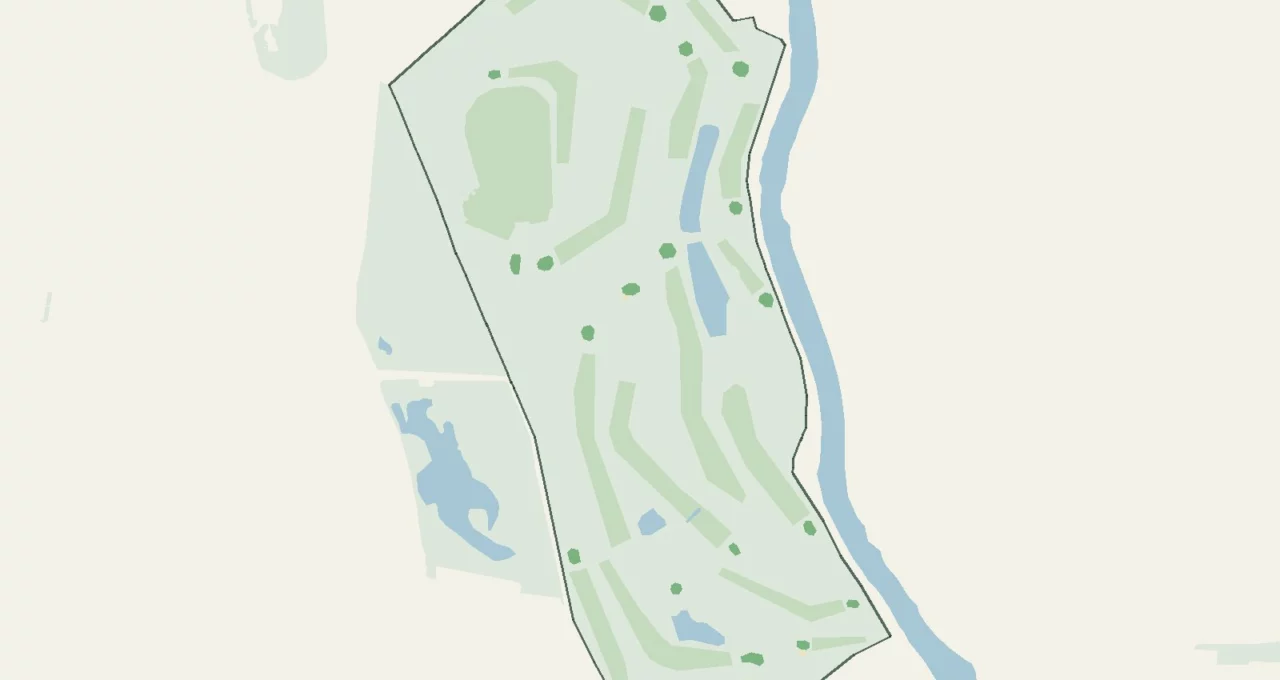
Layout of Barwon Valley Golf Club from OpenStreetMap survey data (ODbL licence).
Barwon Valley Golf Club
Holes
18
By
70
Length
5,540 metres (club); 5,485 metres on a published hole-by-hole card
Green fee
—
Best season
All year
Barwon Valley Golf Club is the public course on Belmont Common, the broad stretch of river flat on the south bank of the Barwon River in Geelong. The address is 61 Barwon Heads Road, Belmont, Victoria 3216, and the club puts the course about three kilometres from the centre of the city. On one side runs the river; on the other, between the course and the main road, lie wetlands that the club and Golf Australia both describe as rich in birdlife.
It is an eighteen-hole course of par 70, open to the public seven days a week, with no membership or handicap needed to book a round. Golf Australia lists it as a public course and gives its area as 54 hectares of public open space on Belmont Common; the outline of the course on OpenStreetMap measures almost exactly the same, at about 53.5 hectares. The club runs a 16-bay driving range beside it, and a clubhouse with a bar.
One point needs clearing up from the start. Data compiled automatically from OpenStreetMap can give Barwon Valley 36 holes. That figure is wrong: the map carries eighteen hole lines, numbered 1 to 18, and they have been counted twice. The club, Golf Australia and every booking site agree on eighteen holes, and there is no second course on the site.
The course in figures
The par of 70 is split evenly, 35 out and 35 home. There are five par 3s (the 3rd, 5th, 10th, 13th and 17th), ten par 4s and three par 5s (the 7th, 11th and 18th). The pars of every hole recorded on OpenStreetMap match the published card hole for hole, and the totals match the par of 70 given by GolfNow, GolfPass and other listings.
On length, the sources differ slightly. The club gives 5,540 metres, and the same figure appears for the men’s tees on GolfNow and GolfPass, which also give 4,961 metres for the women’s tees. A hole-by-hole card published on the Golfing Record site, for a single set of white tees, adds up to 5,485 metres; the card on GolfPass gives the same hole lengths in imperial units. The difference of about 55 metres is small and probably reflects a change of tee somewhere on the course, but we have not been able to confirm which figure is current. We give both.
According to that card, the front nine measures 2,874 metres and the back nine 2,611. The longest hole is the 7th, a par 5 of 482 metres, followed by the two other par 5s, the 18th at 451 metres and the 11th at 447. The longest par 4 is the 9th, at 399 metres; the 4th, at 267 metres, is the shortest. Among the par 3s, the 3rd plays 184 metres and the 17th 180, while the 13th, at 130 metres, and the 10th, at 146, are the short ones. The lengths of the holes as drawn on OpenStreetMap broadly agree with the card.
Course and slope ratings are published by several booking sites, but they do not agree with each other, and Golf Australia’s own rating table did not load when we consulted it. We therefore do not report a rating or slope here. The stroke index varies between sources too, and one of them simply numbers the holes 1 to 18 in order, so we leave it out.
Belmont Common and the river
The ground the course sits on has a history that explains a good deal about how it plays and why it closes. Victorian Places, the reference work on the state’s towns and suburbs, records that Belmont Common was once a lagoon, and that the Kardinia homestead of Dr Alexander Thomson, built in 1850, stood on rising ground at its edge. The common is low, flat and next to a river that floods.
It has had other lives. In 1928 the aviator Bert Hinkler landed on the common after his solo flight from England, and an aerodrome was later laid out on its north-western part. Wikipedia’s article on Belmont notes that the Pratt brothers ran a flying school and hangar there, that the aerodrome had closed by the early 1950s and that the land returned to grazing. Today the common holds the golf course and driving range alongside baseball fields, shooting ranges, a dog obedience club, ovals and wetlands.
The same article names 1952 and 1995 as years of major floods on the common. The most recent serious one came in October 2022. Golf Australia reported that the Barwon rose to more than 3.8 metres, that the river spilled onto the greens and that the club lost its pro shop. On 17 October 2022 the City of Greater Geelong listed the course among its facilities closed by flooding. The Geelong Advertiser reported in November that the course had been shut since 9 October and that the club had lost significant revenue and cancelled events. The full eighteen holes reopened on Saturday 11 March 2023, after five months, a major greens renovation and, according to the club’s general manager, countless hours spent by volunteers and greenkeepers scraping mud off the course.
The club
The club’s life members page dates the club to 1972. Several booking listings give the course a construction date of 1924, and GolfPass gives a previous name, Barwon Golf Club, The Valley Course. We have found no primary source for either, and we cannot say whether golf was played on the common before the present club was formed. One scorecard site credits a 1949 design to Vern Morcom, and GolfPass lists Bob Shearer and Ben Davey as architects in 2010; we have not been able to confirm either attribution, and the club does not name a designer.
What the club does say is that its life members carried it through droughts, floods, financial setbacks and negotiations with government and council. Fifteen people have received life membership. The club is run by a board, publishes a list of reciprocal clubs in Victoria and New South Wales, and raises money for the National Breast Cancer Foundation each year with a Sink For Pink day; it reports having raised a little over 19,000 dollars in 2024.
Members play competitions six days a week. The club names Tuesday, Wednesday and Saturday as its main competition days, with events on Monday, Thursday and Sunday as well, nine-hole competitions for women on Wednesdays and Fridays, mixed competitions with equal prize money, and five preferential tee times for women on Saturdays. Members can represent the club in SWGA competitions and pennant.
What it asks of you
Barwon Valley is short by modern standards and flat, and those two facts shape the round. At around 5,500 metres for a par of 70, it does not demand great length from the tee, and the club itself presents it as equally suited to high and low handicappers. Golf Australia notes that the flat terrain makes walking easy. Carts can be hired for those who prefer them.
Short does not mean simple, though. The par 4s are where the course earns its par. Nine of the ten measure between 293 and 399 metres, long enough that a mis-hit drive leaves a long approach, and a player who reviewed the course on Hole19 described a collection of dogleg par 4s that play longer than their stated length. On a flat site the shape of a hole comes from its routing and its hazards rather than from the ground, and a dogleg asks the player to choose a line rather than simply hit as far as possible.
Water is the other theme. The river curves around the northern and eastern edges of the course, and OpenStreetMap shows several ponds within the layout, mostly in its middle and southern sections, with the wetlands along its western side. The routing turns back on itself repeatedly: from the hole lines on the map, the front nine runs out towards the river and back, and the back nine works through the southern part of the common before the 18th, a par 5 of 451 metres, heads north to finish. Wind direction will therefore change from hole to hole, and on open river flats the wind is rarely absent.
Of the three par 5s, the 7th, at 482 metres, is the longest hole on the course; the 11th and the 18th are some 30 metres shorter. The par 3s offer a real spread, from a short iron at the 13th to a long iron or hybrid at the 3rd and the 17th, both around 180 metres.
The greens are what the club and Golf Australia single out. Both describe them as having long been recognised for a very high standard. That reputation was tested by the 2022 flood, which left silt on the putting surfaces and led to the major renovation before the reopening in 2023. The club reports that most fairways are now Santa Ana couch, a warm-season grass that thrives in summer and slows down and colours off in the Victorian winter.
What that means for your game
For most club golfers the useful advice is to think about position rather than distance off the tee. On a dogleg par 4 of 350 metres, a fairway wood or long iron to the corner may leave a better approach than a driver through it. Expect the fairways to run in summer and play softer in winter, when a wet river flat gives little roll. Read the wind before every tee shot, because the routing changes direction often. And because the greens are the course’s strongest feature, time on the putting green before the round is well spent.
For beginners, the course is one of the more accessible full-length rounds in the region: flat, public and not long. Families can also use the driving range without booking.
Practice and facilities
The driving range has 16 bays, eight of them under cover, and a separate grass area for hitting off turf. It is open seven days a week without booking, and balls are bought by token. The council’s directory once described a 14-bay range; the club’s own figure of 16 is the more recent. There are two practice putting greens and a chipping green.
Lessons are given by the Geelong Golf Academy, which the club names as its golf professional, offering one-to-one and group coaching. The clubhouse has a bar and serves food, with the current menu published on the club’s site. Carts, pull buggies and clubs can be hired. The club takes group bookings and hires out the clubhouse for functions.
What players say about it
Public comment on Barwon Valley is limited. There are few written reviews on the golf platforms, and most of what can be read comes in short remarks or simple ratings. The points below summarise what recurs. These are other people’s opinions, not ours: we have not played the course, and we name and quote no one.
What comes up in its favour
- The riverside setting, with the Barwon on one side and wetlands and birdlife on the other, is what most descriptions open with.
- The most detailed written review we found describes the course as more challenging than its length suggests, largely because of the dogleg par 4s.
- The flat ground makes it an easy walk, and the course is close to central Geelong.
- Reviewers on GolfPass recommend it, and rate the layout, the pace of play and the friendliness of the place as good or excellent.
What comes up against
- Opinions on course condition vary. Ratings on GolfPass range from excellent to fair, and the most recent there, from 2025, rates conditions and value as only fair.
- The course floods. It was closed for five months after the October 2022 flood, and its position on a flood plain means that heavy rain upstream can close it again.
- Amenities are rated average to good rather than better; this is a community club, not a resort.
- At around 5,500 metres, it is short for strong players looking for a long test.
Who it suits
Barwon Valley suits golfers in and around Geelong who want an affordable public eighteen holes close to town, players who prefer to walk, and anyone who wants a full-length round without the length of a championship course. It is a good choice for improving players, for social groups, and for visitors who want a round near the city rather than out on the Bellarine Peninsula. Low handicappers looking for a stern test of driving will find more length elsewhere. Geelong has other public courses, including Queens Park, which also sits on the Barwon, and the Balyang par 3 course in Newtown.
Getting there and when to go
The course is in Belmont, on the south side of the Barwon River from central Geelong. The course is bounded by Barwon Heads Road and Settlement Road to the west, Breakwater Road to the south and the river to the north and east. The club gives its address as 61 Barwon Heads Road; one app lists 1 Settlement Road instead. In a straight line the course is about 3.4 kilometres from Geelong railway station. We have not confirmed bus routes and do not give any.
The club lists the course and clubhouse as open from 7am to 8pm, seven days a week, and notes that hours may change. Golf is played all year. Spring and autumn usually bring the most comfortable conditions; winter on a river flat can be wet and cold. After heavy rain in the Barwon catchment it is worth checking with the club before setting out since the course lies on the flood plain and has been closed by floods before. Saturday is one of the club’s main competition days, so it is worth booking early for a weekend round.
Tee times are booked and paid online through the club’s booking system. The course is public, and visitors are welcome.
Green fees
Rates are set by the club, with separate prices for nine and eighteen holes and for adults, seniors and juniors, plus charges for carts and hire clubs. See the club’s own site.
How this page was made
The factual frame comes from public sources: OpenStreetMap for the location, the outline of the course, the pars of each hole and the ponds and wetlands; the club’s about page for the length, the setting, the turf and the practice facilities; its life members page for the 1972 founding; its membership page for the competitions; its driving range page; and its reciprocal clubs and fundraising pages. Golf Australia’s club page provided the area of 54 hectares and the description of the greens, and its report of March 2023 the flood of 2022 and the reopening. The council’s flood closure notice of 17 October 2022 was read in its republished form; the Geelong Advertiser’s report of November 2022 is known to us only through its summary. The hole lengths are those of the Golfing Record card, which agree with the GolfPass card. The history of Belmont Common comes from Victorian Places and the Wikipedia article on Belmont. Straight-line distances and the area of the course outline are calculated from OpenStreetMap coordinates.
Some sources disagree. The club gives 5,540 metres and the hole-by-hole card 5,485; we give both. The club dates itself to 1972, while booking sites give 1924 and a former name that we cannot confirm; one site names Vern Morcom as designer in 1949 and another Bob Shearer and Ben Davey in 2010, and we have confirmed neither. Course ratings and stroke indexes differ from one site to another, so we report none. The club counts 16 range bays, an older council listing 14. OpenStreetMap-based databases give 36 holes; the course has eighteen. We could not read Golf Australia’s rating table, the council’s page on Belmont Common or several review sites, which blocked our requests.
The opinion section summarises public reviews on golf apps and booking sites, read in October 2026; we report recurring themes rather than individual voices, we reproduce no quotations and we give no ratings or review counts. The written record is thin, and several reviews predate the 2022 flood and the renovation that followed.
We have not played this course, and this page is no substitute for a round. The club has not paid for this page, has not seen it before publication and has no say over its content. If you know the course and something here is wrong or out of date, write to us and we will correct it.
Other courses nearby
Closest to this one in our Australian directory:
- 13th Beach Golf Links — 14 km
- Bacchus Marsh Golf Club — 60 km
- Royal Melbourne Golf Club — 63 km
- Kingston Heath Golf Club — 68 km