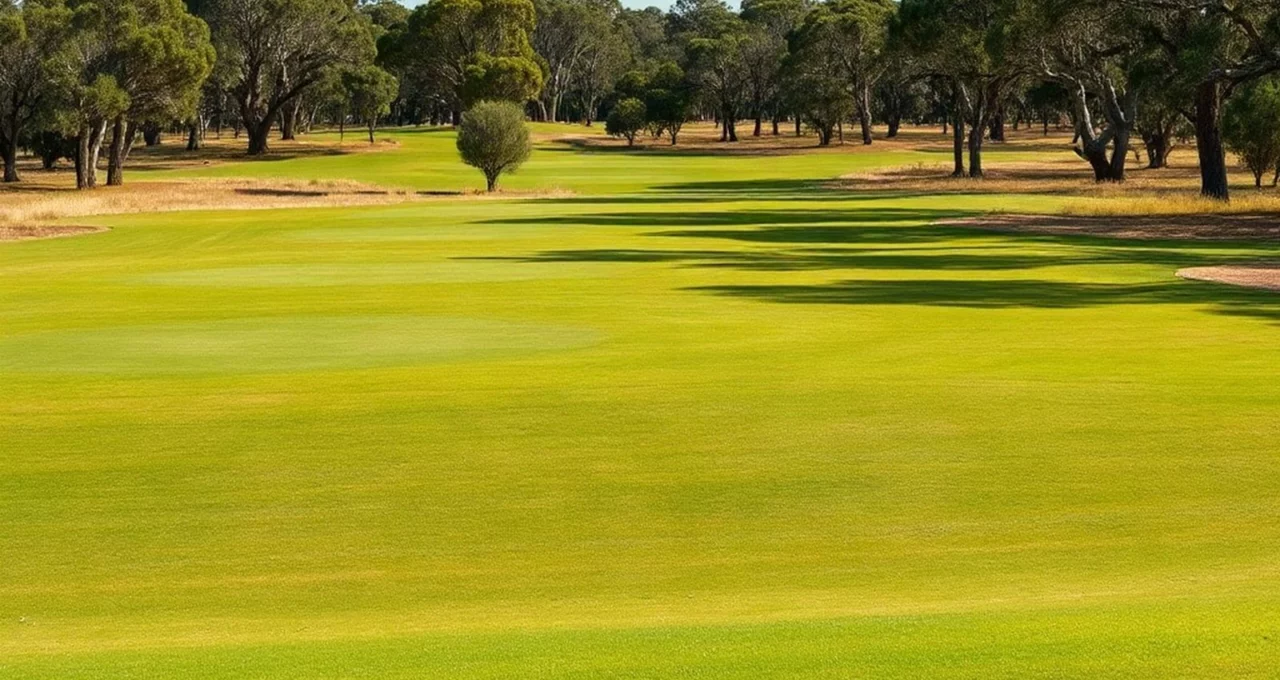
Illustration generated by artificial intelligence. This is not a photograph of this course: no freely licensed image of the site exists to date.
Kingston Heath Golf Club
Holes
18
By
72
Length
—
Green fee
—
Best season
All year
Kingston Heath opened for play on 4 April 1925 with no bunkers at all. Dan Soutar had laid out the holes, and the club was waiting for Alister MacKenzie to advise on the sand. He came the following year, and what he specified, built as at Royal Melbourne by greenkeeper Mick Morcom, is generally held to be the finest bunkering on any course in the country.
The original card is worth remembering for what it says about the era: a par of 82, with twelve par fives and only two par threes, over a little more than 6,200 metres. It is a par 72 today. MacKenzie’s one substantial addition to the Soutar routing was the fifteenth, and he chose well.
What it asks of you
A par 72 on a compact site, smaller than most courses of this rank, which forces the holes close together and puts a premium on knowing where you are allowed to miss. Sand beneath, couch above, firm and fast for most of the year.
The fifteenth is the hole everyone talks about: an uphill short hole of around 145 metres, bunkered from tee to green on both sides, with a green that looks narrow from below and opens up once you reach its level. It is regularly called one of the great short holes in world golf, and it is proof that length is not required for greatness.
It is also, on a firm summer day with a north wind, close to brutal. The deep bunkers overwhelm a small target, and from them even a good player struggles to get up and down. That combination, beautiful and frightening at once, is the course in miniature.
What players say about it
Access is through a member or a recognised club introduction, so the review record comes from visitors who cleared that process, from tournament coverage and from architecture writing. The notes below summarise recurring themes across those public sources. They are other people’s opinions, not ours: we have not played the course, and we do not name or quote individual reviewers.
What comes up in its favour
- The bunkering is the most admired on the Sandbelt, and reviewers repeatedly say MacKenzie’s work here set the standard the rest of the region followed.
- The fifteenth draws superlatives from almost every account, and several rank it among the best short holes anywhere.
- The compact site is treated as a strength rather than a limitation: the routing gets more variety out of less land than seems possible.
- Conditioning and green speed are consistently praised, and the couch turf holds up through the Melbourne summer.
What comes up against
- The bunkers are severe. More than one account describes a shot that missed a green by a few metres costing two strokes, and the recovery as beyond most players.
- The fifteenth divides opinion at the margin: brilliant to most, but unfairly small a target to some, particularly in wind.
- Access is the practical barrier, and a golfer without a club connection is unlikely to get on.
- The site is small and suburban, and visitors expecting a dramatic setting find the appeal entirely architectural.
Getting there and when to go
The club is at Cheltenham, around thirty-five minutes south-east of central Melbourne, with Royal Melbourne, Metropolitan, Commonwealth and Huntingdale all within a few minutes.
The course plays all year on sand that drains. Spring and autumn give the most reliable weather; summer gives the firmest and fastest conditions and the hardest golf. Visitor access is arranged through a member or a recognised club introduction, well in advance.
Green fees
Rates and visitor conditions are set by the club and depend on the introduction. See the club’s own site.
How this page was made
The factual frame comes from public sources: OpenStreetMap for the location, Wikipedia and published architecture coverage for the history, the routing and the bunkering, and the club’s own site for access. The opinion section summarises public reviews, guest accounts and architecture writing read in September 2026; we report recurring themes rather than individual voices, and we do not reproduce or attribute quotes.
We have not played this course, and nothing here is a substitute for that. The club has not paid for this page, has not seen it before publication and has no say in what it says. If you know the course and something here is wrong or out of date, write to us and we will correct it.