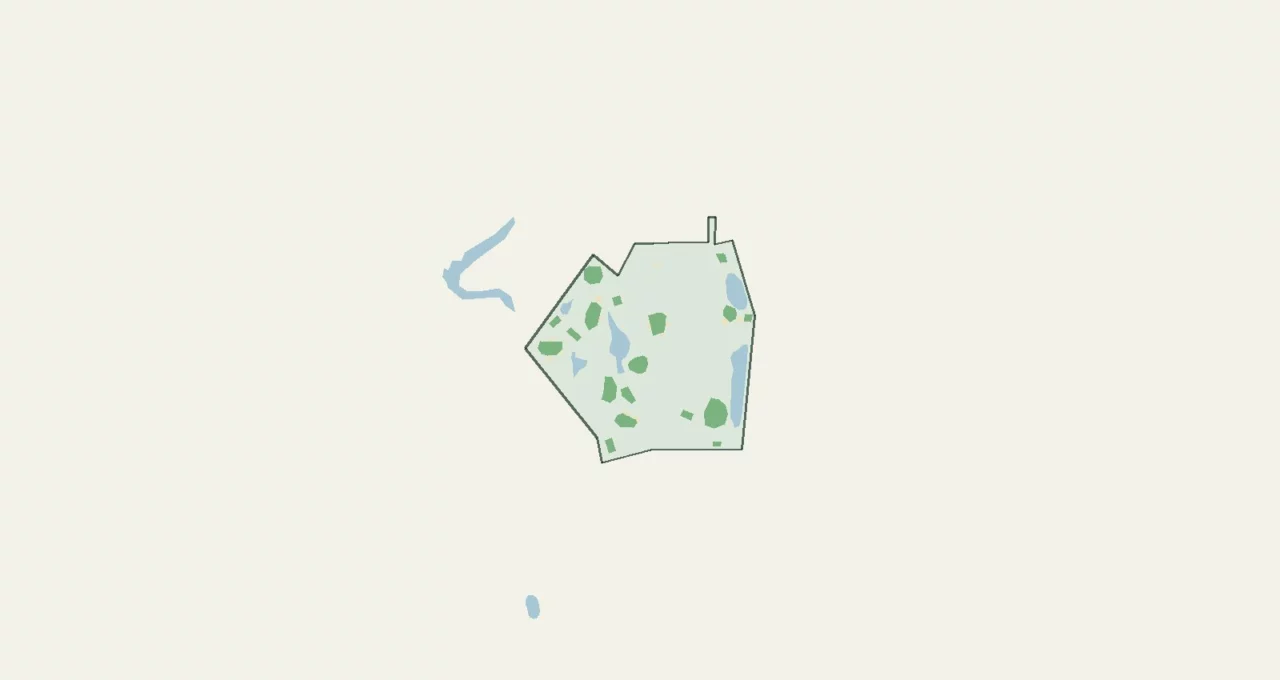
Layout of Red Rocks Golf Club (formerly Aussie Golf Ranch) from OpenStreetMap survey data (ODbL licence).
Red Rocks Golf Club (formerly Aussie Golf Ranch)
Holes
9
By
27
Length
1,324 metres (blue), 1,160 metres (white), 984 metres (red)
Green fee
—
Best season
All year
Red Rocks Golf Club sits on Settlement Road on the north-western side of Phillip Island, a few minutes west of Cowes, on a strip of coastal dune land that runs down to the small beach of Red Rocks. Until 2023 it was called the Aussie Golf Ranch, and that is still the name on OpenStreetMap, on many maps and on a good number of older listings. The address is 627A Settlement Road, Cowes, Victoria 3922; the Bass Coast tourism office describes the drive as 3.5 kilometres west along Settlement Road from the IGA in Cowes.
This is not a full-length course, and it is worth being clear about that from the first line. The main layout, called Saltwater Creek, is a nine-hole par 3 course of 27 strokes, designed by Ross Watson and opened to the public in December 2007. Alongside it the club runs a second nine-hole course, a two-club pitch and putt of 348 metres, and a nine-hole mini golf course. So the complex offers three different kinds of golf on one site, but only one of them is what most golfers would call a golf course, and that is the one this page is about.
It is a real one, though. Saltwater Creek is built to proper standards: greens to USGA specification, bentgrass putting surfaces, couch fairways, bunkers, and wetlands that bring water into play on most holes. It has a slope rating published by the club, a membership, monthly medals and stableford competitions, and reciprocal arrangements with other clubs. Golf Australia magazine has written about it three times: in a 2019 list of the country’s best nine-hole courses, in a 2021 list of its most fun short courses, and in a full course review in February 2024.
How it came to be
The club’s own timeline begins in July 2006, when Rohan and Lisa Walker started building a course on an ocean-front parcel near Cowes. Golf Australia describes the course as the idea of Rohan Walker, a PGA professional who wanted a place to teach children the game while still giving better players something to think about. During construction it was named the Aussie Golf Ranch.
The timing was poor. The summer of 2006 to 2007 was a drought summer in Victoria, and in December 2006, according to the club, there was not enough water to grow grass, so the project was put on hold. Work resumed in September 2007. The club says the bulk of the earthworks was done over about eight weeks, with more than 250,000 cubic metres of earth moved and shaped, most of it to build the wetlands that surround the holes. Greens were boxed out to USGA specification and seeded with G2 bentgrass; surrounds and aprons were seeded with fescue, and tees and fairways sprigged with Santa Ana couch.
The wetlands were not only a design feature. Once they were full, the club says, the course was self-sufficient for water, which after the experience of 2006 was the point. It opened in December 2007.
The Walkers ran it for some sixteen years. In 2023 the property was sold to Moda and renamed Red Rocks after the beach next door. The club gives September 2023 as the date of the change; the Golf Australia review of February 2024 says the sale took place in early 2023. Under the new owners the clubhouse, the pro shop and the on-site cabins have been refurbished, and the club’s news page in 2026 lists new membership categories, lessons and a stocked pro shop.
The numbers
Saltwater Creek has nine holes, all par 3s, for a par of 27. The club’s own course page gives a length of 1,160 metres and a slope of 100, and grades the course as intermediate. Those are the figures for the middle tees.
The course has three sets of tees. The GolfNow listing for the course gives 1,324 metres from the blue tees, 1,160 metres from the white and 984 metres from the red, and the Golf Australia review of 2024 gives the same 1,324 metres from the back markers and 984 metres from the shortest. The club’s own figure of 1,160 metres therefore corresponds to the white tees.
Individual holes run from about 100 metres to well over 150. Golf Australia’s 2021 list gives a range of 103 to 183 metres. The club names the 6th as its longest hole, at 183 metres. The 2024 review gives 103 metres for the 1st, 162 for the 2nd, 145 for the 4th and 148 for the 8th; we have not found a published card with the length of every hole, so we give only those.
On bunkers the sources differ slightly. Golf Australia’s 2019 list counts 17 pot-style bunkers; its 2021 list and the 2024 review speak of nearly 20. A local listing says water comes into play on seven of the nine holes. The whole site, both courses, mini golf, clubhouse and cabins, covers about 23 acres of coastal dune, a little over nine hectares, and the beach of Red Rocks Bay is about 100 metres away according to Golf Australia.
The pitch and putt is a separate nine-hole course of 348 metres, with holes from 22 to 54 metres; the 9th is the longest. It is played with two clubs. The mini golf, described in 2019 as the Aussie Bush Mini Golf course, is the third layout.
What it asks of you
A par 3 course is a test of one thing above all: the iron into the green, from the tee, nine times. There is no driver to hide behind and no chance to make up a poor approach with a good chip after a good drive. Every hole is decided by the first shot and what follows on and around the green. On a course of 1,160 metres, the white tees ask for everything from a wedge to a long iron or hybrid, and the blue tees, at 1,324 metres, push the longer holes towards fairway wood territory for many club golfers.
The wetlands are what make Saltwater Creek more than a practice ground. Ross Watson built the holes around them, and on most of the course a miss in one direction finds water. The 2024 review singles out three holes.
The 1st, at 103 metres, is played across the wetlands to a peanut-shaped green set diagonally to the line of play, with a bunker on each side. It is short, but a diagonal green means the right club depends on where the flag is, and a ball that comes up short is wet.
The 2nd, at 162 metres, is the one the review calls arguably the toughest of the nine. The wetlands run the full length of the left side. A miss left or long goes in the water; a miss to the right tends to find a bunker. That leaves a narrow target from a length that already needs a mid or long iron.
The 4th, at 145 metres, is a tribute to the Redan, the famous 15th at North Berwick in Scotland. A bunker guards the front of a kidney-shaped green, another sits behind it, and the ground is shaped so that a ball landing short and right feeds towards the flag. A Redan rewards the player who plays the slope rather than the flag, and it is the hole the review rates as the highlight of the course.
The 8th, at 148 metres, is listed as playing considerably longer when the prevailing wind is up. That point applies to the whole course: this is an exposed site a short walk from the water, and Golf Australia’s 2019 entry names the coastal winds, with the bunkers, as what gives a round its challenge.
The greens are the other half of the test. Every source that describes the course mentions them. Golf Australia speaks of G2 bentgrass greens with plenty of movement, beautifully presented in 2021 and superbly kept in 2024, and each green is framed by grass-covered mounds. Movement in the greens and mounds around them mean that a ball which misses the putting surface often leaves an awkward pitch from a tight or sloping lie, and that the putt once on the green is rarely straight.
The club’s notice of 13 October 2026 reported the greens running exceptionally well after winter and the course in very good condition. That is the club’s own word, but it is consistent with what independent sources have said over the years.
What that means for your game
For a club golfer the practical points are simple. Bring more balls than you think nine short holes need, because the water is close to the line on most of them. Take note of the wind before choosing a club, especially on the longer holes, and accept that the club for the 8th on a calm morning will not be the club for the 8th in the afternoon. Aim for the fat part of the green rather than the flag, particularly on the 2nd and the 1st, where the wetlands punish any shortfall. And spend time on the putting green before you start: on a par 3 course the score is made with the putter.
For a beginner, the same features that challenge a good player can make a round slow and costly in balls. The pitch and putt next door is the better first step, and the club presents it as the more beginner-friendly option. For a low handicapper, Saltwater Creek is a good way to sharpen the short irons and the putter, and a round of nine holes fits easily into a day on the island. It is not a substitute for a full eighteen, and nobody should come expecting one.
The rest of the site
The pitch and putt sits alongside the rust-coloured dunes of Red Rocks Beach. The club describes it as a two-club course with fast sloping greens, which in practice means a wedge and a putter for most players. It is the obvious place for children and for adults who have never played, and the club suggests it still offers a challenge to more experienced golfers. Golf Australia’s 2019 list mentions that the Aussie Golf Ranch hosted the annual Victorian Open Pitch and Putt Championship, played that year in mid-October; we have not found a more recent edition and do not know whether it still takes place.
There is no driving range. The GolfNow listing confirms the absence and records a pitching and chipping area and a putting green; a local guide mentions two chipping greens with bunkers. Golf clubs and buggies can be hired at the pro shop, which also sells balls and apparel and serves food and drink. The club offers private lessons, clinics and group bookings, and the Bass Coast tourism site lists a children’s golf clinic on Saturday mornings at 9.30, along with junior and adult golf camps.
The club has four cabins on the course, all renovated: two two-bedroom cabins and two studios. One of them, according to the club, sits among the gum trees beside the 8th tee, and another looks across the garden to the 9th green. Guests have private access to the beach path. For golfers coming from Melbourne for a weekend, staying on site is the simplest way to play the course more than once.
The wildlife comes up in almost every description. Cape Barren geese and wallabies are mentioned by local guides, and guests describe seeing birds and the odd wallaby on the course in the evening, once the golfers have gone.
The club has members and runs regular competitions, including a monthly medal and stableford events, and publishes the results on its news page. Its members have reciprocal rights at a list of clubs in Victoria, New South Wales, Tasmania and the Northern Territory, including Phillip Island, Wonthaggi and Lang Lang closer to home.
What players say about it
Public comment on Red Rocks is split between the golf and the accommodation, and more of it deals with the cabins than with the course. Some of the older comment was written under the Aussie Golf Ranch name, before the 2023 sale and the renovations. The points below summarise what recurs. These are other people’s opinions, not ours: we have not played the course, and we name and quote no one.
What comes up in its favour
- The greens are the most consistent point of praise, both from Golf Australia and from players: true-rolling, well kept and with real movement.
- Players describe the course as challenging, harder than a par 3 layout suggests, and they mean it as a compliment. The water on most holes and the wind are what they mention.
- The setting by the dunes and the beach, with the wetlands running through the holes, is what visitors remember.
- Families like it. Between the par 3 course, the pitch and putt and the mini golf, there is something for every age, and comments on the pitch and putt and the mini golf from parents are warm.
- The wildlife, especially the geese and the wallabies, and the quiet of the site in the evening are frequently noted.
- Staff are described as friendly and helpful, and the coaching is praised.
- Golfers who stayed in the cabins appreciate stepping straight from the deck onto the course.
What comes up against
- The water and bunkers that good players enjoy make it a demanding round for a beginner; even the club points newcomers towards the pitch and putt.
- The coastal wind on this exposed site can make the longer holes much harder, and the course plays very differently from one day to the next.
- It is nine short holes. Golfers looking for a full round, or a place to hit drivers, need to go elsewhere, and there is no driving range on site.
- Older comments on the accommodation, written before the renovation, raise maintenance points such as hot water and ageing fittings. More recent comments are more positive, but the record is mixed.
- The course still appears under its old name, Aussie Golf Ranch, on maps and older listings, which makes the current information harder to find.
Who it suits
Red Rocks suits golfers who want a short, well-built test of their irons and putting in a coastal setting, and families who want to play together without sending children onto a full-length course. It is a good choice for a holiday morning on Phillip Island, for a lesson, or for an afternoon of pitch and putt and mini golf with children. Low handicappers will find enough in Saltwater Creek to keep them interested for nine holes, especially in wind. Golfers who want a full eighteen on the island should look at the Phillip Island Golf Club, a separate club on the island and one of Red Rocks’ reciprocal partners.
Getting there and when to go
Phillip Island is reached by road over the bridge from San Remo; Golf Australia puts Cowes about two hours’ drive from Melbourne. From the centre of Cowes, follow Settlement Road west: Visit Bass Coast gives the distance from the IGA as 3.5 kilometres. In a straight line the course is about four kilometres from the Cowes jetty.
The course is open seven days a week and plays all year. A local listing gives longer opening hours in summer than in winter, but the club does not publish fixed hours on its site, so it is worth calling ahead, especially early or late in the day. Spring and autumn usually give the most comfortable conditions on this coast; summer brings the holiday crowds to the island, and winter brings cold, windy weather. The island is busiest during school holidays and on the weekends of major events at the Phillip Island Grand Prix Circuit.
Tee times can be booked online through the club’s website, and the club takes group bookings and private events. The course is public: no membership or handicap is needed to play.
Green fees
Rates are set by the club, with separate prices for the par 3 course and the pitch and putt, for nine and eighteen holes, and for adults and juniors. See the club’s own site.
How this page was made
The factual frame comes from public sources: OpenStreetMap for the location and the former name; the club’s published timeline for the construction dates, the drought pause, the earthworks, the turf and the 2023 change of ownership; the club’s course page for the length and slope from the white tees, the pitch and putt and the mini golf; and the club’s news page for the longest holes, the competitions, the reciprocal clubs and the course update of October 2026. Golf Australia magazine provided the course review of February 2024, with the back and front tee lengths, the hole descriptions and the site area, and its lists of Australia’s best nine-hole courses (2019) and most fun short courses (2021). The three tee lengths are confirmed by the GolfNow listing. The Bass Coast tourism site provided the directions and the children’s clinic. The straight-line distance to the Cowes jetty is calculated from the coordinates.
Some sources disagree. The club gives the length as 1,160 metres, Golf Australia as 1,324 metres; they describe different tees, and we give all three. Golf Australia counted 17 bunkers in 2019 and nearly 20 in 2021 and 2024. The club dates the sale to Moda to September 2023, the 2024 review to early 2023. A local listing says water is in play on seven holes; we have not been able to check this hole by hole. We have found no complete scorecard with the length of every hole, and we do not know whether the Victorian Open Pitch and Putt Championship mentioned in 2019 is still held. The opinion section summarises public reviews on travel and booking sites and in golf guides, read in October 2026; we report recurring themes rather than individual voices, and we reproduce no quotations.
We have not played this course, and this page is no substitute for a round. The club has not paid for this page, has not seen it before publication and has no say over its content. If you know the course and something here is wrong or out of date, write to us and we will correct it.
Other courses nearby
Closest to this one in our Australian directory:
- Royal Melbourne Golf Club — 56 km
- Kingston Heath Golf Club — 56 km
- Commonwealth Golf Club — 59 km
- Huntingdale Golf Club — 60 km