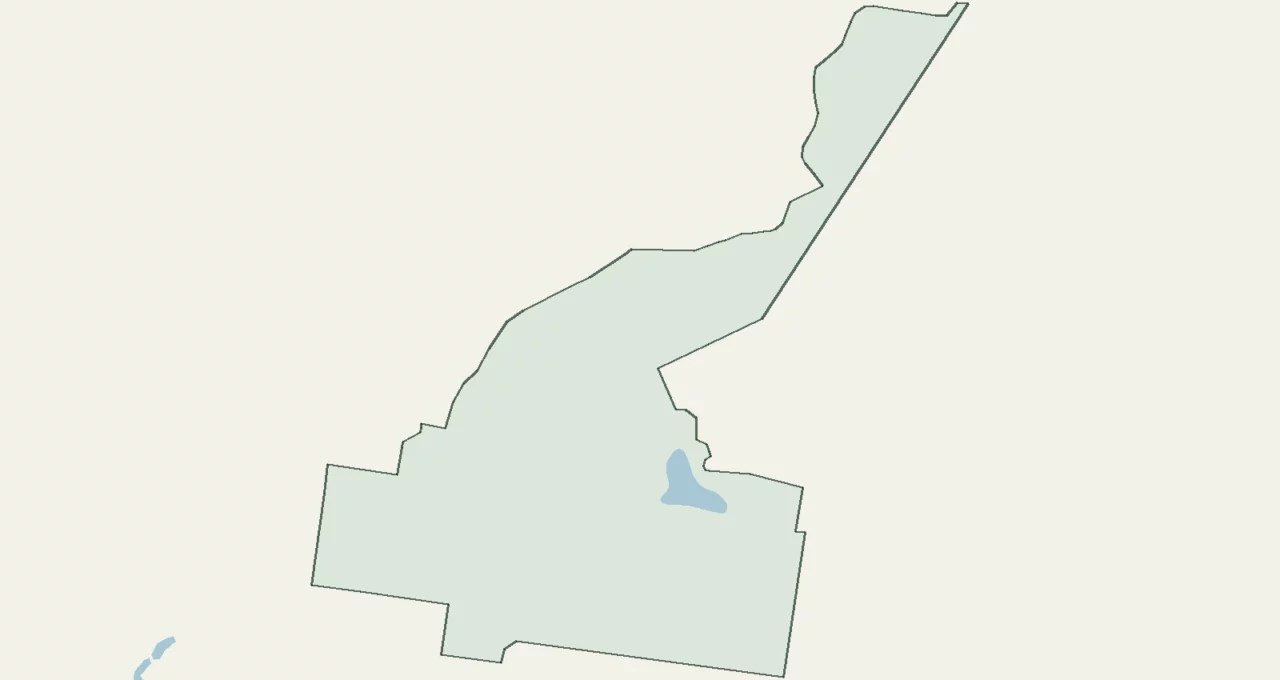
Layout of Box Hill Golf Club from OpenStreetMap survey data (ODbL licence).
Box Hill Golf Club
Holes
18
By
71 (men), 72 (women)
Length
5,618 metres from the back tees, 5,423 metres from the middle tees and 5,133 metres from the forward tees (club course tour)
Green fee
—
Best season
All year
Box Hill Golf Club is a private members’ club with an eighteen-hole course in Box Hill South, in the City of Whitehorse, in Melbourne’s eastern suburbs. The club gives its address as 202 Station Street, Box Hill South, Victoria 3128. It describes itself as 16 kilometres from the Melbourne CBD on one page and as less than 20 kilometres on another; in a straight line, the middle of the course is just under 15 kilometres east of the General Post Office in the city centre, and about two kilometres south of Box Hill station and its shopping centre.
The course is a par 71 of 5,618 metres from the back tees on the club’s own card, with three sets of tees per hole. Gardiners Creek runs through the property from north-east to south-west, and the club’s hole guide brings it, or the irrigation lake beside it, into play on several holes. The course covers about 36 hectares on OpenStreetMap, a block roughly a kilometre long from north to south.
The club says it has more than 1,100 members. Its history runs through three sites, a change of name and a long, gradual purchase of the land it now plays on.
A club on the move
The club’s own history page calls its early years “a golf club on the move”. Its first known site was a nine-hole course just south of Canterbury Road, then called Delaney Road. The first annual general meeting of Box Hill Golf Club was held on 25 April 1913. Other sources place the club’s origins earlier: a golf course consultancy that has worked at the club writes that it dates to around 1892, when golf was first played on a course at Mont Albert, and the club’s own course guide calls it one of the three original golf clubs in Victoria. We have not found a document that settles the founding date, and the club itself gives 1913 for its first AGM.
Suburban subdivision pushed the club off its land. In 1924, the club records, it leased property along Doncaster Road and laid out an eighteen-hole course among the orchards there. A new committee took over the assets and adopted a new name, Eastern Golf Club. Box Hill Golf Club, as a separate body, went into recess.
The name came back in 1933. That year, according to the club, a local man, J.P.C. Wellard, built a course he called the Box Hill Public Golf Links on land that now carries much of the front nine. He laid out the fairways, tees and greens and put in a reticulated water system, and a group of social players who used his links formed a new Box Hill Golf Club. The club’s membership page puts it simply: the club was established on its current site in 1933.
Eastern Golf Club, meanwhile, went its own way. In 1938, the club’s history says, some of its members bought land in the sand belt at East Oakleigh from the Melbourne Hunt Club, and opened a course there in 1941 as Huntingdale Golf Club.
Buying the land
The modern club was built piece by piece. In 1952, the social players approached Mr Wellard to buy the land his course was on. A price was agreed, but the club could not raise all the money and bought only about half of the land an eighteen-hole course would need. In 1967 it leased enough extra land from the Melbourne and Metropolitan Board of Works to build a full eighteen holes. In 1956 it obtained a liquor licence, unusual, the club notes, in what was essentially a dry area.
From the 1980s onwards, the club says, it built new clubrooms and negotiated the purchase of all the land it had leased from Melbourne Water (the successor to the Board of Works), Melbourne Parks and Waterways and Whitehorse City Council. New land to the north became two new holes, the present 15th and 16th, and that in turn allowed the club to rebuild the 13th, 14th, 17th and 18th.
Recent work on the course
We found no name for the designer of the present eighteen holes as a whole. What is on record is recent work. The course design firm Crafter + Mogford says it was appointed course consultant to the club in 2014, and that it has since built new greens at the 12th, opened in 2016, the 4th, which followed, and the 10th, opened in 2018, working with a construction contractor and the club’s course superintendent. The club itself says current projects are focused on tee redevelopments, bunker upgrades and better fairway drainage.
The artists’ camp
The course sits on ground that matters in the history of Australian painting. In the summer of 1885 to 1886, Tom Roberts, Frederick McCubbin and Louis Abrahams pitched a tent beside what was then called Damper Creek, now Gardiners Creek, on land owned by a farmer, David Houston. The Box Hill artists’ camp is often described as the beginning of what became known as the Heidelberg School.
The club says a marker near the tees of the 15th and 17th holes identifies the area, where the artists camped along the creek. Victorian Places, a historical gazetteer of the state, puts the camp a little to the west, near today’s Foch Street in the Golf Links Estate, a 1924 subdivision next to the club, and Wikipedia mentions a commemorative cairn in Artists Park, off Prince Street. The creek runs through both the estate and the course, so the sources need not contradict each other, but they do not point to the same spot.
The course in figures
The club’s online course tour gives a par of 71 and a total of 5,618 metres. Each hole carries three lengths, which the site does not label. Added up, the longest set gives 5,618 metres, 2,734 out and 2,884 home; the middle set gives 5,423 metres; and the shortest set gives 5,133 metres. The front nine is a par 35 and the back nine a par 36.
From the back tees there are five par 3s, at the 4th (190 metres), the 6th (152), the 9th (170), the 11th (178) and the 17th (133), and four par 5s, at the 5th (452 metres), the 7th (480), the 13th (441) and the 18th (446). The remaining nine holes are par 4s. Two of them are long: the 2nd, at 423 metres, and the 12th, at 387. The others are short to medium, from the 1st at 255 metres and the 8th at 283, through the 14th (316), the 10th (317), the 3rd (329), the 16th (330) and the 15th (336).
The shortest set of tees appears to be the women’s. The Hole19 app publishes a card for a tee it calls Ladies with the same figures as the club’s shortest lengths and a total of 5,137, labelled in yards. Those figures match the club’s metres hole by hole, apart from the 12th, which the app gives as 343 rather than 339, so we read them as metres too. That card makes the 2nd, at 430 metres from the forward tee, a par 5 rather than a par 4, which gives a women’s par of 72. This explains why one directory, GolfFinder, lists the course as a par 72, while the club and other sources give 71. On that card the stroke index 1 is the 13th, followed by the 7th and the 18th; we have not found a published stroke index for the men’s tees.
For ratings, the 18Birdies app gives a course rating of 70.5 and a slope of 129 for men from the blue tees, and 74.4 and 131 for women from the same tees, with a length of 6,105 yards, about 5,580 metres, slightly less than the club’s total. GolfFinder gives a range of slopes from 98 to 134 without saying which tees they apply to. We could not read the ratings published by Golf Australia, which is the authority on ratings in this country, so these figures come from third parties and should be checked before they are used for handicap purposes.
OpenStreetMap, from which our data collection started, recorded nine holes for the course. The club and every directory we found describe eighteen, and we follow them; all lengths here are the club’s.
What it asks of you
At 5,618 metres from the back, Box Hill is a medium-length course by Australian standards rather than a long one, and its card puts more weight on accuracy than on power. Four par 5s, all between 441 and 480 metres, are all within reach in two for long hitters according to the club’s own notes, while several par 4s are short enough to tempt an attacking tee shot. In return, the club’s descriptions of the holes keep returning to three words: tight, bunkered and creek.
The front nine
The round opens with a short par 4 of 255 metres that the club calls risk and reward: long hitters may go for the green, but a miss on the left leaves a downhill chip. The 2nd, at 423 metres, is the longest par 4 on the course. The club’s two notes on it differ: one says a long hitter can easily reach it in two, the other that only long hitters will and that most players should plan on a pitch for the third. Greenside bunkers and a right-to-left slope protect the green.
The 3rd is a slight dogleg right of 329 metres. Fairway bunkers guard the right side, and a large gum tree short and left of the green catches poor approaches; the club advises a drive down the right to take the tree out of play. The 4th, a par 3 of 190 metres with one of the new greens, is a hole where par is a very good score, according to the club: a small green, a very large bunker on the left and trees on the right.
The 5th, a par 5 of 452 metres, is a tight drive past a fairway bunker on the right about 230 metres out, then a downhill second, with bunkers 50 metres short of the green. The 6th, a par 3 of 152 metres, is played over the creek to an elevated green surrounded by bunkers, towards the clubhouse, and it plays a little longer than its length. The 7th, at 480 metres the longest hole, climbs to a small green with bunkers on both sides. The 8th, a par 4 of 283 metres with fairway bunkers on both sides, is the club’s idea of a birdie chance, and the 9th, a par 3 of 170 metres, has pot bunkers front and left and the creek to the right, with no easy place to miss.
The back nine
The 10th, at 317 metres, is short but narrow and uphill, with out of bounds on the left and trees on the right, to a raised two-tier green, with the irrigation lake behind the tee. The 11th, a par 3 of 178 metres, is played past that lake, which collects anything pushed to the right, to a firm, small green sloping from back to front. The 12th, at 387 metres, runs slightly downhill between narrowing fairways and bunkers on the left, to a two-tier green with a small false front, another of the greens rebuilt since 2016.
The 13th, a par 5 of 441 metres, is where the creek matters most: it runs the length of the hole, according to the club. Long hitters can carry the left fairway bunker and go for a small green surrounded by sand; others lay up and pitch. The 14th, a par 4 of 316 metres, is short but very tight, with overhanging branches, a gum tree to drive past and a shallow two-tier green. The 15th, at 336 metres, asks for a drive left of the fairway bunkers and a second shot over the creek to a generous green. The 16th, at 330 metres, sweeps left around two fairway bunkers to a small green with a false front.
The finish is short and long. The 17th is a par 3 of only 133 metres, but uphill to an elevated green whose surface the golfer cannot see from the tee; the club says it plays one or two clubs longer than its length. The 18th, a par 5 of 446 metres, has the creek winding down the right and the practice fairway, out of bounds, on the left. The club calls it a birdie chance for those who keep the second shot straight, and warns that some pin positions on its undulating green make putting very difficult.
What that means for your game
Keep the ball in play off the tee: a long iron or hybrid to the fairway will often score better than a driver into the trees, especially on the 3rd, 10th and 14th. Know where the creek is on the 6th, 9th, 13th, 15th and 18th, and the lake on the 11th. Take an extra club on the uphill par 3s, the 6th and the 17th, and on the climb to the 7th green. And treat the par 5s as the place to make up shots: none is longer than 480 metres.
Practice and facilities
The club has a practice fairway beside the 18th, and GolfFinder lists a putting green. We found no mention of a full driving range. The golf shop is open seven days a week from 6.30am to 6pm, according to the club, and its three PGA professionals give lessons and club fitting, and the club runs junior programs and a women’s academy for beginners.
The clubhouse has a members’ lounge, two function rooms, gaming facilities and a TAB, and a bistro open to the public from Tuesday to Sunday, from noon to 8pm according to its page. Dress rules are traditional on the course: collared shirts, tailored trousers or shorts, socks and soft-spike golf shoes, with no runners on the course or practice areas.
What golfers say
Independent comment on Box Hill is limited. Most golf apps carry ratings but few written words, and much of what can be read about the course is the club’s own description. The points below summarise what recurs across golf apps, a ranking site and travel and golf directories read in October 2026. They are other people’s opinions, not ours: we have not played the course, and we name and quote no one.
What comes up in its favour
- Course condition is generally well regarded. One review describes the playing surfaces as consistently in good shape and the ground as draining well, and app ratings for condition and value are good.
- The greens are described as fast, and the bunkering as plentiful and well kept.
- The creek and the water features give a fairly flat block of land some character, and the tree-lined setting is appreciated.
- Several comments mention a friendly membership and a relaxed club atmosphere.
- Pace of play is rated quick in one app.
What comes up against
- One review finds the layout repetitive, with fairways running roughly parallel to one another, and is unconvinced by the course’s place in state rankings.
- App users rate it hard, and the front nine in particular is described as tight; some find the greens small.
- Some of the walks between greens and tees are said to be long, and one route is said to cross the car park.
- One comment says the course can get muddy in winter, which sits awkwardly with another’s praise for its drainage; the club itself lists fairway drainage among its current projects.
- As a private club, it offers limited access to golfers who are not members or members’ guests.
Who it suits
Box Hill suits golfers who live or work in Melbourne’s east and want a members’ club close to home, with competitions most days of the week, a busy clubhouse and coaching on site. Players who value accuracy over length will find plenty in the tight drives, the creek and the tiered greens. Members of the clubs in its reciprocal arrangements, and members’ guests, are the visitors most likely to get a game.
Getting there and when to go
The club’s main entrance, for the bistro, dining and short-term parking, is at 202 Station Street, Box Hill South, where it says there are three disabled parking spaces. For golf and functions, the club asks drivers to continue to the end of Riversdale Road, which leads directly into its lower car park. Box Hill station, on the Lilydale and Belgrave lines, and the bus interchange at Box Hill Central are about two kilometres to the north in a straight line. A linear park and walking trail follows Gardiners Creek past the course. We have not checked current bus routes and give none.
Access to the course is the main thing a visitor needs to know. The club calls its course private and describes its golf in terms of membership. GolfFinder lists the club as private, with social golf restricted and bookings made in advance; Golf Australia’s course listing, as it appears in search results, describes it as a public course, but we could not open the listing to read it in full. The club runs an online tee-time page for non-members through its booking provider, which showed no times available when we looked. Members of the eight clubs in its local reciprocal arrangement, among them Anglesea, Mornington and Yering Meadows, can book through the golf shop with a reciprocal card, subject to availability. Anyone else should phone the golf shop before planning a round.
The club gives the clubhouse number as (03) 9808 1526 and the golf shop as (03) 9808 4519, although its competitions page gives the first for golf shop bookings. Its contact page says the clubhouse is open seven days a week from 10am to midnight; its membership page says 364 days a year until 11.30pm.
Competitions are held almost every day: open events on Tuesday, Thursday, Saturday and Sunday, women’s on Wednesday morning, a nine-hole twilight event on Wednesday afternoon during daylight saving and optional nine-hole events on Monday and Friday. The membership page speaks of competition golf five days a week, which may count only the main events. The course is played all year round.
How this page was made
The factual frame comes from public sources. The club’s website, read in October 2026, provided the address, the history, the artists’ camp marker, the lengths, pars and notes of its course tour, and the practical details: competitions, reciprocal clubs, membership numbers, opening hours, dress code, parking and telephone numbers. The work of Crafter + Mogford comes from that firm’s own project page. The artists’ camp comes from Wikipedia and from Victorian Places, which also gave the 1924 Golf Links Estate and the Gardiners Creek trail. The forward-tee card and stroke index come from the Hole19 app, the course rating and slope from 18Birdies, and the course type, putting green, bunkering and slope range from the GolfFinder directory. OpenStreetMap provided the coordinates, the outline and area of the course and the course of Gardiners Creek; straight-line distances are calculated from its coordinates.
Several sources disagree, and we have said so in the text. The club gives 1913 for its first AGM and 1933 for its establishment on the present site, while a consultancy dates it to around 1892. The club and most sources give a par of 71; GolfFinder gives 72, which matches the women’s card. 18Birdies gives a total about 36 metres shorter than the club’s card, and Hole19 gives one forward-tee length that differs by four metres and labels its metres as yards. GolfFinder calls the club private and Golf Australia’s listing, as indexed, calls it public. The club’s own pages differ on the golf shop’s number, the clubhouse hours and the number of competition days. OpenStreetMap recorded nine holes where the club has eighteen. The artists’ camp is placed near the 15th and 17th tees by the club and near Foch Street by Victorian Places. We could not read Golf Australia’s course pages or GolfPass, which blocked our requests, and found no designer for the present layout and no published men’s stroke index, so none is given.
The opinion section summarises public reviews and ratings on golf apps, a course ranking site and golf directories, read in October 2026; we report recurring themes rather than individual voices, we reproduce no quotations and we give no ratings or review counts. Written reviews are few, and the picture they give is necessarily partial.
We have not played this course, and this page is no substitute for a round. The club has not paid for this page, has not seen it before publication and has no say over its content. If you know the course and something here is wrong or out of date, write to us and we will correct it.
Other courses nearby
Closest to this one in our Australian directory:
- Ringwood Golf — 8 km
- The Metropolitan Golf Club — 9 km
- Huntingdale Golf Club — 9 km
- Commonwealth Golf Club — 11 km