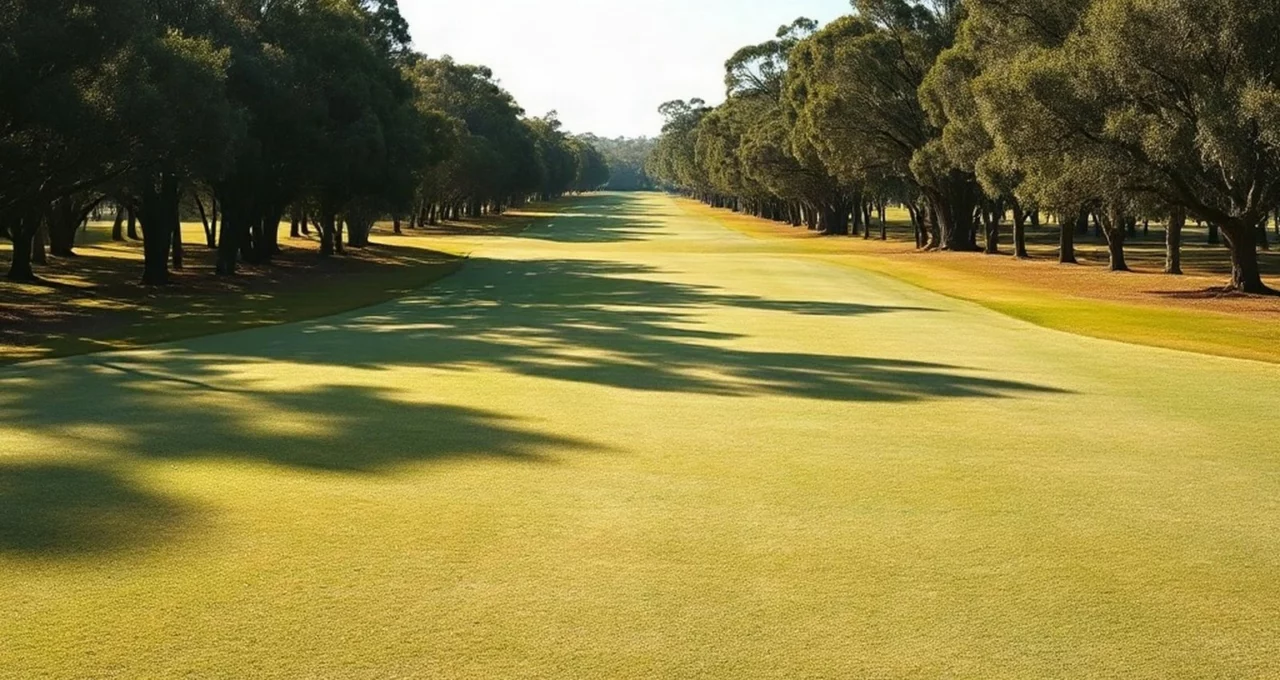
Illustration generated by artificial intelligence. This is not a photograph of this course: no freely licensed image of the site exists to date.
Royal Melbourne Golf Club
Holes
36 (West and East courses)
By
72 (West)
Length
6,077 m (West)
Green fee
—
Best season
All year
Alister MacKenzie came to Melbourne in 1926, spent a matter of weeks on the site at Black Rock and left plans for the West Course. Alex Russell, the 1924 Australian Open champion, worked with him and later built the East. Mick Morcom, the club’s greenkeeper, constructed both, and it is Morcom’s hand in the bunkers and the greens that turned a routing on paper into the best course in the country. The West was finished in 1931.
Between them the two courses supply the Composite Course, a selection of holes from each that avoids the road crossings and is the layout used for the Presidents Cup, the Australian Open and the Women’s Australian Open.
What it asks of you
The West is a par 72 of 6,077 metres, which is short by modern championship measure and entirely beside the point. It will not beat you with length. It will beat you on the approach.
The bunkering is what everybody comes for. Sandbelt soil compacts in a way that allows a face to stand a foot or more above the turf with a crisp edge, and Morcom cut them so that they bite into fairways and putting surfaces rather than sitting politely beside them. They are placed to make you think rather than simply to punish a bad strike, and the depth of sand varies from one to the next.
The greens run very fast and their contours are true. Being on the wrong side of the hole is a real penalty on almost every one of them, and the whole course is arranged so that the angle of approach decides whether that is possible. It is firm, it is fast, and the ground game is not optional.
What players say about it
Access is through a member or a recognised club introduction, so the review record comes from visitors who cleared that process, from tournament coverage and from architecture writing. The notes below summarise recurring themes across those public sources. They are other people’s opinions, not ours: we have not played the course, and we do not name or quote individual reviewers.
What comes up in its favour
- The bunkering is described in superlatives by practically everyone who writes about the course, and it is the single most admired feature.
- The greens draw the same reaction: fast, true, and among the most demanding and most enjoyable putting surfaces reviewers have played.
- Practice facilities, staff and the clubhouse are consistently praised, and visitors describe the welcome as warmer than they expected.
- Green fees and hire rates are described as moderate for a course ranked in the world’s top ten, which surprises international visitors.
What comes up against
- The holes across Cheltenham Road, roughly thirteen to sixteen, are the recognised weak stretch: flatter land, less interest, and two holes that feel constrained by the boundaries.
- Access is the real barrier. The visitor verification process is demanding, and a golfer without a club connection is unlikely to get on.
- The greens are hard enough that some visitors find them intimidating rather than enjoyable on a single visit.
- It is not a course for anyone wanting a cheap or flexible round, and reviewers say so plainly.
Getting there and when to go
Black Rock is around forty minutes south-east of central Melbourne and half an hour from Tullamarine outside peak traffic. Kingston Heath, Metropolitan, Commonwealth and Huntingdale are all within a few minutes, which makes this the densest concentration of great courses in the southern hemisphere.
The course plays all year on sand that drains. Melbourne’s spring and autumn give the firmest turf and the most reliable weather. Visitor access is arranged through a member or a recognised club introduction and must be organised well in advance.
Green fees
Rates and visitor conditions are set by the club and depend on the introduction. See the club’s own site.
How this page was made
The factual frame comes from public sources: OpenStreetMap for the location, Wikipedia and published architecture and championship coverage for the history and the design, and the club’s own site for access. The opinion section summarises public reviews, guest accounts and architecture writing read in September 2026; we report recurring themes rather than individual voices, and we do not reproduce or attribute quotes.
We have not played this course, and nothing here is a substitute for that. The club has not paid for this page, has not seen it before publication and has no say in what it says. If you know the course and something here is wrong or out of date, write to us and we will correct it.