Hybrid or 4-iron off firm Aussie fairways: a ten-ball shoot-out and where to try one first
From 170 metres off a thin spring lie, plenty of golfers reach for a 4-iron they do not trust. Ten balls on the range, alternated with a hybrid of the same loft, will show which club deserves the spot, and Australian conditions often tip it one way.
In brief
- Match lofts before comparing: a 4-iron against a 4H or a 22 to 23 degree hybrid, a 5-iron against a 5H.
- Alternate the clubs ball by ball and judge each one by its two worst shots, never its best.
- Ping lists the G440 hybrid in six lofts from 17 to 34 degrees, with loft adjustable 1.5 degrees either way.
- The G440 hybrid was A$499.95 at an Australian retailer in October 2026; on firm couch and in kikuyu rough its wide sole is the main argument for it.
Spring comps are back, the couch fairways are waking up after winter, and somewhere in your bag there is probably a club you only pull out when you have run out of excuses. For a lot of Australian golfers it is the 4-iron. You are 170 metres out, the ball is sitting down on a thin, dry lie, the flag is tucked behind a bunker, and you already know the most likely result is a low skinny one that runs out of puff halfway there. The hybrid was designed for that moment. Plenty of good players still swear by the long iron, though, and both camps have a point.
Rather than pick a side, this guide gives you a way to answer the question for your own swing in a single range session. Along the way it looks at one current hybrid, Ping’s G440, as a concrete example: what Ping says about it, what it costs here this spring and what owners are saying online. Ping’s own specification sheet is the source for every number about the club. Nobody at Panxis Golf has swung it, so read what follows as a buying guide built on published facts and public opinion, not as a review.
Same loft, two very different heads
Put a 4-iron and a 23-degree hybrid side by side and the loft is about the only thing they share.
The iron head is slim and compact, with most of its mass close to the face. That keeps the centre of gravity forward and relatively high, so the ball comes off lower with less spin. Hit it out of the middle with a slightly descending blow and you get a strong, boring flight that holds its line in a breeze. Catch it a touch thin, or a centimetre out towards the toe, and you lose a big slice of both height and distance.
The hybrid is a small hollow head that runs deeper from face to back. Weight sits lower and further behind the ball, which helps it climb and adds a little spin, and the broad sole slides over the turf instead of digging into it. That forgiveness comes at a price: some golfers find the flight balloons, and others fight a hook because the head turns over more easily through impact.
Which one suits you depends on three things: how fast you swing, how consistently you find the centre of the face, and the kind of ground you usually play off.
Ping G440 hybrid: the published specifications
The G440 hybrid belongs to Ping’s 2025 G440 range. Ping’s specification table lists six heads:
| Head | Loft | Typical iron it replaces |
|---|---|---|
| 2H | 17 degrees | 2-iron or a high 5-wood |
| 3H | 20 degrees | 3-iron |
| 4H | 23 degrees | 4-iron |
| 5H | 26 degrees | 5-iron |
| 6H | 30 degrees | 6-iron |
| 7H | 34 degrees | 7-iron |
A few more details from the same sheet:
- Length. Ping lists the lengths in inches: 40.75 for the 2H down to 38.25 for the 7H, in half-inch steps. In metric terms that is roughly 103.5 cm down to 97.2 cm, with about 1.3 cm between heads.
- Lie. Standard lie goes from 57 degrees on the 2H to 59.5 degrees on the 7H.
- Adjustability. The hosel moves loft 1.5 degrees either way and can set the lie up to 3 degrees flatter than standard.
- Build. A CarbonFly wrap crown, a face that is thinner and not as tall as on the previous model, and an internal hosel design.
- Shaft and swing weight. The stock shaft is Ping’s Alta CB Blue 70 in soft regular, regular and stiff. Standard swing weight is D1, and the lighter High Launch build is listed at C7.
On price, the G440 hybrid was A$499.95 when read in October 2026 at an Australian retailer, as a custom-built club in both right- and left-hand versions. That is a serious amount for one club, so it pays to be sure it will actually earn its place before you order it.
Why Australian conditions often favour the hybrid
Course conditions here push the argument in a particular direction, and it is worth thinking about them before you set foot on the range.
Firm, fast ground. On sandbelt-style layouts and on most courses once summer dries them out, the ball sits tight on firm couch with very little grass under it. A long iron from a bare lie demands a precise strike. A hybrid’s wide sole sweeps across the surface and is far more tolerant if you make contact a fraction early.
Kikuyu and couch rough. Thick, grabby rough wraps around a narrow iron hosel and twists the face shut. The hybrid’s rounder head cuts through it more cleanly, which is the single most common reason club golfers make the switch.
Firm greens. A higher, steeper landing stops the ball sooner on a hard green. With a long iron you are often forced to land short and hope it releases the right amount.
Wind. This is where the iron fights back. On exposed coastal courses, a well-struck long iron stays under the breeze, while a hybrid can climb and get knocked around. If your home course is on the water and blows most afternoons, keep that in mind.
Settle it yourself: the ten-ball shoot-out
Opinions about this question are easy to come by. A simple range session gives you something better: your own evidence.
- Pick a fair matchup. Pair clubs within a degree or two of loft: your 4-iron against a 4H or anything around 22 or 23 degrees, your 5-iron against a 5H. A mismatch makes the result meaningless.
- Warm up properly. Hit a bucket of wedges and mid-irons first. You want your usual Saturday swing, not your first-ball-of-the-day swing.
- Choose one target. Something between 150 and 180 metres suits most players. A simulator bay is a bonus, but a flag and honest eyes will do.
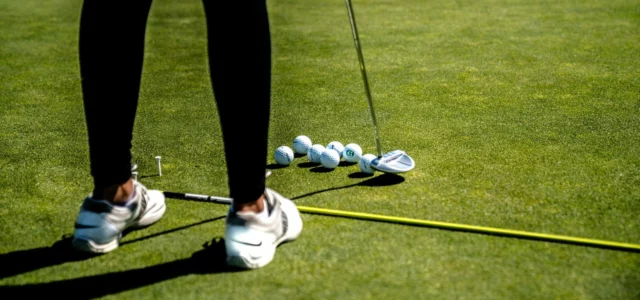
- Alternate every ball. Iron, hybrid, iron, hybrid, five of each. Hitting one club five times in a row lets you groove it and flatters whichever one goes second.
- Keep a simple scorecard. For each ball, jot down where it landed (not where it finished), how far left or right of the line, whether the strike was clean, thin, heavy, toey or heely, and whether the height would hold a green.
If you are using a launch monitor, our guide to the launch monitor numbers worth trusting this spring explains which readings matter and which you can ignore.
Now read the scorecard the right way. Ignore your best shot with each club and look at the two worst. A 4-iron that carries 175 metres when it is pure and 135 when it is not is a lottery ticket, not a 175-metre club. If the hybrid keeps all five balls in a tighter group, it wins, even if the longest ball of the day came off the iron.
A few common results and what they mean:
- The iron gives you two or more poor strikes and the hybrid gives you none: switch.
- Both are solid but the hybrid keeps drawing left: before you give up on it, look at the lie setting and whether a weaker loft setting straightens it out.
- The iron matches the hybrid for consistency: keep the iron and enjoy the control.
Then do it again on another day, this time from a tight lie or the first cut of rough if your practice area allows it. That second round is usually where the difference shows up most clearly.
What golfers are saying about the Ping G440 hybrid
Golf forums, social media threads and public retailer reviews keep returning to the same points.
On the plus side
- Mishits that still get there. Strikes low on the face or out towards the toe that finish close to normal distance are mentioned again and again.
- One club for several jobs. Owners describe using it off the tee, from the fairway and out of the rough, which is exactly what a long-iron replacement should do.
- The adjustable hosel. Tweaking the loft to sit neatly above the top iron, instead of buying another club, gets regular praise.
On the minus side
- A lower flight than before. Some players who wanted a hybrid to help them get the ball up say the earlier G430 launched higher and felt easier.
- Not much of a jump. A common view is that a G430 already in the bag is not worth replacing, especially as used ones cost much less.
- A plain look. The matte finish strikes several reviewers as dull next to other new hybrids.
- The price of a single club, when an older hybrid or a second-hand long iron would do the same job for many club golfers.
Where to try a hybrid in Australia before you buy
The best version of the shoot-out happens with both clubs in your hands and a launch monitor on the ground. Spring is a good time to organise it, because demo days and fitting bookings pick up as the comp season gets going.
Your club’s pro shop is often the best starting point. Many professionals hold demo days with the major brands’ fitting carts, and some will let you take a demo head onto the practice fairway. Real grass matters: a mat lets a slightly heavy iron shot bounce through, which hides the very weakness you are trying to measure.
Large golf stores with simulator bays let you compare several heads and shafts back to back. Ask them to use the same ball in every session, and ask whether the demo can be set to the loft and lie you would actually order.
Independent fitters charge for their time, but you walk away with numbers comparing your current iron against hybrids from several brands. That is money well spent if you are replacing two or three clubs at once.
Online and second-hand is the cheaper route, but you lose the comparison. Check the returns policy covers a club that does not suit you, and check the hosel setting on a used head, as the last owner may have moved it.
Wherever you go, ask the same three things: can I hit the exact loft and shaft I would buy, can it be set to match the gapping of my irons, and what happens if it does not work after a few rounds? With your first rounds of the season counting towards your Golf Australia handicap, it is worth getting this sorted before the club championship rather than halfway through it.
The short version
- Find the long iron you avoid on the course. That is your candidate.
- Compare it with a hybrid within a degree or two of loft.
- Alternate ten balls at one target and record carry, line, strike and height.
- Decide on your two worst shots, never your best one.
- Make sure the new club does not carry the same distance as its neighbours.
- Repeat off a tight lie or light rough before you commit.
Ten balls will not fix your swing, but they will tell you which club gives it the best chance from 170 metres on a firm spring fairway. That is a sounder basis for a A$500 decision than any forum argument.
How this page was put together
This is a buying guide and a reading of public opinion, not a test. Nobody at Panxis Golf has hit this club. The lofts, lengths, lie angles, hosel adjustment range, construction, stock shaft and swing weights of the Ping G440 hybrid come from Ping’s published specifications; the lengths are given by Ping in inches and were converted to centimetres for this page. The price of A$499.95 was read in October 2026 on the website of Drummond Golf, an Australian golf retailer. What golfers say was drawn from golf forums, social media threads and public retailer reviews; nobody is quoted by name, nothing was counted, and no impression is presented as a statistic.
There is no commercial link on this page, no affiliate arrangement and no commission of any kind. If any content on this site is ever paid for by a brand, it will carry an advertising notice at the top of the page, before the first line.