Golf headcovers vs Australian sun, hot car boots and dust: what fades, what cracks, what lasts
In Australia a headcover is worn out by sun, heat and dust long before rain gets a look in. Three headcovers on sale here this month, from A$34.95 to A$49.95, what their makers publish, what owners say fades and fails first, and how to keep your covers out of the summer that cooks them.
In brief
- The headcovers: Callaway 2026 AM Premium Driver Headcover in PU, GolfCraft Australia Mallet Putter Headcover in green and gold, and the GolfCraft Soft Touch Iron Headcovers set of 10.
- Australian prices read on 2 November 2026: A$39.95 for the Callaway, A$34.95 for the GolfCraft putter cover and A$49.95 for the iron set; no weight or UV figure published for any of them.
- Golfers praise clean driver crowns, PU that wipes clean and covers that make the bag easy to read; they complain about fading and cracking in the sun, putter covers that fall off, covers left on the tee and poor fit.
- Cover the driver first, choose a lighter colour and a material that copes with UV, match the putter cover to the head, dry clubs before covering them and keep the bag out of a hot car boot.
Leave your bag on a buggy in the January sun for a full round, then throw it in the boot of a car parked in an open car park for the afternoon, and you have just put your headcovers through the toughest test they will face all year. In most of Australia, the thing that wrecks a headcover is not the rain. It is UV, heat and dust, season after season, until the black goes grey, the stitching gives way and the fake leather starts to crack like an old car seat. With November bringing the end of spring and the start of the long hot run to autumn, it is a good moment to look at what a headcover is really doing in your bag, and which kind will still look decent next winter.
Below are three headcovers on sale in Australia this month, a PU driver cover from a club brand, a green and gold mallet putter cover and a ten-piece set of iron covers, priced from A$34.95 to A$49.95. You will find what the makers publish, what owners say about covers like these, and how to stop the Australian summer chewing through them. Nobody at Panxis Golf put these covers on a club, carried them or left them in a hot car for this page. It is a product presentation and a summary of public opinion, and every figure comes from a published listing.
Why bother with a headcover at all
Club heads mostly get damaged when you are not swinging them. The bag rattles along a cart path on a motorised cart, bounces on the back of a push buggy over a dry, rutted track, or slides around the boot on the drive home. Every bump knocks the heads together, and an iron’s leading edge is sharp enough to chip paint.
The driver and fairway woods take the worst of it. They have big painted crowns sitting at the top of the bag, right where the irons swing into them. A chip on a crown is cosmetic, but it is also the mark that annoys golfers most, because it sits in your eyeline at address on every tee. Next is the putter, which often has a softer face and a finish that marks easily. A long sock on a wood cover also protects the top section of a graphite shaft, where irons rub through the paint over time.
Iron covers are the optional extra. Irons clacking together leave small dings that do not change how the club performs, which is why plenty of good players skip them. Others like their forged irons to stay shiny, especially if they plan to sell or trade them in later.
What the Australian climate does to a headcover
Most headcover advice is written for wet, mild places. Here the problems run the other way, and they shape what you should buy.
- UV breaks down fabric and coatings. PU, the polyurethane used for most “leather look” covers, is a plastic coating over a fabric backing. Long exposure to strong sun dries it out, fades dark colours and eventually lets the surface crack and peel, starting where the cover folds or is stitched. A cover that spends its whole life on top of a bag, in a cart with no roof or on the back seat of a car, gets more sun than most outdoor furniture.
- The car boot is an oven. On a summer afternoon a closed car in the sun gets far hotter than the air outside, and the boot is no exception. Heat softens glue and seams, can warp synthetic panels, and stiffens real leather. Leaving the clubs in the car between rounds is a common habit and one of the hardest on headcovers.
- Dust and sand get everywhere. Dry fairways, sandy bunkers, red dust on inland courses and gravel cart paths fill soft linings with grit. A dusty velour or fleece lining then rubs over the crown every time you pull the cover on and off. Shaking covers out after a dusty round, and the occasional wash where the maker allows it, keeps the inside doing its job.
- Humidity and storms, especially up north. In Queensland, the Top End and along the east coast, warm wet days and late afternoon storms mean clubs often go back in the bag damp. A cover on a wet head holds moisture against steel, and that is how rust spots appear on wedges and raw putter faces. Dry the head first, every time.
None of this means you need an expensive cover. It means colour, material and closure matter more here than the logo, and that where you keep the bag between rounds matters as much as what you buy.
Materials, from an Australian point of view
- PU leather. The most common material on brand covers. It is easy to wipe clean, shrugs off a light shower and looks sharp when new. Its weak point in our climate is the sun: cheaper PU can fade and crack within a few summers if left exposed. Lighter colours hide fading better than black.
- Genuine leather. Holds its shape and ages well when looked after, but it dries out and stiffens in heat, marks if it stays wet, and costs more. Owners who keep leather covers for years talk about conditioning them now and then.
- Neoprene and soft synthetic fabrics. The usual choice for iron covers. Soft, cushioning and cheap to replace. Neoprene copes with sun better than PU by reputation, though colours still fade.
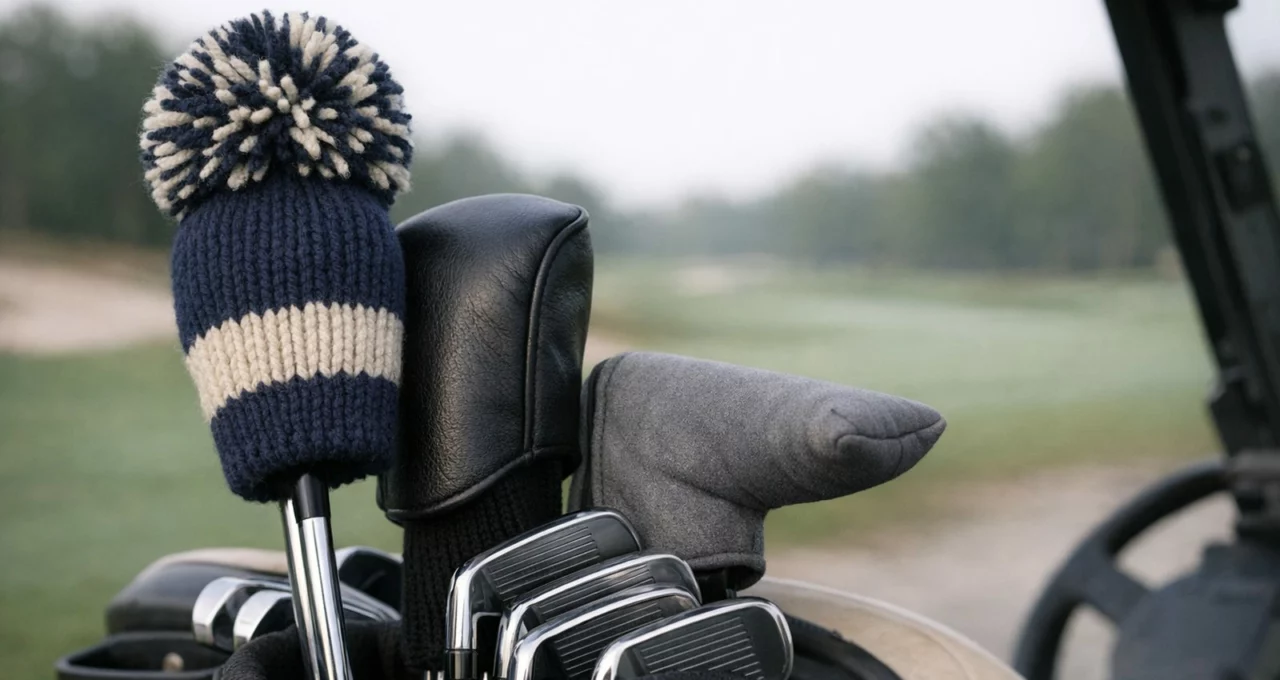
- Knit and wool. The classic pom-pom look. Breathes well and dries quickly in warm weather, but collects burrs, grass seeds and dust, stretches with time, and can snag on the adjustable weights of a modern driver.
Closures matter mainly on putter covers. Hook-and-loop strips, usually called Velcro, hold firmly when new, but dust and lint clog them, and the ripping noise on a quiet green bothers some golfers. Magnetic closures are quieter and quicker but only as good as the magnet. Driver and wood covers usually rely on a snug fit rather than any closure at all.
Callaway 2026 AM Premium Driver Headcover
Callaway’s AM Premium range is a vintage-styled set of covers sold in two-tone colourways. The driver cover comes in black with white and in white with black, and matching covers exist for fairway woods and hybrids.
- What the maker publishes, as shown on an Australian listing: premium PU construction; vintage styling; all colours offered in driver, fairway and hybrid versions. Lining, closure, dimensions, the head sizes it fits and weight: not published on the listing read.
- Price: read in November 2026 at an Australian golf retailer: A$39.95 for both colourways, shown in stock.
- Who it suits: a golfer who wants a brand cover in PU at a modest price, and who likes being able to match the driver, woods and hybrid.
The listing is short, so the useful questions are the ones it leaves open: how long the sock is, whether it fits a 460cc head with weights at the back, and how the PU holds up in the sun. The white-based colourway is the one likely to show fading least, though it will show dust and grass stains more.
GolfCraft Australia Mallet Putter Headcover, Green/Gold
GolfCraft is a value brand widely sold in Australia, and its “Australia” covers come in green and gold, with blade and mallet putter versions plus a driver cover. The mallet putter version is the one presented here.
- What the maker publishes, as shown on an Australian listing: high quality embroidered design; durable water-resistant PU leather; Velcro closure to keep the cover secured on the putter. Lining, dimensions, the mallet shapes it fits and weight: not published on the listing read.
- Price: read in November 2026 at an Australian golf retailer: A$34.95, shown in stock. The blade version was listed at the same price.
- Who it suits: a golfer with a standard-sized mallet who wants a sturdy, water-resistant cover with a firm closure, and a bit of national colour in the bag.
Two things are worth checking in the shop. First, the fit on your own putter, because mallets vary a lot in size and shape and the listing does not say which ones it fits. Second, the Velcro: open and close it a few times and look at how much hook surface there is, since that is the part that wears and clogs with dust.
GolfCraft Soft Touch Iron Headcovers
For golfers who do cover their irons, GolfCraft also sells a full set, described as soft and durable.
- What the maker publishes, as shown on an Australian listing: a full set of 10 covers for irons 3 to 9, plus pitching, sand and wedge; designed to be soft and durable; helps prevent scratches, dings and wear during transport and play; fits both right and left-handed clubs. Material, closure and weight: not published on the listing read.
- Price: read in November 2026 at an Australian golf retailer: A$49.95 for the set, shown in stock.
- Who it suits: a golfer with forged or polished irons, who rides on a cart most rounds or travels with the clubs, and who will take the covers off to dry after a damp day.
Ten covers is more than most bags need. If your set runs from 5-iron to wedge, the spares are handy for replacing the ones that inevitably go missing.
The three at a glance
| Headcover | For | Material, as published | Closure | Price, November 2026 |
|---|---|---|---|---|
| Callaway 2026 AM Premium Driver Headcover | Driver (fairway and hybrid versions also sold) | Premium PU | Not published | A$39.95 |
| GolfCraft Australia Mallet Putter Headcover, Green/Gold | Mallet putters (fit not published) | Water-resistant PU leather, embroidered | Velcro | A$34.95 |
| GolfCraft Soft Touch Iron Headcovers | Irons 3 to 9, PW, SW and a wedge; right or left-handed | Not published | Not published | A$49.95 (set of 10) |
None of the three listings published a weight, a lining material or any figure for UV resistance. That is normal for headcovers, which are sold on looks, so if sun resistance matters to you, ask and look closely at the material yourself.
What golfers are saying
The points below were gathered from owner reviews on retail sites, golf forum threads and golf media articles about headcovers in general. They describe what keeps coming up about covers of these kinds, not a verdict on the three models above.
What they like
- A crown that stays clean. Golfers who have chipped the paint on an uncovered driver are the keenest on covers, and many say they would never carry a driver or wood without one again.
- PU that wipes clean. Owners like that a PU cover can be wiped down after a dusty or muddy round, where knit soaks up dirt and needs washing.
- Covers that make the bag easy to read. Distinctive covers, from bright colours to novelty designs, make it quick to pull the right club and harder for a playing partner to walk off with yours.
What they complain about
- Fading and cracking in the sun. Owners describe dark covers turning dull or patchy and synthetic leather cracking at the folds after a few years outdoors, with some reviving real leather with a cleaner or conditioner only to see it fade again in the sun.
- Putter covers that come off. Worn Velcro or a weak magnet lets the cover drop off on the cart or the walk to the next tee, and it is often not missed until the end of the round.
- Covers left behind. Fairway and hybrid covers placed on the grass at a tee are some of the most often lost items on a course, which is why golfers suggest bright colours or pocketing the cover instead.
- Fit that is wrong out of the box. Large mallets that do not fit a “mallet” cover, tight new covers on big drivers, and knit covers catching on driver weights all come up regularly.
No one is named, nothing has been counted, and none of these impressions is a measurement. They are the themes that come back again and again in public reviews and forums.
One rules note while we are here: a headcover is not a club, so it does not count towards the 14-club limit in Rule 4.1b, and nothing in the Rules of Golf, as administered here by Golf Australia, restricts which headcovers you use.
Where to buy headcovers in Australia, and how to keep them out of the sun
Headcovers are easy to find here, and the right place depends on whether you want a match for your clubs, a bit of fun or a cheap replacement.
- Your club’s pro shop. Often has logo covers, putter covers and the odd leather cover. Bring the club in and check the fit before you pay, and ask whether the covers are made for a hot climate.
- Golf specialty stores. The widest range in one place: brand covers, value covers, novelty animal and green and gold designs, and iron cover sets. Try the cover on your own driver or putter, especially a large mallet or a driver with movable weights.
- Online golf retailers and brand websites. Good for matching covers to current models, comparing prices and finding a replacement for a lost original. Check the return policy, as a cover that does not fit is the most common reason to send one back.
- Second-hand. Used headcovers turn up in pre-owned club sections and on marketplace sites. Check the seams, the lining and the closure, and on PU covers look closely at the folds for early cracking from sun exposure.
Whatever you buy, ask what the outer material is, what the lining is, which head sizes it fits, and whether it can be washed. If the only answer to the material question is “premium,” keep asking.
Then look after it, because in Australia the care matters more than the price:
- Get the clubs out of the car. Store the bag inside, in a laundry, a cupboard or a garage that does not cook in summer, rather than in the boot between rounds.
- Keep the bag in the shade on the course. Park the buggy or cart under a tree while you wait on a tee, and turn the bag so the covers are not facing straight into the afternoon sun.
- Shake out the dust. After a dry, dusty round, tip the covers upside down and give them a shake, and brush out the linings now and then.
- Dry before you cover. After a storm, a dewy morning or a wet bunker, wipe the head dry before the cover goes back on, and at home take the covers off and let both dry apart.
- Treat the leather. If you have genuine leather covers, an occasional leather conditioner helps stop them drying out and cracking in the heat.
Before you buy
- Driver first. If you only buy one cover, put it on the driver, with a sock long enough to reach down over the top of the shaft.
- Pick a colour for the sun. Black PU shows fading first. A white, light or two-tone cover hides it better and is easier to spot on the grass.
- Fit the putter cover to the head. Blade covers do not fit mallets, and not every mallet cover fits every mallet. Try it on and give the club a gentle shake to test the closure.
- Be honest about iron covers. Worth it for forged or polished irons, regular cart rounds and travel. Not essential for a cast set in a bag with full-length dividers.
- Plan for the heat. Expect a cheap PU cover left in the sun and the boot to show its age quickly, and budget to replace it, or store the bag out of the heat and make it last.
A headcover is cheap protection for the clubs that mark most easily, the driver, the woods and the putter. In Australia it also has to survive conditions that most headcovers were never designed for. Choose one that fits, pick a material and colour that can handle the sun, keep the bag out of a hot boot, and do not leave the cover on the 7th tee when you walk the next 350 metres to your ball.
How this page was put together
This is a neutral presentation of products and a reading of public opinion, not a test. Nobody at Panxis Golf fitted, carried or handled any of these headcovers for this page. Features come from the descriptions published by the makers, Callaway for the 2026 AM Premium Driver Headcover and GolfCraft for the Australia Mallet Putter Headcover and the Soft Touch Iron Headcovers, as shown on Australian product listings. Where a figure or material is not given, such as the lining and closure of the Callaway cover, the material of the GolfCraft iron covers and the weight of all three, this page says “not published” rather than estimating it.
Prices were read on 2 November 2026, in Australian dollars, at Drummond Golf (drummondgolf.com.au), where all three headcovers were shown in stock that day. Prices change with promotions, colours and stock, so the price at the counter is the one that counts.
What golfers say was read in owner reviews on golf retail websites, in golf forum threads including the Team Titleist forum and The Sand Trap, and in golf media articles about headcovers such as Golf Monthly, some only through search excerpts. Nobody is quoted by name, nothing is counted, and no impression is presented as a statistic. The rule cited is Rule 4.1b of the Rules of Golf as administered in Australia by Golf Australia. There is no commercial link on this page, no affiliate arrangement and no commission of any kind. If content on this site is ever paid for by a brand, it will carry an advertising notice at the top of the page, before the first line.