Hard case or soft golf travel cover: 23 kg, and what Qantas, Virgin and Jetstar publish
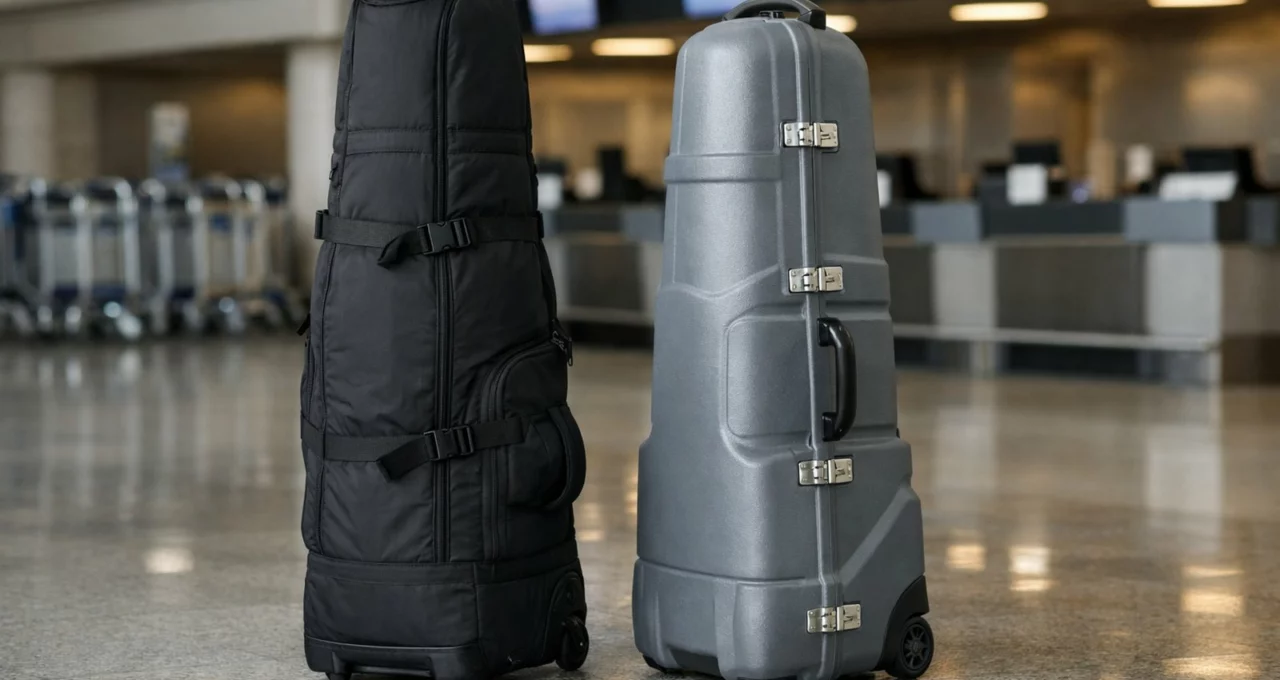
For an Australian golfer the first question is not hard or soft, it is 23 kilos: the usual checked piece on a domestic economy fare, and the cover has to fit inside it with the clubs. Here is one hard case and one soft wheeled cover on sale locally, at prices read on 11 November 2026, with what golfers say about each type.
In brief
- The two examples: the Samsonite Hardside Golf Club Carrier (6.3 kg, A$299.99) and the Sun Mountain ClubGlider Meridian soft cover with fold-out legs (5.1 kg, A$439.96), prices read on 11 November 2026.
- Only 1.2 kg separates them: under a 23 kg piece, the hard case leaves 16.7 kg for the golf bag and its contents, the soft cover 17.9 kg.
- None of the Qantas, Virgin Australia, Jetstar or Air New Zealand pages we read asks for a hard case or a waiver for a soft cover; they set weight, size and claim deadlines, and Jetstar treats anything over one metre as oversized.
- Whichever you choose, put a support rod beside the driver, pad the heads, weigh the packed cover at home and photograph the clubs before you zip it up.
Between now and the end of January, a lot of Australian golf bags will ride a baggage belt: down to Launceston for the Tasmanian links, into Melbourne for a Sandbelt week, up to the Sunshine Coast, or across the Tasman to Queenstown. Whether the clubs come off the other end in one piece depends partly on what they travel in. The choice is usually framed as hard case against soft travel cover, but for an Australian golfer the first question is simpler and comes with a number attached: 23 kilos. That is the usual size of one checked piece on a domestic economy fare, and the cover has to fit inside it along with the clubs. This page sets out one hard case and one soft wheeled cover that are both on sale here, with the makers’ figures, prices in Australian dollars read on 11 November 2026, what golfers say about each type, and what Qantas, Virgin Australia, Jetstar and Air New Zealand publish about golf bags. Nobody at Panxis Golf has packed or flown with either one.
Do the sums in kilos before you look at a single cover
Stand on the bathroom scales holding your loaded golf bag, then subtract your own weight. A cart bag with fourteen clubs, a dozen balls, shoes and a rain jacket commonly lands somewhere in the mid-teens. Now add the cover. If the total passes the limit on your ticket, you pay an overweight charge or you start pulling things out on the terminal floor.
Australian golf shops call the whole category a travel cover, and most of what they stock is soft: a padded nylon bag with two wheels at one end. Fully rigid cases are thin on the ground here. The moulded American case that appears in most overseas buying guides, the SKB, could not be found at an Australian golf retailer with a price in our dollars on 11 November 2026, so it is left out of this page. The hard case below is one you can actually buy locally.
The surprise is how close the two examples are on weight. The hard case is listed at 6.3 kg and the soft wheeled cover at 5.1 kg, a gap of 1.2 kg. Under a 23 kg piece, that leaves 16.7 kg for the golf bag and everything in it with the hard case, and 17.9 kg with the soft one. On paper, the old line that a hard case costs you half your allowance does not hold for these two.
The soft cover: Sun Mountain ClubGlider Meridian
Sun Mountain’s ClubGlider is the best-known wheeled cover in golf, and the Meridian is its mainstream model. What sets it apart is underneath: two legs with small wheels swing out of a moulded tray, so the loaded bag sits level on four wheels and you push or pull it with one hand without carrying any of the weight. Fold the legs back into the tray and it goes onto the belt like any other cover.
- Weight: 5.12 kg according to Sun Mountain, shown as 5.1 kg on an Australian listing.
- Body: nylon with reinforcement in the high-wear areas and dense foam padding through the top, where the clubheads sit.
- Access: two-way zips that run the full length of the bag, and two outside pockets.
- Inside: cinch straps to hold the golf bag still, according to published reviews.
On 11 November 2026 an Australian golf retailer listed the ClubGlider Meridian at A$439.96, marked down from A$549.95, and a second Australian retailer had it at A$439.99. That makes it one of the dearer soft covers on the local shelves, where plain two-wheel covers start at well under half that.
The hard case: Samsonite Hardside Golf Club Carrier
The hard option on sale in Australia this week comes from a luggage maker, not a golf brand. Samsonite’s Hardside Golf Club Carrier is a polycarbonate shell, the same plastic used in hard suitcases, on inline skate wheels.
- Size: 1.34 metres tall, 37 cm wide and 39 cm deep on the outside, according to the Australian listing.
- Weight: 6.3 kg empty, on the same listing.
- Shell: polycarbonate.
- Handles and wheels: retractable top and side carry handles, inline skate wheels.
- Lock: an integrated TSA-approved lock, the type security staff can open without breaking it.
- Inside: internal organisation for clubs, shoes and other items, in the maker’s words.
On 11 November 2026 an Australian warehouse retailer listed it at A$299.99, delivery included.
Two things the listing does not say are worth asking before you pay: the longest driver the case will take, and the length and terms of the warranty. Overseas listings for the same model mention zip pullers, which suggests the shell closes with a zip and not with the metal latches of a moulded flight case. If that matters to you, check it in person.
So the hard case is the cheaper of the two here, by about A$140. Hardness is not what you pay for in this category. Wheels, legs, fabric and the brand on the side move the price more than the shell does.
What golfers are saying
These are themes that come up repeatedly in published reviews and on golf and frequent flyer forums, including Australian ones. They are impressions, not measurements. Public opinion on the Samsonite carrier itself is thin: we found almost no written reviews of this exact model, so the hard case comments below are mostly about the type.
In favour of a soft wheeled cover. The ClubGlider’s legs get the most praise. Reviewers describe steering it through a terminal with a fingertip and leaving it standing on its own in the bag-drop queue. They report room for a fourteen-way cart bag plus shoes and clothes, thick padding over the heads, and clubs that arrived as they were packed. Australian forum posters make a broader point for soft covers in general: they are light, and a light cover leaves more of a 23 kg piece for the gear.
Against it. Price comes up first with the ClubGlider. Some reviewers find it bulky, the legs take a few goes to fold and unfold cleanly, and one wanted a tougher underside because the base picks up dirt. For soft covers as a type, the complaint is the obvious one: a bag dropped on its top puts the load through the driver. Australian posters describe snapped driver shafts and a head broken off in transit, and shoes or a box of balls going missing from an outside pocket.
In favour of a hard case. Golfers who have had a club broken once are the ones who swear by a shell. They also argue that a rigid case puts the airline in a weaker position if something does break, since nobody can say the clubs were badly packed. A lockable shell answers the outside pocket problem too.
Against it. Bulk. A hard case does not fold, so it needs a spot in the garage for the fifty weeks it is not flying, and it has to fit in the hire car at the other end. Posters also point out that shells are not indestructible: more than one tells of a hard case that came off the belt wrecked. Reviews of Samsonite’s older golf cases mention that a loaded case feels heavy to haul and that a broken wheel is hard to replace.
One Australian detail runs through the forum threads. When an airline does pay for a damaged club, posters say the amount is worked out on the depreciated value, not the price of a new one. A five-year-old driver may be worth far less on a claim form than it is to you.
What Qantas, Virgin Australia, Jetstar and Air New Zealand publish
In the United States, some airlines tie their responsibility for golf clubs to a hard case and ask for a signed waiver with a soft one. We found nothing like that in what the four carriers below publish for Australian travellers. None of the pages and extracts we read in November 2026 asks for a hard case or mentions a waiver for a soft cover. What they do set out is weight, size and deadlines.
- Qantas. Its sporting equipment page says golf bags and collapsible buggies travel as checked baggage and are exempt from the normal size limits on flights Qantas operates. Each item is one piece, it comes out of the allowance on your fare, and no piece may weigh more than 32 kg. The baggage services page adds that packing oversized items such as sporting equipment is your job, and that Qantas is not liable for damage to baggage that is unsuitably packed. Damage has to be reported within three days of a purely domestic trip and seven days of an international one, with photos that show the bag tag still attached.
- Virgin Australia. Golf clubs are on its sports equipment list and count as one piece. Choice and Flex fares include a 23 kg piece, anything over 23 kg attracts an overweight fee, and nothing over 32 kg is accepted. Its conditions of carriage, in the version dated 14 October 2025, appear to list sports equipment among the delicate items for which liability is excluded unless the airline has agreed otherwise in writing, and give seven days to claim for damage in writing. Read that clause yourself before you rely on the airline for an expensive set.
- Jetstar. Anything with a side longer than one metre is an oversized item, wheels and handles included. Both covers on this page are well over that, so a handling fee applies per item, on top of the checked baggage you buy, and it is cheaper paid in advance than at the airport. The weight of the clubs counts against your purchased allowance, no single item may exceed 32 kg, and Jetstar asks that clubs, balls, shoes and umbrella be securely packed in a closed golf bag. Starter fares include no checked baggage at all.
- Air New Zealand. Across the Tasman, a golf bag containing clubs and one pair of shoes counts as a standard bag if it is under two metres long and weighs up to 23 kg. The maximum is 32 kg, with a charge above 23.
Behind the airline pages sits the law. On Australian domestic flights, a carrier’s liability for checked baggage has been capped at A$3,000 per passenger since October 2019. On international flights the Montreal Convention sets the cap in Special Drawing Rights, an international unit, and the figure published by the federal transport department is 1,519 since December 2024. A fitted set with a current driver can be worth more than either cap, which is why home contents cover for sports equipment away from home, or travel insurance that names golf clubs, deserves a phone call before a big trip.
Match the cover to the trip you actually take
Jets between capitals, a few times a year. Either type works under a 23 kg piece. If you fly Jetstar, both attract the oversized fee, so the cover does not change the bill.
Small planes to the islands. Regional aircraft have far tighter allowances than jets, and our guide to flying with golf clubs in Australia works through the King Island numbers. Here every kilo is contested, and a 5 kg or 6 kg cover of either kind is a heavy passenger. A plain padded cover and a half set may be the honest answer.
The hire car at the other end. Two hard cases, two suitcases and two golfers will test the boot of a small hatchback at Hobart or Coolangatta. A soft cover gives a little around a wheel arch. A shell 1.34 metres long does not.
Storage at home. In a unit with no garage, a rigid case is a piece of furniture. A soft cover lives on top of a wardrobe.
What is in the bag. If the driver alone would cost A$900 to replace and you fly with it four times a year, the argument for a shell, or at least for removing the head, gets stronger.
Either way, look after the top of the bag
Breakages happen at the head end, when a bag is stood on its nose or dropped from the belt. A support rod, an adjustable pole set a few centimetres taller than the driver, takes that hit in a soft cover and stops the clubs sliding up inside a hard one. Take the head off an adjustable driver with its wrench and carry it in your cabin bag. Leave the headcovers on, wrap a towel around the woods and pack clothes around the irons until nothing moves.
It is summer, so two more things. Dry the bag and the cover before you zip them up after a humid round or a storm, or you will open a mouldy cover in March. And if you are heading north, our summer packing list for Queensland, the Top End and Fiji covers what goes in around the clubs.
Where to buy a golf travel cover in Australia
- Golf chain stores carry the widest range of soft covers and usually have several on the floor. Take your own golf bag in and ask to zip it into the cover. A cart bag with a wide top is the thing that does not fit.
- Your club’s pro shop may stock one or two and can order others. The staff see what members’ covers look like after a trip, which is worth more than a brochure.
- Luggage shops and warehouse retailers are where hard cases turn up in Australia, since luggage makers build them. Ask whether you need a membership to buy, and who handles a warranty claim.
- Online has the most choice. Check the cost of sending back a box 1.3 metres long before you order, and whether change-of-mind returns are accepted at all.
- Second-hand, through online classifieds or a club noticeboard, suits covers that were bought for one trip. Check the wheels, the zips, the base and any hinges, and ask whether the warranty transfers.
Whoever sells it, ask three things: the empty weight in kilos, the longest driver it takes, and whether a support rod comes with it.
Before you check in
- Read the golf section of your airline’s baggage page for the fare you bought, and screenshot it.
- Weigh the packed cover at home: under 23 kg for a standard piece, never over 32 kg.
- On Jetstar, pay the oversized item fee online in advance.
- Support rod in, driver head off, heads padded, nothing loose in outside pockets.
- Photograph the clubs, the packed bag and the outside of the cover.
- Name and mobile number inside the cover as well as on the tag.
- Open the cover at the carousel, report any damage before you leave the terminal, and keep the bag tag on for the photos.
How this page was put together
This is a neutral presentation of two products, not a review. No cover was packed, checked in or flown by us, and no club was hit. The Sun Mountain figures are the maker’s, as published by Sun Mountain and reproduced on Australian listings. The Samsonite figures are those shown on the Australian listing we read; where it gives no figure, for driver length or warranty, none is given here.
Prices were read on 11 November 2026, in Australian dollars: the Sun Mountain ClubGlider Meridian at House of Golf (A$439.96, previously A$549.95) and at Golf Box (A$439.99, previously A$549.99), and the Samsonite Hardside Golf Club Carrier at Costco Australia (A$299.99, delivery included). Drummond Golf, our usual reference, listed neither product that day. No Australian price could be found for the SKB hard case, so it is not presented. Prices move, and the one at the counter is the one that counts.
Airline rules come from the baggage pages of Qantas, Virgin Australia, Jetstar and Air New Zealand and from Virgin Australia’s conditions of carriage, consulted in November 2026, several of them through search engine extracts because the airline sites would not load for our tools. Jetstar’s oversized fee is left without an amount because the sources we read disagreed. The domestic liability cap comes from a published legal summary of the Civil Aviation (Carriers’ Liability) Regulations 2019. Rules change, and the airline’s own page on the day you fly is the only reference that counts.
What golfers say was read in published reviews (National Club Golfer, GolfMagic, GolfWRX, Critical Golf, Golf Monthly), in Australian Golf Digest’s travel coverage, and in threads on the Australian Frequent Flyer and Team Titleist forums, some through search extracts. Nobody is quoted by name and nothing is counted. Panxis Golf has no commercial link with any brand, airline or retailer named here and earns no commission. If content on this site is ever paid for by a brand, it will carry an advertising notice at the top of the page, before the first line.