Used irons in Australia: spring trade-in prices, your consumer rights and the checks to make first
October is a good month to pick up used irons and an easy one to pick up the wrong set. A lie angle cut for someone else, a reshafted club or hard grips will cost you more than the discount. Here is how to spot them, and what a shop or private seller owes you.
In brief
- Used Ping G425 sets were listed at A$1,029 to A$1,199 by an Australian used-club retailer in September 2026, graded 7.5 out of 10.
- Ping's dot tells you the lie angle: black is standard, gold is 4 degrees flat and maroon 5 degrees upright. Ask for it before you pay.
- Check matching shafts and ferrules, even half-inch length steps, worn grooves on the scoring clubs, and how the pitching wedge meets your wedges.
- A business selling second-hand clubs still owes you the consumer guarantees; a one-off private sale carries almost none of them.
Spring is trade-in season in Australia. Fairways are drying out, daylight saving arrives this weekend, and plenty of golfers decide the new competition year deserves new irons. The sets they hand over end up on the racks and websites of second-hand sellers, which makes October a good month to buy. It is also a good month to buy badly. A used set can look spotless in six photos and still carry a lie angle cut for a much taller player, a reshafted eight-iron, a pitching wedge that has quietly bent a degree and grips that went hard two summers ago. You only find out on the course, a few rounds into the season, when the ball keeps finishing left of the flag.
This guide walks through those checks using one set as the running example: Ping’s G425 irons, which turn up everywhere on the Australian used market and which carry a coloured dot that tells you how each head was built. The specifications come from Ping, the prices were read at an Australian retailer in September 2026, and no one at Panxis Golf has swung these clubs. Read it as a buying guide, not a review.
The G425 on paper: what Ping publishes
Ping released the G425 family in 2020 as its game-improvement line. It has since been replaced twice, most recently by the G440, which is exactly why so many G425 sets are changing hands: their first owners are moving on, and the irons are still young enough to have plenty of golf left in them. From Ping’s own specifications:
- The 7-iron. 30 degrees of loft, a standard lie of 62 degrees and a standard length of 37 inches in steel.
- The finish. Hydropearl 2.0, a chrome treatment Ping describes as repelling water so the club behaves more consistently on a dewy morning or a wet afternoon.
- The colour code. A small painted dot on each head records the lie angle the club was built to. Ping uses ten colours: gold (4 degrees flat), brown (3 flat), orange (2 flat), red (1 flat), black (standard), blue (1 upright), green (2 upright), white (3 upright), silver (4 upright) and maroon (5 upright).
- Custom builds. Each set left the factory to order, with the buyer’s choice of steel or graphite shaft, flex, length and grip. Two sets sold under the same name can therefore be quite different clubs.
What a used G425 set costs in Australia right now
The prices below were read in September 2026 at an Australian retailer that specialises in used clubs. It listed three right-handed G425 sets, each graded 7.5 on its ten-point condition scale:
| Set make-up | Shaft and flex | Price |
|---|---|---|
| 5-iron to PW (6 clubs) | Steel, stiff | A$1,029 |
| 7-iron to PW, plus UW and SW (6 clubs) | Graphite, stiff | A$1,049 |
| 4-iron to PW, plus UW and SW (9 clubs) | Graphite, regular | A$1,199 |
Two things stand out. First, the nine-club set costs only A$170 more than the six-club sets, so per club it is by far the cheapest, provided you would actually use a 4-iron and a sand wedge from the same family. Second, none of the three written descriptions stated the colour of the lie dot. That is not unusual, and it is the first question to put to any seller, because it changes the value of the set more than a cosmetic scratch ever will.
Check 1: whose lie angle are you buying?
The lie angle is the angle between the shaft and the ground when the sole rests flat. Get it wrong and the face points off line at impact even when your swing is fine. Too upright and the toe sits up, the heel catches the turf and the ball starts left for a right-hander. Too flat and it starts right. A couple of degrees does not look like much at address. Over a 140-metre approach it is the difference between the middle of the green and the bunker beside it.
This is where Ping makes life easy. Black means standard. Blue and green were built for a slightly taller player; white, silver and maroon for someone well above average height or with short arms. Gold, brown and orange go the other way. If you are around average height and the set you like wears silver dots, the price needs to cover a trip to a club builder. Most cast heads such as the G425 can be bent a degree or two either way for a modest per-club charge, but bending has limits, and a head that has been bent repeatedly is best avoided.
If you do not know your own numbers, a short fitting session or a wrist-to-floor measurement at a pro shop will tell you roughly which colour to look for before you start browsing.
Check 2: shafts, lengths and ferrules
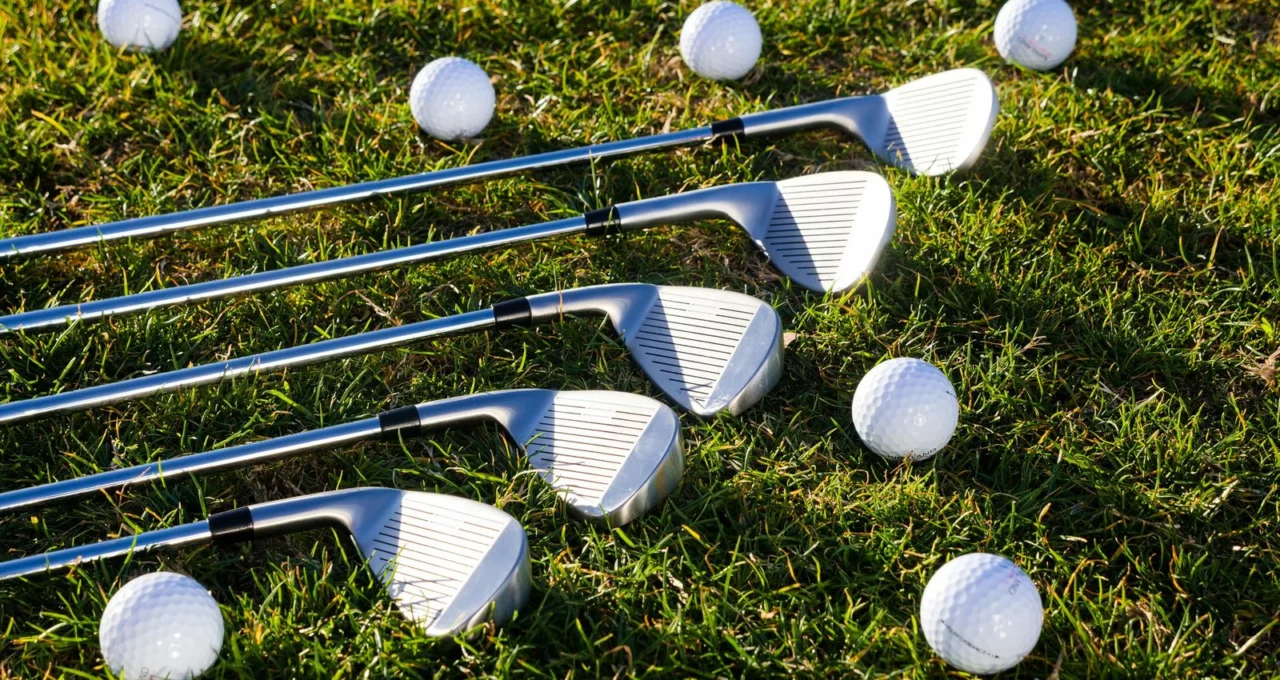
Sets get broken up and patched together. A snapped 6-iron is replaced with whatever was on hand, or a stray club from another set ends up in the bag. Lay the irons out side by side and look for four things:
- Labels. Every shaft should carry the same model, flex and band. A single odd one out is a replacement.
- Lengths. They should step down evenly, normally half an inch per club. One that breaks the pattern has probably been reshafted.
- Ferrules. The small plastic collars where shaft meets head should match in colour and height. A gap, a different shade or a smear of epoxy says the head has been off.
- Flex. A stiff steel set suits a quick swing; if your 7-iron carries around 120 metres, a regular or graphite build will probably serve you better, and the steel set is no bargain for you however good the price.
A reshafted club is not a deal-breaker on its own. It is a reason to ask who did the work and to negotiate.
Check 3: faces, grooves and the chrome
Tilt each face under good light. A shiny, worn oval in the centre where the grooves have lost their crisp edges tells you the club has hit a lot of balls. On a forgiving iron like the G425 that matters little in the 5-iron and a lot more in the pitching wedge, UW and SW, where spin from the rough and from wet grass is what stops the ball.
Scuffs on the sole and a few chips in the chrome are normal wear and should simply come off the price. Rust inside the grooves, pitting across the face or a dent in the top line are another matter. They point to clubs stored damp in a car boot or pounded off hard range mats for years.
Check 4: have the lofts drifted?
Iron lofts can move over time, especially on sets that have been played off mats or have clipped tree roots. A 7-iron that has crept a degree weaker and an 8-iron that has crept a degree stronger will fly almost the same distance, and you will notice the hole in your distance chart on every par 3. Build a loft and lie check into the budget from the start. It costs little next to the set and it resets everything to a known starting point.
Check 5: how the set meets your wedges
Like most modern game-improvement irons, the G425 has strong lofts, so its pitching wedge is several degrees stronger than one from a set bought fifteen years ago. That leaves a wide space between PW and a typical sand wedge. Ping sells a UW (its name for a gap wedge) for exactly this reason, which is why the two sets above that include UW and SW are worth a closer look. Before you buy, write the lofts of the set and of your current wedges on one line and look for any gap much bigger than the others. Our guide to choosing your wedges covers how to fill it. And be honest about the long end: if a 4-iron has not left your bag in years, a hybrid may earn its place more readily.
Check 6: fakes, serial numbers and tired grips
Counterfeit clubs mostly surface in anonymous online listings with prices that look too good. Each genuine G425 head should carry a cleanly engraved serial number on the hosel, paint fill and fonts that match Ping’s own images, and shafts and grips you can identify. A seller who will not send a close-up of the hosel is answering your question for you.
Then feel the grips. Australian summers are hard on rubber left in hot cars, and a set with slick, shiny grips will need new ones before the club championship, not after it. A full set of grips fitted is a real cost, so add it to the price when comparing listings.
What golfers are saying about buying a used G425 set
On golf forums, club-building groups and in public customer reviews, the same themes keep coming up.
The praise
- Forgiveness at a lower price. Players who moved from new to used G425 irons often say they gave up nothing noticeable on mishits compared with newer models, and paid far less.
- The dot system. Buyers appreciate being able to read the lie angle from a photo, which removes much of the guesswork from buying online.
- A finish that lasts. Owners report the chrome and the cavity badge standing up well, so a set that has been looked after still looks tidy several seasons on.
The complaints
- Built for somebody else. The complaint heard most often is a lie or length mismatch discovered after the purchase and fixed at extra cost.
- Condition grades that mean different things. A set one seller calls “very good” another would call “fair”, and listing photos rarely show the faces clearly enough.
- A crowded bottom end. Golfers coming from older irons find the pitching wedge flies further than they expect and end up buying another wedge.
- Bulky at address. Some lower-handicap players find the thick top line and offset hard to look down on, which matters if you hope to keep the set as your game improves.
Where to find a used set in Australia, and what to ask
There are four main routes, and each comes with different protection.
Specialist used-club retailers photograph the actual set and grade it on a published scale. Read that scale before you trust a number like 7.5, and check whether a return means a refund or only store credit.
Big golf retailers with trade-in programs resell what customers bring in. The advantage is that you can hold the clubs, inspect the faces and often book a loft and lie check in the same visit.
Your club’s pro shop sometimes sells members’ sets on consignment. The history is known, and the professional can watch a few swings and tell you whether the lie and shaft suit you. With the new season starting, it is worth asking before your first round that counts towards your Golf Australia handicap.
Online classifieds and private sales offer the lowest prices and the least protection. Ask for photos of every face, sole, hosel and grip, the serial numbers and the original build specifications, and pay in a way that protects the buyer.
The law is worth knowing too. Under the Australian Consumer Law, a business selling second-hand goods still gives you the consumer guarantees, adjusted for the age and condition of the item. According to the ACCC, most of those guarantees do not apply to a one-off sale between two people where the seller is not running a business; only title, undisturbed possession and freedom from hidden debts do. And no seller is obliged to take back a set that is simply the wrong fit for you, unless its own returns policy says so.
So wherever you buy, ask three questions: can I return the set if the lie or shaft does not suit me, what exactly does your condition grade mean, and who pays for a loft and lie adjustment?
Before you hand over the money
- Know your lie angle, or at least your height and wrist-to-floor measurement, and the dot colour that goes with it.
- Ask the seller for the dot colour or original build sheet, and walk away from a set more than two degrees from what you need.
- Line up the clubs: matching shaft labels, bands and ferrules, and even half-inch steps in length.
- Inspect faces and grooves in good light, starting with PW, UW and SW.
- Budget for a loft and lie check and, if the grips are hard or shiny, a new set of grips.
- Write down the lofts and plan how the set joins your wedges.
- Buy from a seller whose returns policy covers a set that does not fit.
Get through that list and a used set becomes what it should be: good irons for a fraction of the new price, ready for a long Australian summer. Skip it and you may spend the season blaming your swing for a fault that was built into the clubs.
How this page was put together
This is a buying guide and a reading of public opinion, not a test. No one at Panxis Golf has hit these irons. The 7-iron loft, lie and length of the Ping G425, the Hydropearl 2.0 finish and the custom build options come from Ping’s published specifications, and the ten lie colours come from Ping’s colour code chart. The three set prices (A$1,029, A$1,049 and A$1,199) were read in September 2026 on the website of Recreation Station Golf, an Australian retailer of used golf clubs. The consumer law points come from the ACCC’s published guidance on consumer rights and guarantees. What golfers say was drawn from golf forums, club-building communities and public customer reviews; nobody is quoted by name, nothing was counted, and no impression is presented as a statistic.
There is no commercial link on this page, no affiliate arrangement and no commission of any kind. If any content on this site is ever paid for by a brand, it will carry an advertising notice at the top of the page, before the first line.