Used irons in Canada: shop over the winter, ask about returns, and spot six traps before spring
Winter is when Canadian golfers shop for used irons, and when a bad set is hardest to spot. Using the Ping G425 as a worked example, here is how to read the build history on the head, what a set costs, and the six traps to catch in the listing rather than on the first tee in May.
In brief
- In September 2026, two used Ping G425 sets were listed in Canada at C$999.99 and C$1,009.99 before tax, against C$1,249.00 for the same steel set new.
- Ping's colour dot records the lie angle each club was built to, from gold (4 degrees flat) to maroon (5 degrees upright); black is standard.
- Check that shafts, flexes, ferrules and lengths match, look for rust from winter storage, and plan the gap between the pitching wedge and your wedges.
- A store generally does not have to take back a set you changed your mind about, so read the return policy and ask whether you get a refund or a credit.
The clubs go into the basement in late October, the snow arrives, and by January half the golfers in the country are scrolling through used iron sets. It is a sensible time to shop: nobody needs a seven-iron in February, sellers clear space before the spring models land, and you have months to get a set checked. It is also when a bad set is hardest to spot. You cannot hit it on a range, the photos were taken on a kitchen table, and the problems that spoil a season only show up in May. This guide walks through them one by one, so you catch them in the listing instead of on the course.
One set as a worked example: the Ping G425
The whole guide follows a model that turns up constantly on the Canadian second-hand market. Ping launched the G425 iron in its 2020 range, and two generations have followed, with the G440 now current. That age is the point: plenty of first owners have moved on, and Ping stamps a piece of build history on every head, which makes the G425 good practice for reading any used set. Ping publishes the following:
- The seven-iron. 30 degrees of loft, a standard lie of 62 degrees and a standard steel length of 37 inches.
- The finish. Hydropearl 2.0, a chrome treatment designed to shed water so contact stays predictable on wet grass.
- The colour code. A dot on each club records the lie angle it was built to. Gold is 4 degrees flat, brown 3 flat, orange 2 flat, red 1 flat, black is standard, then blue 1 degree upright, green 2, white 3, silver 4 and maroon 5 degrees upright.
- Custom builds. Sets were built to order, with steel or graphite shafts, several flexes, adjusted lengths and different grip sizes. The badge stays the same; the club underneath can change a great deal.
What a used G425 set costs in Canada
Prices read in September 2026 at a Canadian used-club retailer: on September 30, its site listed two pre-owned G425 sets, in Canadian dollars before sales tax.
- Four-iron to pitching wedge, stiff Ping AWT 2.0 steel, black dot (standard lie), graded mint: C$1,009.99.
- Five-iron to pitching wedge plus a utility wedge, stiff Ping Alta CB Slate graphite, red dot (about 1 degree flat), graded very good: C$999.99.
The same retailer listed the steel four-iron to pitching wedge set new at C$1,249.00. So the discount on a set this age is smaller than many buyers expect, and the two used sets, ten dollars apart, are very different clubs: one steel and standard, the other graphite, one degree flat and a club longer at the bottom. The price says almost nothing about whether either suits you. The build says everything. Add GST or HST, and PST where your province charges it, before comparing with a private listing.
Trap 1: a lie angle that belongs to somebody else
Lie is the angle the shaft makes with the ground when the sole sits flat. Too upright for you, and the heel catches first and the face turns left; too flat, and the ball starts right. You will not see it in a photo or feel it on a simulator in February. You will see it in June, when every solid seven-iron finishes in the left bunker and you start rebuilding a swing that was fine.
Take the red-dot graphite set above: built one degree flat, it suits a shorter golfer or someone whose hands sit low at address, and would need bending for a player of average height. A white or silver dot pushes the problem the other way. Most cast irons, the G425 included, can be adjusted a degree or two by a club builder, and the work leaves the club perfectly legal for any Golf Canada event. But each bend has a limit, and a set bent back and forth by several owners is one to walk away from. For brands without a colour code, ask for the original build sheet, or count a loft and lie check as part of the price.
Trap 2: shafts, lengths and ferrules that do not match
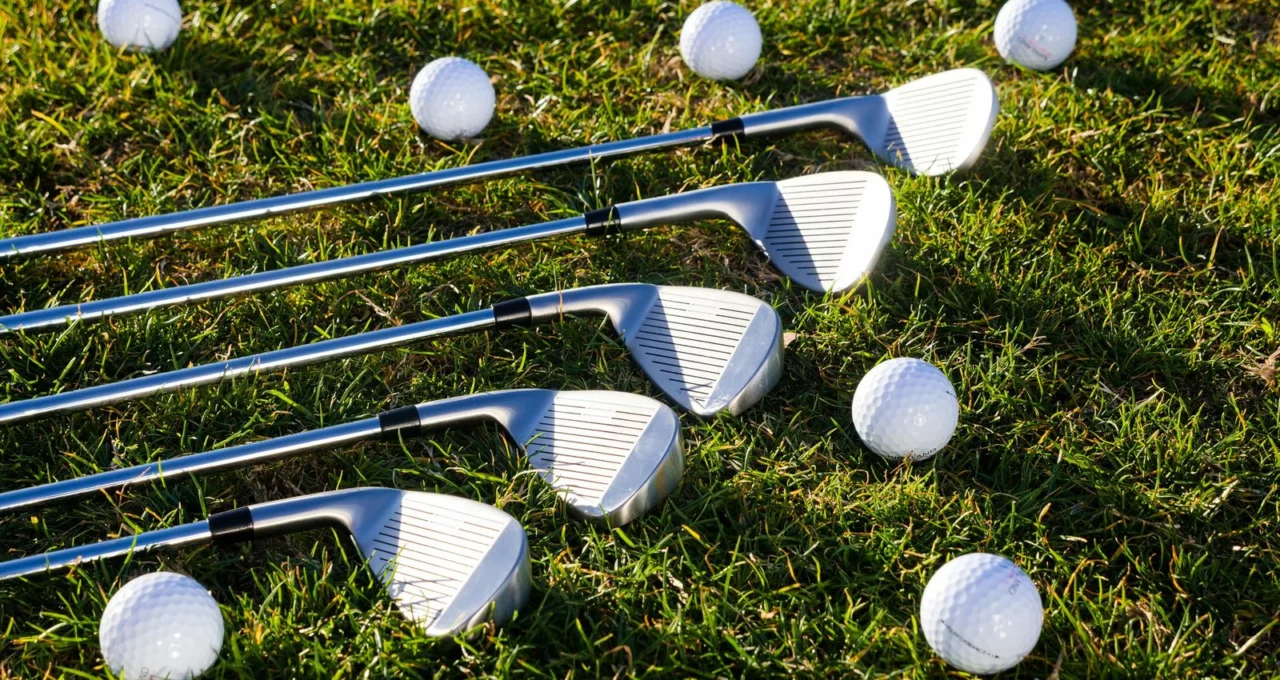
In the used market, clubs go missing: a nine-iron snapped on a cart path, a replacement from another set, a shaft swapped by an owner who wanted something lighter. Lay the clubs side by side, or ask for a photo that does, and check that every shaft carries the same model, flex and label position, and that lengths step down by about half an inch. One club that breaks the pattern has usually been reshafted. The ferrules, the collars where shaft meets head, should be identical too; a different shade, a gap or dried epoxy means the head was pulled at some point. Not a reason to refuse the set, but a reason to ask and to negotiate.
Flex matters as much as matching. Stiff graphite and stiff steel feel nothing alike, and a golfer whose seven-iron carries around 140 yards is usually better served by a softer, lighter shaft than by a stiff steel set that happened to be on sale.
Trap 3: worn faces, tired grooves and winter rust
Tilt each club under a strong light. A glossy patch in the centre of the face and grooves with rounded edges mean heavy use. On a game-improvement iron, worn grooves cost little in the long irons and more in the scoring clubs, where spin decides whether an approach from the first cut holds or runs through.
Canadian storage adds its own wear. A bag that went into an unheated garage with wet towels and damp head covers can come out in April with rust in the grooves and along the sole. Chips on the sole and leading edge are normal and should be priced in. Pitting on the face, rust inside the grooves and dents on the top line do not polish out.
Trap 4: lofts that have moved
Range mats, a root or years of play can shift a club by a degree. That sounds small until the eight-iron flies as far as the seven, leaving two clubs for one yardage and a hole elsewhere. A loft and lie check costs little next to the set, and the off-season is the ideal time: the shop is quiet and the adjusted set is ready for the first round of spring.
Trap 5: the wedge gap at the bottom of the set
The G425 has strong lofts, and its pitching wedge is noticeably stronger than one from the late 2000s. Bolt it onto a bag that still holds an old 56-degree sand wedge and you may find a gap of 25 yards or more between your two shortest full swings. Write down the lofts of the set and of your wedges before buying. The graphite set above came with a utility wedge, which fills part of the gap; the steel set did not. Our guide to choosing your wedges explains how to space the bottom of the bag. At the top, be honest too: if you have not hit a four-iron well in years, a set starting at five plus a hybrid will probably score better.
Trap 6: counterfeits, serial numbers and old grips
Fakes circulate mostly through anonymous online listings with generous-looking prices. Ask for a close photo of the hosel: the serial number should be there and cleanly engraved. Compare paint fill, fonts and badge with Ping’s own images, and make sure shafts and grips carry brands you can identify. A seller who will not send those pictures has answered your question. Then price the grips: rubber hardens with age and cold garages, and slick grips need replacing before the first round. Eight new grips plus installation belong in any offer.
What golfers are saying about used G425 irons
Golf forums, club-building communities and public retailer reviews keep returning to the same themes.
The praise:
- Forgiveness for less. Owners who bought a G425 set second-hand often say it felt close to newer models on mishits, and the saving mattered more than the latest technology.
- A build history printed on the club. Buyers like being able to check the lie from the dot before paying.
- A finish that ages well. The chrome and cavity badge stay tidy after several seasons, so a cared-for set still looks good at resale.
The complaints:
- Clubs that did not fit on arrival. The most common story is a wrong lie or length that meant an extra trip to a club builder.
- Condition grades that mean different things in different places, and photos that rarely show the faces clearly.
- Returns that end as store credit. Some buyers who sent a set back received a gift certificate instead of a refund, and had nothing to play with while waiting for another set.
- A bulky look at address. Better players sometimes find the top line and offset heavier than they like, which matters if you hope to grow into the set.
Where to buy used irons in Canada, and what to ask first
Online used-club specialists grade each set on a published scale, photograph the actual clubs, list shafts and lie, and ship across the country. Read the grading scale, and check whether a return means a refund or a credit note.
Big-box golf stores with a trade-in program take in much of their used stock in spring, when golfers trade old sets toward new ones. You can handle the clubs, inspect the faces and often book a loft and lie check or a hitting bay in the same visit, which counts for a lot while the courses are under snow.
Your club’s pro shop may sell members’ clubs on consignment. The history is known, and the pro can judge the lie and shaft in a few swings, on the range or in the winter simulator.
Classified ads and private sales offer the lowest prices and the fewest safeguards. Meet in person if you can, ask for photos of every face, sole, hosel and grip plus the serial number, and pay in a way that leaves a record.
Know where you stand. In Canada, a store generally does not have to take back something you simply changed your mind about, so the return policy is your protection: read it before paying. Provincial consumer protection laws cover purchases from businesses, online ones included, and misrepresented goods, but the details vary by province, and a sale between two individuals usually falls outside them.
Ask four questions everywhere: can I return the set if it does not fit, for a refund or a credit? What does your condition grade mean? What are the lie, lengths and shafts, club by club? Who pays if it needs bending or new grips?
Your checklist before handing over the money
- Know your own lie angle, or at least your height and wrist-to-floor measurement.
- Read the colour dot or build sheet, and skip any set more than two degrees from what you need.
- Check that shafts, flexes, labels and ferrules match and that lengths step down evenly.
- Inspect faces, grooves and soles in strong light, and look for rust from winter storage.
- List the lofts of the set and of your wedges, and plan how to fill any gap.
- Budget for a loft and lie check and, if needed, eight new grips.
- Read the return policy, and prefer a seller who refunds a set that does not fit.
- Book the adjustment over the winter so the set is ready for spring.
Bought this way, a used set gives you the same golf as a new one for a good deal less. Bought on a nice photo and a low price, it can give you a season of shots that start straight and finish somewhere else.
How this page was put together
This page is a buying guide and a summary of public opinion, not a test. The seven-iron loft, lie and length of the Ping G425, the Hydropearl 2.0 finish and the build options come from Ping and its published specifications; the ten colour codes and their lie angles come from Ping’s colour code chart. The used prices of C$1,009.99 (four-iron to pitching wedge, stiff steel, black dot, mint) and C$999.99 (five-iron to pitching wedge plus utility wedge, stiff graphite, red dot, very good), and the new price of C$1,249.00, were read on September 30, 2026 on GlobalGolf.ca, the Canadian website of GlobalGolf, operated by Worldwide Golf Canada, Ltd. Prices are shown before sales tax and change as stock sells. Golfers’ opinions were read in golf forums, club-building communities and public retailer reviews; nobody is named, nothing is counted, and an impression is never presented as a statistic.
No one on the Canada desk has hit these irons. There is no commercial link on this page, no affiliate arrangement and no commission of any kind. If a piece of content on this site is ever paid for by a brand, it will carry an advertising notice at the top of the page, before the first line.