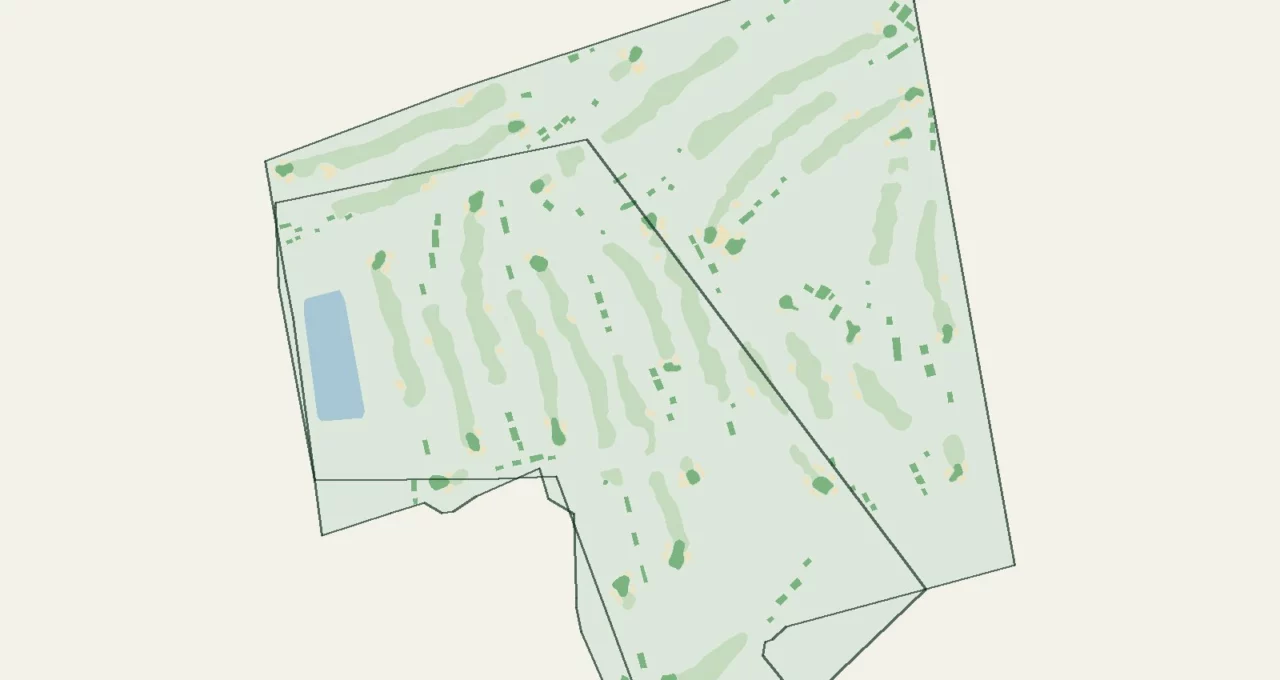
Layout of Oakdale Golf & Country Club from OpenStreetMap survey data (ODbL licence).
Oakdale Golf & Country Club
Holes
27
By
—
Length
—
Green fee
—
Best season
Roughly April to November
Oakdale was founded in 1926 by members of Toronto’s Jewish community, who at the time were not admitted to the city’s existing clubs, and its first eighteen holes were designed by Stanley Thompson in the years that followed. That origin is the essential fact about the place, and the club has never been shy about it.
A third nine was added in 1957 by Robbie Robinson, a disciple of Thompson, giving the twenty-seven holes played today. The club staged the RBC Canadian Open in 2023 and again in 2026, which brought a hundred-year-old private club into public view.
What it asks of you
Parkland in North York, on more than two hundred acres of well-treed, undulating ground that rolls more than the flat suburb around it suggests. Black Creek, a tributary of the Humber, runs through the property and affects eleven of the twenty-seven holes.
The Thompson circuit is relatively short and demands accuracy both off the tee and on the approach. The greens are quick and true, and the mature trees have narrowed the corridors over a century, so a drive that finds the wrong side of a fairway leaves no shot at the flag.
The three nines have distinct characters, which is the practical advantage of twenty-seven holes: the course a member plays on a Tuesday evening is not the one the tour played.
What players say about it
Guests play by member introduction, so the public record comes from guest accounts and tournament coverage. The notes below summarise recurring themes across those public sources. They are other people’s opinions, not ours: we have not played the course, and we do not name or quote individual reviewers.
What comes up in its favour
- Conditioning is described as immaculate, with pristine fairways and fast, true greens, and the Canadian Open visits have raised the standard further.
- The three nines are praised for having genuinely different characters rather than being interchangeable.
- Black Creek is treated as a real asset, giving the property movement and hazard on nearly half the holes.
- The Thompson architecture is admired, and the club’s place in the Canadian top hundred is not disputed.
What comes up against
- The Thompson nines are short by modern championship standards, which is why the tour setup has to stretch them.
- The tree cover has narrowed the corridors well beyond what was drawn, and longer hitters find the driver unusable on several holes.
- Access is closed outside tournament weeks, and the review record is thin as a result.
- The Robinson nine from 1957 is generally rated below the Thompson holes.
Getting there and when to go
The club is in North York, around twenty-five minutes from downtown Toronto and twenty from Pearson.
The season runs from roughly April to November. Late spring and September give the firmest ground. Guest play is arranged through a member.
Green fees
Guest conditions and rates are set by the club and are not published. See the club’s own site.
How this page was made
The factual frame comes from public sources: OpenStreetMap for the location, Wikipedia and published architecture and championship coverage for the history, the Thompson and Robinson work and the Canadian Open visits, and the club’s own site for access. The opinion section summarises public reviews and guest accounts read in September 2026; we report recurring themes rather than individual voices, and we do not reproduce or attribute quotes.
We have not played this course, and nothing here is a substitute for that. The club has not paid for this page, has not seen it before publication and has no say in what it says. If you know the course and something here is wrong or out of date, write to us and we will correct it.