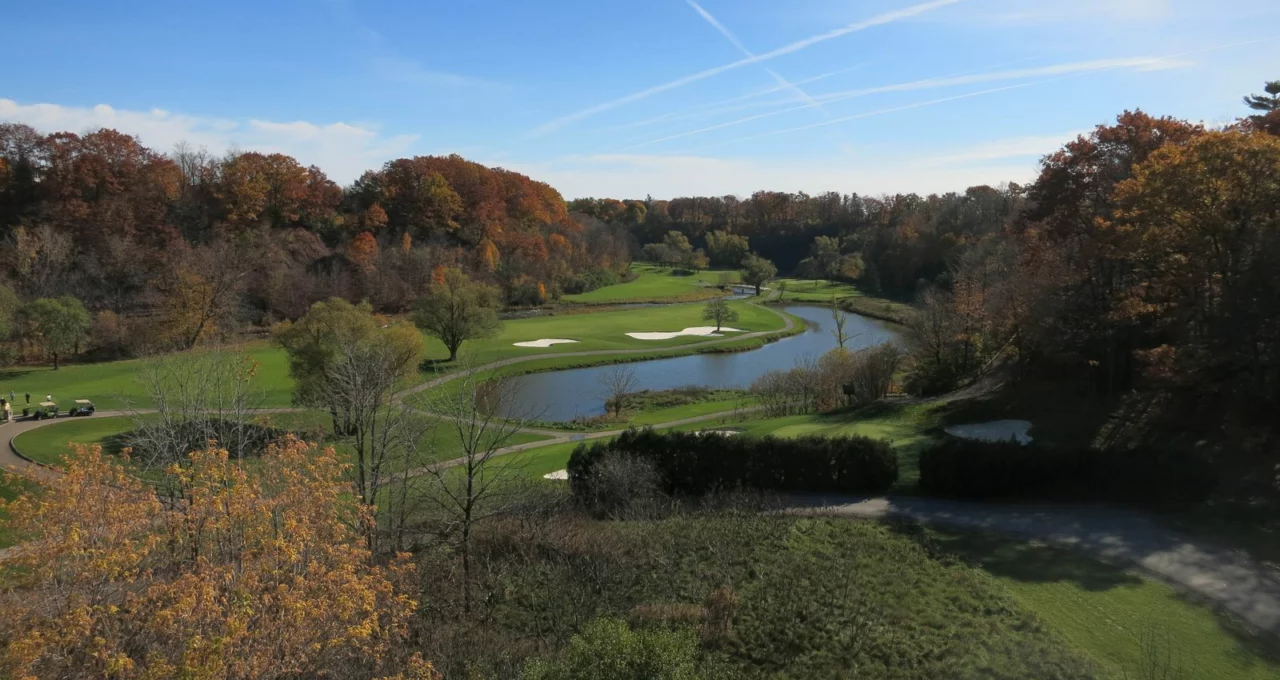
Glen Abbey golf course in Oakville, Ontario, Canada — Photo Whpq / Wikimedia Commons, CC BY-SA 4.0
Glen Abbey Golf Club
Holes
18
By
73, 36 out and 37 in (club's 2026 scorecard; Wikipedia); Wikidata gives 72
Length
7,214 yards from the black tees, 6,603 gold, 6,142 blue, 5,730 green, 5,306 red (club's 2026 scorecard); Wikipedia gives 7,273 yards from the black tees
Green fee
—
Best season
—
Glen Abbey Golf Club is an 18-hole course at 1333 Dorval Drive in Oakville, Ontario, on the western edge of the Greater Toronto Area. It was the first course Jack Nicklaus designed on his own, it is owned and run by ClubLink, and it has staged the Canadian Open 30 times between 1977 and 2018, more than any other venue in the championship’s history. The club’s 2026 scorecard gives a par of 73, 36 out and 37 in, and 7,214 yards from the black tees. Unlike most courses with that kind of tournament record, Glen Abbey takes daily-fee players as well as ClubLink members, which is why so many Ontario golfers have played it at least once.
The property carries a second story that has little to do with golf scores. Between 2015 and 2021 the course was the subject of one of the longest planning disputes in Ontario, when its owner proposed to replace it with housing and the Town of Oakville responded by designating it under the Ontario Heritage Act. The course survived, and it is still open for play. This page sets out what the public record says about the course, the holes and the visit, and it flags the places where sources do not agree.
History: a course built for the Canadian Open
The land has a long chain of owners. According to the English Wikipedia article on the course, it was patented to King’s College, the forerunner of the University of Toronto, in 1814, sold to Andre Dorfman as a private estate in 1937, and sold again in 1953 to the Jesuit Fathers of Upper Canada, who used it as a retreat. Through the 1960s and early 1970s developers floated a gentlemen’s club and even a ski hill before a golf course was finally built.
A 2015 Global News feature tells how that happened. Developer Rod McIsaac attended the 1972 Canadian Open at Cherry Hill and could not see the play over the crowds. Two years later he bought the Upper Canada Country Club in Oakville, on what had been a 350-acre Jesuit estate, and hired Jack Nicklaus to design a new course. Construction began in 1974, cost a reported two million dollars and took two years. The course was meant to host the 1976 Canadian Open but was not ready in time; the championship came for the first time in 1977. Wikipedia gives 1976 as the year the club was established.
Nicklaus built Glen Abbey with spectators in mind. In the same feature he describes a wheel-spoke routing with several viewing areas for galleries, and he is quoted as calling it the best gallery course in the world after touring it in 1976. He also said the course reflected his belief that golf is a game of precision rather than power. It opened two years after his Muirfield Village in Ohio, and he never won a Canadian Open on the course he designed.
The Royal Canadian Golf Association, now Golf Canada, became the owner and made Glen Abbey the home of its national open. The date and the price depend on the source: Global News says the association bought the course in 1981 for three million dollars, while Wikipedia gives 1990. ClubLink then acquired it, in 1998 for a reported 40 million dollars according to Global News, or in 1999 according to Wikipedia. The Town of Oakville describes the course as originally built by the association as the home of the Canadian Open, which matches the purpose, if not the exact ownership chronology, of the other accounts.
Golf Canada kept its headquarters on the property for decades, together with the Canadian Golf Hall of Fame and Museum, housed in an estate building it leased on the grounds. In July 2022 it announced that it would leave Oakville for a new campus at TPC Toronto at Osprey Valley in Caledon, a search that began after the redevelopment application of 2015. Local press reported in 2026 that construction of the new headquarters was complete. The national open itself had already moved on: since 2019 it has been played at Hamilton, St. George’s, Oakdale and, in 2025 and 2026, at Osprey Valley.
The Canadian Open years
Wikipedia’s list of venues counts 30 Canadian Opens at Glen Abbey, from 1977 to 2018, and the club’s own overview gives the same figure. Some older press reports give 28, because they were written before the last editions. The winners include Lee Trevino in 1979, Greg Norman in 1984 and 1992, Curtis Strange in 1985 and 1987, Nick Price in 1991 and 1994, Vijay Singh in 2004, Jason Day in 2015, Jhonattan Vegas in 2016 and 2017, and Dustin Johnson in 2018, the last edition played here, at 23 under par.
The moment most people associate with the course came in the final round in 2000. Locked in a duel with Grant Waite, Tiger Woods played his second shot to the 18th from a bunker to the right of the fairway and hit a six-iron 218 yards over the pond that guards the green, then went on to win. Global News and Wikipedia both describe it as one of the most spectacular shots of his career. Glen Abbey also produced a PGA Tour record in 2009, when Mark Calcavecchia made nine consecutive birdies in the second round. Wikipedia lists the course record as 62, shared by Greg Norman in 1986 and John Merrick in 2013.
The redevelopment dispute
In October 2015 ClubLink applied to redevelop the property with no golf course at all. Wikipedia summarises the plan as 3,222 housing units with retail, commercial and office space. In August 2017 Oakville council voted unanimously to designate the course under the Ontario Heritage Act, and in February 2018 its planning and development council unanimously rejected the demolition application. ClubLink took the matter to the courts and to the provincial tribunal. In October 2018 a Superior Court judge ruled that ClubLink could take its demolition application to the Local Planning Appeal Tribunal despite the town’s refusal, and council voted to appeal; in December 2018 the same court struck down the town’s conservation plan and bylaws. A citizens’ coalition, Save Glen Abbey, campaigned throughout to keep the course.
The dispute ended in July 2021. According to the Town of Oakville’s news release of 9 July 2021, ClubLink withdrew its appeals to the Ontario Land Tribunal against the refusal of its demolition applications, after the province’s municipal affairs minister secured a commitment from the company, and a hearing scheduled for August 2021 did not go ahead. The town said the Glen Abbey lands would be conserved. The heritage designation by-law remains in place, and the course continues to operate as a ClubLink property open to members and the public.
What it asks of you
The 2026 scorecard published on the club’s website lists five sets of tees. From the black tees the course measures 7,214 yards with a men’s course rating of 75.3 and a slope of 144. The gold tees play 6,603 yards (72.5 and 139), the blue 6,142 yards (70.4 and 132 for men, 76.2 and 144 for women), the green 5,730 yards (68.1 and 134 for men, 73.3 and 138 for women) and the red 5,306 yards (65.5 and 129 for men, 71.5 and 131 for women). Those figures differ from the ones still repeated on Wikipedia and several booking and review sites, which give 7,273 yards and 74.7 and 132 from the back; we use the club’s 2026 card. All yardage markers on the course measure to the centre of the green.
The par of 73 comes from five par 5s, four par 3s and nine par 4s. Several of the par 4s are long by any standard: from the black tees the 9th is 461 yards and the 10th and 14th are 446 each, while the 2nd, 4th, 6th, 8th, 11th and 17th all run between 411 and 442 yards. The par 5s give some of that back. From the black tees they range from 487 yards at the 1st and 511 at the 18th to 543 at the 13th. Players who drive the ball well will see several chances to reach in two; players who do not will find the par 4s the real test. Moving up a tee changes the picture considerably: from the blue tees the course loses more than a thousand yards.
The par 3s are a mixed set. The 3rd is 159 yards from the black tees and the 7th is 197. The 12th, at 203 yards, is the longest, and the 15th, at 139 yards, the shortest hole on the course. On the club’s men’s handicap index the 9th is the hardest hole, followed by the 2nd and the 10th; the women’s index also puts the 9th first, then the 11th and the 8th. The 1st is the easiest hole on the men’s index.
The valley holes
The holes that define Glen Abbey are the 11th to the 15th, which drop into the valley of Sixteen Mile Creek. Wikipedia describes the 11th, a par 4 of 442 yards from the black tees, as a tee shot played from a cliff to a fairway about 60 feet below. The creek then comes into play as a hazard on the 12th, a par 3 of 203 yards, on the 13th, the 543-yard par 5, and on the 14th, a par 4 of 446 yards. The stretch ends at the 15th, the short par 3 of 139 yards, with a sharply sloping green. Global News quotes the view that the run from the 11th to the 15th is among the finest stretches in Canadian golf, and reviewers repeat it.
The rest of the course is played on the ground above the valley. That contrast is what most visitors notice and what reviewers return to: the upper holes are where the length and the bunkering do the work, and the valley is where the scenery and the creek take over.
The finish
The closing stretch is a short par 5, a long par 4 and another par 5. The 16th is 521 yards from the black tees, the 17th a par 4 of 441 yards, and the 18th a par 5 of 511 yards with a pond guarding the green. It is a hole made for a tournament finish, within reach in two for long hitters but with water waiting for a second shot that comes up short. Woods’s six-iron from the bunker in 2000 is the obvious reference, but the hole asks the same question of any player with a long second shot: go for it over the water, or lay up and rely on a wedge.
What golfers say
Because Glen Abbey takes daily-fee players, it has a large public review record, mainly on GolfPass, read in October 2026. The points below summarise themes that recur across those reviews. They are other people’s opinions, not ours: nobody from Panxis has played the course, we do not name or quote individual reviewers, and we have not tried to count or score their views.
What comes up in its favour
- The valley holes, from the 11th to the 15th, draw the most consistent praise, for the drop to the creek, the views and the variety of shots they demand.
- Reviewers value the history: the chance to play the 18th where Woods hit his shot and to see the course as the Canadian Open players did.
- The layout as a whole is described as a proper championship test, long from the back tees and well bunkered.
- Golfers playing it for the first time describe a welcoming staff and a memorable day.
- Conditioning is often rated good or very good.
What comes up against
- Pace of play is the most frequent complaint. Several reviewers describe rounds well over the expected time and too little intervention on the course to keep groups moving.
- Conditions are not uniformly praised: some reviews mention dry or brown areas, thin sand in bunkers, slower greens in the valley and worn tee boxes.
- Value for money is the most divided point. Some reviewers find the experience worth it for a Canadian Open venue; others say the on-course service does not match what they paid.
- Some players find the front nine on the upper ground less memorable than the valley stretch on the back nine.
- Carts are mandatory, which disappoints golfers who prefer to walk.
Playing as a visitor
Glen Abbey welcomes both public golfers and ClubLink members, according to the club’s overview. Daily-fee tee times are booked online through ClubLink’s LinkLine system, linked from the club’s website, or by telephone. The club’s policies say members may book up to five days ahead and that visitors may be restricted at peak times, especially weekend mornings; daily-fee bookings must be cancelled at least 48 hours in advance. Glen Abbey is excluded from some of the reciprocal privileges that apply at other ClubLink clubs, so members of other clubs should check their terms before booking.
Power carts are mandatory at Glen Abbey, unlike at most ClubLink clubs, and walking the course is not permitted. Drivers need a valid licence. Soft spikes only, golf attire with no denim on the course, and no outside alcohol anywhere on the property. Non-golfing guests and pets may not ride or walk along. ClubLink’s policies ask players to check in at the golf shop before using the practice facilities; the club’s website does not describe Glen Abbey’s own practice area, so we say nothing more about it. The clubhouse has a dining room called Eighteen, open to the public all year, and rooms for banquets and meetings.
Getting there and when to go
The club is at 1333 Dorval Drive, Oakville, ON L6M 4G2, north of the Queen Elizabeth Way. The club’s directions from Toronto are to take the QEW west to Oakville, exit north on Dorval Drive and follow it for about one kilometre to the main entrance. From Toronto Pearson Airport, take Highway 27 south to the QEW and follow the same route. The main switchboard is 905-844-1800.
The club does not publish opening and closing dates for the golf season, so check with the golf shop in spring and autumn.
Green fees
Daily-fee rates are set by ClubLink and change through the season, so we do not reproduce them. See the club’s own site for current rates and booking.
How this page was made
The factual frame comes from public sources read in October 2026: OpenStreetMap for the location and the outline of the holes; the club’s website (glenabbey.clublink.ca) for the overview, the 2026 scorecard, the ratings and slopes, the policies on carts, booking, dress and practice, and the contact details and directions; Wikidata for the identifier; the English Wikipedia articles on Glen Abbey and on the Canadian Open for the property history, the list of championships and winners, the valley holes, the course record and the redevelopment dispute; Global News (Robert Thompson, July 2015) for the origins, the Nicklaus design and the 2000 shot; the Town of Oakville’s news release of 9 July 2021 for the end of the dispute; and Golf Canada and Ontario press coverage for the move of its headquarters to Caledon.
Where sources disagree, we say so. The length is 7,214 yards from the black tees on the club’s 2026 scorecard, 7,273 on Wikipedia and on GolfPass, and 7,227 on a provincial listing; the black-tee rating and slope are 75.3 and 144 on the club’s card and 74.7 and 132 on Wikipedia. Par is 73 on the scorecard and on Wikipedia, but 72 on Wikidata. The purchase by the Royal Canadian Golf Association is dated 1981 by Global News and 1990 by Wikipedia; ClubLink’s purchase 1998 by Global News and 1999 by Wikipedia. Older press reports give 28 Canadian Opens rather than 30, because they predate the last editions. Accounts of when Golf Canada and the Hall of Fame arrived on the property differ between 1975, 1976 and 1977. We follow the club’s card for every figure on the course itself.
We did not find a reliable statement of the opening day of play, the acreage of the present course, or the season dates, and we have left them out. The opinion section summarises reviews read in October 2026; we report recurring themes rather than individual voices and reproduce no quotations from reviewers. Nobody from Panxis has played or visited this course, and this page is no substitute for a round.
The club has not paid for this page, has not seen it before publication and has no say over its content. This page contains no commercial link and earns us no commission. If you know the course and something here is wrong or out of date, write to us and we will correct it.
Other courses nearby
Closest to this one in our Canadian directory:
- Mississaugua Golf & Country Club — 13 km
- Toronto Golf Club — 20 km
- Greystone Golf Club — 22 km
- St. George’s Golf and Country Club — 29 km
The hole to know
A par 5 of 511 yards from the black tees with a pond guarding the green, reachable in two by long hitters. In the final round of the 2000 Canadian Open Tiger Woods hit a six-iron 218 yards from a fairway bunker over the water to win (club's 2026 scorecard; Global News; Wikipedia).