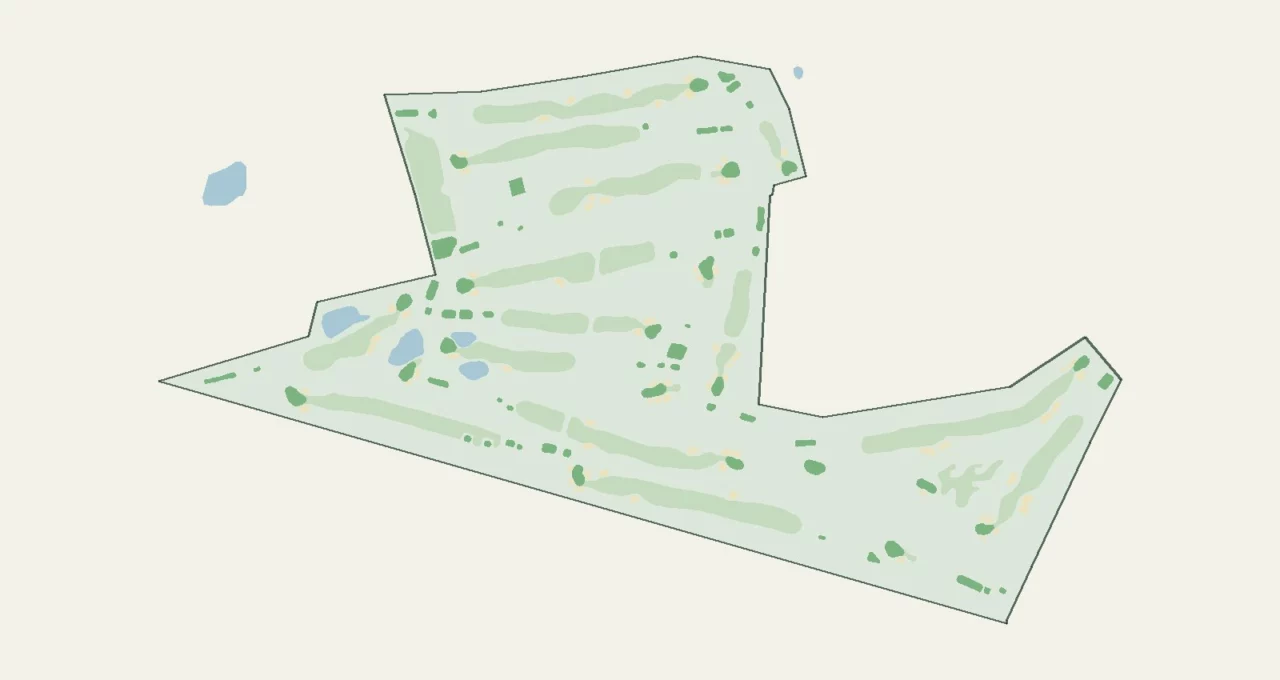
Layout of Brantford Golf & Country Club from OpenStreetMap survey data (ODbL licence).
Brantford Golf & Country Club
Holes
18
By
72, 36 out and 36 in (scorecard on GolfingRecord; Wikipedia, Wikidata)
Length
6,570 yards from the black tees, 6,345 blue, 6,043 white, 5,380 red, 4,928 yellow (undated scorecard on GolfingRecord); Wikipedia gives 6,602 yards
Green fee
—
Best season
Seasonal outdoor golf, dates not published; clubhouse open all year with indoor golf and an indoor practice area in winter (club website)
Brantford Golf & Country Club is a private 18-hole members’ club on Ava Road in Brantford, Ontario, laid out on the slopes and floodplain above the Grand River, next to the Glenhyrst Art Gallery. Founded in 1879, it describes itself as the fourth oldest golf club in North America, after Royal Montreal, Royal Quebec and Toronto. The course is a par 72 with five par 3s and five par 5s; the scorecard we found gives 6,570 yards from the black tees, while the club’s Wikipedia entry gives 6,602. In August 2026 it hosted the Canadian Men’s Mid-Amateur Championship. Its website is brantfordgolfandcountryclub.com, and the address is 60 Ava Road, Brantford, ON N3T 5H2.
The club’s own pages describe a “rolling, rambling property”, with some holes looking out over the Grand River valley and others climbing hillsides towards their greens. That split between the high ground and the valley floor is the thread running through almost every account of the course we read. After a five-million-dollar renovation by Rod Whitman and Keith Cutten between 2021 and 2023, the club has been ranked 69th in SCOREGolf’s 2022 list of Canada’s top 100 courses and 47th in Beyond the Contour’s 2024 list, according to its website.
History: from Vinegar Hill to the Grand River
The club’s timeline starts in 1873, when James Darling introduced the game to Brantford, though only a few games were played before he moved to Halifax. The club proper dates from January 1879, when a notice in the local Courier announced that “a golf club (whatever that may mean)” had been organized, with A. Robertson as captain. This account comes from an excerpt of John Gordon’s book The Great Golf Courses of Canada published on the club’s members’ site, which adds that A.S. Hardy, later premier of Ontario, joined the same year. The first course had four holes on Vinegar Hill common, between today’s Colborne, Alfred and Murray streets. The club moved to Terrace Hill in 1881, briefly to part of Arrowdale in 1882, where a caretaker was first hired and the first formal greens and hazards were made, and in 1883 to Glenmount, east of West Street and Henry. Gordon notes that a herd of cattle helped keep the grass down. Brantford and Toronto were then the only clubs in Ontario, and Brantford players were part of the Ontario side in the first inter-provincial matches against Quebec in 1882.
In 1906 the club moved to its present site, land donated from the estate of E.L. Cockshutt, organized formally as Brantford Golf & Country Club and built a clubhouse for $7,000. Nine holes were laid out. A new railway line soon cut through the property, isolating the 7th, 8th and 9th greens, and in 1915 the club won $9,240 in damages from the Brantford and Lake Erie Railroad after a case that went to the Supreme Court. In 1917 Nicol Thompson, the Hamilton professional and architect, supervised the lengthening of the nine holes to about 3,100 yards. In 1919 members voted to buy more land for a second nine: 60 acres according to the club, 69 according to Wikipedia. By 1920 the new nine had been laid out by George Cumming and Nicol Thompson and built by Thompson, Cumming and Thompson, the Toronto partnership of the brothers Nicol and Stanley Thompson with Cumming, then head professional at Toronto Golf Club. The magazine Canadian Golfer, whose editor Ralph Reville was a Brantford member, put the new 18 holes at 6,300 yards with three short holes and greens that were “sloping, rolling and punch bowl”.
The design credit is shared differently depending on the source. The club’s golf page calls Nicol “the main architect” and Stanley a co-visionary; Gordon’s excerpt says the club history gives most of the credit to Cumming and Nicol; the Stanley Thompson Society lists work on the 18 holes by Stanley Thompson’s firm, at its second level of verification; Wikipedia says Stanley oversaw the project. Top 100 Golf Courses goes further and writes that Stanley created the nine holes of 1906 and that Nicol improved the design in 1922. We follow the club and Gordon.
The next big change came in 1960, when members approved a plan by C.E. “Robbie” Robinson, a protégé of Stanley Thompson. In his proposal, quoted by Gordon, Robinson wanted to remove two consecutive par 3s on the back nine, give the course a strong finishing hole and replace greens he called “small, flat and uninteresting”. He also proposed fairway bunkers and a widened stream to create water hazards on two or three holes, for a total of about 6,800 yards. Construction began in 1962 at a cost of $15,000 according to the club timeline; R. Bruce Forbes, a former club president and later president of the Royal Canadian Golf Association, told Gordon that Robinson was never paid. The current routing dates from that work, according to Top 100 Golf Courses. A new clubhouse, the club’s third, opened in 2002. Curling, offered since 1962, ended in 2024, a decision Wikipedia says drew criticism from local curlers.
Between Robinson and the latest renovation, reviewers mention bunker work by Graham Cooke and later by Doug Carrick, who removed trees and reshaped bunkers to bring back more of the Thompson character. Whitman and Cutten were hired in 2018 to draw up a master plan. Golf Course Architecture reported in April 2021 that members had approved it, with work starting that September on the 6th, 16th and 17th holes. Their firm, Whitman, Axland & Cutten, describes a project costing about $5 million (CAD): all bunkers rebuilt, fairways widened, a new irrigation system, an enlarged pond, new tees and five green complexes reworked, on the 3rd, 6th, 7th, 16th and 17th. Wikipedia dates the end of the work to 2023. Keith Cutten has been the club’s consulting architect since 2024, with drainage, tees and the practice areas next on the list.
Championships
Gordon’s excerpt and Wikipedia agree that the first major professional event on Robinson’s course was the 1970 Canadian PGA Championship, won by Al Balding with 282, and that the Canadian Amateur came in 1979, the club’s centenary, won by Rafael Alarcon of Mexico, also with 282. The club’s own timeline reverses the two, placing the Canadian Men’s Amateur in 1970 and the CPGA Championship in 1979; we follow Gordon and Wikipedia, which agree with each other and give the winners. The Ontario Women’s Amateur was played here in 1929. In August 2026 Golf Canada brought the Canadian Men’s Mid-Amateur Championship to Brantford: Garrett Rank of Waterloo won his fourth title at 18 under par, 270, one shot ahead of Evan Nachtigall of Brandon, Manitoba, who led after each of the first three rounds. Golf Canada called the three opening rounds of 64 a new competitive course record; Wikipedia lists a course record of 61 by David Hearn in 2015, and Gordon records a 64 by Bob Panasik in the 1970 pro-am. Wikipedia names Hearn, Alena Sharp, Moe Norman, Nicole Vandermade and Jennifer Kirby among notable members.
What it asks of you
The club does not publish its scorecard online. The card we used, on GolfingRecord and undated, gives five sets of tees: black at 6,570 yards (course rating 71.7, slope 131), blue at 6,345 (70.4, 127), white at 6,043 (69.1, 122), red at 5,380 (71.3, 121) and yellow at 4,928 (68.7, 114). The red and yellow ratings appear to be women’s ratings, though the card does not say so. Par is 36 out and 36 in. Because Whitman and Cutten added new tees, this card may not match the course as it now plays; ask the pro shop for current figures.
The way the routing uses the property matters more than the yardage. The opening holes sit on flat ground at the top of the site, the 3rd and 4th drop into the valley, and from there the round moves in and out of it, with several holes playing straight up the slope. Reviewers describe half the course as lying in the Grand River floodplain and the rest above it or on the hillside between, which produces sidehill, uphill and downhill lies all day. Five par 3s and five par 5s replace the usual run of par 4s, and the par 4s include a long one at the 5th and two short ones, the 2nd and 9th, that tempt long hitters. Older descriptions call Brantford one of Canada’s toughest courses; the 2026 championship scores suggest that, in good conditions after the renovation, good players can score here. The club runs a strict pace-of-play program, according to Top 100 Golf Courses: rounds are timed by the starter, with a maximum of four hours and fifteen minutes, and repeat offenders can be called before the board.
The front nine
The 1st is a par 5 of 511 yards from the black tees; during the Mid-Amateur one leader reached it with a seven-iron for an eagle. The 2nd, a par 4 of 334 yards, was driven to the front of the green by the same player. Reviewers find these first two holes gentle. The 3rd, a par 3 of 197 yards, is where the course comes alive: it plays downhill to a green cut into the hillside, with a long view over the valley, and it was one of the five greens rebuilt in the renovation. The 4th, a par 5 of 526 yards, continues the descent, bending slightly left to an undulating green guarded at the front by a large bunker. The 5th is a long par 4, 470 yards on the card (one reviewer gives 442 from the back), to an open-fronted green below the fairway that accepts a running shot; it is stroke index 1 from the black tees.
The 6th, 353 yards, has fairway bunkers right and a pond left; the 7th, 355 yards, climbs to an elevated green that slopes hard from back to front, with the approach partly blind. Both greens were rebuilt. The 8th is a par 3 of 156 yards over a small valley to a large green. The 9th is the hole most discussed: a par 4 of only 308 yards on which the fairway falls away about 200 yards out, leaving a blind or semi-blind shot to a long, elevated green if the drive comes up short. Reviewers suggest a mid-iron and wedge, though the bold can try to drive it.
The back nine
The 10th, a par 3 of 176 yards, is played over a gorge to a green bunkered in front and to the side, described by one reviewer as redan-style; two reviewers name it the best of the short holes. Top 100 Golf Courses places the par 3 with a gorge at the 9th, which contradicts the card and the other descriptions; we follow the card. The 11th, 408 yards, drops from an elevated tee to a green beside a small pond. Across the road, the 12th is a par 5 of only 476 yards that plays steeply uphill, with a creek and bunkers to carry from the tee, a narrowing fairway, a cross bunker short of the green and a blind putting surface that tilts from right to left. The 13th is a par 4 of 458 yards and the 14th a par 5 of 508 that plays longer than its number, uphill between fairway bunkers.
The 15th, 192 yards, is an uphill par 3 to a green that runs from back to front, with a bunker cut into the hillside on the left; reviewers rate it the hardest one-shotter. The 16th, a par 4 of 458 yards, plays downhill off the tee with out of bounds all down the right; reviewers before the renovation found it hemmed in by trees, and a 2024 reviewer names its rebuilt green complex as a favourite. The 17th, 154 yards over a pond, is generally seen as the weakest hole. The 18th, a par 5 of 530 yards, climbs the hill to an elevated green that is blind on the approach and slopes towards the river. In the final round in 2026 the leader found a bunker on the left of this hole and made bogey, handing Rank the title.
What golfers say
As a private club, Brantford has few public reviews. We read the course page and five reader reviews on Top 100 Golf Courses (from 2019, 2022, 2024, 2025 and 2026), the quotations from the press that the club reproduces, and Golf Canada’s championship reports. The points below summarise what recurs. They are other people’s opinions, not ours; nobody from Panxis has played the course, and we quote no reviewer.
What comes up in its favour
- The routing in and out of the Grand River valley, with long views and changes of elevation that reviewers consider the course’s main asset.
- The par 3s as a set, particularly the 3rd, 10th and 15th, and the par 5s, which are reachable but each defended differently.
- Variety: the mix of lies, short and long par 4s, and holes that ask for every club in the bag.
- The renovation: rebuilt greens, especially the 16th, and bunkers that recent reviewers say suit the old design better.
- Conditioning, compared by one reviewer with the best courses in Ontario, and the history of the club.
What comes up against
- The first two holes are seen as a quiet start before the course reaches the valley.
- The 17th is widely called the weakest hole, squeezed in to complete the routing.
- Before the renovation, trees narrowed several holes, notably the 16th; this was part of what Whitman and Cutten set out to address.
- Older accounts find it a relentless, very hard test; some of the 2026 reviews instead find the par 4s scoreable.
- One recent reviewer rates the facilities and amenities lower than the course itself.
Playing as a visitor
Brantford is a private club, and its website offers no public tee-time booking, only a members’ login. Its membership page mentions guest fees and lists senior golf membership (40 and over), intermediate golf membership (20 to 39), a social membership that includes up to five rounds a season and a corporate social membership whose members play five times a season at the guest fee, at times set by the pro shop. The site does not explain how non-members can play. The best route is through a member or by contacting the pro shop on 519-756-6880 or the clubhouse on 519-752-3731.
The clubhouse is open all year, with dining, a patio overlooking the course and the river, and an indoor practice area with indoor golf and pickleball in winter. We found no reliable information on carts, rentals or the outdoor practice facilities.
Getting there and when to go
The club is at 60 Ava Road, on the west side of Brantford, beside the Glenhyrst Art Gallery and the Grand River. One reviewer puts it about an hour’s drive southwest of Toronto. The club acknowledges that its land lies on the Haldimand Tract, granted to the Haudenosaunee of the Six Nations of the Grand River.
The golf season is that of southern Ontario, and the club did not publish opening or closing dates that we could find. The Mid-Amateur, played in the third week of August, gives an idea of the course in summer condition.
Green fees
Brantford is a members’ club and does not publish green fees for visitors: contact the club through its website for guest rates and conditions.
How this page was made
The factual frame comes from public sources read in October 2026: OpenStreetMap for the location (its outline of the course is partial); Wikidata for the identifier and par; the club’s website for its history timeline, the architects, the renovation, the rankings, the membership categories, the clubhouse and contact details; John Gordon’s history excerpt on the club’s members’ site for the founding, the early inter-provincial matches, Robinson’s 1960 plan and the 1970 and 1979 championships; the English Wikipedia article for the length, acreage, curling and course record; the Stanley Thompson Society’s course page; Whitman, Axland & Cutten’s project page and Golf Course Architecture (April 2021) for the renovation; Golf Canada and AmateurGolf.com for the 2026 Mid-Amateur; GolfingRecord for the scorecard and ratings; and Top 100 Golf Courses for the course profile, the pace-of-play rules and reader reviews.
Where sources disagree, we say so. The club’s timeline places the Canadian Amateur in 1970 and the CPGA Championship in 1979; Gordon and Wikipedia give the reverse, and we follow them. The land bought in 1919 is 60 acres for the club and 69 for Wikipedia. The length is 6,602 yards on Wikipedia and 6,570 on the scorecard we used, which is undated. One reviewer gives the 5th as 442 yards rather than 470. The design credit is shared differently by the club, Gordon, the Stanley Thompson Society, Wikipedia and Top 100 Golf Courses, which also puts the gorge par 3 at the 9th. Course records differ between Wikipedia (61 in 2015), Gordon (64 in 1970) and Golf Canada (64 in 2026, described as a competitive record). Wikidata places the club about 400 metres from the point OpenStreetMap uses. We could not read GolfPass’s scorecard page or the original SCOREGolf, Beyond the Contour and Hamilton Spectator articles the club quotes, and we found no official information on carts, practice facilities or season dates.
The opinion section summarises reviews read in October 2026. We report recurring themes rather than individual voices, and we reproduce no quotations from reviewers. Nobody from Panxis has played or visited this course, and this page is no substitute for a round.
The club has not paid for this page, has not seen it before publication and has no say over its content. This page contains no commercial link and earns us no commission. If you know the course and something here is wrong or out of date, write to us and we will correct it.
Other courses nearby
Closest to this one in our Canadian directory:
- Westmount Golf & Country Club — 37 km
- Greystone Golf Club — 52 km
- Glen Abbey Golf Club — 57 km
- Mississaugua Golf & Country Club — 70 km
The hole to know
A short par 5 of 476 yards from the black tees that climbs steeply uphill: tee shot over a creek between bunkers that pinch the landing area, a narrowing fairway, a cross bunker short of the green and a blind putting surface sloping hard from right to left (scorecard; Top 100 Golf Courses reviews).