Golf umbrellas for Australian UV, summer storms and sandbelt wind: three double canopies
In Australia the golf umbrella is a patch of shade far more often than it is rain cover, and on the coast or the Melbourne sandbelt it has to do both in the wind. Three double canopy umbrellas on sale here this month, from A$72.95 to A$114.95, what their makers publish, what golfers say breaks first, and the rule on who may hold one over you.
In brief
- The umbrellas: Titleist 2026 Tour Double Canopy (68 in.), TaylorMade Tour 64" Double Canopy and GolfCraft 72" UV Umbrella in silver.
- Australian prices read on 1 November 2026: A$114.95 for the Titleist, A$109.95 for the TaylorMade and A$72.95 for the GolfCraft; no weight or wind rating published for any of them.
- Golfers praise vents that stop the canopy flipping, silver undersides that feel cooler and fibreglass that bends back; they complain about struts snapping at the hinge, big canopies that tire the arm in a crosswind, shafts that do not fit the buggy holder and coatings that wear.
- Buy for shade first, choose the size for your wind, insist on a vented double canopy and a fibreglass frame, and remember an umbrella is no protection from lightning.
Ask most Australian golfers when they last opened their umbrella in the rain and they will have to think about it. Ask when they last stood under it on a par 3 tee waiting for the group ahead, with the UV index in double figures, and the answer is probably last weekend. In this country the golf umbrella works as a portable patch of shade for most of the year, and as storm cover for a few hectic afternoons in between. Both jobs get harder when the wind gets up, and on a coastal links or a Melbourne sandbelt course the wind is rarely absent for long.
With November here and summer only weeks away, this page looks at three golf umbrellas on sale in Australia, priced from A$72.95 to A$114.95 in November 2026: what their makers say about canopy, frame and vents, what golfers say about umbrellas of this type, and the part of the Rules of Golf that decides who is allowed to hold one. It is a presentation of products and a summary of public opinion. Nobody at Panxis Golf opened, carried or stood under any of these umbrellas, and no figure on this page was measured by us.
Shade first, rain second
The case for carrying an umbrella from December to March has little to do with rain. A summer round in most Australian cities means four to five hours outdoors, often through the middle of the day, when the UV index regularly reaches the very high and extreme bands. The Cancer Council’s SunSmart advice is to use sun protection whenever the UV index is 3 or above, which in much of the country covers most daylight hours in summer.
An umbrella helps with one part of that advice, the shade, and only one part. A canopy overhead does nothing about UV bouncing off a sand bunker or a pale fairway, or scattered from the sky around you. So the hat, the sunscreen and the long sleeves stay on. What an umbrella adds is a cooler few minutes on every tee and green, which over 18 holes adds up to a fair amount of time out of the direct sun.
That changes what is worth looking for. A canopy with a silver or UV-coated underside is designed to reflect sunlight, and a lighter umbrella is easier to keep open in one hand while you wait. Rain performance still matters, because when a summer storm arrives it tends to arrive hard. But for an Australian golfer the shade side of the brief is not a bonus. It is most of the job.
Reading the size: inches over the arc
Golf umbrellas in Australia are still sold by a number in inches, usually 62, 64, 68 or 72. That figure is the length of the canopy measured over the curve from edge to edge, not the width of the shadow it throws. Roughly, 62 inches is about 157 cm of arc, 64 inches about 163 cm, 68 inches about 173 cm and 72 inches about 183 cm. The flat diameter of the shade on the ground is a good deal less than that.
Each step up in size covers more of you and your bag, and each step catches more wind. A 68-inch canopy will keep the grips dry on a carry bag slung over your shoulder. A 72-inch one gives a shadow big enough for two people to stand in at a drinks break. In a 30 km/h crosswind, though, the bigger canopy is the one pulling at your wrist, and the one more likely to fold if you hold it at the wrong angle.
Four details on a listing that matter in the wind
- Vents. A double canopy has a second, smaller layer of fabric sitting over a ring of openings near the top. When a gust pushes up under the umbrella, the air escapes through the gap instead of turning the whole thing inside out. All three umbrellas on this page are sold as double canopy designs.
- Frame material. Fibreglass, often written “FRP” (fibre-reinforced plastic), bends under load and recovers. Steel is stiff and cheap but stays bent once overloaded. If a listing does not name the frame material, it is fair to ask, and fair to assume nothing until you get an answer.
- Struts and joints. Ribs rarely snap halfway along. They fail at the small hinges where the supporting struts meet them, and near the runner that slides up the shaft. Phrases like “reinforced struts” or “anti-inversion struts” describe this area, but they are a maker’s description, not a measurement.
- Handle. In a summer round, you will hold the umbrella with a sweaty hand or a damp glove. Foam and rubber-style handles hold better than hard plastic, and a shape you can grip without squeezing makes a difference on a windy afternoon.
None of the three listings read for this page gives a wind speed rating or a weight. That is common. Where a brand does publish a wind figure, it comes from a test arranged by the brand in steady airflow, which is not the same as a gusty sea breeze swirling around a dune.
Titleist 2026 Tour Double Canopy
Titleist’s tour-style umbrella has been around in one form or another for years. The 2026 edition updates the branding and keeps the familiar full-size canopy.
- What the maker publishes, as shown on an Australian listing: 68 inches of coverage; double canopy; UV protective coating; reinforced struts and ribs “for quality and durability”; soft foam handle with debossed Titleist script; updated branding. Rib and shaft material, opening system, weight and any wind rating: not published on the listing read.
- Price: A$114.95, read on 1 November 2026 at an Australian golf retailer, shown in stock in black and white.
- Who it suits: a golfer who walks with a carry bag or pushes a buggy and wants the full 68-inch size from a club brand, with a UV coating for summer and a soft handle for wet days.
The gap in the listing is the frame. “Reinforced struts and ribs” says the maker has paid attention to the weak points, but not what they are made of. If that matters to you, and on a windy course it should, check the swing tag or ask in store.
TaylorMade Tour 64″ Double Canopy
The TaylorMade is the one umbrella here whose listing names its frame material and describes a specific defence against inversion.
- What the maker publishes, as shown on an Australian listing: manual opening; “Vortex” vented canopy “engineered to resist wind”; FRP fibreglass frame with anti-inversion struts; TPR tabs with the TaylorMade logo; ergonomic custom V3 handle. Weight and wind rating: not published.
- Size: the product name says 64 inches, while a line in the same Australian listing says 68 inches. Listings for the same model in other countries describe it as 64 inches, so 64 is the likelier figure, but check the tag before buying if the size matters to you.
- Price: A$109.95, read on 1 November 2026 at an Australian golf retailer, shown in stock in black and white.
- Who it suits: a golfer on an exposed course who would rather give up a little coverage for a fibreglass frame and a vent designed around wind, and who is happy to open it by hand.
Manual opening is often an advantage in wind. There is no spring to fire the canopy open at the wrong moment, and no catch to wear out.
GolfCraft 72″ UV Umbrella (Silver)
The GolfCraft is the largest and cheapest umbrella on this page, and the one most clearly built around the sun. It is sold in silver and in black, with the silver version shown here.
- What the maker publishes, as shown on an Australian listing: 72-inch double canopy described as a “solar umbrella”; “wind escape pockets” designed to stop the wind blowing the umbrella about. Frame material, opening system, UV rating figure, handle and weight: not published.
- Price: A$72.95, read on 1 November 2026 at an Australian golf retailer, shown in stock. The black version was listed at the same price.
- Who it suits: a golfer who mostly wants shade, often shares it with a playing partner at the turn, and plays courses where the wind is not usually the main problem.
The listing is short. “Solar” and the silver finish point to a sun umbrella first, but there is no published UPF or UV figure to compare with the other two, and no frame material. A 72-inch canopy is also a lot of fabric to hold in a coastal breeze. The same retailer sells a 68-inch “Windbuster” version from the same brand with the same short description, at a lower price.
The three side by side
| Umbrella | Size (arc) | Canopy | Frame, as published | Opening | Price, November 2026 |
|---|---|---|---|---|---|
| Titleist 2026 Tour Double Canopy | 68 in., about 173 cm | Double, UV protective coating | Reinforced struts and ribs, material not published | Not published | A$114.95 |
| TaylorMade Tour 64″ Double Canopy | 64 in., about 163 cm (listing also mentions 68 in.) | Double, “Vortex” vented | FRP fibreglass, anti-inversion struts | Manual | A$109.95 |
| GolfCraft 72″ UV Umbrella (Silver) | 72 in., about 183 cm | Double, “solar”, wind escape pockets | Not published | Not published | A$72.95 |
Weight and wind rating were not published for any of the three on the listings read.
What golfers are saying
Golf umbrellas do not attract many detailed reviews, and few of those discuss one model at length. What follows comes from owner reviews on golf retail sites, umbrella buyer’s guides in golf media and golf forum threads, mostly about double canopy golf umbrellas in general. These are the points that come up again and again.
What they like
- Vents that stop the flip. Owners of vented double canopy umbrellas often describe a gust lifting the canopy, the vent opening, and the umbrella settling back without turning inside out. Many say they would not buy a single canopy golf umbrella again.
- Silver undersides that feel cooler. Golfers who play in hot climates describe a reflective or UV-coated umbrella as noticeably more comfortable to stand under between shots than a plain dark one, and some carry one only for summer.
- Fibreglass that gives. Players describe watching a fibreglass frame bend hard in the wind and spring back into shape, where an older steel-framed umbrella stayed crooked.
What they complain about
- Struts that break at the hinge. The most frequent complaint is a strut or rib snapping at the small joint near the runner, often after one or two seasons, leaving a sagging panel that is hard to repair.
- Too big for one hand in a crosswind. Owners of 68 and 72-inch umbrellas say they are tiring to hold steady on a windy day, and some end up leaving them in the bag on exactly the days they bought them for.
- Shafts that do not fit the holder. A thick tour-style shaft does not always fit the umbrella holder on a push buggy or a motorised cart, a complaint that comes up often enough to be worth checking before you pay.
- Coatings and fabric that wear. Some buyers report the inner coating fading or flaking after long exposure to the sun, and the canopy fraying where it is stitched to the tip.
No one is quoted and nothing has been counted. These are recurring impressions from public reviews and forum discussions, not measurements.
Where Australians need an umbrella: UV, summer storms and wind off the sea
The right umbrella in Australia depends less on how much it rains where you live than on how hard the sun shines and how hard the wind blows.
- The sun, almost everywhere. From late spring to early autumn the UV index in Brisbane, Perth, Adelaide and Sydney regularly sits in the very high to extreme range around the middle of the day, and in the tropical north it stays high for most of the year. This is where the umbrella earns its place in the bag. A UV-coated or silver underside, a size you can hold up without effort, and the habit of opening it on every tee and green while you wait all help. Keep the broad-brimmed hat on under it.
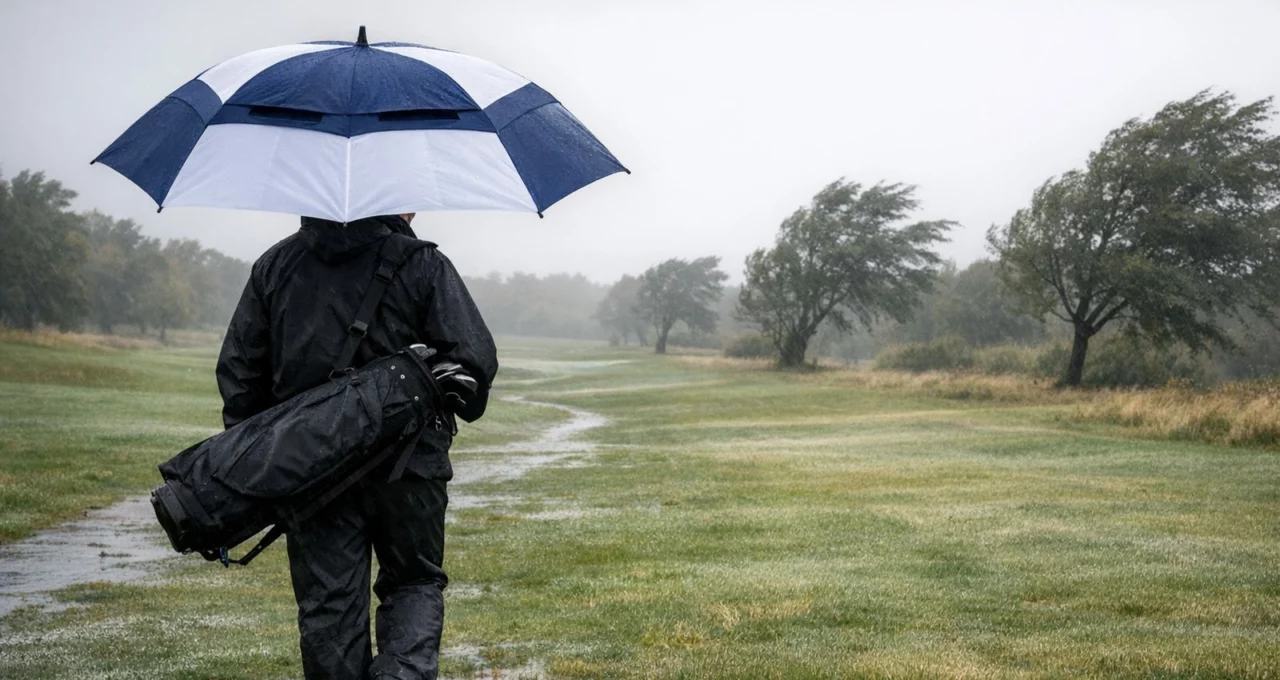
- Summer storms on the east coast. In south-east Queensland and around Sydney, hot humid days often end in a late-afternoon thunderstorm, with heavy rain, strong gusts and sometimes hail. An umbrella will keep the scorecard dry for the walk to the clubhouse. It will not protect you from lightning, and carrying a long shaft above your head in the open is the last thing you want to be doing. When you hear thunder or a siren sounds, leave the course and get into a solid building or a hard-top car, away from isolated trees and shelters. Do not head back out until the storm has clearly passed.
- The wet season up north. From around November to April, Darwin and the tropics get humid heat and heavy afternoon downpours. Rain there is warm and short, so a big canopy that keeps you and the bag dry for twenty minutes matters more than a jacket.
- Coastal links and the sea breeze. On the clifftop and dune courses of Tasmania, the Mornington Peninsula and the southern coast, and on any course near the ocean, wind is the real test of an umbrella. In Perth, the afternoon sea breeze known as the Fremantle Doctor arrives on many summer days and can make a 72-inch canopy hard to manage. A vented double canopy, a fibreglass frame and a slightly smaller size you can hold low into the wind are worth more here than extra coverage.
- The Melbourne sandbelt. The famous courses south-east of the city sit on open, sandy heathland with firm, fast turf and few tall trees between holes. Breezes off Port Phillip Bay and the gusty northerlies that run ahead of a summer cool change sweep across them with little to slow them down, and the same afternoon can bring sun, wind and a sharp shower. A sandbelt umbrella needs to survive a gust above all, and closing it before you walk onto an exposed tee saves a lot of broken struts.
Distances add to the case for a lighter umbrella. On a course of around 6,000 metres you may walk eight or nine kilometres in a round, and every gram in the bag is carried the whole way.
The rule about who holds the umbrella
Golf Australia administers the Rules of Golf in this country, and Rule 10.2b(5) covers protection from the elements. You may hold your own umbrella over yourself while you prepare to play. What you must not do is make a stroke while you are being protected from rain, sun or wind by your caddie, another person, or an object you have deliberately placed there. A playing partner holding the umbrella over you as you putt, or an umbrella wedged into the turf to shade you over the ball, costs you the general penalty: two strokes in stroke play, loss of the hole in match play. Lower it, or move out from under it, before you play.
Where to buy, and what to ask
- Your club’s pro shop. Often stocks one or two tour-style umbrellas and a club-logo umbrella. A good place to feel the weight and check the shaft fits your buggy’s holder.
- Golf specialty stores. A wider range in one place, and the chance to open several umbrellas side by side and compare the handle, the vents and the joints near the runner.
- Online golf retailers and brand websites. Useful for comparing prices and colours. Read the listing for the frame material and the canopy size, and do not take a size in the product name on trust if the description says something else.
- Second-hand. A used golf umbrella is a reasonable buy if it opens and locks smoothly, every strut is straight and the canopy is not frayed at the tip.
Wherever you buy, ask what the frame and shaft are made of, whether the warranty covers broken struts, and whether the umbrella fits the holder on your buggy or cart.
Before you buy
- Decide what it is mostly for. Shade in the heat, or cover in the rain. For most Australian golfers, shade wins, so look for a UV coating or a silver underside.
- Choose the size for your wind. 72 inches for shade on sheltered parkland, 68 for a carry bag, 62 or 64 if you play on the coast or the sandbelt.
- Insist on a vented double canopy. It is the feature golfers credit most often when an umbrella survives a gust.
- Ask about the frame. Fibreglass is the answer you want. If no one can tell you, take that into account.
- Look after it. Dry it open, not folded in the bag, and keep it out of the car boot in high summer, where heat is hard on coatings and glue.
A good golf umbrella in Australia is one that gives you a few minutes out of the sun on every tee, keeps the bag dry when the afternoon storm breaks, and survives the gust on the most exposed hole of your course. Buy the frame and the vents first, the size second and the logo last.
How this page was put together
This is a neutral presentation of products and a reading of public opinion, not a test. Nobody at Panxis Golf opened, carried or stood under any of these umbrellas. Specifications come from the descriptions published by the makers, Titleist, TaylorMade and GolfCraft, as shown on Australian product listings. Where a figure such as weight, frame material or wind rating is not given, this page says “not published” rather than estimating one. The TaylorMade listing gives both 64 and 68 inches; its size was cross-checked against listings for the same model in other countries. Arc lengths in centimetres are simple conversions of the inch figures, not measurements.
Prices were read on 1 November 2026, in Australian dollars, at Drummond Golf (drummondgolf.com.au), where all three umbrellas were shown in stock that day. Prices change with promotions, colours and stock, so the price at the counter is the one that counts.
What golfers say was read in owner reviews on golf retail websites, in golf umbrella buyer’s guides published by golf media such as Golf Monthly, and in golf forum threads, some only through search excerpts. Nobody is quoted by name, nothing is counted, and no impression is presented as a statistic. Sun advice refers to the Cancer Council’s SunSmart guidance; the rule cited is Rule 10.2b(5) of the Rules of Golf as administered in Australia by Golf Australia. There is no commercial link on this page, no affiliate arrangement and no commission of any kind. If content on this site is ever paid for by a brand, it will carry an advertising notice at the top of the page, before the first line.