Hard case or soft golf travel bag: what Air Canada, WestJet and Porter ask for, with Canadian prices
Air Canada, WestJet and Porter all write "rigid and/or hard-shell container" on their baggage pages, yet the oversize belt is full of soft covers every winter Saturday. Here is one known bag of each kind, what it costs or rents for in Canada on November 11, 2026, what golfers report, and how to choose before you fly south.
In brief
- The two examples: the Sun Mountain ClubGlider Meridian soft bag (C$398.97 before tax, regular C$449.99, read on November 11, 2026) and the SKB Deluxe Standard ATA hard case, for which no Canadian purchase price could be read but which an Ontario shop rents at C$4 a day.
- Air Canada and Porter ask for a rigid or hard-shell container; WestJet also accepts a bag with an attached hood; Air Canada and Air Transat allow sports equipment only in the bag, so no clothing as padding.
- The limit is 23 kg: the soft bag weighs 5.1 kg and the hard case 7.1 to 9.5 kg depending on the source, which leaves 13.5 to 17.9 kg for the clubs.
- WestJet states its liability at about C$2,800 per bag; report damage before leaving the airport, put it in writing within seven days and keep your receipts.
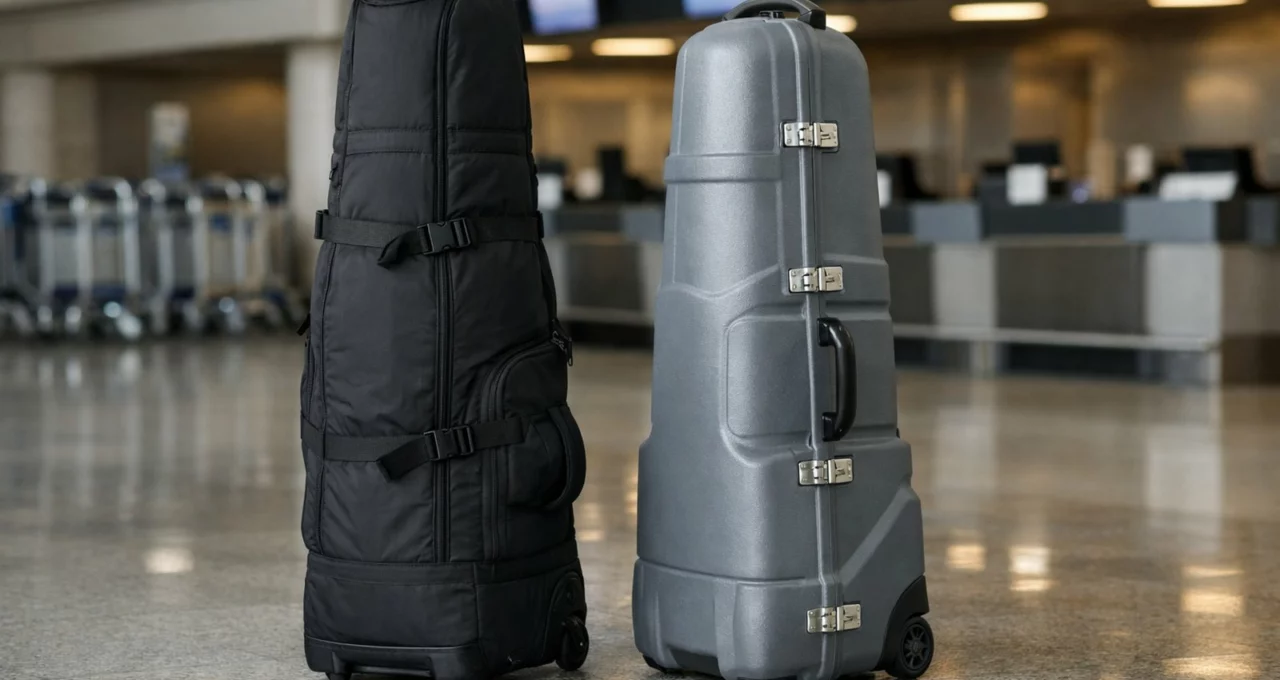
Somewhere between the first snowfall and the flight to Fort Myers or Phoenix, a Canadian golfer has to decide what the clubs will travel in. The baggage pages of Air Canada, WestJet and Porter all use the same phrase for sports equipment, “a rigid and/or hard-shell container,” yet the oversize belt at Pearson or Calgary is full of padded soft covers every Saturday from January to March. Both things are true at once, and that gap is what this page is about. It looks at one well-known bag of each kind, the Sun Mountain ClubGlider Meridian (soft, on wheels) and the SKB Deluxe Standard ATA (a moulded hard case), at what their makers publish, at what they cost or rent for in Canada on November 11, 2026, at what golfers report after flying with them, and at what five Canadian airlines put in writing. Panxis Golf did not pack, check or fly either bag. This is a presentation of public information, and it says where that information runs thin.
The soft bag: Sun Mountain ClubGlider Meridian
Most soft travel covers are a padded sleeve with two wheels at one end, and you carry half the weight in your arm all the way from the parkade. The ClubGlider’s idea is different. Two legs with small pivoting wheels swing out from the body, so the loaded bag sits on four wheels and holds itself up. You push or pull it with a couple of fingers, and it stays standing in the check-in line. For the flight, the legs fold back into a moulded tray on the underside.
The published details:
- Weight: 11.3 lb, or 5.12 kg, according to Sun Mountain.
- Inside: 52 by 14 by 14 inches, according to the Canadian product page we read. That is room for a cart bag.
- Build: ballistic-style nylon, dense foam through the top where the clubheads sit, full-length two-way zippers, two outside pockets and reinforced wear areas.
- Canadian price: C$398.97 before tax, against a regular price of C$449.99, read on November 11, 2026, at a Canadian online golf retailer. Six colours were listed, two of them backordered to late November.
It is a soft bag only up to a point. The tray and the leg mechanism are rigid, so it will not roll up and disappear into a closet the way a plain padded cover does. And nothing above the tray is hard: what protects the driver is foam and whatever you add yourself.
The hard case: SKB Deluxe Standard ATA
SKB builds moulded cases for instruments and cameras, and its golf cases follow the same logic: two plastic half-shells, metal latches, wheels built into one end. The Deluxe Standard ATA carries the model number 2SKB-4814W.
From the maker’s product page, read in November 2026:
- Inside: a little under 49 inches long and roughly 11 by 14 inches across. SKB says it takes stand bags and carry bags, a pair of shoes and drivers up to 48 inches.
- What does not fit: newer stand or cart bags with a moulded top handle that makes the top wider than 12 inches. SKB points those owners to a larger case.
- Locks: latches with a TSA-accessible lock, useful on any route through the United States, where screeners may open a checked bag.
- Weight: here the sources disagree. The maker’s page gives 15.71 lb (7.13 kg). Dealer listings and published reviews put the empty case between 18 and 21 lb, about 8 to 9.5 kg. Put it on a scale before you plan around either figure.
- Warranty: a lifetime warranty for the original owner. The page excludes cases that were previously owned or used for rental. Some SKB listings also advertise coverage for clubs damaged by an airline while locked in the case; the page for this model that we read does not mention it, so ask in writing whether it applies to a case bought in Canada.
Now the Canadian wrinkle. We could not read a Canadian purchase price for this case on November 11, 2026: the listings we found had been taken down, and two national golf chains block our tools. So this page gives none. What we did find is a way to use the same case without owning it. An Ontario golf shop rents SKB 14-inch hard cases for C$4 a day, in-store pickup only. A ten-day trip comes to C$40, and the case goes back to the shop instead of into your garage.
What Canadian shops do stock is the in-between type: a fabric body under a crush-resistant plastic cap. One example, the Bag Boy T-10 Hard Top, was listed at C$249.99 before tax the same day (regular C$279.99), with an ABS top, an ABS base, in-line skate wheels and a 600D polyester body that folds into the cap for storage. Whether an airline agent counts that as a “hard-shell container” is not something any airline page we read answers.
Start from 23 kilograms
On Canadian carriers a golf bag is weighed like any other checked bag. Porter’s sporting equipment page sets the overweight line at 23 kg (50 lb), and Air Transat’s baggage page gives the same maximum per checked bag. Air Canada ties it to “the baggage allowance for your fare,” which is 23 kg on its standard economy fares.
Subtract the travel bag and see what is left:
- ClubGlider Meridian, 5.1 kg: about 17.9 kg for the golf bag and everything in it.
- SKB case at the maker’s 7.1 kg: about 15.9 kg.
- SKB case at the 9.5 kg some dealers quote: about 13.5 kg.
A light stand bag with fourteen clubs, shoes and a dozen balls fits inside any of those numbers. A staff-style cart bag with a full ball pocket, a rain suit and an umbrella may not fit under the last one. Air Transat’s page lists a C$100 overweight fee for golf equipment. That is about a quarter of the price of the soft bag above, and it can be charged in each direction.
What five Canadian airlines put in writing
These are summaries of the airlines’ own pages, consulted in November 2026, except where noted. The wording changes; the page on the day you fly is the one that counts.
Air Canada. One golf bag with approximately 14 clubs, 12 balls and one pair of shoes counts as one checked bag, and no oversize charge applies. Sports equipment “must be suitably packaged in a rigid and/or hard-shell container specially designed for shipping,” and “items that are improperly packaged may not be accepted.” The bag must carry sports equipment only: no clothing, no personal items.
WestJet. One golf set per guest, meaning clubs, balls and shoes. It must be packed “in a rigid and/or hard shell container specially designed for shipping, or in a bag with an attached hood.” Stand-bag legs must be taped or secured. The oversize fee is waived; extra-piece and overweight fees apply. WestJet is the one carrier here whose wording clearly includes a hooded soft bag.
Porter. Golf equipment is accepted as one piece of checked baggage with no oversize fee, and an overweight fee applies above 23 kg. Porter’s special items page asks for a rigid or hard-shell container designed for shipping. We read Porter’s wording in search-engine extracts, because its pages refused our tools.
Air Transat. The golf entry reads “1 golf bag, 14 clubs, 12 balls, 1 pair of golf shoes.” Standard baggage fees apply, there is no oversize fee, and sports equipment can be prepaid and preregistered only up to 72 hours before departure. The page sets no hard-case rule for golf, but says sports bags “can only carry sporting goods,” and it recommends buying baggage insurance.
Flair. Flair’s own pages were closed to our tools. A Canadian travel guide dated October 2026 reports that Flair charges a separate sports equipment fee on each flight segment and accepts one set of clubs, balls and shoes per customer. Check the amount when you book, because it is not the ordinary checked-bag price.
Two things stand out for a Canadian reader. First, none of these pages describes the signed release that some U.S. airlines hand to golfers with soft bags. The Canadian version is a packing rule, and none of the pages we read says what happens to a damage claim when the clubs were in a soft cover. Do not assume the answer in either direction; ask the airline in writing if it matters to you. Second, the habit of wrapping sweaters around the irons breaks Air Canada’s and Air Transat’s contents rule. Pad with golf towels, foam or bubble wrap instead. One of the ClubGlider’s selling points, room for clothes, is worth less on those two carriers.
If a club comes back broken
WestJet’s page puts a number on its exposure: 1,519 Special Drawing Rights per bag on domestic flights, which it gives as approximately C$2,800 depending on exchange rates, with international trips governed by the Montreal Convention at the same figure in most cases. Under the Convention that ceiling is per passenger, so a suitcase and a golf bag damaged on the same trip share it. It is a ceiling on proven loss, not a payout, and a fitted set of clubs can be worth more. WestJet also sells excess valuation at the airport, up to C$4,000.
The deadline is short. Air Canada’s damaged-baggage guidance asks for a claim within seven days of getting the bag back, which matches the Convention’s limit for a written complaint. In practice, open the bag in the baggage hall and report damage before you leave the airport. A Toronto television report on an Ontario golfer whose clubs came home bent from Florida turned on a detail worth remembering: the airline asked for original receipts. Keep yours, or photograph them now.
What golfers are saying
The opinions below come from published reviews and golf forums, most of them American or British. Accounts from Canadian golfers about these two models are few, so treat this as a list of recurring themes.
In favour of the ClubGlider. Reviewers keep coming back to the legs: the bag stands by itself, rolls with one hand and takes the load off the shoulder. Several are surprised by the room inside. Reviews that followed the bag through a flight report clubs arriving untouched, and credit the thick padding at the top.
Against it. The price, first. Some owners call it heavy and bulky for a soft cover. The leg mechanism takes practice, and one reviewer wanted a harder underside because the bag picks up dirt where it stands. The general objection to every soft bag applies too: dropped on its top, the longest club takes the force unless a support rod is taller.
In favour of the SKB. Protection is why people buy it, and reviewers rank it among the sturdiest cases they have handled. The latches, the built-in lock and the foam lining around the clubheads are named. Golfers who have had a shaft snapped in a soft bag are its most loyal owners.
Against it. It is narrow inside, so a wide-topped bag may not go in. It does not fold, it fills a rental car’s trunk, and it needs a home between trips. The weight comes straight out of the 23 kg. And hard does not mean unbreakable: one long-time owner on a golf forum wrote that his first case failed within a year and that he would not buy another.
Which one for which Canadian trip
One week in Scottsdale or Myrtle Beach, once a winter. Renting a hard case for the trip, or a soft bag with a hood and a support rod, both make sense. Owning a moulded case for seven days of use a year is hard to justify in a condo.
Three months in Florida. Snowbirds who drive down need no travel bag at all. Those who fly make two flights a season, and the case then sits in a rented unit until April. A soft bag that slides under a bed is easier to live with.
Several flights a year, often with a connection. Every transfer through Toronto, Montreal or Vancouver is another trip down a belt and another cart. This is the golfer for whom a hard case, or at least a hard top, earns its weight.
Four friends and one rental SUV. Four rigid cases about 50 inches long will not all go in. Agree on soft bags before anyone buys.
A cart bag with a big moulded top. Measure it. If the top is wider than 12 inches, the standard SKB is out by the maker’s own description.
Whatever the bag, the driver you count on for 230 yards is the club at risk. If its head unscrews, take it off and wrap it separately. Our guide to taking your clubs on Air Canada or WestJet covers packing and delayed bags in detail, and the winter trip packing list covers everything that goes in your other suitcase.
Where to buy or rent a golf travel bag in Canada
- Golf retailers, in store. Size is the whole question, so shop in person if you can. Bring your golf bag and ask to load it into the cover on the floor. Ask for the empty weight in kilograms and whether a support rod is included; one Canadian shop listed a rod at C$34.99, out of stock that day.
- Shops that rent. Ask any golf shop near you whether it rents hard cases. Check the daily rate, the pickup and return dates, and who pays if the case comes back cracked.
- Your club’s pro shop. Many close or cut their hours once the course shuts, so call first. A pro who has watched members leave for the South every winter knows which covers come back in one piece.
- Luggage stores. They carry hard-top and luxury hard-sided golf cases beside the suitcases, some priced well above C$1,000. They tend to know airline size and lock questions well.
- Online, from a Canadian seller. Check the return policy on an oversize box and who pays the shipping back. Ordering from a U.S. site can add duty, tax and brokerage at the door.
- Second-hand. Hard cases bought for a single trip often end up in the classifieds. Test the latches, wheels and hinges. Remember that SKB’s warranty, by its own terms, does not cover a previously owned case.
Before you leave for the airport
- Reread your airline’s golf paragraph and save a screenshot on your phone.
- On Air Canada and Air Transat, take the clothing out of the golf bag. On WestJet, check that a soft bag has an attached hood and that stand legs are secured.
- Weigh the packed bag on a bathroom scale and stay under 23 kg.
- Stand a support rod taller than the driver in the bag, leave headcovers on and fill the gaps with towels or foam.
- Photograph the clubs, the closed bag and your receipts.
- Keep the rangefinder, the GPS watch and spare batteries in your carry-on.
- On arrival, unzip or unlatch the bag beside the carousel and report any damage at the airline’s desk before you walk out. You have seven days to put it in writing.
How this page was put together
This is a neutral presentation, not a hands-on review. Specifications are those published by the makers and their dealers: the SKB details were read on SKB’s own product page, the ClubGlider weight comes from Sun Mountain, and the other ClubGlider details from the Canadian product page named below. Where sources disagree, as on the weight of the SKB case, both figures are given. Prices are in Canadian dollars before tax and were read on November 11, 2026: the Sun Mountain ClubGlider Meridian (C$398.97, regular C$449.99) and the Bag Boy T-10 Hard Top (C$249.99, regular C$279.99) at Canadian Pro Shop Online; the SKB hard-case rental (C$4 a day, in-store pickup) and the Bag Boy Back Bone travel stick (C$34.99, out of stock) at Niagara Golf Warehouse. No Canadian purchase price could be read for the SKB Deluxe Standard ATA, so none is given. The pages of Golf Town and Golf Avenue could not be read by our tools that day, and we cannot say what they stock or charge.
Airline rules come from the baggage pages of Air Canada, WestJet and Air Transat, read directly in November 2026; from Porter’s pages as quoted in search-engine extracts; and, for Flair, from a guide published by Milesopedia in October 2026. The seven-day deadline and the news report were also read in extracts. Nothing here is legal advice, and the airline’s page on the day you fly is the reference. Opinions were read in published reviews (Critical Golf, GolfWRX, National Club Golfer, GolfMagic), on the MyGolfSpy forum and in customer reviews, several of them through search extracts. No bag was packed, checked or flown by us, and no club was hit. Panxis Golf has no commercial link with any brand, airline or retailer named here and earns no commission. If a piece of content is ever paid for by a brand, it will carry an advertising notice at the top of the page, before the first line.