Winter golf trip from Canada: packing for Florida, Arizona, Palm Springs, Mexico and the islands
Your provincial health card may pay only a small part of a hospital bill in the South, desert mornings can start near 8°C, and the sun is stronger than anything you have played under since September. Here is how to pack for a winter golf trip from Canada, destination by destination.
In brief
- Canadians flying to the U.S. need a passport or NEXUS card, and those staying longer than 30 days must be registered; check your I-94 record early in the trip.
- Travel.gc.ca warns that provincial plans may cover none or only a small part of care abroad; Ontario pays at most C$400 a day for emergency inpatient care.
- Leaving Canada, liquids go in containers of 100 ml or less in one 1 L bag; the TSA rule on the way back is 3.4 oz in a quart bag, medication exempt both ways.
- Use a broad-spectrum, water-resistant SPF 30 or higher every two hours, pack three gloves for humid courses, and expect the ball to carry a few extra yards.
By mid-January the home course is under snow, the dome bays are booked three nights out and the simulator has started to feel like a job. That is when a lot of Canadian golfers, from week-long vacationers to snowbirds who leave in November and come back with the robins, fly south with their clubs. Florida, Arizona, the Palm Springs area, the Mexican coasts and the Caribbean all offer golf in January. Getting there with the right bag is another matter. You leave a driveway at minus fifteen and walk onto a first tee that can be cool at dawn and warm by noon, under a sun your skin has not seen since September, on grass that behaves nothing like bentgrass in Muskoka or the Fraser Valley. Add border papers, health coverage and two different sets of airport liquid rules, and the suitcase deserves a proper plan. Here is one, written for golfers leaving from Canada.
Paperwork first, clubs second
Nothing ruins a golf trip faster than a document problem at the gate, so start with the folder, not the bag.
The United States. The Government of Canada’s travel advice for the United States says Canadians flying to or even connecting through the U.S. need a passport or a NEXUS card, and that the passport must be valid for the length of the stay. Canadian visitors can usually stay up to six months without a visa, and you are expected to state your planned length of stay when you enter. If you are a snowbird, note the newer point on the same page: Canadians staying in the U.S. for longer than 30 days must be registered with the U.S. government. Travel.gc.ca explains that you can check whether you were registered automatically on entry by looking up your I-94 record on the U.S. Customs and Border Protection website. Do it in the first days of the trip, not the week you plan to drive home.
Mexico. Travel.gc.ca says Canadians need a passport valid for the expected length of the stay and no tourist visa for stays of up to 180 days. That maximum is not automatic: the immigration officer decides how long you may stay. Arriving by air, you complete a digital migratory form (the FMMD) online on arrival, and you are told to keep it with you as proof of legal status for the whole trip. A photo of it on your phone and a printed copy in the golf bag pocket cover most situations.
The Caribbean. Rules differ from one island to the next, and some airlines apply stricter passport validity rules than the destination itself. Read the travel.gc.ca page for the exact country you are flying to before you book, and again a week before you leave.
Your provincial health card will not pay the bill
This is the part golfers skip, and it is the most expensive one to get wrong. Travel.gc.ca is blunt: your provincial or territorial health plan “may cover none, or only a small part, of the costs of your medical care abroad,” and “it will never pay your bills up front.”
Ontario shows what “a small part” means. The province’s page on OHIP coverage outside Canada lists, for emergency care, up to C$50 a day for outpatient hospital care and up to C$400 a day for inpatient care at the highest levels, such as intensive care or an operating room, and up to C$200 a day for lower levels of care. Physician services are paid at the lesser of the bill or Ontario’s own fee schedule. A night in a U.S. hospital after a fall on a cart path costs far more than that. Other provinces have their own rules and amounts, so check your own plan before you rely on it.
Long stays raise a second question: keeping your provincial coverage at all. Ontario, for example, lets residents who will be outside Canada for more than seven months in a 12-month period keep coverage for up to two years, provided Ontario stays their primary home and they spent at least 153 days in the province in each of the two 12-month periods before leaving. Every province sets its own limit, and the dates of a long winter in the sun need to fit inside it.
Then buy travel health insurance that matches the trip. Travel.gc.ca recommends a written agreement that the policy covers any pre-existing medical condition, and suggests carrying your insurance details with you and leaving a copy with someone at home. For golfers, two practical additions: keep the insurer’s emergency number in your phone and on a card in the golf bag, and read what the policy says about sports injuries. A back that goes on the fourth day is exactly the kind of claim you want to have checked in advance.
From minus fifteen to plus twenty in one morning
The most common packing mistake is assuming the South will be hot all day. In Phoenix, the National Weather Service’s 1991 to 2020 normals give an average January high of about 20°C and an average low of about 8°C. Desert air sheds heat quickly at night, so an early tee time often starts in a fleece and finishes in a polo. In Fort Myers, on Florida’s Gulf Coast, the same normals put January at about 24°C by day and 12°C at night, with more humidity and the odd cold front that makes a morning feel much cooler.
Pack layers that come off one at a time and fit in a bag pocket:
- A long-sleeve polo or a thin base layer for the first holes.
- A vest or light quarter-zip. Leave the heavy Canadian fall layers at home; you will not wear them.
- A wind shell that packs small, for breezy desert afternoons and seaside courses.
- A toque for the first hour, and a wide-brimmed hat or cap for the rest of the round.
- Shorts and golf trousers. Many resort and private clubs in the U.S. and Mexico expect collared shirts and tailored shorts, so check the dress code of each course you have booked.
A sun your skin has forgotten
After four months of short grey days, a January sun in southern Florida or the Sonoran Desert feels mild and is not. Health Canada advises a broad-spectrum sunscreen with an SPF of 30 or higher, and the Canadian Dermatology Association adds water resistance and reapplication every two hours, or sooner after sweating or towelling off. A round of 18 holes runs well past two hours, so the plan is simple: apply before you leave the room, again at the turn, and again if you play a few extra holes or sit on the patio afterwards.
Golfers burn in the same places: the back of the neck, the tops of the ears, the nose, the lower lip and the back of the ungloved hand. A sunscreen stick handles ears, nose and lips without leaving cream on your grips. An SPF lip balm takes no room in a pocket. Polarised sunglasses are welcome on a bright tee box; some players take them off on the green to see the slopes better.
Liquids, both ways
Canada and the United States apply similar rules, but you deal with both on one trip. Leaving Canada, CATSA, the Canadian Air Transport Security Authority, limits liquids, aerosols and gels in your carry-on to containers of 100 ml or less, all fitting in one clear, closed, resealable plastic bag of no more than 1 L. Liquid medication, prescription or not, is not limited to 100 ml: you may carry the amount you need for the trip, and CATSA asks that larger quantities be taken out of the bag for separate screening.
Coming home from the U.S., the TSA rule is the same idea in American units: containers of 3.4 ounces (100 ml) or less, all in one quart-sized bag, with larger containers going in checked baggage and medication exempt. If you fly back from Mexico or an island, follow the rules posted at that airport.
For golfers, this mostly concerns sunscreen. The big bottle goes in the checked suitcase. A travel tube of 100 ml or less rides in the carry-on, so you can still play the first afternoon if the suitcase takes a later flight.
Clubs, balls and southern grass
Most winter-sun courses in the southern United States grow bermudagrass. The University of Arizona’s extension service explains that in the low desert, bermudagrass goes dormant and loses its colour in winter, so many courses overseed it each fall with perennial ryegrass to keep it green. In Florida, many courses play on bermuda through the winter. Three things change for a Canadian player:
- Grain on the greens. Bermuda putts faster down grain and slower into it, and the grain can pull a putt off its line near the hole. Look at the edge of the cup: the ragged side tends to show where the grass is growing.
- Chips that grab. Around the greens, a low running chip is often more reliable than a high pitch, because the leading edge of a wedge can catch in grainy turf.
- Overseeding closures. Desert courses close for a few weeks in the fall while the new grass takes. A trip in October or early November should check course dates before booking.
The ball also carries farther. Warm air is less dense than the cold air of your last October round, and a warm ball is livelier, so your irons will likely fly a few yards longer than you remember. Spend the first range session finding out how many before you trust your numbers on the course.
Bring more balls than you would at home. Desert layouts are framed by rock, cactus and native brush where a ball is often not worth chasing, and many Florida courses have water on most holes. Pack three gloves rather than one, because a glove that is damp by the 12th hole in Florida humidity slips just when you need it to hold; our piece on getting the most out of a golf glove in a short season covers how to rotate and dry them. Two towels, one for grips and clubface, one for hands and face, finish the job.
The carry-on that saves round one
Checked golf bags arrive late often enough that the carry-on should be built so a delay costs you a rental set, not a tee time:
- Golf shoes. Rental clubs are easy to find in golf destinations; shoes in your size are not.
- One glove, a sleeve of balls, tees and a ball marker.
- Rangefinder or GPS watch, plus charger.
- Medication in its original packaging, and the travel tube of sunscreen.
- One complete golf outfit.
- Your passport, insurance card and the insurer’s emergency number.
A last note on the body. After months of dome sessions, three rounds in three days on firm fairways is a lot to ask of a back. Warm up before every round, even on a crowded resort range: the five-minute warm-up we built for dome season works just as well in Scottsdale. Drink water from the first hole, because dry desert air takes it from you faster than you feel. And pack blister plasters, especially if the shoes are new.
Where Canadians golf in winter, and what each place asks of your bag
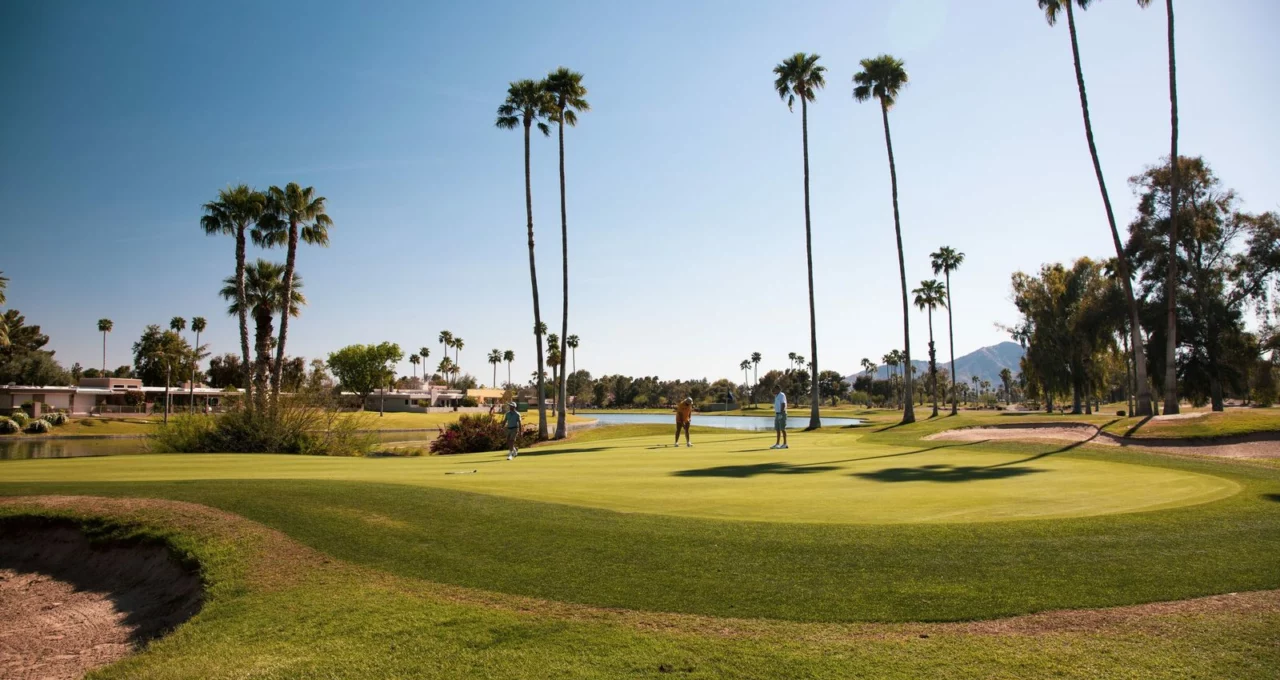
Arizona. Phoenix, Scottsdale, Mesa and Tucson are a classic winter base for Canadian golfers. Expect dry air, cool mornings and strong sun. Pack the toque and the fleece for early tee times, a full bottle of sunscreen in the checked bag, extra balls for the desert areas and lip balm for the dry air. If you travel in the fall, check overseeding closures first.
Palm Springs and the Coachella Valley. Palm Springs, Palm Desert, Indian Wells and La Quinta offer a similar desert pattern in California: chilly mornings, warm afternoons and low humidity, with wind sometimes funnelling through the valley. A packable wind layer earns its place here, and the same overseeding caution applies in autumn.
Florida. A long-standing favourite of Canadian snowbirds. Winter is drier than summer, and the south of the state is warmer than the north: a January stretch near Jacksonville or in the Panhandle needs a real jacket on some mornings, while the Gulf Coast around Fort Myers and Naples usually does not. Pack for humidity: extra gloves, a second towel, a light rain jacket and insect repellent for late rounds near water. Many Canadians also have home-course privileges to protect while they are away; our look at memberships for cottage and snowbird golfers covers that side of things.
Mexico. Los Cabos, Puerto Vallarta and the Riviera Maya are popular with Canadian golfers who want a resort week rather than a season. The sun is closer to the tropics and stronger, the humidity is higher on the Caribbean side, and seaside courses can be windy. Keep the FMMD with your passport, carry sunscreen and a hat that stays on in a breeze, and bring enough balls of the kind you like.
The Caribbean. The Dominican Republic, Barbados, Jamaica and the Bahamas, among others, have golf near the beach. Plan for heat, humidity and trade winds rather than cool mornings, and pack lighter: breathable shirts, a wind shirt, extra gloves and plenty of water-resistant sunscreen. Entry rules differ by country, so the travel.gc.ca destination page is your first stop.
Coming home
The return trip has its own rules. The Canada Border Services Agency allows a personal exemption of up to C$200 after an absence of 24 hours or more, and up to C$800 after 48 hours or more, and goods claimed under those two exemptions must be with you when you arrive. A new driver or a dozen boxes of balls bought on the trip counts toward that amount, so keep the receipts handy and declare them.
The packing list
- Documents: passport or NEXUS card for the U.S., FMMD for Mexico, travel insurance details with the emergency number, a copy left at home.
- Health: medication in its original packaging, blister plasters, a refillable water bottle.
- Layers: long-sleeve polo or base layer, vest or quarter-zip, packable wind shell, toque plus sun hat, shorts and trousers that meet dress codes.
- Sun: broad-spectrum, water-resistant SPF 30 or higher, a sunscreen stick, SPF lip balm, sunglasses.
- Liquids: one clear 1 L bag with containers of 100 ml or less in the carry-on, full-size bottles in the checked suitcase.
- Golf: three gloves, two towels, more balls than usual, tees, ball markers, divot tool, rangefinder.
- Carry-on: shoes, one outfit, glove, balls, rangefinder, travel sunscreen.
- Coming back: receipts for anything you bought, to declare at the border.
Pack the night before, tick the list, and leave the snow brush in the car. The only thing left to sort out on the first tee is which way the grain runs.