Golfing far from home in Canada: the provincial card, the cottage club and the snowbird winter
Many Canadian golfers live in one place and play in another: the cottage in summer, the mountains on long weekends, Florida or Arizona in winter. Membership at a distance here comes in three pieces, from a C$64.95 provincial card to a five-figure club initiation. Here is what each one costs, what it covers and which one your season really needs.
In brief
- Golf Ontario's Public Player membership was listed at C$64.95 in October 2026, valid 365 days, with a Handicap Index, event eligibility and equipment coverage; BC Golf's Player's Club was C$64.95 plus taxes for B.C. residents.
- Snowbirds keep one record: Golf Ontario says rounds played in Florida or Arizona during the Ontario off-season still count and are posted as away scores, as long as the course itself is in its active season.
- In cottage country and golf communities, non-resident often means not owning a home there: Cobble Beach listed its non-resident category at a C$50,000 initiation and C$5,900 in annual dues, plus taxes.
- Provincial resident green fees can beat any distant membership: Kananaskis Country listed C$114 for Albertans against C$175 standard for a Monday to Wednesday regular-time round in 2026, plus GST.
Ask a Canadian golfer where they belong and the answer is often two places at once. The house is in Toronto, Calgary or Halifax, but the summer weekends happen at the cottage, the mountain trips happen in Kananaskis, and the winter rounds happen in Florida or Arizona. A golf membership built on the idea that you live ten minutes from the first tee does not fit that life very well. So Canadians have quietly assembled their own version of “membership at a distance”, and it comes in three pieces: a Golf Canada card bought through a provincial association with no club attached, a resort or cottage-country club joined as a non-resident, and the provincial resident green fee that some courses offer to anyone with a local address. Each piece costs something very different, and each one answers a different question. Here is how to tell which of them your season actually needs.
Start with the question, not the price
Before comparing any fee, be honest about what you are trying to buy. In practice, Canadian golfers who look at a distant membership want one of three things.
Some want a number. They play public and semi-private courses near home, they want a Handicap Index to enter a club championship, a provincial qualifier or a net event, and they have no interest in a clubhouse. For them, the whole question is a card, not a club.
Some want a course. They spend July and August near a lake two or three hours from the city, or they own a place in a golf community, and they want guaranteed tee times there during the weeks they are around. That is a real club membership, with real money attached.
Some want both continuity and a winter. They play all summer at home, then spend part of the off-season in the southern United States, and what they really need is for their rounds on both sides of the border to land in one record.
The card without a club: what a provincial association sells you
Every golfer who holds a Handicap Index in Canada does so through Golf Canada and a provincial association. Most get it bundled into their club dues without noticing. Golfers with no club can buy the same membership directly, and the provincial associations present it as the full package rather than a lesser tier.
In Ontario, Golf Ontario says plainly on its membership page that golfers who are not tied to a private or semi-private club can join as a Public Player “with all the same member benefits”. The page listed the Public Player fee at C$64.95 when we read it in October 2026, with coverage and membership valid for 365 days from the date you enrol rather than for a fixed season. The same page lists what comes with it:
- an official Handicap Index under the World Handicap System, with the Golf Canada Score Centre and the Golf Canada app to post rounds;
- eligibility for regional, provincial and national events sanctioned by Golf Ontario and Golf Canada;
- incident protection, including up to C$1,500 for damaged, lost or stolen equipment and up to C$1,500 for golf cart accidents;
- free online Rules of Golf education and 15% off tickets to the RBC Canadian Open and the CPKC Women’s Open.
For comparison, Golf Ontario’s 2026 fee structure sets the individual fee that clubs pass on to each adult member at C$44.00 plus HST, or C$49.72. Club members pay that inside their dues; public players pay a little more because the association handles the membership directly. The gap is small enough that it should never decide anything on its own.
In British Columbia, the equivalent is the British Columbia Golf Player’s Club. Its membership page, read in October 2026, set the fee at C$64.95 plus applicable taxes and limited it to golfers who live in British Columbia. Older BC Golf pages still online quote lower figures; the sign-up form at the moment you pay is what counts. BC Golf also allows a group of 15 or more golfers who do not belong to a private or semi-private club to form their own Public Player Member Group, which is how many leagues and men’s and women’s nights end up with handicaps.
Other provinces run comparable options with their own prices and residency rules; check yours directly.
What the card does not do
It gives you no access to any course, no member rate, no booking privileges and no locker. It also does not produce an index on day one: Alberta Golf’s 2026 registration guidance reminds players that an index needs at least 54 holes of submitted scores, in any mix of nine-hole and 18-hole rounds. If you want to enter something in June, start posting in May.
And it is not a pass into every competition. Alberta Golf’s championships and qualifiers require an active Golf Canada membership and, for most events, a valid Handicap Index. The card meets that bar. A member-guest or a club’s own invitational, on the other hand, is set by the host club, and the card has nothing to say about it.
Your index can spend the winter in the south
This is where the card earns its keep for snowbirds. Golf Ontario sets the start and end of its inactive season according to local weather and course conditions. But an inactive season at home does not freeze your record when you play somewhere that is still in season.
Golf Ontario’s handicapping guidance, dated January 2025, is direct about it: if you play outside Ontario during the inactive season, for example in Florida or Arizona, those scores still count, and you post them as an “Away” round. The reverse is also true. A round played on a course that is itself in its inactive season is not acceptable for handicap purposes, because course conditions in that period do not match the conditions under which the course was rated.
Golf Canada has also explained for years that its system is linked to the American one through the International Golf Network, and that a Canadian does not need to belong to a U.S. club to post: you can post as a guest at the course, provided that course is part of its state association. In practice, a Canadian who spends three winter months on public courses in the Sun Belt can keep one continuous record without buying anything American at all.
Where it gets more complicated is when a snowbird does join a club down south. Then you have two memberships and one index, and you need to know which club is your home club for handicap purposes. Settle that with both clubs before the first winter round, not in April when the scores need to be reconciled.
The cottage club and the golf community: what non-resident really means here
The second piece is the expensive one. In Canada, a lot of distant membership happens in cottage country and in golf communities, and the word “resident” often has nothing to do with how far away you live. It usually means whether you own a home in the development.
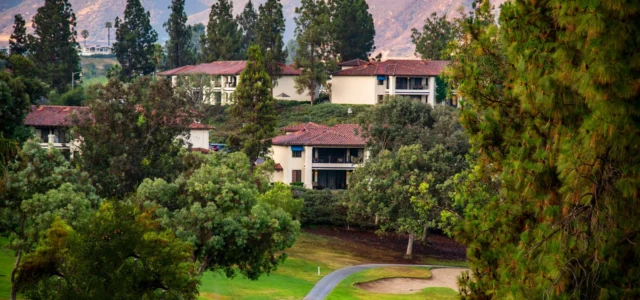
Cobble Beach, on Georgian Bay in Ontario, shows the logic clearly. Its rates page, read in October 2026, explains that the resident golf membership carries no initiation fee for new home buyers, because the initiation is included with the purchase. The non-resident golf membership, the category for everyone outside that arrangement, listed a principal initiation fee of C$50,000 and principal annual dues of C$5,900, with a spousal initiation of C$25,000 and spousal dues of C$4,900, all subject to applicable taxes. Both categories came with 17-day advance booking. The page does not say anything about a distance test or a cap on rounds, so do not assume either exists; ask.
Muskoka Bay Resort in Gravenhurst, deep in Ontario cottage country, listed a principal membership when we read its page in October 2026, with a C$45,000 initiation, C$8,160 in annual dues and a C$1,500 food and beverage minimum. The page also presents a multi-club option that pairs unlimited play and priority tee times at a home club with access to two additional clubs. None of these categories is labelled non-resident, but for a family whose main house is in the city, that is exactly what a cottage-country membership is.
Those figures are the headline. What decides whether the deal is good for a part-time member sits elsewhere:
- The food and beverage minimum. At Muskoka Bay it is listed separately from dues. A member who is there eight weekends a summer pays it in full anyway.
- The initiation fee and what happens to it. At these amounts, whether it is refundable, transferable or simply gone when you resign matters more than the dues.
- Seasonal reality. A course in cottage country is open for a Canadian season, not a year. Dues spread over twelve months buy a few months of golf.
- Taxes. Both clubs above quote fees subject to applicable taxes, which in Ontario means HST on top.
Provincial resident rates: the membership you may already hold
There is a third piece that rarely gets called a membership, but works like a small one: some courses charge less to people who live in the province. For golfers who only travel within Canada, it can change the arithmetic more than any club category.
The Kananaskis Country golf courses in Alberta, for instance, listed 2026 rates where a Monday to Wednesday regular-time round was C$175 at the standard rate and C$114 at the Alberta resident rate, while Thursday to Sunday regular times went from C$200 to C$129. Rates are subject to 5% GST, and residents must show proof of residency at check-in.
On Cape Breton, Le Portage Golf Club in Chéticamp listed 2026 green fees of C$140 plus HST for an 18-hole guest round in peak season, against C$100 plus HST for a Nova Scotia resident, and C$120 against C$80 in the shoulder seasons. Proof of residency is required there too.
Neither is a membership or a handicap. But for an Albertan who drives out to the mountains a dozen times a summer, a residency discount on every round may do more than any distant club, and it costs nothing to hold.
Doing the arithmetic for a short season
Canadian golfers are usually told to divide dues by rounds. That is right, but in a five- or six-month season the result is often sobering, so do it with real numbers.
Take the Cobble Beach non-resident category above and set the initiation aside for a moment. Dues of C$5,900 spread over 40 rounds come to C$147.50 a round before taxes; over 20 rounds, C$295. Then put the initiation back in: C$50,000 spread over ten seasons is another C$5,000 a year, before any return of it you might negotiate. A part-time member who plays 20 times a summer is paying several hundred dollars a round, which is far more than a premium public green fee in most of the country.
Now take the card. C$64.95 for 365 days of Handicap Index, posting tools, event eligibility and equipment coverage. If what you want is to play anywhere, from a municipal nine to a championship layout of 7,000 yards, and still have a number that means something, nothing else in Canadian golf gives you more per dollar.
The honest test: count last season’s rounds, not the ones you meant to play. If that number does not justify a club, the card plus green fees is the answer.
Where a distant membership makes sense in Canada
Ontario cottage country and Georgian Bay. This is where non-resident and part-time membership is most natural, because so many members are city families who spend the summer there. It is also where the costs are highest, so read the food and beverage minimum and the initiation terms closely.
The Rockies. For Albertans who play in the mountains, the resident green fee often does the job of a membership. Pair it with a provincial card if you want an index, and you have covered most of what a Calgary or Edmonton golfer needs from a course they visit rather than live by.
The B.C. coast. Golf Ontario’s own handicapping notes point out that some regions, such as British Columbia, stay active year-round thanks to the climate. A coastal golfer can post through the winter, so the snowbird problem matters less, and the Player’s Club card is often all a public-course player needs.
Atlantic Canada. Some destination courses, like Le Portage on the Cabot Trail, price visitors and residents differently. A Maritimer leans on the resident rate; a visitor budgets for the guest rate rather than hunting for a membership.
Snowbirds anywhere in the country. Keep your home provincial membership active, post your winter rounds as away scores from courses that are in their active season, and only consider a club in the south if you will play there often enough to justify it in U.S. dollars.
Before you sign anything
Whatever piece you are looking at, the same short list sorts the good deal from the expensive habit:
- What problem am I solving? A number, a course or a winter. Buy only the piece that answers it.
- What does it cost all in, taxes included? Initiation, dues, food and beverage minimum, cart and storage fees, plus GST or HST.
- How many rounds will I really play there? Use last season’s count. A cottage club at 20 rounds is a very different deal from the same club at 60.
- How does the club define non-resident? Distance in km, home ownership in the development, or something else. Get it in writing, along with any limit on rounds or booking.
- What happens if my life changes? Selling the cottage, moving closer, retiring south: ask whether the category changes and what happens to the initiation fee.
- Is my provincial card current? Check the 365-day renewal date before the season opens, and post at least 54 holes early if you need a fresh index for June events.
For most Canadians who play at a distance, the starting point is the least glamorous one: a provincial association card, a list of courses with good resident or public rates, and a habit of posting every round, at home and in the south. A cottage or resort club can be wonderful, but it should be the answer to a clear question, not the default. Count the rounds first, then sign.