Hard or soft golf travel bag: a molded case, a wheeled bag, and what U.S. airlines cover
Hard protects more and soft is easier to live with, but that is not the whole choice. Some U.S. airlines tie their liability for golf clubs to a hard-sided case, and an 18-pound case eats into a 50-pound allowance. Here is one well-known example of each kind, at U.S. prices read on November 11, 2026, with what golfers say about them.
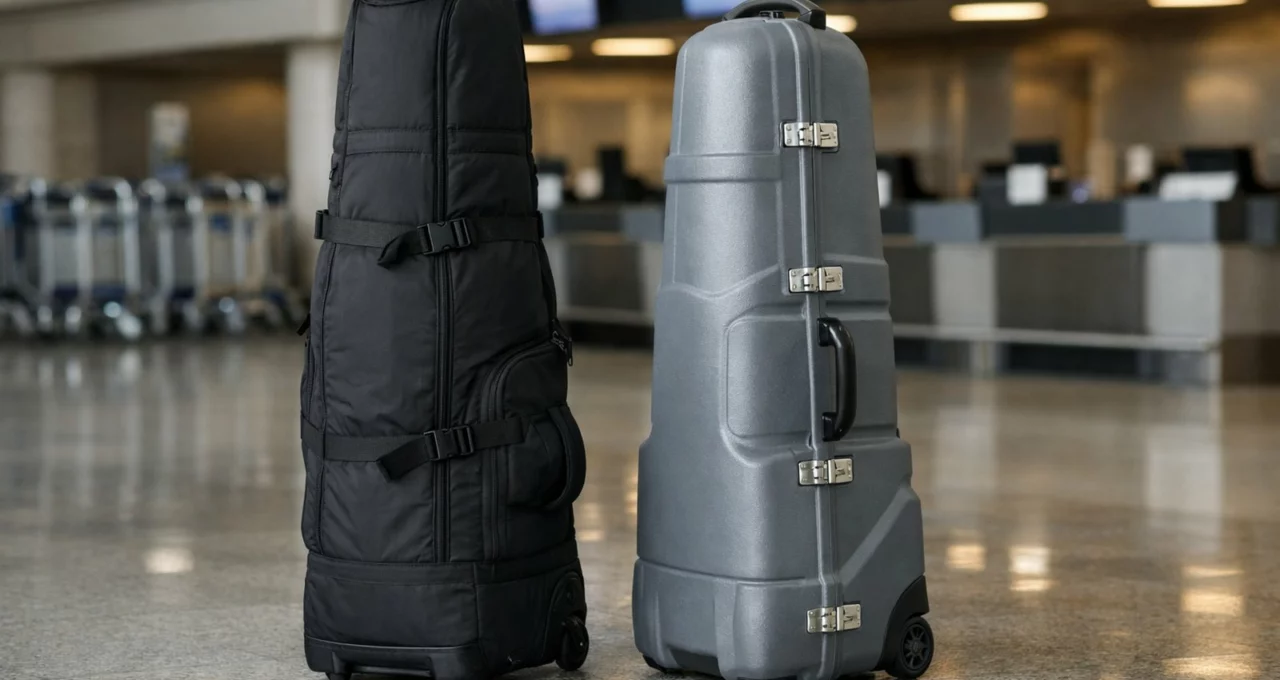
In brief
- The two examples: the SKB Deluxe Standard ATA hard case ($304.99) and the Sun Mountain ClubGlider Meridian soft bag with fold-out legs ($379.99), prices read on November 11, 2026.
- Delta asks for a hard-shell case and accepts a soft-sided golf travel bag only with a signed limited release; check your own airline's golf rules before you buy.
- Golfers praise the hard case for protection and its locking latches, and criticize its size, weight and the fight with a rental car; the soft bag wins on rolling and storage and loses on price and bulk.
- Whichever you choose, stand a support rod next to the driver, pad the clubheads, stay under 50 pounds and photograph the clubs before you close the bag.
Every golfer who books a winter trip ends up at the same fork: a hard case that looks like it could survive a fall off the baggage cart, or a padded soft bag that weighs half as much and folds under a bed. The usual advice stops at “hard protects more, soft is easier,” which is true and not much help. The more useful question is what happens at the claims desk when a driver comes off the carousel in two pieces, because several U.S. airlines treat the two kinds of bag differently. This page presents one well-known example of each, a molded hard case and a wheeled soft bag, with the specifications their makers publish, U.S. prices read on November 11, 2026, and what golfers and reviewers say about living with them. Nobody at Panxis Golf flew with either one for this page.
Start with the airline, not the bag
A travel bag does two jobs. It protects the clubs, and it decides what the airline will accept responsibility for. Most golfers shop for the first job and discover the second at the check-in counter.
Delta’s sporting equipment page asks for golf clubs to travel in a hard-shell case, and accepts a soft-sided golf travel bag only with a signed limited release. That release is the form a counter agent may hand you with a soft bag: by signing it, you accept that the airline’s responsibility for damage to the contents is limited. Guides to airline golf policies report similar positions at United and American, where liability for damaged golf equipment is tied to a hard-sided case, and in American’s case to visible damage on the outside of that case. Other carriers accept both kinds of bag without a release. The wording changes, so read the golf section of your own airline’s baggage page before you buy anything, and read it again before you fly.
Two practical points follow. First, a soft bag is not a reckless choice, and plenty of golfers fly with one for years without a problem. But on some airlines it moves the risk of a snapped shaft from the carrier to you, and that is worth knowing before you choose. Second, a hard case is not a guarantee. A claim still depends on the airline’s rules, on reporting the damage before you leave the airport, and on the limits of liability that apply to all checked baggage.
The other number that matters is weight. A golf bag is generally checked as an ordinary bag, and the ordinary limit on most U.S. carriers is 50 pounds before overweight fees begin. A full set of clubs in a stand bag with shoes and balls already uses up most of that. Every pound the travel bag weighs is a pound you cannot pack.
The hard case: SKB Deluxe Standard ATA
SKB makes molded transport cases for musical instruments, cameras and firearms, and its golf cases are built the same way: a rigid plastic shell in two halves, closed with latches, on two built-in wheels. The Deluxe Standard ATA, model 2SKB-4814W, is the size most golfers look at first.
What the published specifications say:
- Interior: 48 inches long, 14 inches wide and 11 inches deep, according to the specification sheet carried by U.S. dealers.
- What fits: stand bags and carry bags, a pair of shoes, and drivers up to 48 inches. The listing warns that it will not take newer stand or cart bags with a molded top handle that makes the bag more than 12 inches wide.
- Closure: latches with TSA-accepted locks, so security staff can open the case without cutting anything.
- Weight: dealer listings and published reviews put the empty case between about 18 and 21 pounds. Check the figure on the page you buy from.
- Warranty: SKB advertises a lifetime warranty on the case and, on selected golf cases, coverage of up to $1,500 to repair or replace clubs damaged by a commercial airline while secured inside an ATA-rated case. Read the conditions on the maker’s site, because the coverage applies to selected products only.
On November 11, 2026, a U.S. online retailer listed the case at $304.99, against a list price of $344.39.
The arithmetic is the thing to notice. At 18 pounds or more, the case leaves roughly 30 pounds for a bag, fourteen clubs, shoes and balls under a 50-pound limit. That works with a light stand bag. It does not work with a loaded cart bag and a week’s worth of rain gear.
The soft bag: Sun Mountain ClubGlider Meridian
The ClubGlider is the soft bag that changed what golfers expect from the category. Its distinguishing feature is a pair of retractable legs with wheels that fold out from the body of the bag. With the legs down, the bag rides on four wheels and carries its own weight, so you steer it through the terminal instead of dragging it. With the legs folded, it loads like any other travel bag.
What the published specifications say:
- Weight: 11.3 pounds, according to the maker’s product page.
- Interior: about 52 by 14 by 14 inches in a U.S. dealer’s listing for the 2026 model.
- Construction: a fabric shell with dense padding around the top, where the clubheads sit, and a molded base that carries the wheels and the leg mechanism.
- Storage: the shell is soft, but the base and the legs are not, so it folds down less than a plain padded cover.
On November 11, 2026, a U.S. golf retailer listed the 2026 ClubGlider Meridian at $379.99.
Yes, the soft bag costs more than the hard case here. Price does not track hardness in this category: it tracks wheels, fabric and engineering. Plain padded covers without legs sell for far less than either product on this page, and molded cases built for touring professionals cost far more.
At 11.3 pounds, the ClubGlider leaves close to 39 pounds for everything inside it, which is the difference between packing shoes and a rain suit with the clubs and paying for a second bag.
What golfers are saying
Here is what comes back in published reviews, golf forums and travel columns about the two products and about the two kinds of bag. These are recurring themes, not a survey.
Hard cases and the SKB, praise. Protection is the reason people buy one, and reviewers place the SKB among the most protective cases they have looked at. The metal latches and the built-in TSA locks are singled out, as is the foam inside the top that holds the clubheads still. Golfers who have already had a club broken by an airline are the ones who say they will not go back to a soft bag, and the claims rules described above are the second reason they give.
Hard cases and the SKB, criticism. Size comes first. The interior is tight for a bulky bag, the case cannot be folded, and it has to live somewhere between trips. Travel writers compare hauling a hard case through an airport and down a hotel hallway to moving furniture, and getting one into a rental car with a second golfer’s luggage is a recurring complaint. The weight eats into the 50-pound allowance. And golfers on the forums point out that hard cases get broken too: a cracked shell or a bent latch is not unheard of.
Soft bags and the ClubGlider, praise. The legs are the headline: reviewers describe a bag that stands on its own in the check-in line and rolls with one hand. The room inside surprises people, with space for a cart bag plus shoes and clothes. The padding around the top is described as thick, and published reviews report clubs arriving intact. More generally, golfers like that a soft bag fits across the back seat of an ordinary rental car and under a bed at home.
Soft bags and the ClubGlider, criticism. Price is the most common objection. Several reviewers find it heavy and bulky for a soft bag, and note that the legs take a few tries to fold and unfold smoothly. One asks for a harder base, because the bag gets dirty where it stands. Beyond this model, the standing criticism of soft bags is the one that matters most: without a support rod, the driver is the tallest thing in the bag and takes the hit when the bag is dropped on its top. And cheap soft covers draw a warning of their own, for torn straps and failed wheels.
Five questions that settle it
Which airline do you fly most? If its policy ties liability to a hard-sided case, and you carry a driver that costs $600 to replace, the hard case has an argument no amount of padding can match.
How heavy is your golf bag? Weigh it loaded on a bathroom scale. Add the weight of the travel bag. If a hard case takes you past 50 pounds, you will either pay overweight fees or leave things out on every trip.
What do you drive at the other end? A hard case is a rigid object about four and a half feet long. Two of them, plus two suitcases, will not go into a mid-size rental sedan. A soft bag bends around a wheel arch.
Where will it live for the other fifty weeks? A hard case needs a garage wall or a closet of its own. A soft bag folds, at least partly.
How often do you fly with clubs? For one trip a year, renting clubs at the destination or shipping your own may make more sense than owning either bag. Our page on flying with golf clubs compares those options.
Whichever you choose, protect the top
Most damage happens at the clubhead end. A support rod, an adjustable pole slightly taller than the driver that stands in the bag with the clubs, costs little and takes the impact when a bag lands upside down. It is essential in a soft bag and still sensible in a hard case, where the clubs can slide toward the top.
Then fill the space. Wrap a towel around the heads of the woods, leave the headcovers on, and pack rain gear or a sweater around the irons so nothing rattles. If your driver has an adjustable hosel, take the head off with the wrench that came with it and carry the head in your hand luggage or in a shoe inside the bag. Finally, take a photo of the packed clubs before you close the bag. It is the first thing a claims agent will ask for.
If the trip is to somewhere warm, our winter sun packing list covers what goes in around the clubs.
Where to buy a golf travel bag in the U.S.
A travel bag is one of the few golf purchases worth making in person, because size is the whole question.
- Large golf and sporting-goods stores usually keep several travel bags on the floor. Bring your own golf bag, or its measurements at the widest point of the top, and ask to put it inside the model you are considering.
- Your club’s pro shop may stock one or two models and can often order others. The advantage is a person who has seen what members’ bags look like after a trip.
- Luggage and case specialists carry molded hard cases, since the same makers build cases for instruments and cameras. They tend to know the warranty terms well.
- Online gives the widest choice. Check the return policy first: sending back an oversized box is expensive, and some sellers charge a restocking fee.
- Used is a real option for hard cases, which are bought for one trip and then sit in garages. Check the latches, the wheels and the hinges, and ask whether the warranty transfers, because it often does not.
Whatever the seller, ask three things: the empty weight, the warranty and who handles a claim, and whether a support rod is included.
Before you check in
- Read your airline’s golf section and note whether a soft bag needs a signed release.
- Weigh the packed bag at home and stay under 50 pounds, or under your carrier’s own limit.
- Stand a support rod next to the driver, pad the heads and remove an adjustable driver head.
- Photograph the clubs and the outside of the bag.
- Put your name and phone number inside the bag as well as on the tag.
- At the carousel, open the bag before you leave the baggage hall, and report any damage at the airline’s desk on the spot.
How this page was put together
This is a neutral presentation, not a hands-on review. The specifications are those published by SKB, Sun Mountain and their U.S. dealers; where sources disagree, as they do on the weight of the SKB case, the page gives the range. Prices were read on November 11, 2026: the SKB Deluxe Standard ATA at OpticsPlanet and the 2026 Sun Mountain ClubGlider Meridian at Golf Discount. The airline rules come from Delta’s sporting equipment page and from published guides to U.S. airline golf policies; they change, and the airline’s own page is the only reference that counts on the day you fly. The opinions were read in published reviews from Critical Golf, GolfWRX, National Club Golfer, Golf Monthly and GolfMagic, in the travel columns of Golf.com, and in threads on the Team Titleist and MyGolfSpy forums. No bag was packed, flown or dropped by us, and no club was hit. Panxis Golf has no commercial link with any brand or retailer named here and earns no commission. If a piece of content is ever paid for by a brand, it will carry an advertising notice at the top of the page.