Flying with your clubs: how to pack a travel bag
The damage happens at the top of the bag, when a loaded travel bag is dropped on its end and the longest shaft takes the weight. A support rod and a towel prevent nearly all of it.
In brief
- Buy a support rod that stands above the driver head. It costs a fraction of a driver.
- Turn the heads inward, headcovers on, clothing packed around them.
- Read your airline's sporting equipment page before booking and again before flying.
- Lithium batteries and rangefinders travel in hand luggage.
- For one round on a business trip, renting beats two bag fees.
Clubs travel well when they are packed properly and badly when they are not. The damage almost always happens at the top of the bag, where the shafts of the longest clubs sit unsupported, and almost all of it is preventable with a stick and a towel.
The failure mode is worth picturing, because it explains every piece of advice below. A loaded travel bag stood on its end and dropped, which is what happens at a baggage transfer, puts the entire weight of the bag through the longest shaft in it. That is how a driver arrives in two pieces, and it is why the single most useful item you can buy is a rod that takes the impact instead.
Hard case or soft bag
A hard case protects better and weighs more. A padded travel bag is lighter, folds away in a hotel closet at your destination, and relies on you packing sensibly.
Most golfers who travel a few times a year are well served by a good soft bag with a support rod. Golfers who fly often, who carry expensive graphite shafts, or who connect through busy hubs where bags are handled repeatedly, are better off with a hard shell and should accept the weight penalty.
The middle option, a soft bag with a rigid base and reinforced top, covers most cases. Whatever you use, it must have wheels: a loaded travel bag weighs around 40 pounds and American terminals are long.
Pack the top of the bag first
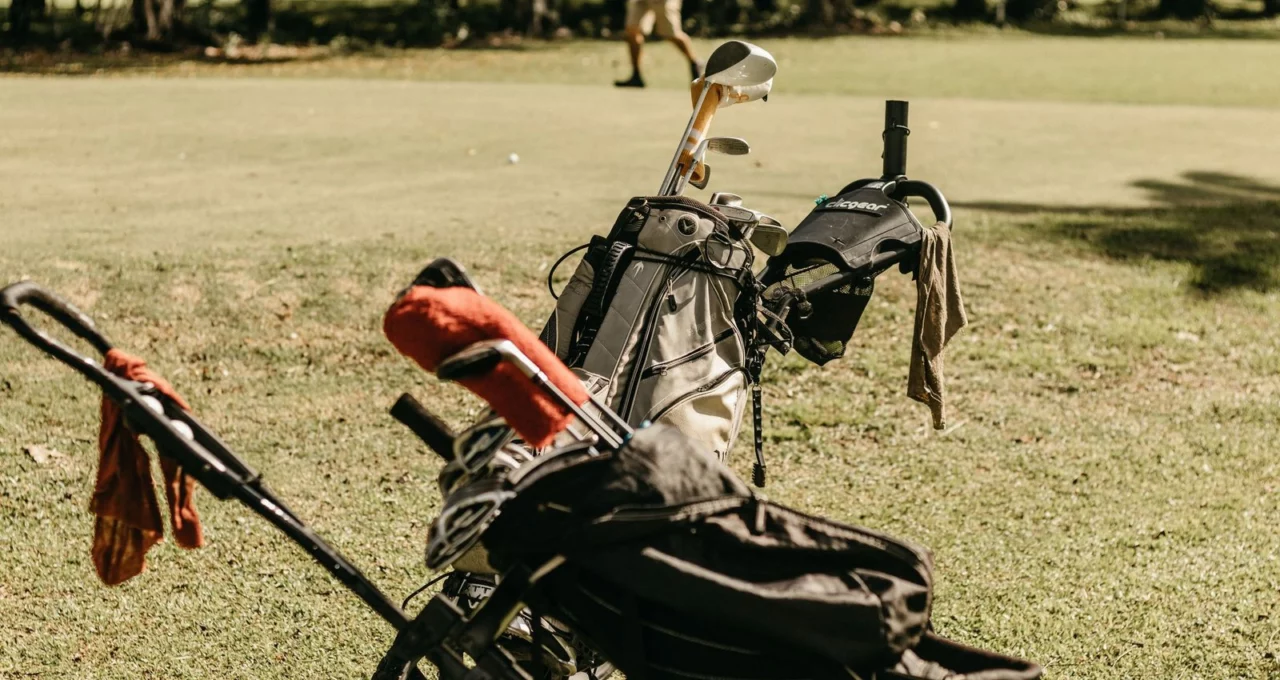
Buy a support rod, usually sold as a stiff arm. It extends above the driver head and takes the impact if the bag is dropped on its end, and it costs a fraction of a driver. If you do not have one, a length of PVC pipe cut to size or an inverted umbrella alongside the longest clubs does the same job.
Then turn every clubhead in toward the middle of the bag so nothing sits against the outer wall, put headcovers on the woods, and wrap a towel around the crowns. The crown of a driver is the part that scratches, and it scratches against the shaft of the club next to it rather than against the case.
Fill the space around the heads with soft clothing. It protects the clubs, it stops everything shifting in transit, and it saves room in your suitcase, which is worth something when the second bag fee is what it is.
Weigh the finished bag at home on a bathroom scale. It is the single easiest way to avoid a surprise at the counter.
What the airline expects
U.S. carriers generally accept golf clubs as checked baggage, and several count a golf travel bag as one standard checked item rather than as oversized sports equipment, which makes it considerably cheaper than golfers expect.
Policies and fees change regularly, and they differ between domestic and international routes on the same airline. Read the sporting equipment page of your specific carrier before you book and again in the week before you fly, and print or screenshot it, because a gate agent applying the wrong policy is easier to correct with the airline’s own page on your phone.
Weight limits still apply, and a packed travel bag near the limit is common. The excess-weight charge is usually more than the bag fee itself, so if you are close, move the shoes into your suitcase.
On regional aircraft, oversized items sometimes travel on a later flight even when yours does not. If you are connecting onto a small aircraft for the last leg, build in a day before your first tee time.
Security, batteries, and the small print
Clubs must be checked and can never be carried on. The Transportation Security Administration allows golf balls, tees and shoes in either bag.
Rangefinders and anything else with a lithium battery should travel in your hand luggage, which is where airlines want loose lithium cells, and where a device worth several hundred dollars belongs anyway. The same applies to a GPS watch and to any launch monitor.
Use a TSA-approved lock or none at all. A lock that has to be cut protects nothing and leaves your bag open for the rest of the journey. Put a tag with your name and phone number inside the bag as well as outside, since outside tags are the first thing to come off on a carousel.
Insurance and tracking
Airline liability for checked baggage is capped by regulation and rarely covers the full replacement cost of a modern set, particularly one that has been fitted.
Before buying separate cover, check whether your homeowner’s or renter’s insurance already covers sports equipment away from home, and whether the credit card you booked with includes baggage protection. Many do, and the coverage is frequently better than what an airline offers at the counter.
A tracking tile in a side pocket costs very little and turns a lost bag into a delayed one, because you can tell the airline where their bag actually is rather than filing a report and waiting. This has become the single most useful item in a travel bag after the support rod.
Shipping instead of flying with them
Club shipping services exist in the United States precisely because bag fees, weight limits and the risk of a lost set add up. They collect from your home or club, deliver to the resort’s bag room, and hold your set for the return.
The arithmetic is worth doing rather than assuming. For a single golfer on a short domestic trip, checking the bag is usually cheaper. For a group, for a longer trip, or for anywhere involving a connection onto a small aircraft, shipping is often comparable in price and considerably less trouble, and your clubs are waiting when you arrive.
Confirm two things with the resort before booking any of this: that they accept shipped clubs and hold them, and what they charge to store and return them.
The alternative: rent at the other end
Resort courses and many destination clubs rent current-model sets, and for a short trip the rental cost can be less than two airline bag fees.
It is the obvious answer for a single round on a business trip, where carrying a set across the country for four hours of golf makes no sense. It is a poor answer for a week of golf, where playing clubs you know matters and where the rental cost multiplies by the round.
If you do rent, bring your own putter and your own wedges if you can. Those are the clubs where feel matters most and they fit in a suitcase.
Where to buy the gear in the U.S.
Large U.S. golf and sporting-goods chains all carry travel bags, hard cases and support rods in store, which is worth using because a travel bag is a thing you want to see the size of before buying. Manufacturers sell directly, and last season’s models are frequently identical and discounted.
For the trip itself, check the resort’s own page for rental sets and shipping policy rather than relying on a booking site, and check your airline’s sporting equipment page rather than a summary of it. Panxis Golf has no commercial relationship with any airline, retailer, shipper or resort mentioned here, and earns no commission.
What to do when the bag does not arrive
It happens, and the difference between a lost afternoon and a lost trip is what you did in the first hour.
File the claim at the airport before leaving, not later by telephone, and keep the reference number. Airlines are obliged to handle delayed baggage and most will deliver it to a hotel or a resort, but the claim has to exist first.
Then tell the golf course. Resort and destination properties deal with this every week, they keep rental sets for exactly this reason, and many will hold or move a tee time if you call early. A club that knows at eight in the morning can help; one that finds out at the first tee cannot.
Most airlines reimburse reasonable essential expenses during a delay, which can include a rental set, so keep the receipts and ask what their policy is rather than assuming it is nothing. Travel insurance and credit card baggage cover frequently pay where the airline will not.
The preventive measures are the same three as everywhere else: a tracking tile so you know where the bag actually is, a contact tag inside the bag as well as outside, and a day of slack between arriving and your first tee time.
Carrying on what you cannot replace
Decide before packing which items would genuinely spoil the trip if they went missing, and carry those.
For most golfers that is short and specific: the rangefinder or GPS watch, a glove, golf shoes if they are broken in, and a putter if you can fit it. Everything else in a bag is replaceable at a pro shop for money.
Shoes are the one people forget. A rental set solves the clubs, and nothing solves a day of golf in shoes that do not fit.
A packing list that survives the carousel
- Support rod above the longest club, headcovers on, heads turned inward.
- Clothing packed around the heads, towel over the crowns.
- Bag weighed at home before you leave for the airport.
- Rangefinder, watch and anything with a lithium battery in hand luggage.
- Name and number inside the bag as well as outside, tracker in a side pocket.
- Airline policy screenshotted, and a spare day before the first tee time if you connect.
Ten minutes of packing is the difference between arriving with a set of clubs and arriving with a story about one.
How this page was put together
Information on the availability of travel bags, hard cases and support rods in U.S. stores comes from PGA TOUR Superstore, Golf Galaxy and Dick’s Sporting Goods. Panxis has no commercial relationship with these retailers.