Golf gifts under A$50 for a summer Christmas, and what to ask about returns, vouchers and Boxing Day
An Australian Christmas falls in peak golf season, so the best cheap gifts are the ones that get used on Boxing Day. Four that cost A$21.59 to A$42.95 this week, what golfers say about each, and what to ask about change-of-mind returns and gift vouchers before you pay.
In brief
- The four gifts: Srixon Q-Star Tour 6 balls (A$42.95 a dozen), FootJoy RainGrip glove (A$26.95), PuttOUT Premium Pressure Putt Trainer (A$39.96) and Pitchfix Hybrid pitch mark tool (A$21.59), prices read on 8 November 2026.
- The Titleist Tour Soft misses the budget in Australia (A$50.99 at best), but a three-piece urethane ball fits under A$50; a glove for sweat and summer storms replaces the northern winter glove.
- Golfers praise the Q-Star's value around the greens, the RainGrip's hold on wet and humid days, the PuttOUT's instant pace feedback and the Pitchfix's build; complaints are a soft feel for fast swingers, faster wear in the dry, short straight putts only, and markers lost off the magnet.
- Change-of-mind returns are store policy, not a right under the Australian Consumer Law, so ask before you pay; most gift cards must be valid for at least three years.
Christmas in Australia lands in the middle of the golf season, not at the end of it. The present unwrapped on the 25th can be on the course by Boxing Day, in 33 degrees, with a storm building over the clubhouse by mid-afternoon. That changes what makes a good cheap golf gift here. A beanie or a pair of winter mitts makes no sense in December, and a gadget that only works on a frosty morning will sit in the cupboard until June. This page looks at four gifts that cost less than A$50 each in Australia this week, from A$21.59 to A$42.95, read on 8 November 2026. For each one: what the maker says, what golfers report in public, and what to check before you wrap it. Then a local section on where to buy, and what to ask about returns, vouchers and the Boxing Day sales.
One thing up front: nobody at Panxis Golf has used any of these products. This is a summary of maker information, Australian prices and published opinion, not a test.
What a sub-A$50 golf gift has to do
The test is simple. A gift worth giving gets used every week, it does not depend on the golfer’s swing or club specs, and it is something they would not quite get around to buying for themselves. That rules out clubs, shafts and grips, all of which need a fitting or at least a conversation. It rules out most electronics at this price, too. What remains is a short list: a better box of balls, something for the hands in heat and summer storms, a simple putting aid, and a small accessory built to last.
The calendar works in your favour. December and January are peak golf months in most of the country, with daylight saving giving long evenings in New South Wales, Victoria, South Australia, Tasmania and the ACT. Whatever you choose will be used straight away, so it pays to think about the conditions it will meet: hard sunlight, sweaty hands, sudden afternoon downpours in Brisbane and Sydney, and fast, firm greens.
A urethane ball under A$50: Srixon Q-Star Tour 6
Balls are the gift nobody can get wrong, because everyone loses them. The idea is to buy a dozen that are a step above what the golfer usually picks up, without spending premium money on someone who leaves three in the dam every round.
The obvious candidate overseas is Titleist’s Tour Soft, and it was the first ball we looked for. In Australia it misses the budget: on 8 November 2026 the lowest price we could read for a dozen was A$50.99, with other Australian listings at A$53.96 and A$59.95. So it is left out here.
What does fit, and this is the surprise of the Australian price list, is a urethane ball. Srixon’s Q-Star Tour 6 is a three-piece ball with a urethane cover, the softer, grabbier material used on tour balls. Srixon describes the 2026 version as its softest tour-level ball, with a reworked core that is slightly firmer than before for ball speed, an even softer cover for more spin on approach shots, and a coating it calls Spin Skin to help the cover bite on iron and wedge grooves. It is aimed at moderate swing speeds. On 8 November 2026 an Australian golf retailer listed a dozen at A$42.95, in white and yellow, with a two-tone Divide version at the same price.
If the golfer already plays a Pro V1, a TP5 or a Chrome Soft, this is a sideways move, not an upgrade. If they play whatever is in the bargain bin or the bucket of lake balls, it is a real step up around the greens. Our page on premium and mid-range golf balls explains where the differences actually show.
For sweaty hands and summer storms: FootJoy RainGrip
In the northern hemisphere this slot goes to a winter glove. Here, the hands have the opposite problem. A leather glove soaked in sweat on a humid January afternoon slips just as badly as one caught in the rain, and summer in Queensland and coastal New South Wales delivers both.
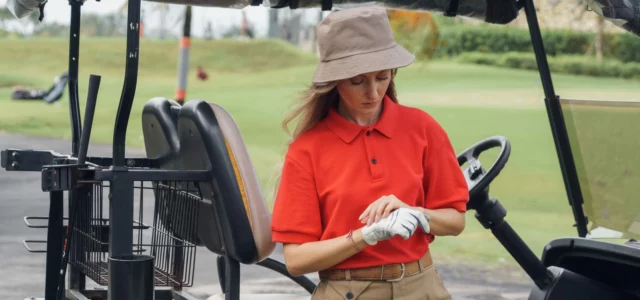
FootJoy’s RainGrip is a rain glove, but it is useful well beyond wet days. FootJoy describes a water-absorbent Sure-Grip Autosuede knit palm that is meant to grip better as it gets wet, quick-drying material on the back of the fingers, and an angled tab closure for a secure fit. It is sold as a single glove for the lead hand, in a men’s and a ladies’ version, and in sizes from small to double extra large. On 8 November 2026 an Australian golf retailer listed it at A$26.95, and another had it marked down to A$21.56.
Size is the thing to get right. Check the size printed inside the cuff of the golfer’s current glove, and remember which hand they play: a right-hander wears the glove on the left hand. Some golfers keep a rain glove in the bag only for storms and sweaty back nines, which is part of its appeal. Our guide to gloves, heat and sweat covers the leather versus synthetic question in more detail.
Putting practice in the lounge room: PuttOUT Premium Pressure Putt Trainer
Summer is not the off-season here, but the evenings after work, the days of extreme heat when the course is closed or simply too hot, and the week of family visits all leave time for putting on the carpet. A plain plastic cup does not teach much. The PuttOUT trainer has become one of the most reviewed small training aids in the British and American golf press.
It is a curved ramp that folds flat. A putt struck at the right pace runs up the ramp and settles in a small target near the top; too firm or too soft, and the ball rolls back towards the golfer. The maker’s pitch is that the micro target is harder to find than a real hole, so the cup looks bigger on the course. On 8 November 2026 an Australian golf retailer listed it at A$39.96, down from A$49.95.
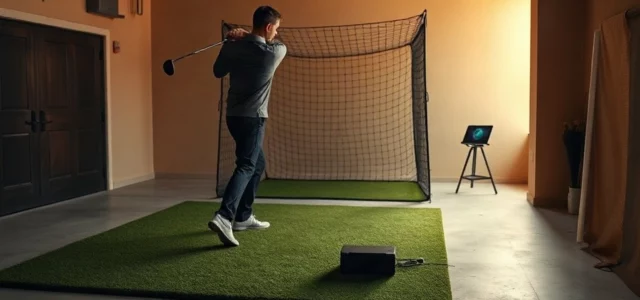
It works on carpet, on a hard floor with a rug, and on the practice green, and fits in a bag pocket. Our page on practising at home in two square metres has drills that use exactly this kind of target, mostly from 1 to 2 metres.
A pitch mark tool that stays in the pocket: Pitchfix Hybrid
Every golfer owns a pitch mark repair tool, and most of them are free plastic forks that snap within a season. On firm summer greens a ball landing from height still leaves a mark, and a metal tool that opens with a button and closes again so it cannot tear a pocket is an upgrade people tend to keep for years.
The Pitchfix Hybrid is a switchblade-style tool: press the button and the prongs spring out, press again and they fold away. The listing we read describes soft-touch rubberised handles, aluminium trim and a removable logo ball marker held on the side. The maker’s current version is called the Hybrid 2.0; the Australian listing names it simply the Hybrid. On 8 November 2026 an Australian golf retailer listed it at A$21.59, down from A$26.99, in black, blue and grey.
At that price there is room for a second item inside A$50. The Pitchfix and a RainGrip together came to A$48.54 at the prices read that day.
What golfers are saying
The themes below come from published reviews, retailer comments and golf forums. They are impressions that come back in more than one place, not a count and not our verdict. Australian coverage of these four products is thin, so most of it comes from British and American sources.
Srixon Q-Star Tour. Reviewers keep returning to value: spin and feel around the greens that are good for the money, and a ball that shines on approach shots and around the greens. The 2026 version is said to fly a little flatter than the previous generation. On the other side, one reviewer of the 2026 ball found little feedback off the club face, and others note that it is neither the longest nor the highest-spinning ball they have tried. Faster swingers sometimes find the soft core gets away from them, and greenside control is still a notch below the true premium balls.
FootJoy RainGrip. The praise is consistent: grip in the rain that a leather glove cannot match, and, for several reviewers, a better hold than leather on hot, humid days with sweaty hands. The criticism is consistent too. The palm wears faster when the glove is used in dry conditions, it is a snug fit that some buyers found ran small, and a few golfers prefer to keep a leather glove for dry days and switch when the weather turns.
PuttOUT trainer. Easy to set up, folds flat, and gives immediate feedback on pace, because a poor putt comes back to you. Reviewers like that it works on almost any floor. Published criticism is thin, and we say so. What comes up is scope rather than faults: it trains pace and start line on short, straight putts, not reading the break on a long one. Reviewers comparing the range also point out that the original PuttOUT trainer costs less than the Premium.
Pitchfix Hybrid. Golfers like the solid build, the clean pocket thanks to the folding prongs, and having the marker always on hand. The recurring complaint is the magnet: markers slip off in a pocket or a bag and are lost. Some find the spring that opens the prongs a little weak. There are far fewer detailed reviews of this tool than of the other three, so read these points with that in mind.
Two gifts with no price attached
Alignment sticks. A pair of fibreglass sticks laid on the ground shows where the feet, hips and club face really point. The brand barely matters. Check you are getting two, and that the ends are capped or tapered, which protects hands and the bag.
Range time or a lesson. A prepaid range card at the golfer’s usual driving range, or a half-hour lesson with a PGA of Australia professional, cannot be the wrong size. Prices vary too much between facilities to quote one figure, so ask the range or the pro directly. For a child aged 5 to 12, ask the local club whether it runs MyGolf, the introductory junior program run jointly by Golf Australia and the PGA of Australia, and whether a place can be booked as a gift.
What to skip
Anything that depends on the golfer’s specs: a wedge, a putter, a grip size. Cheap electronics, where the bottom of the range collects most of the complaints. Personalised balls, unless you know the exact model the golfer plays. And anything that leans on cold weather; it will not see daylight until the winter comps.
Where to buy golf gifts in Australia before Christmas, and what to ask
Four kinds of shop sell everything on this page, and each is good at something different.
- Your golfer’s club pro shop. The best place when you are unsure of a glove size or a ball model, because the staff often know what members play. Most pro shops sell gift vouchers that can be used for lessons, range balls and the Christmas comp entry fee, and buying there keeps money in the club.
- Golf superstores. The widest range of sizes and colours, a returns counter, and usually a hitting bay if you want to see the putting trainer or a ball in action. Pre-Christmas promotions are common, so compare the marked price with the regular one.
- Online golf retailers. Often the lowest prices in November and December, but check delivery cut-off dates for Christmas, which are earlier in regional areas, and the return window. That matters more for a gift than the last few dollars.
- Second-hand and lake balls. Fine for practice balls, not usually for a gift; if you go that way, buy graded balls of a named model.
Returns and change of mind. Under the Australian Consumer Law, a shop must offer a remedy if a product is faulty, but it does not have to take back a glove that is the wrong size or a ball the golfer does not like. Many golf retailers do offer change-of-mind returns or exchanges, often extended over the holidays, but that is store policy, not a right. Ask before you pay, ask whether the period runs past Christmas into January, and keep the receipt.
Gift vouchers. Since November 2019, most gift cards sold in Australia must be valid for at least three years. Check the expiry date printed on the card all the same, and ask whether a pro shop voucher can be used for lessons and green fees as well as merchandise.
Boxing Day. The sales that start on 26 December are a good time for a golfer to swap a gift or spend a voucher, so a voucher can be worth more than it looks. It is also the day plenty of golfers head straight to the course, so a gift that is ready to use on the 26th, balls, a glove, a pitch mark tool, beats one that needs a trip back to the shop.
And one practical note for a summer Christmas: on days of extreme heat, some clubs bring tee times forward or close the course in the afternoon. Our page on heat, UV and club rules in a heatwave has the details, and it is one more reason the putting trainer earns its place.
A simple way to choose
Ask yourself how the golfer on your list spends a summer. If they play every Saturday comp and a twilight nine, the balls or the RainGrip will be used within the week. If the heat keeps them indoors or the family keeps them off the course over the holidays, the putting trainer fills the gap. The Pitchfix suits everyone, and leaves enough of the budget for a glove or a sleeve of their own balls. Whatever you choose, keep the receipt. Golfers are particular, and a swap at the counter beats a gift in the drawer.
How this page was put together
This page presents products and summarises public opinion. It is not a test: nobody at Panxis Golf used these products, and nothing on the page was measured by us. Product descriptions come from the makers’ published material as reproduced on Australian retailer listings: Srixon’s description of the 2026 Q-Star Tour, FootJoy’s description of the RainGrip, the Pitchfix Hybrid listing, and PuttOUT’s description of its trainer. Where a maker publishes no figure, none is given.
Prices were read on 8 November 2026, in Australian dollars: the Srixon Q-Star Tour 6 (A$42.95) and the FootJoy RainGrip (A$26.95) at Drummond Golf, the RainGrip marked down (A$21.56) and the PuttOUT Premium Pressure Putt Trainer (A$39.96, previously A$49.95) at House of Golf, and the Pitchfix Hybrid (A$21.59, previously A$26.99) at Golf Box. The Titleist Tour Soft was found at A$50.99 at Golf Box, A$53.96 at House of Golf and A$59.95 at Drummond Golf, all above the budget. Golf Mart’s site could not be read by our tools. Prices change often before Christmas, and the figure at the counter is the one that counts. No price is given for alignment sticks, range cards or lessons, because they vary too much to quote honestly.
What golfers say comes from published reviews (Today’s Golfer, GolfMagic, Golf Monthly, Golfalot, Golf Insider UK, Plugged In Golf, National Club Golfer), retailer customer reviews and golf forums, several read only in search engine extracts. No Australian review of these four products turned up, so the opinions are mostly British and American. Only themes found in more than one place were kept. Nobody is quoted by name, nothing is counted, and no impression is presented as a statistic. There is no commercial link on this page, no affiliate arrangement and no commission of any kind. If content on this site is ever paid for by a brand, it will carry an advertising notice at the top of the page, before the first line.