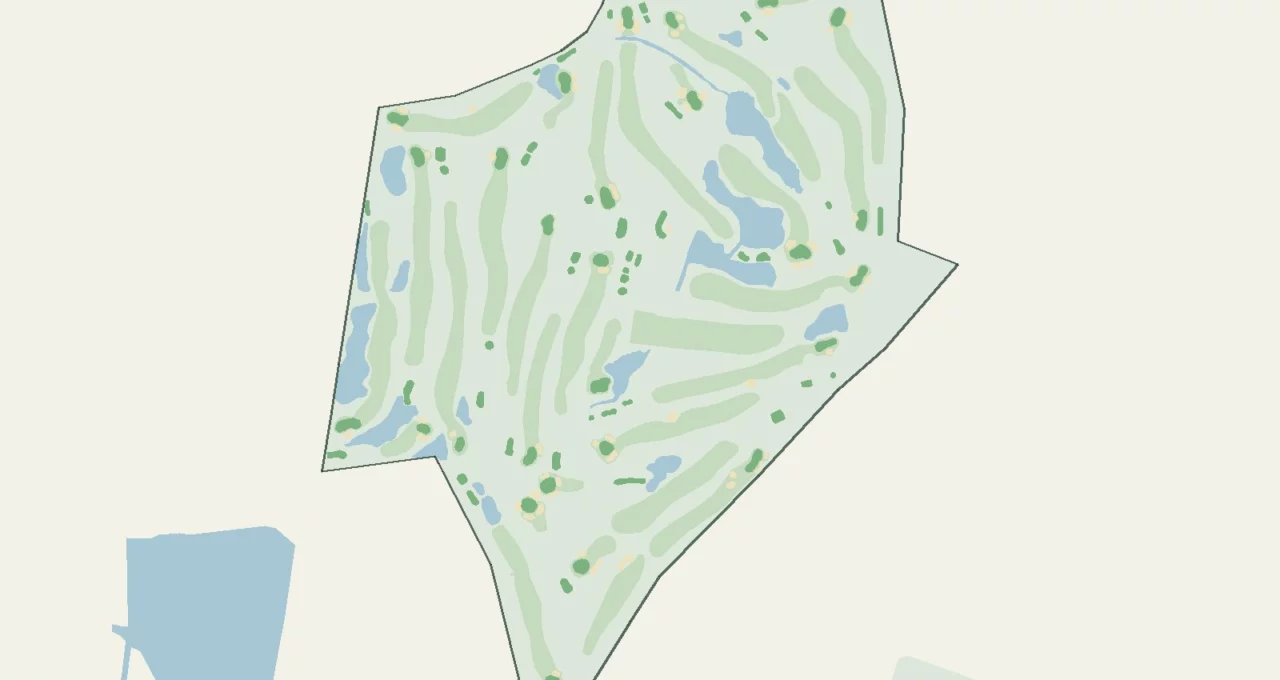
Layout of Coffs Harbour Golf Club from OpenStreetMap survey data (ODbL licence).
Coffs Harbour Golf Club
Holes
27
By
The Lakes 71 (men), 74 (women); East Lakes 70; West Lakes 69 (men's par, from the club's hole pages)
Length
The Lakes 5,838 metres (blue), 5,372 metres (red); East Lakes 5,763 metres and West Lakes 5,627 metres (blue)
Green fee
—
Best season
All year
Coffs Harbour Golf Club is a twenty-seven-hole members’ club on the southern side of Coffs Harbour, on the Mid North Coast of New South Wales. The club gives its address as Earl Street, Coffs Harbour NSW 2450. The course lies on low ground between the residential streets of the southern suburbs and Coffs Harbour Airport, whose terminal is reached from Hogbin Drive, about a kilometre and a half to the south-east of the middle of the course. The railway station is a little over two kilometres away in a straight line. Wikipedia puts the city itself at about 530 to 540 kilometres north of Sydney, depending on which part of the article you read, and 390 kilometres south of Brisbane.
The club describes itself as a 27-hole championship course and promises “big city standards with friendly small town charm”. It welcomes visitors for social golf every day and for most competitions, and it celebrated its centenary in 2026. Its three nines are combined into three eighteen-hole layouts: The Lakes, East Lakes and West Lakes. The Lakes is the one most often ranked and reviewed; Golf Australia magazine placed it at No. 85 in its Top-100 ranking in 2023, four places higher than the year before.
From 1951 to 1975 it was the only venue of the North Coast Open, whose winners include Kel Nagle, four times, and Gary Player, twice. In 2018 it hosted the Women’s NSW Open, the first edition co-sanctioned by the Ladies European Tour, and in 2025 the Australian Women’s Classic, another Ladies European Tour event.
A hundred years in Coffs Harbour
According to a local newspaper report published for the centenary in February 2026, the club began in 1926 with a temporary six-hole course built by members on the Coffs Harbour Showground site. The first competition was a mixed four-ball, and the founding group numbered twenty members. The club’s centenary pages confirm the anniversary, with an opening night on 13 February 2026 and a centenary book.
The move to the present site is dated differently by different sources. The centenary report and the Top 100 Golf Courses website give 1940, with a nine-hole course; a Golf Australia magazine feature of February 2023 gives 1938. Both agree that the original nine holes were designed by Carnegie Clark. The same Golf Australia feature says the course was extended to eighteen holes by Arthur East shortly before 1951, and that a further nine holes were added in the early 1970s, which brought the club to its present twenty-seven.
The magazine also records that all the greens were converted to Bermuda Tifgreen 328 in the late 1980s. A club job advertisement of July 2023 describes 328 couch greens, predominantly couch fairways and Kustom Bind bunkers.
The Craig Parry master plan
The most recent chapter is a course master plan. In April 2021 the club engaged Craig Parry, the former PGA Tour player turned course designer, to walk all twenty-seven holes and prepare a plan, for ten or twenty years depending on the report. Work has followed: the 2023 job advertisement refers to significant investment in the plan, the club’s general manager credited it, notably the bunker work, for the course’s rise in the rankings, and Golf Australia says Parry worked with the superintendent on changes to key holes. We have found no list of the holes changed and no completion date.
Rankings
In November 2022, Golf Australia magazine’s list of Australia’s Favourite Top-50 courses put Coffs Harbour fifth, behind Bonville Golf Resort, its neighbour eleven kilometres to the south. In 2023 the magazine’s Top-100 ranking placed The Lakes at No. 85, up from No. 89 a year earlier; the local paper describes the list as one of public courses, which the magazine article does not. The Top 100 Golf Courses website ranks it 54th in New South Wales.
The North Coast Open and the women’s events
Wikipedia’s article on the North Coast Open says the tournament was always held at Coffs Harbour Golf Club. The first two editions were played as the Coffs Harbour Golf Club £200 Professional Purse. The event grew from 36 holes to 54 in 1959 and 72 in 1962, and was part of the PGA Tour of Australia from 1973 until it ended in 1975.
Kel Nagle won in 1951, 1952, 1954 and 1955, Gary Player in 1956 and 1957, Bruce Crampton in 1958, Norman Von Nida in 1965 and Bill Dunk four times between 1966 and 1971. Golf Australia magazine adds that it was Australia’s first tournament played over four rounds on four days; Wikipedia does not say so and we have found no other source for it. The club still hosts a North Coast Open, which a local report describes as a qualifying event for the NSW Open.
Women’s professional golf came later. In 2018 the Women’s NSW Open moved from Oatlands to Coffs Harbour, the first edition co-sanctioned by the Ladies European Tour; England’s Meghan MacLaren won at ten under par, her first title on that tour, and the tournament has moved between venues since. In March 2025 the club hosted the Australian Women’s Classic for the first time, after six years at Bonville; Belgium’s Manon De Roey won with a total of 201, nine under par.
Three nines, three courses
The club’s course tour divides the twenty-seven holes into three nines, numbered 1 to 9, 10 to 18 and 19 to 27, and combines them into three eighteen-hole layouts for members:
- The Lakes: holes 1 to 9, then 10 to 18.
- East Lakes: holes 10 to 18, then 19 to 27.
- West Lakes: holes 19 to 27, then 1 to 9.
Every hole has its own page on the club’s site, with a short description and lengths from four sets of tees, labelled blue, white, red and yellow. The notes for several holes refer separately to the men’s and the women’s tees, and the lengths and pars suggest that blue and white are the men’s tees and red and yellow the women’s, but the club does not say so in as many words.
The figures
Added up from the club’s hole pages, the nines measure as follows from the blue tees: 2,851 metres for holes 1 to 9, 2,987 metres for holes 10 to 18 and 2,776 metres for holes 19 to 27. From the red tees, the same nines measure 2,658, 2,714 and 2,550 metres. The Lakes therefore comes to 5,838 metres from the blue tees, 5,566 from the white, 5,372 from the red and 5,196 from the yellow. These totals are exactly those GolfFinder gives for The Lakes. East Lakes works out at 5,763 metres from the blue tees and West Lakes at 5,627.
Par is less simple. Four holes carry two pars on the club’s pages: the 5th, 7th, 10th and 25th are par 4 for men and par 5 for women, and the 19th is a par 3 for men and a par 4 for women. Read that way, the men’s par is 35 for the first nine, 36 for the second and 34 for the third, which gives 71 for The Lakes, 70 for East Lakes and 69 for West Lakes. The women’s pars are 74, 73 and 73.
The other sources do not all agree. GolfFinder and GolfPass give 71 for The Lakes, which matches. OpenStreetMap describes the course as an eighteen-hole Lakes course of par 72 and a nine-hole East course of par 34, which matches neither the club’s names nor its par for The Lakes. GolfPass gives The Lakes a length of 5,915 metres, about 80 metres more than the club’s blue tees. The Hole19 app gives an eighteen-hole card of 5,763 metres and par 70 from the blue tees, which is East Lakes, with a course rating of 72 and a slope of 136. GolfFinder gives a slope range of 141 to 142 without naming the tees, and GolfPass a slope of 131 for The Lakes. Golf Australia’s rating page blocked our requests, so none could be checked with the body that issues them. Whatever the exact number, every source puts the slope well above the standard 113, which marks this as a demanding course for its length.
OpenStreetMap maps all twenty-seven holes, with 63 bunkers and seventeen water hazards inside the course boundary. Its hole lengths broadly match the club’s, but not always: it gives the 5th as a par 4 of 436 metres from the blue tees, where the club gives 355 metres, and the hole line drawn on the map measures about 350. We follow the club.
What it asks of you
At under 6,000 metres for each combination, Coffs Harbour is not long by championship standards. What it asks for is accuracy. The club’s own summary is tree-lined fairways, formidable bunkering and plenty of water hazards, and the hole notes bear that out: out of bounds runs along the right of the 4th, the 11th and the 24th, a dozen holes or more have water in play from the tee or on the approach, and several tee shots are played from a chute between trees. The ground is low, between about 3 and 20 metres above sea level according to a satellite elevation model, but the course is not flat: elevated tees and raised greens recur through the notes, and they matter more than the modest relief suggests.
Holes 1 to 9
The 1st, a par 4 of 320 metres from an elevated tee, bends slightly left. The 2nd, 382 metres, is long and straight for men and much shorter for women. The 3rd, a par 3 of 138 metres, plays from a raised tee over water that guards the front and left of the green.
The 4th, 312 metres, doglegs right around a bunker on the inside corner, with a carry the club puts at 195 metres from the men’s tee and 165 from the women’s, and out of bounds the whole way down the right. The 5th, 355 metres, has water left and right from the tee and a hidden hazard behind the green. The 8th, at 452 metres, is the par 5 of the nine, straight but narrow, with water from about 70 to 20 metres short of a small green. The 9th finishes uphill: from an elevated tee the drive goes left of centre to open up a green that slopes so severely from back to front that a short approach will roll back off it.
Holes 10 to 18
The second nine is the longest of the three. The 11th, 345 metres, bends gently left with out of bounds on the right all the way and a fairway that slopes so steeply left that anything short of about 120 metres from the green rolls towards the trees. The 12th, a par 3 of 171 metres, plays to a green that slopes hard from back to front.
The 13th, 382 metres, is the hole the notes call tough for both men and women: a severe dogleg right around a stand of trees known at the club as the gaol, leaving about 160 metres to an elevated green with a back tier that slopes away. The 15th, a par 3 of 163 metres, often plays into the wind, to a two-tier green with bunkers on all four sides, two large gum trees narrowing the entrance and water crossing the hole.
The 16th, only 307 metres, has water left and right off the tee and a cross hazard 80 metres out, and the club suggests a long iron or rescue club from the tee. The 17th, a par 5 of 461 metres and the longest hole on The Lakes, needs a drive left of centre between water hazards and a second around a dogleg right, with a cross drain ten metres short of the green. The 18th, 329 metres, finishes at a large green that sits well above the fairway; the club advises at least one more club for the approach, and the clubhouse behind the green is out of bounds.
Holes 19 to 27
The third nine is the shortest but has some of the tightest driving. The 19th, a par 3 of 171 metres for men, plays from a raised tee to a green with a lake along its left. The 20th and 21st, par 4s of 382 and 367 metres, ask for accurate drives between trees, and the 22nd, a par 3 of 147 metres, is deceptively uphill.
The 24th, a par 5 of 490 metres, is the longest hole on the property and probably the most complex: a tight drive through a chute, a fairway bunker at about 220 metres, a drain 30 metres further on, deep cross bunkers about 40 metres short of a long three-tier green, and out of bounds all the way up the right. The club says the position of the flag can make three clubs’ difference to the approach. The 26th is a downhill par 3 of 141 metres to a two-tier green, and the 27th, 333 metres, climbs to a short, wide, highly elevated green with the clubhouse and car park out of bounds behind it.
What that means for your game
Keep the ball in play from the tee before thinking about distance. With this many trees, drains and water hazards, on holes such as the 4th, the 11th and the 24th a fairway wood or hybrid is often the wiser club. Take an extra club to the raised greens, especially at the 9th, 18th, 22nd, 25th and 27th, and try to leave the ball below the hole: the club’s descriptions of steep back-to-front slopes come up on almost every page, and putts from above the hole are where shots are lost. Allow for wind on the 15th.
Practice and facilities
The clubhouse houses the Lakes Restaurant and Bar and a function venue; the club gives the bar’s hours as 10 am daily and publishes the restaurant’s trading hours separately. The pro shop opens daily from 6.30 am. Motorised carts are available for hire, and the club prices them as twin share.
Practice facilities are reported differently by different sources. A local report from November 2022 says the club had recently added an all-weather practice facility, the 2023 job advertisement mentions significant practice facilities, and OpenStreetMap maps a driving range within the property, while the GolfFinder directory lists only a putting green. We have not been able to establish what is open to visitors and on what terms, so it is worth asking the pro shop.
What golfers say
Public comment on Coffs Harbour is warm but thin: the golf apps carry many star ratings and few written comments. The points below summarise what recurs across the reviews and descriptions we could read in October 2026. They are other people’s views, not ours: we have not played the course, and we name and quote no one.
What comes up in its favour
- Condition is the most consistent theme. Reviewers describe the course as immaculate, very clean and tidy, and in excellent shape week after week, and a ranking judge picked out the presentation of the fairways and greens.
- The variety of the holes and the subtle changes of elevation are praised, and one detailed review picks out strong par 3s and tee shots that reward good play.
- Staff and the pro shop are repeatedly singled out for friendly service.
- The clubhouse and its food are well regarded, and several reviewers consider the course good value.
- The Lakes is generally seen as the strongest of the three combinations.
What comes up against, or should be weighed
- The amount of water is noted as a challenge, and the narrow, tree-lined holes and high slope figures make it hard for higher handicappers.
- Written reviews are few and almost uniformly positive, so a visitor has little independent detail to go on, and almost nothing about pace of play or the state of the course after heavy rain.
- Access for visitors is limited on some days: Saturday competitions are for members only, and Thursday’s competition is closed to visitors in winter, although spare tee times may be booked up to three days ahead.
- The published figures for par, length and slope differ from one source to the next, which makes it hard to know in advance exactly what card you will be playing.
- Bonville, about eleven kilometres south, is ranked ahead of it in the magazine lists, and a visitor with time for one round has a choice to make.
Who it suits
Coffs Harbour suits holidaymakers on the Coffs Coast who want a well-kept members’ course close to town, handicap golfers who like to enter a club competition when they travel, and anyone interested in Australian golf history. Mid and low handicappers who value accuracy over power will enjoy it most; beginners and high handicappers will find the water, the trees and the steep greens punishing and should consider the forward tees.
Getting there and when to go
The course is in the southern part of Coffs Harbour, reached from Earl Street. Coffs Harbour Airport, a few minutes away, has daily flights to Sydney, Melbourne and Brisbane according to Wikipedia, and NSW TrainLink’s XPT trains stop at Coffs Harbour station, about two kilometres away in a straight line, twice a day in each direction. OpenStreetMap shows a Busways stop on Thompsons Road at the edge of the course; we have not checked routes or timetables and give none.
Social golf is open to visitors and is booked online through the club’s public booking calendar; the club says online bookings are discounted. Groups of more than twelve and advance bookings go through the pro shop by email. Visitors aged 15 and over with a Golf Australia number and a handicap may enter the Tuesday, Friday and Sunday medley competitions, and women the Tuesday nine-hole and Wednesday eighteen-hole events. Thursday’s men’s competition is open to visitors outside winter, and Saturday is reserved for members, with spare tee times released up to three days ahead. The club’s office is open on weekdays and can be reached on 02 6652 3244.
Coffs Harbour has a humid subtropical climate. Wikipedia’s climate table gives average maximums of about 27 degrees in January and 19 in July, and around 1,670 to 1,700 millimetres of rain a year, with February and March the wettest months. Golf is played all year. Late summer is warm, humid and wet, so check conditions with the club after heavy rain.
How this page was put together
The club’s course tour and twenty-seven hole pages provided the combinations, hole descriptions, pars and lengths, from which we calculated the totals; its home, visitor and centenary pages the address, telephone, facilities, hours and visitor rules. A News Of The Area report of February 2026 provided the 1926 founding and the move; Golf Australia magazine’s feature of February 2023 the designers, extensions, greens and Parry work; local reports from 2021 to 2023 the master plan and rankings; a club job advertisement of July 2023 the grasses and bunkers. Wikipedia’s articles on the North Coast Open, the Women’s NSW Open and Coffs Harbour provided the tournament history, the climate, the distances and the transport; the Ladies European Tour and golf news sites the 2025 Australian Women’s Classic. GolfFinder, GolfPass, Hole19 and Top 100 Golf Courses provided the other figures. OpenStreetMap provided the location and mapped features, from which we calculated straight-line distances; heights come from a satellite elevation model.
Several sources disagree, and we have said so in the text. The move to the present site is dated 1940 by the centenary report and Top 100 Golf Courses and 1938 by Golf Australia magazine. The club’s pages give The Lakes a men’s par of 71 and 5,838 metres from the blue tees; OpenStreetMap gives par 72 and GolfPass 5,915 metres; slope figures range from 131 to 142 depending on the source and layout, and none could be checked with Golf Australia, whose rating page blocked our requests. OpenStreetMap’s length for the 5th is longer than the club’s. GolfFinder lists no driving range where other sources describe practice facilities. Wikipedia gives two distances from Sydney. The claim that the North Coast Open was the country’s first four-round, four-day tournament comes from a single source. We found no stroke indexes, and no record of which holes the Parry plan has changed.
The opinion section summarises public reviews and ratings on golf apps, ranking sites and travel sites, read in October 2026; we report recurring themes rather than individual voices, we reproduce no reviewers’ words and we give no ratings or review counts. We have not played this course, and this page is no substitute for a round. The club has not paid for this page, has not seen it before publication and has no say over its content. If you know the course and something here is wrong or out of date, write to us and we will correct it.
Other courses nearby
Closest to this one in our Australian directory:
- Armidale Golf Club — 143 km
- Ballina Golf & Sports Club — 168 km
- The Vintage Golf Club — 319 km
- Ashgrove Golf Club — 319 km