How to get real value from a golf lesson
The money is rarely the problem: an hour of instruction costs less than a green fee. What goes wrong is the goal, the practice plan and the fortnight afterward, which is when most golfers quit a change that was working.
In brief
- Ask a coach how they assess a player and how you will know it is working.
- State the goal as a score and a specific loss, not as a feeling.
- A real change feels wrong for two to three weeks. That is motor learning, not failure.
- Leave with a drill, a number of balls and a frequency: twenty balls three times beats a hundred once.
- Once a season, take a playing lesson over nine holes instead of a range hour.
Most golfers take a lesson when something breaks, work on it for a week, and go back to what they were doing. The golfers who improve treat lessons as a series with a plan, and they choose the coach before they choose the swing change.
The money is not usually the problem. An hour of instruction costs less than a green fee at a decent public course, and considerably less than the driver most golfers buy instead. What goes wrong is everything around the hour: the goal, the practice, and the fortnight afterward.
Choose the coach, not the nearest range
Ask three questions before you book anything. How do you assess a new player? What does a typical block of lessons look like? How will I know it is working?
A coach who answers with a process is the one to book. A coach who answers with a swing theory, particularly one attached to a named method, is telling you that you will be fitted to their model rather than the model fitted to you. Both kinds of coach exist in every market.
PGA of America membership is the baseline credential in the United States, and it means a professional has been through an education programme and is accountable to an association. Beyond that, ask other members or other players at your range who they use and, more usefully, why. The question that produces honest answers is not who is good, it is who helped you and what changed.
One more practical filter: ask whether the coach teaches players at your level regularly. A professional who spends most of their week with junior elite players is not necessarily the right person for a 24-handicap who plays twice a month, and the reverse is equally true.
Say what you want, in terms of scores
Turning up and saying that your swing feels bad gets you a generic fix, because you have given the coach nothing to work with.
Turning up and saying that you shoot 92, that you lose four shots a round to a slice off the tee, and that you want to break 90 by August gets you a plan. The difference is that the second version can be measured, which means both of you will know whether it worked.
Bring evidence if you have it. Three recent scorecards, or a season of shot-tracking data, or simply a tally of penalty strokes and three-putts from your last five rounds. Coaches spend a large part of a first lesson establishing what an article of information like that would have told them in thirty seconds.
A good coach will change the goal if it is unrealistic, and that is itself useful. Being told that breaking 90 by August is achievable but that it will come from your wedges rather than your driver is worth the price of the lesson on its own.
One change at a time, and expect it to feel wrong
A real change feels uncomfortable for two to three weeks and usually makes the ball flight worse before it improves. That is the normal shape of motor learning, not a sign that the lesson failed.
The mechanism is worth understanding because it stops you quitting. You have a pattern that works, in the sense that it produces a predictable result, and a change breaks the compensations built around it. For a while you have neither the old pattern nor the new one, and that is when the ball goes in directions it has not gone in for years.
Coaches lose most of their clients in exactly that window, which is why a good one tells you about it in the first session and books the second session inside it. If your coach has not warned you, ask directly how long this should feel wrong for.
Timing follows from this. A swing change made in February costs you nothing because you are not scoring. The same change in July costs you the summer.
Record the lesson and take notes afterward
Film the last five minutes on your phone, with the coach summarizing the change in their own words, and write three lines before you drive home: what changed, what to feel, what to practice.
A week later the feel has gone. It reliably does, for everybody, and the notes are all that remains. Golfers who keep a lesson notebook across a season can see what they were working on in April, which is what makes the difference between a series of lessons and eight unrelated hours.
Ask for a slow-motion video of one good repetition too, so you have something to compare against rather than relying on memory.
Practice the way the lesson told you to
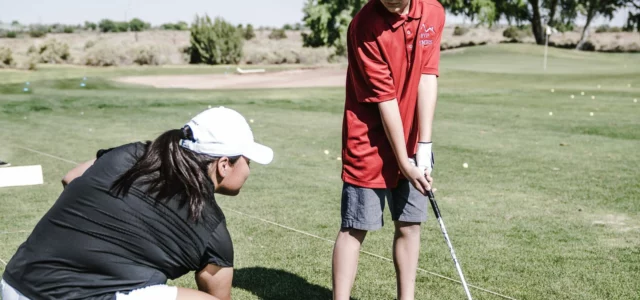
A lesson without a practice plan is entertainment. Leave with three specifics: the drill, the number of balls, and the frequency.
Twenty balls three times a week beats a hundred balls once, because motor learning responds to repetition spread over time rather than volume in one session. This is the single most reliable finding in the field and the one amateurs most consistently ignore.
Blocked practice, meaning the same shot over and over, is right at the start when you are building a feel. It should give way sooner than you expect to random practice, meaning a different club and a different target every ball, because that is what a golf course asks for. A golfer who only ever practices in blocks gets very good on the range and no better on the course.
Ask the coach explicitly when to make that switch. Most will tell you after a specific number of sessions or once the strike is consistent.
Book a block, not a single lesson
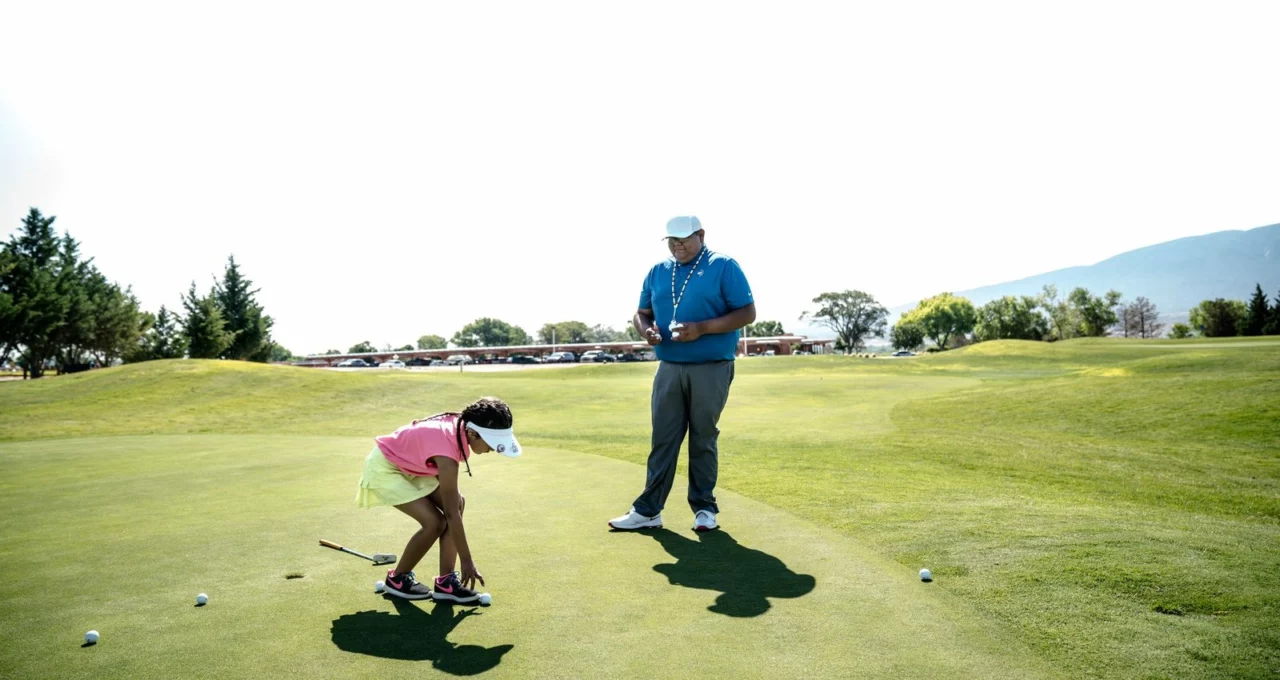
Almost nothing worth changing gets fixed in an hour. Three or four sessions across six weeks lets the coach see whether the change is holding, adjust it, and catch the compensation you have invented in between.
Many professionals price a block below the single-lesson rate for exactly this reason, and the ones who do not will usually still prefer it, because a coach’s reputation is built on players who improved rather than players who visited.
Playing lessons are underused
An hour on the course with a coach shows you the shots you actually face, the clubs you should be hitting off the tee, and the decisions costing you strokes. None of that is visible on a range.
For a golfer whose technique is adequate and whose scores are not, a playing lesson is worth three range lessons. It is also the format that exposes the things nobody admits to: the pre-shot routine that disappears under pressure, the automatic driver on a hole that does not need one, the recovery attempt through a two-foot gap.
Nine holes is enough. Ask the professional to say nothing for the first three holes and simply watch.
What a lesson costs, and where the money goes furthest
Rates vary widely by market and by professional, from the range instructor at a municipal facility to a director of instruction at a resort academy, and any figure printed here would be wrong somewhere. The useful comparisons are structural rather than numerical.
Group clinics are substantially cheaper per hour than individual instruction and are better than their reputation, particularly for beginners, because everybody in the group is equally new and the coach is teaching fundamentals that do not need to be personalized. Junior programmes are frequently subsidized. Winter, when the teaching diary is empty, is when a professional has time to give you a proper assessment rather than fitting you between two members.
Where to find a coach in the U.S.
The PGA of America maintains a directory of professionals searchable by location, which is the reasonable starting point and the only one that verifies credentials. Most public courses and standalone ranges have teaching staff with rates published in the shop, and municipal facilities frequently run the cheapest group instruction in a metro area.
Golf schools and academies at resort properties offer multi-day programmes, which suit a golfer starting from nothing considerably better than an occasional hour does: three consecutive days of instruction builds something that a lesson every six weeks cannot.
Your own club’s professional has one advantage nobody else has, which is that they know the course you play and can tell you which shots on it are costing you strokes. For a playing lesson specifically, that is decisive.
Panxis Golf has no commercial relationship with any coach, academy or association mentioned here, and earns no commission.
Before your next lesson
- Write the goal as a score and a specific loss, not as a feeling.
- Book three sessions rather than one, and put the second one inside three weeks.
- Leave with a drill, a number of balls and a frequency.
- Film the summary and write three lines before you drive home.
- Once a season, take a playing lesson over nine holes instead of a range hour.
The difference between golfers who improve with lessons and golfers who do not is almost never the coach. It is what happens in the fortnight afterward.