A winter on the launch monitor: four Garmin R10 numbers to track, and where to hit in Canada
From November to April, much of Canadian golf happens in front of a screen that shows fourteen numbers per swing. Only four of them are measured tightly enough to guide your practice; the rest can scroll by.
In brief
- Garmin publishes an accuracy for the R10's ball speed (1 mph), launch angle and launch direction (1 degree) and carry (5 yards), and none for spin, club path or face angle.
- Read carry over ten balls as a range, and ball speed as an average rather than a peak.
- Garmin rates the R10 down to -10 °C, so check an unheated garage before a January session.
- In September 2026 a Canadian online golf retailer listed the Approach R10 at C$699.99 before tax; virtual courses need a paid membership.
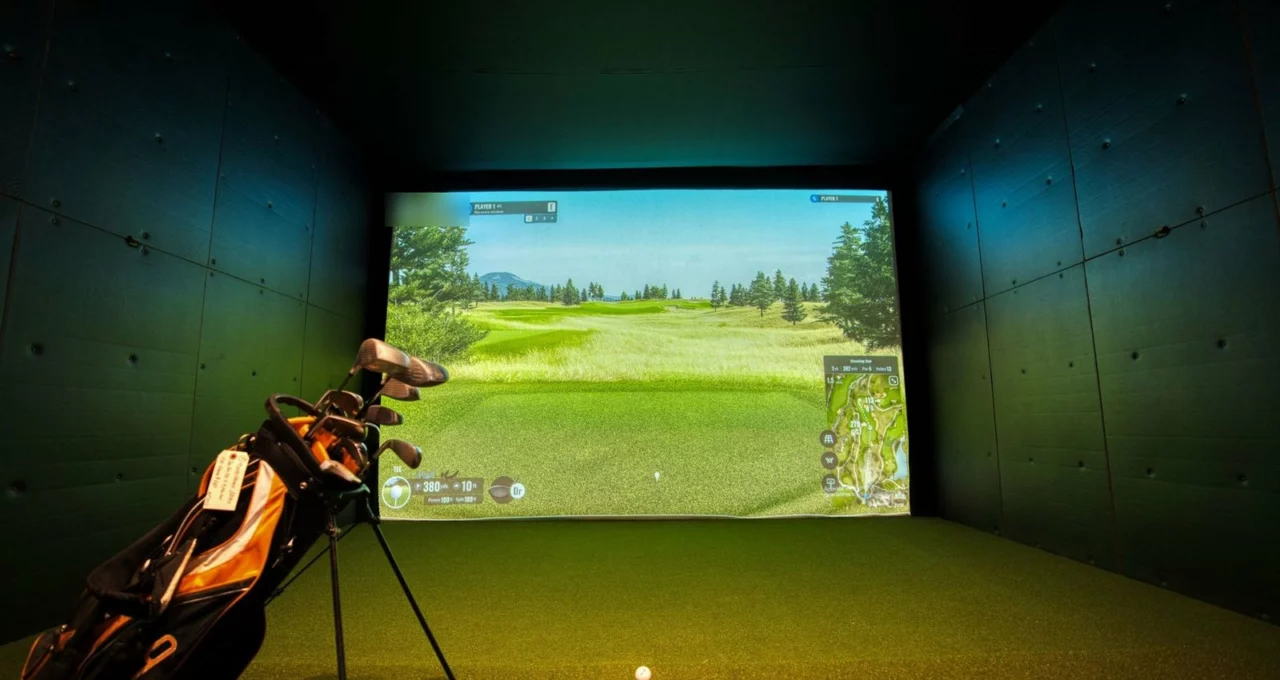
Sometime in November, the clubs come out of the trunk for the last time and the golf moves inside: a simulator bay booked by the hour, a dome range with radar on every mat, or a net strung across the garage with a small launch monitor on the floor. Five months of that is a long time to stare at a screen. Every swing produces a row of fourteen figures, all of them slightly different from the swing before, and by March most golfers can recite their longest drive of the winter and nothing useful about their 8-iron. The fix is not a better device. It is knowing which few figures on the screen deserve a pencil and which can be left to scroll by.
Four of them earn that pencil: carry, read as a range rather than a single number; ball speed, averaged; launch angle; and the direction the ball starts. This page explains why those four, what to do with the others, and how to set up a winter of sessions so that the numbers still mean something when the courses reopen in spring. The example throughout is the Garmin Approach R10, a unit plenty of Canadian golfers own or are thinking about. Its specifications come from Garmin, its Canadian price was read online in September 2026, and no one on the Canada desk has hit a single ball in front of it.
One test for every number: did the maker put a margin on it?
A consumer radar is good at watching a golf ball. The ball is round, it leaves the face in a clear direction and it travels a long way in a straight line, which is exactly what a Doppler signal handles well. The club is a harder target: it is thin, it moves faster and it passes close to the ground. Spin is harder still, because a plain white ball looks the same from every side. So the unit measures a few things directly and calculates the rest, and every calculation stacks its own error on top of the error in the figures it was built from.
That gives a simple way to sort the screen without any engineering background. If the manufacturer is prepared to publish an accuracy figure for a number, read it. If it is not, treat the number as a rough hint at best. A company that sells a launch monitor has every reason to advertise how precise it is. When it stays silent about a metric, that silence is information.
The Approach R10 as a case study
The R10 is a pocket-sized radar that sits on the ground behind the ball and sends its data by Bluetooth to the Garmin Golf app on a phone or tablet. Here is what Garmin says about it:
- Size. 88.5 x 70.25 x 25 mm; 148 grams on its own, 220.8 grams on its tripod.
- Battery and weather. Up to 10 hours per charge, an IPX7 water rating and an operating range of -10 to 55 °C.
- The fourteen metrics. Club head speed, face angle, club path, angle of attack, ball speed, launch angle, launch direction, spin axis, spin rate, apex height, smash factor, carry, total distance and deviation.
- The five with a published accuracy. Ball speed within 1 mph (about 1.6 km/h), launch angle within 1 degree, launch direction within 1 degree, club head speed within 5 mph and carry within 5 yards. Nothing is published for the remaining nine.
- Spin and special balls. Garmin says Titleist Pro V1 and Pro V1x balls with Radar Capture Technology make spin readings up to 30 times more accurate and carry up to 50 percent more accurate.
- Virtual golf. More than 43,000 courses, but only with a paid Garmin Golf membership once a 30-day free trial ends. The unit also works with simulator software such as E6 Connect and Awesome Golf, which carry their own subscriptions.
In September 2026, a Canadian online golf retailer listed the R10 at C$699.99, before tax. Add a winter of membership fees and you are into the price range of a good new driver, so it pays to know what the screen can and cannot tell you before the box is opened.
Apply the margin test to that list and the choice makes itself. Club head speed has a published figure, but plus or minus 5 mph is too loose to judge one swing against another. That leaves four. Our overview of launch monitors in Canada covers how radar and camera units differ; what follows is about reading the one you already have access to.
Ball speed: the honest answer to “was that a good one?”
Ball speed is the tightest measurement on the R10, and it is the closest thing on the screen to a verdict on your strike. With the same club, more ball speed means you swung faster, found the centre of the face more often, or both. Nothing else on the display tells you as cleanly whether a change is working.
Use it every time you try something that is supposed to add distance: a different tee height, a new shaft, a winter of speed training. The trap is the peak. One driver at 139 mph is a good swing, not a new baseline. What matters is the average over a set of ten. If that average creeps from 126 to 130 mph between December and March, the gain is real and it will show up on the course.
You will notice smash factor sitting next to it, calculated as ball speed divided by club head speed and often treated as a strike score. Because club head speed is only good to 5 mph either way on this unit, the ratio jumps around too much to read one shot at a time. Ball speed alone does the same job without the noise.
Launch angle: why the drive dies or the iron never climbs
Launch angle is the vertical angle at which the ball leaves the face. It explains a surprising number of shots that simply feel wrong: the drive that rises and then drops out of the sky, the long iron that never gets high enough to hold a green, the wedge that comes out low and runs. At plus or minus one degree, it is reliable enough to compare two settings or two swings.
If you spent the fall adjusting your driver, this is the number that tells you whether the loft change did anything. Our step-by-step guide to driver settings before winter suggests testing one change per session on a launch monitor; launch angle is the figure to write down each time. For the irons, compare clubs side by side. If your 5-iron and 7-iron launch at almost the same angle, the 5-iron is probably not flying much farther either, and the gap in your bag is not where you think it is.
Launch direction: the best view of your clubface you can get at home
Launch direction is where the ball starts relative to your target line, measured in degrees left or right. The face angle at impact does most of the work in deciding that start line, so this is the most trustworthy window a consumer radar gives you into what the face is doing. Garmin gives it the same one-degree margin as launch angle.
Read it alongside the finish. A ball that starts three degrees right and keeps curving right is a different problem from one that starts three degrees left and slices back past the target. Over twenty or thirty shots, the pattern is what counts: if most balls start on one side of the line, you have a fact to take to your next lesson, which is worth more than the feeling you had in the bay.
Carry: a range, never a single shot
Carry is how far the ball flies before it lands, and it is the number that picks the club on every approach. It is also the one golfers remember most generously. The pure strike stays in memory; the thin one does not.
So never read carry shot by shot. Hit ten balls with one club, drop the obvious mishit, and write down three figures: the shortest reasonable carry, the typical one and the longest. An 8-iron that flies between 131 and 144 yards is a far better guide on the course than the 149 you would like to believe in. The width of that range is your real consistency, and it is the thing to shrink over the winter. The same approach works with partial swings in our piece on wedge distances.
Keep Garmin’s five-yard margin in mind when comparing sessions. Four yards more than last week is inside the noise. Twelve yards is a change.
What to leave on the screen
The remaining numbers are not useless, but none of them is solid enough to steer your practice on its own.
- Total distance. The roll is modelled, not measured. On a real fairway it depends on the turf, the slope and whether it rained, and in April on a Canadian course the ground is rarely firm. Carry is the part that transfers.
- Club path and face angle. On the R10 these are worked out from the ball’s flight, and Garmin publishes no accuracy for either. Chasing them all winter is a reliable way to spend four months fixing the wrong fault.
- Spin rate and spin axis. Unless you are hitting the Titleist balls with Radar Capture Technology, spin is the least stable figure on the screen, especially indoors.
- Apex, deviation and smash factor. All calculated from other numbers, so they add error rather than information.
- Your best shot of the session. Not a metric, but the one everyone looks at first. Ignore it.
Setting up in a garage, basement or dome
A radar placed carelessly will produce confident, wrong numbers. Garmin’s owner’s manual is specific about the steps that matter, and a Canadian winter adds one of its own.
- Distance behind the ball. The unit belongs 1.8 to 2.4 metres (six to eight feet) behind the ball. Enter the exact distance in the app when it asks.
- Room in front. Indoors, keep the ball at least 2.4 metres (eight feet) from the net. Many basements and single garages run out of space here, so measure before buying.
- Alignment. Point the device down the target line, then hit a short, straight wedge. If the launch direction on the screen does not match what you saw, adjust and hit another. A unit a few degrees off will be a few degrees off on every start-line reading all winter.
- Conditions. Enter weather and elevation in the app to match where you usually play. A carry chart built for a course near sea level on the coast will not match what the ball does in Calgary or Banff.
- Temperature. Garmin rates the R10 down to -10 °C. An unheated garage in January can go well below that on the Prairies or in northern Ontario, so check the thermometer before you plug in.
- The mat. A hitting mat lets a slightly heavy iron shot skid through where turf would grab it, so winter iron carries tend to flatter you. Confirm the numbers on grass in spring.
A thirty-ball session for a winter evening
A booked hour in a simulator bay disappears fast. Before the first swing, decide the one question the session will answer, for example “How far does my 7-iron really carry?” or “Does teeing it higher add ball speed?” Then split the bucket in three:
- ten balls to warm up with a short iron, screen ignored;
- ten balls with the club in question, looking only at the number that answers the question;
- ten balls with the change you are testing, looking at that same number.
Note the averages and the spread, and stop there. Keep the notes in one place from November to April. When your course opens, take the same question to the range and see whether the answer held up outdoors. The same one-question habit makes any range session more productive, screen or not.
What golfers are saying about the Approach R10
The R10 comes up constantly in golf forums, simulator groups and public retailer reviews, and the same themes recur. This is a summary of repeated comments, not a tally.
On the plus side.
- Outdoor carry and ball speed. Owners who have compared it with a professional launch monitor at a fitting often report that range carries were close enough to build a usable yardage chart.
- Easy to carry around. A unit that fits in a bag pocket and lasts through a long range session is one of the most common reasons people give for choosing it.
- An affordable way into simulator golf. Many describe it as the least expensive route to virtual rounds at home that still feels like real golf.
On the minus side.
- Indoor spin. The complaint heard most: with regular balls in a garage, spin jumps around from shot to shot and the curve on screen does not always match the real ball.
- Club path and face angle. Golfers working on a slice often say these readings disagreed with what their coach or a professional unit showed.
- Space. Buyers who planned to use it in a small room are frequently caught out by how much depth it needs behind and in front of the ball.
- Subscriptions. A recurring point is that virtual courses require a membership and some simulator programs cost extra, which changes the real price.
For shot-by-shot data against a professional launch monitor, see the independent Golf Insider UK review.
Where to read these four numbers in Canada this winter
You do not have to own a launch monitor to start keeping track of carry spread, ball speed, launch angle and start direction. A few ways to get in front of one between now and spring:
- Indoor golf centres. Simulator facilities in most Canadian cities rent bays by the hour through the winter. Bring your notebook and your one question.
- Dome and heated ranges. Some winter practice facilities have radar tracking at the bays, which is enough to build a carry chart for every club in a single visit.
- Golf stores with a hitting bay. Larger golf stores and independent fitters usually have a launch monitor in a fitting bay. Weekday afternoons, well before the spring rush, are the time to ask for a session. Our guide to what a fitting can fix explains how those sessions work.
- Your club professional. A PGA of Canada pro who knows your swing can tell you what your launch direction pattern actually means, which a screen cannot.
If you are thinking of buying, a handful of questions will separate the offers. Which metrics and modes work without a membership, and what does the membership cost after the trial? How long is the return window, and does it cover a unit that turns out not to fit your basement? Is the warranty handled by the store or by the manufacturer? Buying used, check that the tripod and charging cable are included and that the seller can release the device from their app account.
Whichever route you take, finish every session by writing down the same four things. By the time the snow is gone, those notes will say more about your game than any single screen.
How this page was put together
This page is a guide and a summary of public opinion, not a test. The dimensions, weight, battery life, water rating, operating temperature, list of metrics and accuracy figures of the Garmin Approach R10, the claims about Titleist balls with Radar Capture Technology, the number of virtual courses and the membership trial come from Garmin’s product page. The placement distances, the distance to the net, the wedge alignment check and the weather setting come from Garmin’s owner’s manual for the device. The price of C$699.99, shown before sales tax, was read on September 28, 2026 on the website of Canadian Pro Shop Online, a Canadian golf retailer. Golfers’ opinions were read in golf forums, simulator communities and public retailer reviews; nobody is named, nothing is counted, and an impression is never presented as a statistic.
No one on the Canada desk has hit a ball in front of this launch monitor. There is no commercial link on this page, no affiliate arrangement and no commission of any kind. If a piece of content on this site is ever paid for by a brand, it will carry an advertising notice at the top of the page, before the first line.