Topgolf on Friday, a par 3 on Sunday? What Britain’s range and simulator boom does for golf
Record rounds in 2025, four Topgolf venues, Trackman and Toptracer in ordinary golf centres and a public row about virtual golf overtaking the real thing. Does a night in a bay produce golfers? Sometimes, if somebody has built the next step.
In brief
- Sporting Insights recorded the most rounds in Great Britain since 2005 and credited simulator venues and tracked ranges as entry points.
- A bay builds contact with the ball but teaches nothing about slopes, rough, rules or pace of play.
- The on-ramp that works is cheap group tuition ending on a short course, as in Hoebridge's Pathway to Golf.
- After the clocks go back, bay time is practice only if you build a carry chart or test one change at a time.
- A customer who only ever wants the bay is a happy customer, not a failed convert.
More rounds of golf were played on commercial courses in Great Britain in 2025 than in any year since comparable records began in 2005, according to the research firm Sporting Insights: up 14% on 2024 and ahead of every post-pandemic year. When its managing director, John Bushell, explained the jump, he did not only credit the sunny weather. He pointed to simulator venues and ranges fitted with shot tracking, which he said were bringing in social players and younger golfers and, on the evidence of the rounds data, pushing more people towards traditional golf.
That is the optimistic reading of the bay-and-burger boom. There is a sceptical one too, and anybody who runs a club, or who has only ever swung a club with a drink waiting on the table, should hear both.
Three different evenings with a club in your hand
It helps to separate what gets lumped together as “entertainment golf”, because the three formats do different jobs.
The big target venues. Topgolf started in Watford in 2000 and now lists four UK venues: Chigwell in Essex, Watford in Hertfordshire, Surrey and Glasgow. You hit chipped balls at scored targets from a heated bay, with food and music. The golf is real, but the evening is about the group.
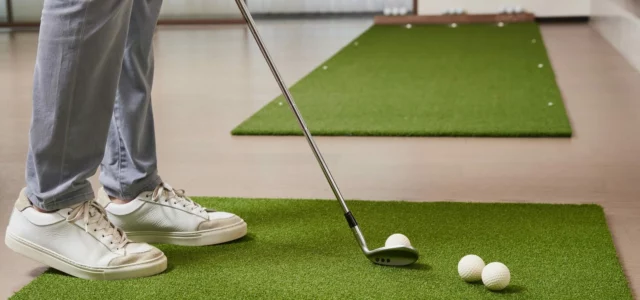
The tracked range. A growing number of ordinary driving ranges now have ball tracking in every bay and a café behind them, which puts them halfway between practice ground and night out. Trafford Golf Centre in Manchester has 53 Toptracer bays, a golf shop and an adventure golf course on site. Hoebridge Golf Centre near Woking has Trackman in every bay, premium bays for up to four people at £20 an hour with unlimited balls, and VIP bays for up to six with Sky Sports on the screen and food brought to you.
Simulators and crazy golf. Indoor simulator lounges fit into a city-centre unit and ignore the weather. Adventure and crazy golf sits at the far end: putting as a family outing, with no pretence of being the sport.
The argument for: the door is wider than it used to be
The strongest case is about barriers. A newcomer arriving at a members’ club faces a dress code, an unfamiliar etiquette, a group waiting on the first tee and four hours of commitment. A bay with three friends has none of that. You can be terrible and nobody who matters is watching.
The venues also reach people clubs have struggled to reach. Bushell’s point about younger and social players is the same one many clubs make privately when they look at the average age of their membership list and then at the queue for a Friday night Topgolf booking.
The argument against: a mat is not a fairway
A bay teaches you to hit a perfectly teed-up ball at a target from a flat mat, with no consequence for a miss. It teaches nothing about a ball on a downslope in wet rough, pace of play behind a four-ball, or what to do when your drive disappears into gorse. A mat also forgives a heavy strike that turf would punish, so habits formed indoors do not always survive the first real round.
Then there is the bolder claim. At the end of the first quarter of 2026, BBC Sport looked at a prediction from an indoor golf technology firm that more virtual rounds than outdoor rounds would be played in the UK by the end of 2028. Sporting Insights disagreed publicly: Great Britain and Ireland have more than 3,000 golf courses and have not run out of capacity, whereas South Korea, often cited as the model, has around 830 courses and 6,000 simulator facilities. Their view is that simulators are an entrance to the game, not a replacement for it.
And plenty of bay customers never want to play a course. That is a perfectly good outcome for them, and treating them as failed recruits misreads what they paid for.
What an on-ramp looks like in practice
The useful question for a club is not whether venues create golfers in general but what happens to one curious person after their third night in a bay. Hoebridge’s Pathway to Golf is a clear example of a staged route. It starts with a one-hour group taster at £10 a head. Four one-hour group lessons on grip, stance and swing follow at £60 (range balls are extra), then four more on the short game at £48, the last of them played on the course. After that comes a month’s free membership with a free social golf session each week. Hire clubs are included throughout.
The same centre has the kind of golf a nervous beginner can actually handle: a par 3 Short Course that takes around 90 minutes, and the nine-hole Shey Copse. That combination, cheap tuition that ends on grass and a short course to go to afterwards, is what most clubs are missing when they conclude that venue players do not convert.
If your golf so far has happened in a bay
You have already cleared the hardest hurdle, which is making decent contact with a golf ball. What is missing is the course, and the gap is smaller than it feels.
- Start short. A par 3 course or a nine-hole layout at a quiet time teaches the rhythm of a round with the shots you already hit indoors.
- Carry less. A hybrid, a 7 iron, a wedge and a putter will get you round a short course. Many venues hire clubs.
- Behave rather than perform. Keep up with the group in front, repair pitch marks and rake bunkers. Nobody on a municipal par 3 minds a beginner who does that.
- Learn four situations. Teeing within the markers, a lost ball and a provisional, a penalty area, and an unplayable lie. The R&A’s Rules of Golf app covers the rest.
If you sit on a club committee
The venue crowd is the largest pool of potential golfers your club will ever be near, and none of them is going to start with a full subscription and a joining fee. What tends to work is small and cheap: a nine-hole competition in the evenings, a twilight rate that is noticeably lower, a beginners’ session with clubs provided, and a clear next step after it. The tee sheet at half past five on a weekday is usually quiet anyway.
Some clubs are going further and installing a simulator bay of their own, which keeps members swinging through January and gives an indoor-only player a reason to walk into the clubhouse.
Turning winter bay time into practice
The clocks go back on 25 October 2026, and from then until spring a bay is where a lot of British golfers will do their swinging. Used with a plan it is genuine practice; used without one it is an expensive way to hit drivers.
- Build a carry chart for every club, from the wedges up, using the tracking numbers rather than your memory.
- Test one change at a time: ten balls before, ten after, and compare dispersion as well as distance.
- Play a simulated round and make the club choices you would on a real course, including laying up.
- Resist the default of hitting a whole bucket with the driver because the screen shows the distance.
Where to find bays, short courses and first lessons in Britain
Venues. Topgolf’s UK sites are Chigwell, Watford, Surrey and Glasgow. Tracked ranges are spreading through ordinary golf centres, Trafford in Manchester and Hoebridge in Surrey among them, and are usually cheaper than a venue for practice.
Short courses. In Edinburgh, Edinburgh Leisure, which runs the city’s public courses, operates the Wee Braids next to Braid Hills: a nine-hole par 3 pitched as an introduction for beginners, with clubs for hire for nine holes at £16.50. Look at your own council or leisure trust for the local equivalent.
Lessons. England Golf’s Get into Golf lists beginner sessions at clubs and facilities across England, and PGA Play lets you search among around 8,000 PGA Professionals by location. Group sessions are cheaper than individual lessons and a lot less intimidating when everyone else is new too.
Panxis Golf has no commercial relationship with any venue, course or booking platform mentioned here, and earns no commission.
In short
- Britain’s record rounds in 2025 came with simulators and tracked ranges credited as an entry point.
- A bay builds contact with the ball; it does not teach you how to get round a course.
- The conversion happens on a short course with cheap group tuition, not on the phone.
- Winter bay time only counts as practice if you arrive with a question.
- Somebody who only ever wants the bay is a happy customer, not a lost member.