Drought, sprays and wild rough: what British golf courses really do with water and chemicals
Almost three quarters of England was still in drought in mid September 2026. Behind the tan fairways sit winter reservoirs, certificated sprayers, a national plan to cut pesticide risk by 2030 and the wild ground nobody plays. Here is how to read it at your own club.

In brief
- After the driest July and joint-hottest August on record, greens get the water first and fairways very little.
- The better model stores winter river water for summer use, as Hoebridge does with a 37,500 cubic metre reservoir.
- Professional sprayers need an accredited certificate, and the UK plan published in October 2025 names golf courses in its amenity sector.
- GEO Foundation certification means someone outside the club has checked the water, energy and habitat records.
- Repair pitch marks, keep trolleys off wet ground and treat a brown fairway as part of the course.
By the middle of September 2026, almost three quarters of England was still officially in drought. The government said so after the National Drought Group met on 15 September, pointing to an exceptionally dry spring, the driest July and the joint-hottest August on record. If your home course has spent the summer looking more like a cricket outfield in a heatwave than a television fairway, that is the backdrop, and it is also the best possible moment to understand what the greenkeeping team is doing with water, sprays and the parts of the property you never walk on.
The short version: the brown was mostly deliberate, the spraying is more regulated than most members assume, and the questions worth asking your club are specific enough to get real answers.
A drought year, seen from the first tee
The official figures explain why so many clubs turned the sprinklers off the fairways weeks ago. England received just over half (56%) of its typical spring rainfall this year. The Environment Agency told the drought group that the country now needs around 120% of normal rainfall over the next seven months for every area to be considered out of drought, and that even in the most likely scenario Devon and Cornwall and East Anglia will still be in drought at the start of April 2027. The group, which brings together government, the Met Office, regulators, water companies, farmers and conservation bodies, is meeting weekly.
There is some context that cuts the other way. Between September 2025 and March 2026 England had 130% of its typical rainfall, which is how the country recovered from the 2025 drought before sliding back into this one. British weather lurches, and a golf course has to be managed for both ends of it: a sodden winter that fills ditches and a summer in which every litre on a fairway is a litre the river could have kept.
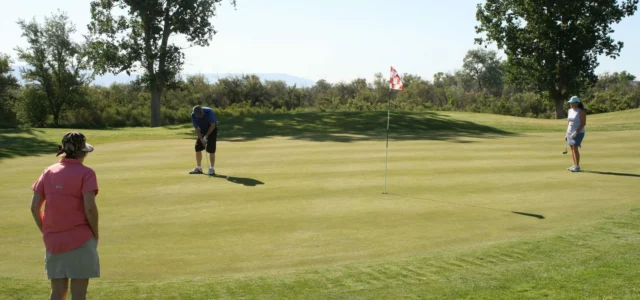
For a golf club, that translates into a pecking order. Greens come first, because a green lost to drought stress takes a season to recover and closes a hole. Tees come next. Fairways get what is left, and in a year like this one that is very little. Semi-rough and deep rough usually get nothing at all.
Winter water for summer greens: one Surrey example
Where the water comes from matters as much as how much of it goes on. Hoebridge Golf Centre, near Woking, publishes an unusually clear account. Its courses are irrigated with water taken from the River Hoe in winter, when flows are high, and stored in a 37,500 cubic metre reservoir for use in summer. The club says the reservoir cost £350,000 when it was built in 2010, and that the arrangement means it does not need mains water, or water from the river when summer flows are low.
That is the model to look for. A course that fills its own storage when there is plenty and draws on it when there is not is in a very different position from one pulling from the mains in August, however green the second one looks. If your club has a reservoir, ask how full it was in May and how many weeks of greens irrigation it covers. If it has no storage at all, ask what happens when a hosepipe-style restriction reaches its supply.
Why the fairway is the colour of a digestive biscuit
Most members say they understand that brown turf in August is dormant rather than dead. Far fewer are relaxed about it on their own course when they have a medal on Saturday.
The case for firm, tan fairways is strong and it is very British. Links golf was built on sandy coastal ground where the fine grasses, browntop bent and red fescue among them, run fast and firm, and the ball is meant to bounce and release. A firm, lean surface also drains and dries quickly after rain, which is one reason greenkeepers prefer it to a soft, heavily fed sward. Keeping it bright green through a drought would mean more water, more feed and, sooner or later, more fungicide.
The comparison that causes the trouble is television. A championship venue is prepared for a single week at a level of cost and labour no members’ club can repeat for a season. Your course in the fourth week of August is not failing to meet that standard; it is playing a different game, and arguably a better one, where you have to think about where the ball lands rather than only how far it flies.
The spray tank: certificates, codes and a 2030 target
Chemical use on British courses sits inside a framework that has tightened in stages. A professional who applies pesticides must hold an accredited certificate, unless working under the direct supervision of someone who does. Each of the four UK nations publishes a Code of Practice for using pesticides, covering amenity work as well as farming.
The most recent statement of direction is the UK Pesticides National Action Plan 2025, published by the four governments in October 2025. It names golf courses explicitly as part of the amenity sector, alongside sports pitches, parks and transport verges, and it pushes integrated pest management: prevention and monitoring first, with chemistry only when a threshold is crossed. It sets a target of cutting each of the 20 measures in the UK Pesticide Load Indicator by at least 10% by 2030, against a 2018 baseline. It is also candid about a gap: the governments say they do not currently have robust data on pesticide use in the amenity and amateur sectors, and list gathering it as an action.
Some products have simply gone. Chlorothalonil, a broad-spectrum fungicide long used on turf and crops, was banned by the European Union in March 2019 with effect from May 2020, a decision The Guardian reported at the time as the loss of the UK’s most-used pesticide.
What this means in practice is that a well-run course sprays less on a calendar and more on evidence: disease pressure, weather, soil moisture. Greens still get protected, for the same reason they get the water. It is on fairways and rough that the reductions show.
The acres nobody plays
Every course has ground that is not tee, fairway, green or managed rough: woodland strips, pond margins, heath, hedgerows and long grass beyond the rough. That land is where most of a course’s value for wildlife lies, and it costs little to maintain.
Hoebridge again gives concrete examples: bird boxes, bug hotels and bat boxes installed around the course, and a combination of woodland and grassland habitat that the club says sequesters 266.5 tonnes of CO2 equivalent a year. That figure is the club’s own estimate, but the direction is what matters for a member reading it.
There is a price, and golfers pay it in lost balls. Long grass close to landing areas slows play and irritates people; long grass well away from them is almost free. The best projects put the wild ground where a reasonable tee shot does not go.
Mowers, electricity and the clubhouse
Not all of a course’s footprint is on the grass. Hoebridge reports switching to an electric greens mower and electric greenkeeping machinery, running on 100% renewable electricity, installing EV charging points in 2024, and moving its kitchen off gas. Quieter mowers also matter on courses with houses beside the early holes and staff out at first light.
Where to find the evidence for a British club
The most useful single reference is the GEO Foundation for Sustainable Golf, which runs the Sustainable.Golf platform and its OnCourse programme. Hoebridge, part of the BGL Group, says it has been GEO certified since 2013 and ties its commitments to OnCourse tracking, annual scorecards and a five-yearly certification, with a stated aim of net zero by 2027. GEO certification is not proof of virtue, but it does mean someone outside the club has looked at the water, energy and habitat records.
For water, the government’s drought updates on GOV.UK tell you whether your area is in drought and what the outlook is. Your club’s own website may have a sustainability page; if it does not, that tells you something too.
What you can do on the course
- Repair your pitch mark and one more. Damaged greens need more intervention to recover.
- Keep trolleys and buggies off wet or worn ground, and follow the course’s traffic signs. Compaction is behind much of the aeration members grumble about.
- Fill divots with the sand and seed provided.
- Treat a brown fairway in a drought as part of the course, not a complaint for the committee.
Questions to put to your course manager
- Where does the irrigation water come from, and is there winter storage?
- Which areas stop being watered first when supply is restricted?
- How has the spray programme changed since the old calendar approach, and who on the team holds the certificates?
- How much of the course is left unmown or managed for wildlife, and where?
- Is the club working towards GEO certification, or reporting its figures anywhere?
Most greenkeeping teams are glad to be asked, especially after a summer like this one. And if first-tee nerves are what really bother you on medal day, a firm, running fairway is at least a forgiving place to land a nervous drive.