Brown couch, bigger dams and native heath: how Australian courses manage water and spray
Every Australian course is a water decision with flags on it. Dormant couch, grass swaps, bigger storage, restored heath and spray notices tell you how well yours is run, if you know where to look.
In brief
- Couch goes straw-coloured in a southern winter because it is dormant, not because it is dry.
- Magenta Shores swapped Legend for Santa Ana couch and lifted its water storage by 300 per cent.
- Royal Sydney's Bay course traded paperbarks for coastal heath and ended with more native trees than before.
- In NSW, councils must have a pesticide notification plan for the public places they manage.
- Pitch marks, cart rules after rain and patience with tan fairways are the player's share.
Australia is the driest inhabited continent, and every golf course here is, in the end, a water decision with flags on it. Melbourne’s storages took in 36 per cent less than their 30-year average between July 2024 and June 2025, a run of inflows that echoed the worst years of the Millennium Drought. Victoria has had Permanent Water Saving Rules since 2011. Canberra sat on Stage 3 restrictions through 2007 and 2008. None of that is background noise for a superintendent. It is the operating budget.
So when a member stands on the 1st tee in late summer and asks why the fairway looks like a paddock, the honest answer is often: because somebody made a good call. This piece is a guide to reading those calls on the course you play, from the grass under your feet to the heath beside the tee and the spray sign on the gate.
Two different browns
Australian golfers see a fairway lose its colour at two different times of year, for two different reasons, and it helps to tell them apart.
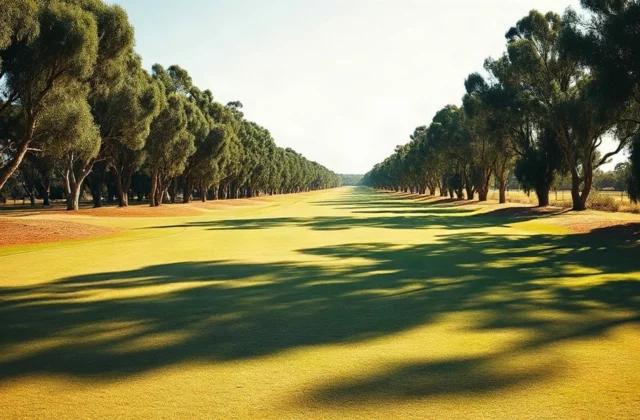
The first is winter. Much of the country’s golf is played on couch, the warm-season grass botanists call Cynodon dactylon. Couch grows actively above about 15 °C and goes dormant when it is colder, turning straw-coloured through a southern winter. Kingston Heath, which hosts the Australian Open in December 2026, has Santa Ana couch fairways. A tawny Sandbelt fairway in July is a grass doing what it is built to do, and pouring water on it would not bring the green back.
The second brown arrives at the other end of the year, from January into March, when a club stops chasing colour on ground that barely affects a shot: the edges of the fairway, the wide rough, the walk between holes. That is a choice, and on a well-run property it is a deliberate one. Dry, firm couch lets the ball run, drains after a storm and is less inviting to the diseases that love soft, overwatered turf.
The trouble is expectation. Most of us picture tournament golf as emerald from boundary to boundary, and a fortnight of championship preparation is not something any club can hold for a season. The clubs that manage this well tend to warn members in spring, in the newsletter or on the noticeboard, before the first complaint lands in February.
Grass swaps and bigger dams
The quiet engineering happens below the surface and at the bottom of the irrigation lake.
Magenta Shores, on the NSW coast just north of The Entrance, is a published example. Golf Australia magazine reported in 2026 that superintendent James Newell had overseen the conversion of all its fairways from Legend couch to Santa Ana couch, described as less thirsty, and that the crew was finishing the last of the back-nine tees with the same grass. The club also expanded its irrigation lake to lift water storage by 300 per cent, which reduced its reliance on the local supply and what that supply cost.
Those two moves, a grass that needs less and a store that catches more, sum up much of what water efficiency means on an Australian course. Neither shows up on a scorecard. Both show up in the accounts, and in whether the course stays playable when restrictions tighten again.
Where the water comes from matters as much as how much is used. A course filling its lake from runoff sits in a different position from one drawing on the town supply, and in a drought the difference decides which fairways get water and which are left to fend for themselves.
What Royal Sydney and the Sandbelt say about bush
The other big shift in Australian golf is visible from the car park: fewer rows of planted trees, more sand, heath and native grasses.
Australian Golf Digest’s April 2026 feature on vegetation tells the Royal Sydney story. For the restoration of the Bay course at Rose Bay, Gil Hanse worked with Sydney vegetation specialist Harley Kruse, and a forest of paperbarks gave way to hectares of sandy coastal heathland. The project removed 597 trees, drew objections from two councils and local residents, and ended up in the Land and Environment Court. The revised plan planted 2,187 native trees, for a total of 4,288 compared with 2,696 before.
The same feature quotes Nicholas Williams, professor of urban ecology at the University of Melbourne, who led a four-year study of biodiversity on Sandbelt courses. His point is that the out-of-play areas are where the value sits: dense tea-tree rough shelters small birds that struggle in mown parks, sandy ground lets native bees nest, a layered understorey brings more insects and more bats, and a course with no lights at night lets nocturnal animals behave normally.
Kruse also describes how courses got so crowded in the first place: exotic plantings in the 1940s, then a 1960s and 1970s “bush garden” movement that planted natives from other states, such as Queensland silky oaks and West Australian flowering gums, partly because they needed less water. Native, in other words, is not always local. At 7 Mile Beach near Hobart, which opened on a former radiata pine plantation with a Clayton, DeVries & Pont design, the general manager told the magazine that shorebirds now nest in the sheltered dunes.
There is a cost worth naming. Heath and long native grass swallow golf balls, and Magenta Shores itself softened its knee-high rough after early complaints. The good versions keep the wild ground away from where most tee shots land.
Spray programmes and the sign on the gate
Pesticide use on golf courses has followed the same logic as water: treat what needs treating, when it needs it, rather than spraying the whole property to a calendar.
Greens are still protected hard, because a lost green closes a hole and costs far more than prevention. The savings come from fairways and rough, where monitoring disease pressure and adjusting mowing, drainage and airflow first can replace routine spraying. Integrated pest management is the name, and a superintendent running it properly can tell you what changed and when.
The rules about telling the public vary by state. In NSW, the Pesticides Regulation 2017 requires public authorities such as councils to consult their community on a pesticide use notification plan and to notify people before using pesticides in the outdoor public places they own or manage; the EPA lists parks, sporting fields and ovals among its examples. If you play a council-owned course in NSW, it is fair to ask how that plan applies to the course and where notices are posted. A notice at the first tee is information, not a warning to go home.
Where to look on your own course
You do not need a soil probe to read how a course is managed. A slow walk round tells you a lot.
- The irrigation lake or dam. Is there one, how full is it in late summer, and does the club say where it is filled from?
- The fairway edges in February. A crisp line between watered and unwatered ground suggests irrigation set to the playing corridor, not to the fence.
- The grass in July. Straw-coloured couch in a southern winter is dormancy, not neglect.
- The ground between holes. Native grasses, heath or sand that is left alone is habitat, and cheaper to keep than mown turf.
- The noticeboard. Course reports that explain spraying, coring and watering are a sign of a crew that expects to be asked.
Your share of the job
Most of this sits with the committee and the course staff, but a player still has a hand in it.
Fix your pitch mark and one more. A mark repaired straight away heals quickly; one left for days leaves a scar that needs more work to fix.
Respect cart rules after rain. Wheels on soft ground compact the soil, and compaction is behind a good share of the coring that members grumble about. Regional superintendents such as Kasey Williams at Harvey Golf Club in WA, profiled by Australian Golf Digest in 2026, name soil compaction among the long-term problems a small crew has to fight.
Fill divots with the sand and seed mix provided. Hit a smaller bucket at the range with a plan for every ball. And when the fairways go tan in a dry February, treat it as the course looking after its water rather than a reason to write to the board.
Questions for the club
- Where does the course’s irrigation water come from, and how much can the club store?
- Has the club changed grass types on fairways or tees to reduce water use?
- Which areas stop being watered first when restrictions come back?
- How much of the property is out of play, and is any of it being returned to local heath or grassland?
- What is sprayed on a schedule now, what is sprayed only when monitoring says so, and how are players told?
No course is a nature reserve, and a lake and some heath do not cancel out the water used on greens. The fair test is narrower and more useful: is your course better run this year than last? A superintendent who can answer that question with numbers is usually glad somebody asked.