The four-hour four-ball: what the Rules say about pace and where British rounds lose time
Slow rounds are lost between shots, not during them. Rule 5.6b already asks for 40 seconds a stroke and ready golf in stroke play; the rest is preparation, provisional balls said out loud and a trolley parked on the right side of the green.

In brief
- Rule 5.6b recommends making each stroke within 40 seconds and encourages ready golf in stroke play.
- Get the yardage, club and glove sorted while others play.
- A ball is lost after three minutes; announce a provisional using the word itself.
- Keep pace with the group in front, and call faster groups through at a safe spot.
- Twilight slots, nine holes and short courses are the quickest golf; Hoebridge's Short Course takes 90 minutes.
The Sunday four-ball that should take four hours and takes five has become one of British golf’s standing complaints, and it is rarely caused by anyone swinging slowly. Four players make somewhere around 350 strokes between them in a typical round. Even at ten seconds apiece, that is under an hour. The rest is walking, waiting, looking for balls and deciding things that could have been decided earlier.
That is good news, because it means nobody needs to rush a shot. The habits below cut time from the gaps, not from the swing, and the group behind will notice long before you do.
What the Rules of Golf actually say
Pace is not just etiquette; it is written into the Rules. Rule 5.6b expects players to play at a prompt pace throughout the round and recommends that, when it is your turn, you make the stroke in no more than 40 seconds, and usually more quickly than that.
The same Rule encourages “ready golf” in stroke play, pointing to Rule 6.4b(2), which allows players to play out of turn in a safe and responsible way. In a medal or a Stableford at your club, the player who is ready can play, provided it is safe; the one thing players must never do is agree to play out of turn to give one of them an advantage. Match play is different: order of play matters there.
Committees can go further. The R&A’s Model Local Rule K-1 lets a club set a maximum time for a round and penalise a group that finishes more than the starting interval behind the group in front and over that time limit. If your club has adopted a pace-of-play policy, it will be on the noticeboard or the competition terms.
Be ready before it is your turn
This is the single biggest saving. Work out your yardage, check the wind, pick the club and put the glove on while others are playing. Four players doing this on every shot can save a large chunk of the round without anyone ever feeling hurried.
In practice: the first player to reach their ball plays if it is safe, shorter hitters tee off while a long hitter waits for the green ahead to clear, and a golfer with a simple chip goes before a partner who is still working out an escape from a gorse bush.
One practice swing, not two
Two automatic practice swings on every shot, over a full round, add up to a surprising amount of standing still. One is plenty. Keep a proper rehearsal for the unusual shot, like a ball above your feet on a links bank, and drop the ritual second swing that achieves nothing.
Leave the trolley on the way out
Walk onto the green and leave your trolley or bag on the side nearest the next tee, taking the two or three clubs you might need from the approach. On a course where trolleys are kept well away from greens and tees, that planning matters more still: a bag abandoned at the front of the green means a walk back while the group behind waits on the fairway.
Buggy users on a paths-only day should take three clubs to the ball, not one.
Three minutes, and announce the provisional
Under the Rules, a ball is lost if it is not found within three minutes of you or your caddie starting to search. If there is any chance the ball is lost outside a penalty area or out of bounds, play a provisional ball before walking forward.
Say so properly. Rule 18.3b requires you to announce that you are playing a provisional ball, using the word “provisional” or otherwise clearly indicating it. Saying “I’ll hit another” is not enough, and that second ball becomes your ball in play under stroke and distance.
If your club has adopted Model Local Rule E-5 for general play, there is also an alternative to stroke and distance: a drop between where the ball was lost and the edge of the fairway, not nearer the hole, for two penalty strokes. Check the local rules before relying on it; it is not intended for elite competitions.
And watch every tee shot in your group all the way down. The player who has just hit a bad one is the least likely to have seen where it went, and gorse, heather and long links rough swallow balls that four pairs of eyes would have found.
Finish short putts and mark the card later
In a friendly round, hole out the tiddlers rather than marking, stepping aside and coming back. And write down scores on the next tee while someone else is hitting, not standing on the green you have just finished while the group behind waits to play in.
Play the right tees
A golfer carrying the driver 200 yards on a 6,800-yard course adds a shot to most par 4s, and every shot takes time. A useful rule of thumb: multiply your average driver carry by 28 to find the course length that suits you, so a 200-yard carry points to around 5,600 yards. Our guide to choosing the right tees explains how scores from forward tees still count for your handicap.
Keep pace with the group in front
The only measure that matters is your position relative to the group ahead, not how close the group behind is. If you walk onto a tee and the group in front has already left the next green, you have lost a hole and you are the problem, however pleasant the chat.
If you fall behind, or you are searching and a faster group is waiting, call them through. Do it at a par 3 or a safe tee, clearly, and stand well out of the way. It costs a couple of minutes and removes the pressure that makes everyone in your group play worse.
Why some rounds are slow however you play
Some delays are built in before you arrive. Short tee intervals on a busy weekend mean one slow group backs up the entire sheet, because there is no gap to absorb it. Tight pin positions, thick rough beside the landing areas and a packed society day do the same. It is worth asking when you book how busy the course is and what the tee interval is.
British weather adds its own delays: a squall that has everyone reaching for waterproofs and umbrellas, or frost that holds up the first tee times on a winter morning and compresses the whole day behind it.
Where to find a quicker round in the UK
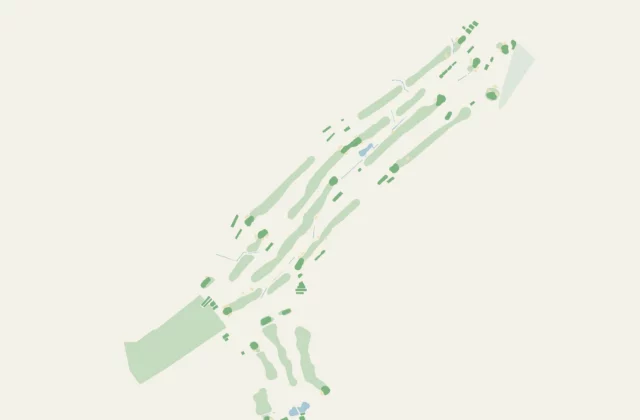
First off or last out. The earliest tee times and the twilight slots after the main sheet has cleared are usually the quickest golf on any course, and twilight is often cheaper. At Hoebridge Golf Centre in Surrey, for example, the main course costs £24 after 5pm, against up to £56 before 1pm at weekends.
Nine holes or a short course. A nine-hole course after work gives you proper golf in half the time. Hoebridge says its par-3 Short Course takes just 90 minutes, and its nine-hole Shey Copse course is £21 from Monday to Thursday.
Midweek. Many clubs have quieter midweek periods; ask the professional’s shop when the tee sheet is lightest and book then.
Ask directly. A well-run club or municipal will tell you honestly how busy a morning looks. The answer tells you what kind of afternoon you are booking.
Panxis Golf has no commercial relationship with any course or organisation named here.
A four-hour checklist
- Prepare while others play; hit within 40 seconds when it is your turn.
- One practice swing.
- If in doubt, play a provisional and say the word “provisional”.
- Leave the trolley on the side of the green nearest the next tee.
- Hole out short putts in friendly rounds and mark the card on the next tee.
- Play the tees that match your driver carry, and keep up with the group in front.