From simulator lounge to municipal par 3: does Canada’s indoor golf boom make golfers?
Simulator golf in Canada went from 23 to 41 per cent of golfers in a few years, and Golf Canada now links indoor rounds to its app and to a national league. Whether a lounge regular becomes a golfer depends on the first round on grass, and on who makes it easy.
In brief
- Golf Canada says 41 per cent of golfers in Canada now play simulator golf, up from about 23 per cent in 2022.
- The Golf Canada App records rounds and practice at member simulator facilities, and simulator leagues can qualify players for the BDO National Golf League.
- A mat forgives heavy strikes and never gives a bad lie, so the first round on grass exposes decisions more than swings.
- Municipal par 3s are the cheap first step: $18 at McCall Lake in Calgary, $19 in Montréal with an Accès Montréal card.
- Someone who only wants the lounge is a customer, not a golfer the game has lost.
In 2022, about 23 per cent of golfers in Canada had played simulator golf. Golf Canada now puts that figure at 41 per cent. Somewhere between a January night in a Leslieville bay and a Saturday in May on a municipal course, a lot of Canadians are deciding whether they are golfers, and the national body has started telling them they already are.
That message is generous, and mostly right. It also skips over the awkward part: a swing that works on a mat in February does not automatically survive a sidehill lie in May, and plenty of people who love the lounge never set foot on grass. Both groups are worth understanding, because the gap between them is where Canadian golf either grows or does not.
Indoor golf in a country with a five-month season
The Canadian version of entertainment golf grew up indoors, for the obvious reason. When the courses close in October and stay closed until April, a heated room with a screen is not a novelty, it is the only golf in town.
Golf Canada describes two separate markets. The first is commercial: simulator facilities opening in plazas, strip malls, office buildings and converted warehouses. The second is inside the traditional game, where clubs have put simulator bays into curling rinks, banquet halls and practice buildings so members can keep swinging through the winter. Its chief marketing officer, Tim McLaughlin, calls off-course golf “geographically accessible”, “likely more affordable”, “less time-consuming” and “less intimidating” for somebody who has never played, and the national body has built its Just Swing campaign around that idea.
The commercial side covers a wide range. In Toronto, FORE! Indoor Golf runs three Trackman locations where members can book bays around the clock, with summer 2026 rates from $20 an hour in Mimico to $30 in Leslieville. In Rosemont, Le Birdie offers 24/7 self-serve entry and community leagues. In Quebec City, VGolf Lounge has up to 20 simulators. Burloak Indoor Golf in Oakville covers 14,400 square feet with 12 bays and a short-game area. CanGOLF in Canmore sells simulator golf with a view of the Three Sisters. Some of these places are serious practice rooms, others are closer to a bar with a launch monitor, and a few are both depending on the night.
The bridge Golf Canada is building
What sets the Canadian picture apart is that the federation has stopped treating the indoor crowd as someone else’s customers.
Since a December 2025 update, the Golf Canada App lets golfers record rounds and practice sessions played at member simulator facilities, and those numbers sit in the same history as their outdoor scores. The app and website also list participating facilities, with filters for technology platform, the number of bays and booking links.
The second bridge is competitive. Off-Course Member Facilities can now run simulator leagues that act as qualifiers for the BDO National Golf League. A league has to finish by August 31. The top player at each participating facility can then move on to an outdoor Regional Final in their home province, and the national championship is played on the Saturday before the RBC Canadian Open, at its host venue. For the first time there is a formal path from a bay in a strip mall to a real course, with a scorecard at the end of it.
What the mat never tells you
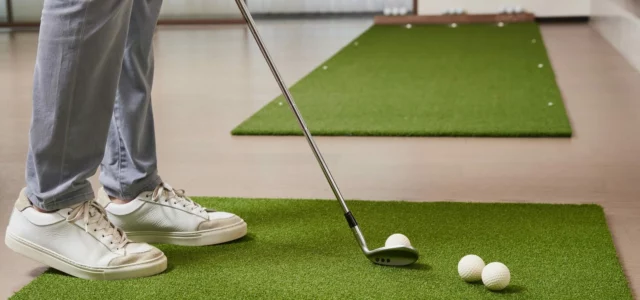
None of that changes what a bay is. You hit from a flat, level surface to a target with nothing at stake, and the ball is always sitting up.
Grass is less forgiving in every way that matters. A mat lets a heavy strike skid into the ball and still report a decent carry. A May fairway in Ontario, still soft from the thaw, takes the club and the distance with it. A simulator shows the shot that finished forty yards right, then gives you another ball on the same perfect lie. On a real hole that shot means a tree, a provisional ball and a group waiting behind you.
The etiquette a course expects is not taught indoors either. Nobody in a lounge learns where to stand while a partner putts, when to wave a group through, or how long you may look for a ball in October leaves before you call it lost. That is why the bay golfer’s first round often feels harder than it should: the swing is not the problem, the three hundred small decisions around it are.
Not every lounge regular wants a tee time
It is tempting to count everyone who never books a round as a failure. That misreads what they paid for.
A birthday in a VIP room with karaoke, a Tuesday team night, a date with pitchers and a leaderboard: these are complete evenings in their own right. Golf Canada says as much. Its line is that off-course golf complements traditional courses rather than replacing them, and that not everyone who plays indoors will move to grass, though many will. The honest target is not converting everybody. It is making sure that the people who are curious find an easy next step, and don’t find a locked gate.
From the lounge to grass in one season
If you have spent a winter in a bay, you have already done the hard bit: you can make contact. The next step should be short, cheap and low on spectators.
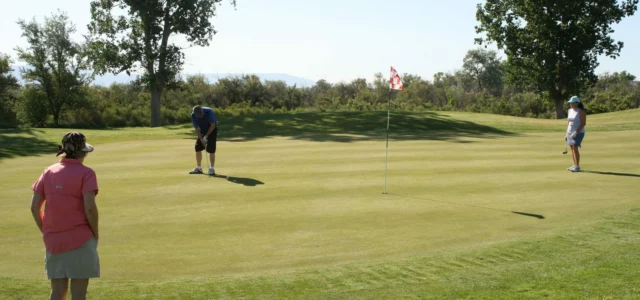
A par 3 course is the natural first stop, and several Canadian cities run one at municipal prices. In Calgary, the nine-hole par 3 at McCall Lake costs $18 for an adult, and a family of up to four with no more than two adults pays $33, or $37 with four sets of rental clubs. In Toronto, Dentonia Park is an 18-hole par 54 of 2,176 yards a few minutes from Victoria Park station; an adult pays $20.17 for nine holes on a weekday, before HST, in the first hour and 40 minutes of the day and again at the end. Rental clubs with a pull cart cost $17.50. Montréal’s municipal course in Rosemont–La Petite-Patrie is a nine-hole par 3, and an adult with an Accès Montréal card pays $19 on a weekday before 3 p.m.
Bring a hybrid, a 7-iron, a wedge and a putter, a sleeve of golf balls you won’t miss, and a friend who has played before. Keep up with the group ahead, repair your ball marks and rake the sand. Nobody on a municipal par 3 expects good golf. They expect reasonable pace.
Four rules will cover almost everything you meet in that first season: where to tee up, what to do when a ball may be lost, the options from a penalty area, and taking an unplayable lie. Golf Canada links to the official Rules of Golf app for the rest. If standing on a first tee with people watching is the real worry, go at the quiet end of the day, when the tee sheet is empty.
What clubs can offer the indoor crowd
A club that wants these golfers has to start its offer well below a full membership and an initiation fee.
The municipal systems show what a low first step looks like. In 2026, Toronto’s five city courses are running 30 free learn-to-golf clinics for juniors, women and seniors, 40 free community events and women’s-only leagues at all five sites, after a record of roughly 250,000 rounds in 2025. A private club doesn’t need that scale. It needs a nine-hole evening where scores are not the point, a twilight rate low enough to notice, and loaner clubs at the desk.
The club bays that Golf Canada mentions, in curling rinks and banquet rooms, work in the other direction. They give the club a winter product, and they give the lounge regular a reason to walk into a clubhouse in February and see what the summer version looks like.
Turning bay time into practice
An hour in a simulator is real practice if you arrive with a job to do. Without one, it’s an expensive hour of drivers.
- Build a carry chart for every club in the bag, then check it against the course in spring, when cold air and soft ground take distance away.
- Test one swing change: ten balls before, ten after, same club, and write down both averages.
- Play a simulated round at a nine-hole pace and make every club decision as if the lie were real.
- Log the session in the Golf Canada App so the winter numbers sit next to the summer ones.
If you are weighing a launch monitor of your own, a few rented hours of Trackman data first will tell you which numbers you actually use.
Where to try it in Canada
For indoor venues, start with Golf Canada’s facility finder, which lists member simulator facilities with their technology and number of bays. Golf Canada’s own winter roundup also names lounges from Quebec City and Montréal to Oakville, Canmore and English Bay in Vancouver.
For grass, look at the municipal systems first. Calgary’s city driving ranges sell a 25-ball bucket for $5, 50 balls for $10 and 100 balls for $15, and Confederation Park has 47 stalls on two levels. Toronto’s courses opened on April 10 in 2026. Montréal’s par 3 publishes its rates on the city website. For a first lesson, a free city clinic or a group session with a PGA of Canada professional costs far less than a private hour, and everyone in the group starts at the same level.
Panxis Golf has no commercial relationship with any venue, course or app named in this article and earns nothing from them.
In short
- A simulator builds contact and confidence, but a course teaches lies, pace and decisions.
- Golf Canada now links the two: app tracking for indoor rounds and a simulator route into the BDO National Golf League.
- The best first round on grass is nine holes on a municipal par 3 at a quiet hour.
- Clubs grow from this crowd with small offers, not initiation fees.
- Someone who only ever wants the lounge is a customer, not a lost golfer.