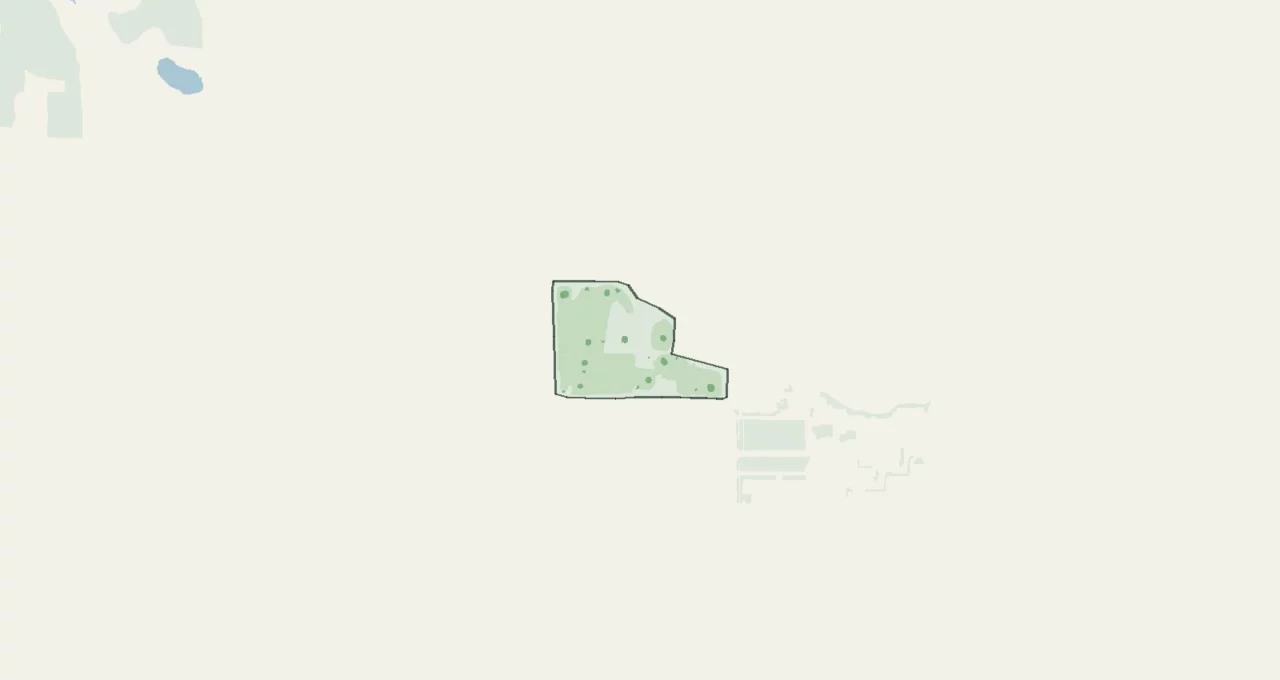
Layout of Hacker's Haven from OpenStreetMap survey data (ODbL licence).
Hacker’s Haven
Holes
9
By
27, every hole a par 3 (club's layout page; 18Birdies; Hole19; OpenStreetMap)
Length
940 yards from a single set of tees, holes from 70 to 165 yards (club's layout page; 18Birdies; OpenStreetMap); Hole19 gives 859 or 861, figures that match the club's yardages converted to metres
Green fee
—
Best season
March 1 to October 30 (GolfN); the club publishes no season dates; tee-off daily from 8 a.m., last round starts at 7 p.m. (club website); directories give 8 a.m. to 8 p.m.
Hacker’s Haven is a nine-hole, par 3 golf course at 12309 240th Street in Maple Ridge, British Columbia, in the Yennadon neighbourhood on the north side of the city. It sits on the west side of 240th Street, about 600 metres north of Dewdney Trunk Road, on a property of 10.5 acres that the club’s history page says was a strawberry farm before it became a golf course. Every hole is a par 3, the total par is 27, and the club’s own layout page gives a length of 940 yards, with holes running from 70 to 165 yards. Play is on a walk-on basis: the club says no tee times are needed and that the course runs first come, first served.
This is not a championship venue and it does not pretend to be one. It is a small, family-owned short course of the kind that used to be common on the edges of Canadian cities, a place to learn the game, practise the short irons or play a quick round after work. This page sets out what the public record says about the course, its holes and the visit, and it says plainly where the sources are thin or do not agree. For a course this size the record is short, and we have not stretched it.
History: from a strawberry farm to a family par 3
The club’s website tells the story in a short timeline, and it is the only detailed account we found. Before 1976, it says, the land was a strawberry farm worked by Chinese farmers, part of the agricultural past of Maple Ridge. In 1976 the Chaplin family bought the 10.5-acre property with the aim of building a nine-hole, par 3 course. Directories such as GolfN, GolfLink and ThreeBestRated give 1976 as the year the course opened; the club’s own wording is that the family bought the land that year with that plan, and it does not give a first day of play. We use 1976 as the date the project began, not as a confirmed opening date.
In 1981, according to the same timeline, John and Helen Kastelein bought the course and gave it the name Hacker’s Haven. A hacker, in golf slang, is a player of modest ability, and the name sums up who the course was meant for. The timeline then lists two pieces of local press coverage, a 1984 feature titled “Hackers Haven Laughs Back” and a 1997 feature titled “Hacking Out a Niche”. We could not find either article online, and the club does not name the publication, so we only report that it lists them. It also mentions a second annual Hacker’s Haven tournament in 2020.
The club describes itself today as family owned and operated. It does not say which family, and one public review mentions a change of ownership in recent years, adding that the service has stayed good. We found no public record of the sale, so we do not name current owners. No source we read names a course architect; the club credits the Chaplin family with the original plan, and we have not gone beyond that.
The course on the ground
The OpenStreetMap outline of the course, which maps each hole, tee, fairway and green, shows a compact property with the clubhouse near the 240th Street side and the holes laid out back and forth across the land to the west. Latimer Creek, a small stream, runs through the property, along with a second stream and an intermittent ditch, and the map shows patches of woodland and a large number of individual trees between the holes. The club describes it as a good walking course with tree-lined fairways, well-kept fields and trimmed areas.
The mapped holes also carry names, which appear on the OpenStreetMap data together with the yardages. Only the first, Duck Soup, is named on the club’s own website, so treat the others as the names recorded by mappers rather than as a scorecard we have seen. The yardages on the map match the club’s layout page hole for hole.
What it asks of you
A par 3 course of 940 yards does not test length. Only the 4th, at 165 yards, calls for more than a short or middle iron for most adult players, and four holes measure 90 yards or less. What Hacker’s Haven tests is the part of the game that most golfers practise least: hitting a small target from a short distance, then getting up and down when the target is missed.
Three things come up again and again in the club’s description and in public reviews. The first is the size of the greens. Reviewers describe them as small, and some say they are fast and hard to hold; one directory summary of reviews notes that they have no collars, so a ball that runs off the putting surface sits straight in longer grass. The second is water and slopes. The club says the 1st plays over a pond in front of the tee to a small green on a plateau, and the map shows Latimer Creek crossing the line of play on the 1st and the 7th, and a smaller stream on the 4th. One reviewer mentions a shot over a ravine. The third is the trees: reviewers describe the fairways as tight, and the map shows trees standing close to several holes.
For a beginner, that combination is useful rather than punishing: the distances are short enough to reach every green, and the trouble teaches club choice and aim. For a better player, the course is a test of wedge and short-iron distance control, and of chipping from tight spots around small greens. Reviewers who play it regularly describe it as a place to practise the short game, the lob wedge and iron accuracy rather than as a full round of golf.
Hole by hole
The yardages below are from the club’s layout page, the stroke index from the scorecard published in the 18Birdies app, and the names and directions from the OpenStreetMap outline. There is a single set of tees on every card we found.
1st, Duck Soup, 110 yards. The club’s own description of its opening hole: a pond just in front of the tee that takes a good swing to clear, and a small green built on a plateau that leaves a difficult chip for anyone who misses it. The hole plays west, and the map shows Latimer Creek crossing between tee and green. It is the 4th hardest hole on the 18Birdies card.
2nd, Tree Trouble, 120 yards. The hole turns back east, across an intermittent ditch on the map. Its name speaks for the trees around it; the 18Birdies card ranks it the 3rd hardest.
3rd, Hookers Delight, 110 yards. Back to the west, with no water mapped across the line of play. The name suggests that a shot curving left is not the disaster it might be elsewhere; we have no description of the hole beyond that.
4th, Driver McIver, 165 yards. The longest hole on the course and the hardest on the 18Birdies card. It plays north, and the map shows a small stream crossing it. For many players this is the one hole that calls for a fairway wood or a hybrid.
5th, Wee Green, 90 yards. A short hole playing south, named for the size of its target. On a course where every green is small, this one is singled out.
6th, Turtle Back, 75 yards. A short hole back to the north. The name usually describes a green that falls away on all sides, which fits the reviews of greens that are hard to hold, but no source we read describes this green in detail.
7th, Waterloo, 125 yards. The hole plays southeast, and Latimer Creek crosses it on the map. The 18Birdies card ranks it the 2nd hardest, and its name hints at what happens to a shot that comes up short.
8th, Easy Does It, 75 yards, and 9th, The End, 70 yards. The course closes with its two shortest holes, both ranked at the bottom of the stroke index, the 9th playing back northwest toward the clubhouse. They are a chance to finish with a birdie, provided the ball stays on the green.
What golfers say
Public reviews of Hacker’s Haven are spread over Google, as summarised by the Wanderlog and ThreeBestRated directories, and over the 18Birdies app, where only a handful of players have left a rating. Golf review sites such as Golfshake, The Social Golfer, Hole19 and GolfN had no reviews of the course when we read them. What follows sums up recurring themes; nobody is named, nothing is quoted from reviewers and nothing is counted.
What comes up in its favour
The most frequent praise is for the course as a place to learn and practise. Reviewers describe it as ideal for beginners, for families with children and for working on the short game and the irons. The condition of the greens and fairways draws many positive comments, with some reviewers noting that the course stays dry after rain and that new greenkeepers have improved it. The staff is described as friendly, and the prices as reasonable, a point that comes up often enough to be a theme. Players also like the setting: a quiet course tucked into a suburban neighbourhood, described as a hidden gem, with deer sometimes seen on the property. In the app, regulars note that the course is rarely busy, with only one or two groups on it at a time, and that rounds move quickly.
What comes up against
The criticisms are fewer and mostly concern the challenge rather than the welcome. The greens are tiny and without collars, so they punish a shot that is slightly off line, and some players find them fast and tough. The fairways are described as tight. In the app, the rating for course condition is lower than the ratings for value and overall experience, which suggests that conditions have varied over time. Some reviewers point out that this is a par 3 course with a few short holes, not a full course, which disappoints anyone who arrives expecting one. Wildlife is part of the setting, and players are advised to keep an eye out for deer.
In short, golfers who come for a relaxed hour of short-game practice, a first round with children or a cheap evening outing tend to like Hacker’s Haven. Players who want length, practice facilities or a full eighteen holes are better served elsewhere.
Playing as a visitor
The course is public. The club says no tee times are needed, play is first come, first served, tee-off starts daily at 8 a.m. and the last round starts at 7 p.m. Directories give opening hours of 8 a.m. to 8 p.m., and the OpenStreetMap entry notes that hours vary through the season and that the club suggests calling ahead. GolfN gives a season from March 1 to October 30; the club does not publish season dates, so a call before an autumn or winter visit is worthwhile, especially in early November.
The club rents sets of irons with a putter, pull carts and power carts, and sells balls, tees, snacks and drinks in its pro shop. It sells punch cards valid for twelve rounds and offers junior rates. GolfN lists a putting green, and the map shows a tenth green beside the course that fits that description. ThreeBestRated also lists a driving range, lessons, tournaments and a junior program, but the club’s own pages do not mention a range or lessons, and we could not confirm them. Walking is the norm on a course this size, and GolfN lists walking as allowed. The club’s FAQ lists questions about dress code and about children and beginners, but its answers were not readable when we visited the site, so we say nothing about a dress code.
The typical visit is short. Wanderlog suggests one to two hours, which fits nine holes of this length when the course is quiet.
Getting there
The address is 12309 240th Street, Maple Ridge, BC V4R 1M9, and the phone number is 604-467-3061. The course is on the west side of 240th Street, north of Dewdney Trunk Road, which crosses Maple Ridge from west to east; from the intersection, turn north on 240th Street and the entrance is about 600 metres up the road. Maple Ridge is in the Fraser Valley, on the north side of the Fraser River east of Vancouver. The nearest bus stops on the map are on Dewdney Trunk Road near 243rd and 244th Streets, a walk of roughly ten minutes to the course; we have not checked current transit routes or schedules.
Green fees
The club publishes its rates for adults, juniors, rentals and punch cards on its own site, and they change from season to season, so we do not reproduce them. See the club’s own site for current rates.
How this page was made
The factual frame comes from public sources read on November 2, 2026: the club’s website (hackershavenpar3.com) for the history timeline, the layout, the description of the 1st hole, the walk-on policy, the hours, the rentals and the contact details; OpenStreetMap for the location, the address, the outline of the holes and their names, the streams and the woodland; the 18Birdies app for the hole-by-hole scorecard and stroke index and for a few reviews; GolfN, Hole19, Golfshake, The Social Golfer and ThreeBestRated for the directory listings; and Wanderlog and ThreeBestRated for summaries of Google reviews.
Where sources disagree, we say so. The club, OpenStreetMap and 18Birdies give 940 yards; Hole19 gives a total of 859 yards on one line and hole lengths adding up to 861 on another, and its figures match the club’s yardages converted to metres, so we follow the club. Directories give 1976 as the opening year, while the club says only that the land was bought that year to build the course; a search excerpt of GolfLink, whose page refused our requests, also showed a 1926 date that seems to belong to another listing. Hours differ between the club (last round at 7 p.m.) and directories (8 a.m. to 8 p.m.). ThreeBestRated lists a driving range and lessons that the club does not mention, and Golfshake lists no clubhouse although the map shows one. The 18Birdies app gives a course rating of about 26.1 and a slope of about 77.3, figures that look computed rather than official; we could not confirm a rating from a provincial or national golf association and have left it out.
We did not find the name of the original builder, a confirmed first day of play, the current owners or the 1984 and 1997 articles the club cites. We have left those gaps open. The opinion section summarises reviews read on November 2, 2026; we report recurring themes rather than individual voices and reproduce no quotations from reviewers. Nobody from Panxis has played or visited this course, and this page is no substitute for a round.
Hacker’s Haven has not paid for this page, has not seen it before publication and has no say over its content. This page contains no commercial link and earns us no commission. If you know the course and something here is wrong or out of date, write to us and we will correct it.
Other courses nearby
Closest to this one in our Canadian directory:
- Eighteen Pastures — 11 km
- Langley Golf Centre — 17 km
- Burnaby Mountain Golf Course — 28 km
- Fraserglen Golf Course — 32 km
The hole to know
Duck Soup, 110 yards: a pond just in front of the tee that takes a good swing to clear, and a small green on a plateau that leaves a difficult chip if missed (club website). OpenStreetMap shows Latimer Creek crossing the line of play.