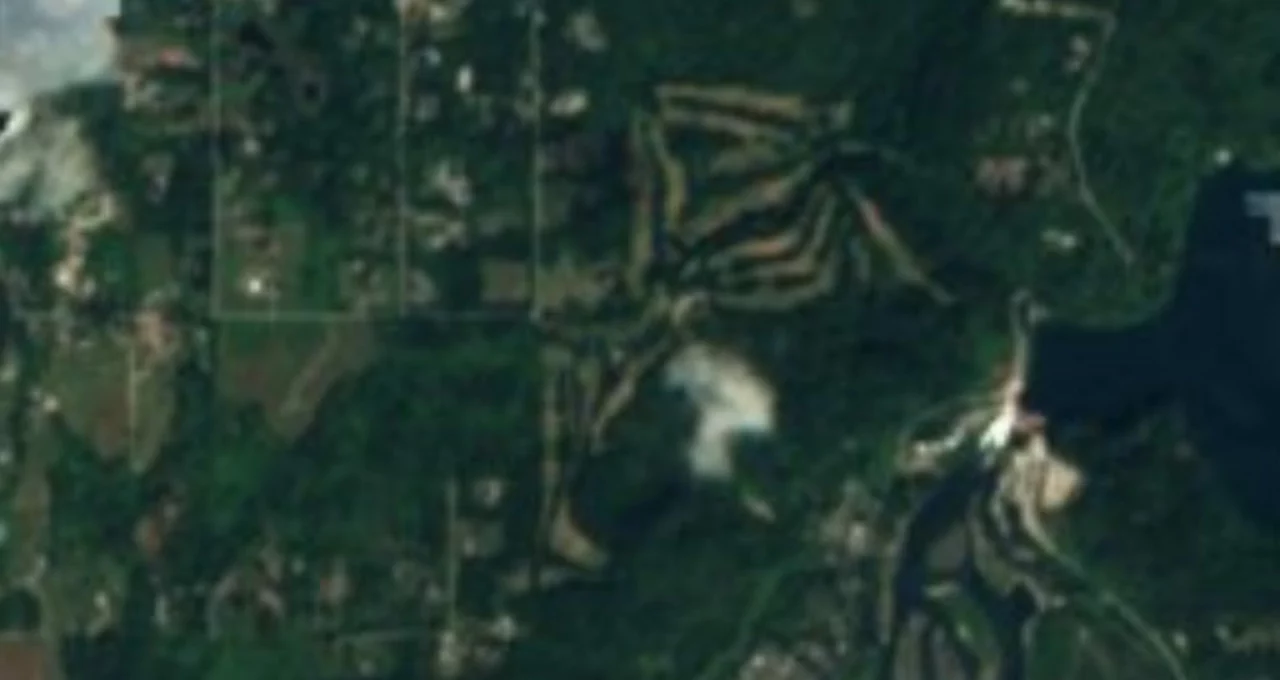
Eighteen Pastures from space. Sentinel-2 cloudless 2016 by EOX IT Services GmbH (contains modified Copernicus Sentinel data), CC BY 4.0.
Eighteen Pastures
Holes
18
By
72 (Golfing Record, 18Birdies, GolfNow scorecards)
Length
6,697 yards yellow, 6,323 blue, 5,948 white, 5,352 red (Golfing Record, 18Birdies); older three-tee card 6,812 blue, 6,403 white, 5,777 red (GolfNow, TeeOff); rating and slope 73.0/145 yellow men, 71.5/135 blue men (18Birdies), 76.6/155 red (GolfNow, TeeOff, 18Birdies)
Green fee
—
Best season
Year-round according to GolfNow, TeeOff and Golf N; no statement from the club found
Eighteen Pastures is a public 18-hole golf course on the western edge of the District of Mission, British Columbia, at 29110 Matheson Avenue, close to the boundary with Maple Ridge in the Fraser Valley. Directories date its opening to 1989, and the course was cut from forest on a hillside: the Canada Golf Card listing places it on the south slope of Iron Mountain. The most detailed scorecard we found gives a par of 72 and 6,697 yards from the yellow tees, with three shorter sets down to 5,352 yards. The club’s website quotes Golf Canada’s magazine as calling it Canada’s highest slope rated public golf course, and every source we read, from the club itself to its harshest reviewers, agrees that it is a hard course. The clubhouse is a red barn that also serves as an event hall. The club’s website is eighteenpastures.com.
It is a modest, independently run course rather than a resort or a member club, and it divides golfers more than most. Players who come back speak of the challenge, the forest setting, the quiet and the value; players who do not come back speak, above all, of course condition. This page sets out what the public record says, where the sources disagree, and what we could not find.
Which course is this?
This page is about the course at the coordinates shown on the map below, recorded in OpenStreetMap as Eighteen Pastures at 29110 Matheson Avenue, Mission. The listings are inconsistent about where exactly that is. OpenStreetMap and The Social Golfer give the postal code V4S 1B5; GolfNow and Hole19 give V2V 6H5; the Expertgolf guide and Disc Golf Scene give V2V 6H3. 18Birdies lists a different street address altogether, 10480 287 Street, under Maple Ridge, and Hole19 also files the course under Maple Ridge. The likely reason is the course’s position on the municipal boundary, with access from both sides: the club’s contact page, as shown in search results, says the Mission (east) entrance has been closed for road repair and directs visitors to the Maple Ridge (west) entrance. We could not confirm whether that closure is still in force.
The name is used for one course only. We found no other golf course called Eighteen Pastures in Canada. One directory, Golf N, lists the website as golf18pastures.com, a domain that did not resolve when we checked; the club’s own address is eighteenpastures.com. Disc Golf Scene lists an “18 Pastures” disc golf venue at the same address: it is not a separate course but temporary disc golf layouts set out on the golf course for tournaments (see below).
History: the toughest course in Canada, by design
The public record of the course’s history is thin. Several directories, among them GolfNow, Golf N and GolfLink, give 1989 as the year the course was built or opened, and none gives another date. The Eventective venue listing, written by the club, says Eighteen Pastures has been hosting events in its Big Red Barn for more than 30 years, which is consistent with that date.
The fullest account of the origins is on the Canada Golf Card listing. It says the course was cut out of the forest on the south slope of Iron Mountain, and that the original members set out to build the toughest golf course in Canada; the listing adds that many people believe they succeeded. The same text contains a parenthesis that can be read as saying Eighteen Pastures was once known by another name, but it is worded ambiguously, and no other source we read mentions a former name, so we do not draw a conclusion from it.
The same listing describes how the course has been softened since. The greens, once very fast and, in its words, dangerous, are now kept at a more manageable speed; a fourth set of tees has been added; and continuous clearing of underbrush has, as the listing puts it, tamed the beast. That account matches the scorecards: the older cards found on GolfNow and TeeOff have three sets of tees, while the more detailed card on Golfing Record and 18Birdies has four.
On ownership, GolfLink names Wayne Lindberg as owner and operator, a detail we could read only as a search excerpt and could not confirm elsewhere. We found no reliable source naming the designer: one listing names an architect, but nothing on the club’s material or on the other directories supports it, so we leave the question open. We also found no local press coverage of the course’s founding.
What it asks of you
The difficulty is the course’s identity. The club describes it, according to search excerpts of its course page, as a layout carved out of the backwoods of Mission that places the emphasis on shot making, where an errant shot is punished, and as one of the most challenging courses in the Lower Mainland. Hole19’s course notes say the layout is built on the side of a mountain, so flat lies are rare, and warn golfers to expect to score well above their usual number. Reviewers’ descriptions converge: long, narrow fairways lined with trees, hilly ground, blind shots, and a lot of lost balls for anyone who sprays the ball. 18Birdies’ users rate its difficulty as very hard.
The scorecard published by Golfing Record, which matches the tee lengths on 18Birdies, has four sets of tees. From the yellow tees the course measures 6,697 yards (3,328 out, 3,369 in); from the blue, 6,323; from the white, 5,948; and from the red, 5,352. Par is 72, split 36 and 36, with four par 3s (the 3rd, 5th, 11th and 17th) and four par 5s (the 6th, 9th, 10th and 18th). The par 3s are short, between 153 and 172 yards from the yellow tees, and none of the par 4s reaches 450 yards. The difficulty lies less in length than in the ground and the trees.
Course ratings are where the course’s reputation comes from, and also where the sources are least tidy. 18Birdies gives the yellow tees a rating of 73.0 and a slope of 145 for men, and the blue tees 71.5 and 135; GolfPass shows the same men’s figures in search excerpts. The figure that stands out is the red tees’ rating of 76.6 with a slope of 155. It appears on GolfNow, TeeOff and 18Birdies, and GolfPass attributes it to women’s play from the red tees. A slope of 155 is the maximum the handicap system allows, which would explain the Golf Canada description the club quotes. The 76.6 rating from tees that are only 5,352 yards long on the four-tee card says a great deal about the terrain. We could not open Golf Canada’s own course rating records, and 18Birdies attaches the 155 figure to men rather than women, so the precise attribution should be checked with the club.
Two other cards circulate. GolfNow and TeeOff list three tees: blue at 6,812 yards (rating 74.5, slope 147), white at 6,403 (72.6 and 144) and red at 5,777 (76.6 and 155). Hole19 lists white tees at 5,438 yards with a hole-by-hole breakdown that matches neither card. The course has evidently been re-teed more than once, and we follow the four-tee card because it is the only complete one and because two independent sources agree on it.
The turf, according to GolfNow and Golf N, is bentgrass on the greens and bluegrass on the fairways. The Canada Golf Card listing says many holes have views over the Fraser Valley and towards Mount Baker, across the border in Washington State.
The course in sequences
Holes 1 to 5
The round starts with the hardest hole on the card. The 1st is a par 4 of 435 yards from the yellow tees and 404 from the blue, and it carries stroke index 1. The 2nd is a shorter par 4, 339 yards from the yellow, followed by the first par 3, 160 yards, the second-easiest hole on the card. The 4th, a par 4 of 374 yards, plays only 260 from the red tees, and the 5th is a par 3 of 164 yards from the yellow and 113 from the red.
Holes 6 to 9
The 6th is the longest hole on the course, a par 5 of 563 yards from the yellow and 544 from the blue, stroke index 5. It is also the one hole the Canada Golf Card listing describes in detail: it calls for a well-placed drive, and a long iron after it leaves about 100 yards to the green, with the fairway dropping several metres below the player. The 7th is a par 4 of 368 yards, the 8th a par 4 of 393 yards and stroke index 3, and the outward half ends with the 9th, a par 5 of 532 yards.
Holes 10 to 14
The back nine opens with a second par 5 in a row, the 10th at 500 yards from the yellow tees, which shrinks to 407 from the red. The 11th is the longest par 3, 172 yards from the yellow but only 95 from the red, the biggest proportional gap on the card. The 12th is a par 4 of 383 yards and stroke index 4, followed by two more par 4s of 387 and 416 yards.
Holes 15 to 18
The 15th is the longest par 4, 446 yards from the yellow and 413 from the blue, and it is stroke index 2. The 16th, 404 yards, is the second hole the Canada Golf Card picks out, for its two-tiered green surrounded by large Douglas firs. The 17th is the shortest hole on the course and stroke index 18, a par 3 of 153 yards. The round ends with a par 5 of 508 yards from the yellow tees and 395 from the red.
What golfers say
Eighteen Pastures has more reviews than most courses of its size, and they are unusually split. In search excerpts, GolfPass shows an average of about 2.4 out of 5 from roughly 95 to 100 reviews, with conditions the lowest of its category scores at about 1.8 and friendliness the highest at about 4.2; its recommendation rate is shown on different pages as 37 to 53 per cent. 18Birdies shows 3.1 from 18 reviews, with value at 4.0 and course condition at 2.5. Tripadvisor shows about 2.1 from 15 reviews, many written between 2016 and 2019, and Yelp 2.9 from seven. GolfPass reviews show play dates in the 2026 season. The points below are recurring themes from what we could read in October 2026. They are other golfers’ opinions, not ours, and we quote and name no one.
What comes up in its favour
- The challenge itself: golfers who enjoy it describe a real test of accuracy and course management.
- Value for money is the most common compliment, and one reviewer calls it the best golfing bargain in the province.
- The staff are frequently described as friendly and welcoming.
- The setting: forest, quiet, views, and wildlife seen crossing fairways, a point the TeeOff description also makes.
- The course is rarely crowded, and pace of play is rated fast on 18Birdies.
What comes up against
- Course condition is the dominant complaint: rough or bare fairways, overgrown bunkers, greens in poor shape, standing water after heavy rain, or ground so dry in summer that balls will not hold on the slopes. Some reviewers say the course needs investment; at least one more recent review reports improvement.
- Cart paths are described as potholed and muddy, and overhanging branches are mentioned.
- The power carts are described as old and as struggling on the hills, and reviewers who did walk recommend a cart anyway because of the climbs.
- Signage between holes is called poor, which matters on a hilly forest course where the next tee is not always visible.
- Beginners are warned to bring plenty of balls.
Playing as a visitor
The course is public. Directories list play on either 9 or 18 holes, and the club’s green-fee page, as shown in search results, says that players may continue for additional holes when there is room on the course. Separate rates exist for weekdays, weekends, seniors and juniors. GolfNow and TeeOff list walking as allowed, singles as allowed, no fivesomes, no metal spikes and a dress code of shirt and shoes. One reviewer in 2025 reported being asked not to book through a third-party tee-time site, so the simplest course is to call the club at 604-462-8622.
The sources disagree on carts. GolfNow and TeeOff say carts and rental clubs are not available, while the Canada Golf Card listing names power carts, pull carts and club rentals, and several reviews mention renting a power cart. On a course of this gradient, ask when booking. The same listing mentions a pro shop, a coffee shop and a licensed dining room; GolfNow and TeeOff list a putting green, a pitching and chipping area and a teaching professional. We found no mention of a driving range.
The clubhouse is a converted red barn, the “Big Red Barn” in the club’s own phrase, which serves food before and after a round and is hired out for weddings, banquets, concerts and other functions; Eventective gives its capacity as up to 250 people, with a bar, a kitchen and an outdoor area. The farm theme runs through the club: its newsletter is called the Mooos-letter.
The course also hosts disc golf. Disc Golf Scene lists “18 Pastures” as a venue since 2015, with temporary disc golf layouts set out on the golf course for tournaments, and two events scheduled for 7 and 8 November 2026. Golfers planning an autumn round may wish to check the calendar.
Getting there and when to go
The course sits on Matheson Avenue on the western edge of Mission, north of the Lougheed Highway (Highway 7) by our reading of the map. By our measurement on the map it lies about 11 km north-west of downtown Mission, about 13 km east of central Maple Ridge, roughly 20 km north of Abbotsford International Airport and about 52 km east of downtown Vancouver, all in a straight line. The area mapped as the course in OpenStreetMap covers roughly 51 hectares. Because of the entrance question raised on the club’s contact page, check with the club which access road to use before setting out.
GolfNow, TeeOff and Golf N all describe the season as year-round, but they give no detail and we found no statement from the club about winter closures or temporary greens. Reviews mention both waterlogged greens after rain and dry, firm ground in summer, so conditions vary considerably with the weather.
Green fees
The club publishes its rates on its green-fees page, with separate weekday, weekend, senior and junior rates. The site could not be reached on 26 October 2026; in that case, call the club for current prices.
How this page was made
The factual frame comes from public sources read in October 2026: OpenStreetMap for the location, outline, address and contact details of the course; the club’s website, which was unreachable when we wrote this page, for its self-description, the Golf Canada quotation, the green-fee policy and the entrance notice, all of which we could read only as search-engine excerpts; the Canada Golf Card listing for the origins, the changes to the course, the facilities and the descriptions of the 6th and 16th holes; Golfing Record for the four-tee scorecard and stroke indexes; 18Birdies for the matching tee lengths, ratings, slopes and its reviews; GolfNow and TeeOff for the year built, turf, policies, the three-tee card and its ratings; Golf N for the opening year; Hole19 for its course notes; Eventective for the barn and its events; Disc Golf Scene for disc golf; GolfLink, as a search excerpt, for the owner’s name; and GolfPass, Tripadvisor and Yelp, also only as search excerpts, for ratings and review themes. Distances and the area of the course were measured by us on the OpenStreetMap outline.
Where sources disagree, we say so. Three scorecards circulate: a four-tee card of 6,697 yards from the back (Golfing Record, 18Birdies), a three-tee card of 6,812 yards (GolfNow, TeeOff) and a white-tee card of 5,438 yards (Hole19). The 76.6 and 155 rating from the red tees is attributed to women by GolfPass and to men by 18Birdies. Three postal codes and two street addresses are in use, and the course is filed under both Mission and Maple Ridge. Directories disagree on whether carts and rental clubs are available. One directory gives a website domain that does not work. One listing names a designer whom no other source mentions, and we do not use it.
We did not find: the designer, the founders’ names, any press coverage of the opening, Golf Canada’s own rating records, a current statement on the season, or confirmation that the east entrance has reopened. The club’s website, GolfPass, Tripadvisor, Yelp and GolfLink could not be opened directly, so their contribution is limited to what search excerpts showed.
The opinion section summarizes reviews read in October 2026. We report recurring themes rather than individual voices, and we reproduce no quotations. Nobody from Panxis has played or visited this course, and this page is no substitute for a round.
The club has not paid for this page, has not seen it before publication and has no say over its content. This page contains no commercial link and earns us no commission. If you know the course and something here is wrong or out of date, write to us and we will correct it.
Other courses nearby
Closest to this one in our Canadian directory:
- Fraserglen Golf Course — 23 km
- Burnaby Mountain Golf Course — 39 km
- Bowen Island Golf Club — 71 km
- Bear Mountain — 113 km
The hole to know
The longest hole: a par 5 of 563 yards from the yellow tees, stroke index 5 (Golfing Record). It calls for a well-placed drive, and a long iron leaves about 100 yards to the green, with the fairway dropping several metres below the player (Canada Golf Card).