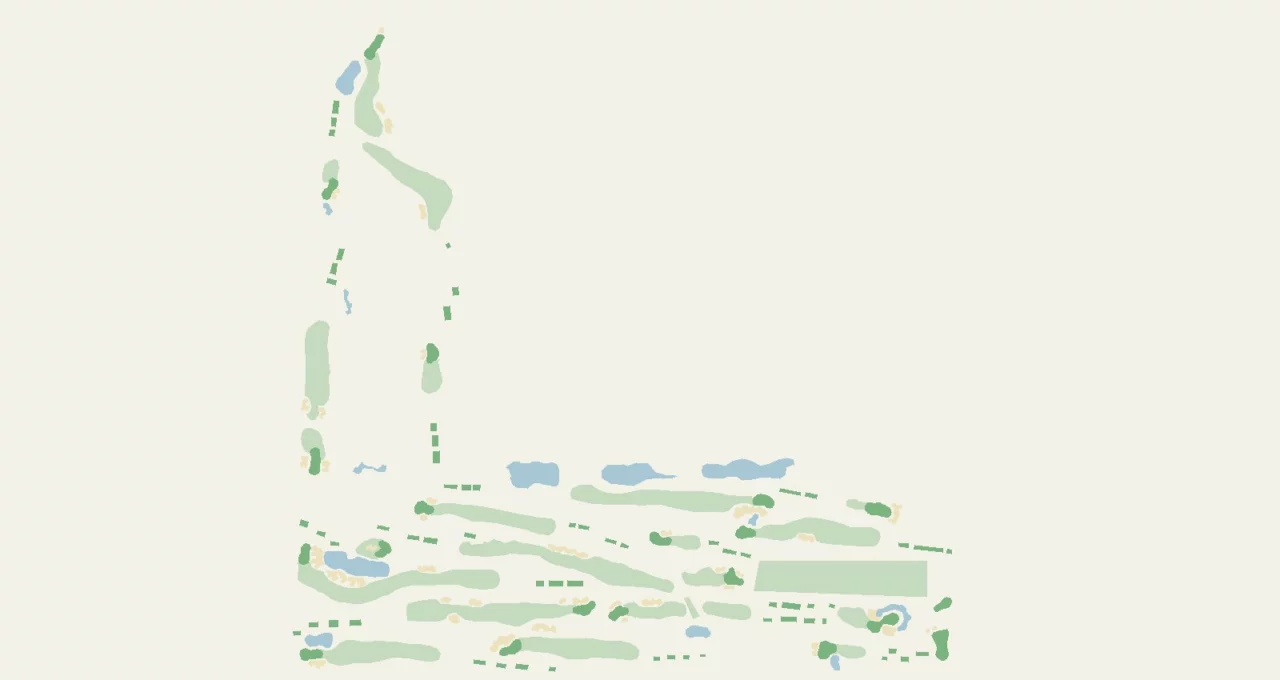
Layout of Campbell River Golf Club from OpenStreetMap survey data (ODbL licence).
Campbell River Golf Club
Holes
18
By
71: 35 out, 36 in; seven par 3s, five par 4s, six par 5s (club scorecard 2025)
Length
6,299 yards from the black tees, 5,830 blue, 5,448 white, 5,006 yellow, 4,559 red (club scorecard 2025)
Green fee
—
Best season
Open all year; peak season early May to late September, winter season November to February (club website)
Campbell River Golf Club is an 18-hole course on Petersen Road in Campbell River, British Columbia, on the east coast of Vancouver Island. It is the golf course of Naturally Pacific Resort, a 100-room hotel that opened on the property in May 2024, and the address on the club’s scorecard is 700 Petersen Rd., Campbell River, BC V9W 3H7. The current card, published as the 2025 scorecard on the resort’s website, gives a par of 71 and 6,299 yards from the black tees, with four shorter sets of tees down to 4,559 yards from the red. The course was rebuilt from tee to green to a design by Graham Cooke of Northern Golf Design and reopened in 2018. Its pages are at naturallypacific.ca/golf.
What makes the card unusual is its mix of holes: seven par 3s, five par 4s and six par 5s. A standard par 71 leans heavily on two-shot holes; here only five of the eighteen are par 4s, so the round alternates between short irons to small targets and long holes where the second shot is a positional decision. Anyone can book a tee time; there is no membership requirement to play.
Which club is this?
The course has carried several names, and older directories still use them. It opened in 1959 as Glen Alder, according to text the club itself published on its former booking page, later grew to 18 holes as Sequoia Springs Golf Course, reopened in 2018 as Campbell River Golf & Country Club and is now presented simply as Campbell River Golf Club at Naturally Pacific Resort. The old club address, crgolf.ca, now redirects to the resort’s website.
It should not be confused with Storey Creek Golf Club, a separate course in the Campbell River area designed by Les Furber, or with the nine-hole Quadra Island Golf Club, reached by a short ferry crossing from the town. This page is about the Petersen Road course only.
History: from five holes to a resort course
The club’s own history page says golf on the site dates back to the 1950s, when it began as a five-hole course called Glen Alder. Sports Illustrated, in a 2019 review, places that five-hole start in the late 1950s and recalls a local rule on the first hole that allowed players to throw a ball back onto the fairway from over the left-hand fence for a one-stroke penalty. The course then grew to nine holes and eventually 18. The sequoias and western red cedars that line its fairways were planted in those early years, and they gave the course its later name.
In 2017 the Mailman family, whose Campbell River business, Seymour Pacific Developments, builds and manages rental housing across Western Canada, bought Sequoia Springs. Golf Course Architecture puts the purchase in February 2017; Inside Golf, writing for British Columbia Golf, says the family closed on the property on March 1, 2017. The family hired Graham Cooke’s firm, Northern Golf Design, and the work on the ground was led by Cooke’s associate Corey Black. Black told one golf writer that on a first walk of the site it was clear there would not be much worth saving, and the old course was cleared down to its trees.
According to Golf Course Architecture, only four of the original holes stayed in their former locations. Some corridors were reused, as many sequoias and cedars as possible were kept or transplanted, and an extra 15 acres on the west end of the property made room for a practice facility while keeping 18 holes. The club describes the result as a course with rolling fairways, several water features and more than 200 trees; BC Golf Guide, writing before the opening, counted six new man-made water features.
The dates of the rebuild differ slightly between sources. The club speaks of a 14-month restoration that began in April 2017; BC Golf Guide says ground was broken in May 2017; Inside Golf and Fairways Golf & Travel both describe a build of about 17 months. Golf Course Architecture expected an opening in July 2018, and Inside Golf reported that the course opened in early August 2018. It joined the Vancouver Island Golf Trail as its 13th member.
The rebuild was only the first stage. At the opening, the club’s general manager spoke of a hotel, conference space, spa and new clubhouse; Sports Illustrated reported in 2019 that the old pro shop and clubhouse would be razed to make way for it, and Naturally Pacific Resort opened in May 2024 with 100 rooms, a spa, restaurants and the course wrapped around it.
What it asks of you
This is a parkland course of modest length by modern standards. At 6,299 yards from the back tees it will not overpower a strong player, but the composition of the card means the yardage is concentrated in the six par 5s, three of which measure more than 540 yards from the black tees. The par 3s range from 148 to 195 yards from the back and from 85 to 125 yards from the red, so a round tests the short and middle irons more than the driver.
The club says it waters with irrigation software that works by the second, protects turf health by stimulating the grass’s natural defences rather than relying on harsh chemicals, and turns fallen trees into wood chips for its native areas. The creek margins are planted with native species, which is why they are protected under the local rules.
Water and sand are everywhere. Inside Golf and Fairways Golf & Travel both report hazards on 16 of the 18 holes, and a creek runs through the property: the scorecard’s local rules mark environmentally sensitive areas along it on holes 3, 8, 11 and 17, with a free drop from the green-and-white-staked zones. Out of bounds is close on several holes, including the driving range, the perimeter fences and the roads, and the card asks players not to hit over the houses on the 5th.
The greens are bentgrass and the fairways perennial ryegrass, according to Sports Illustrated and Inside Golf. Corey Black told Golf Course Architecture that each green has at least one pin position that will challenge even experienced golfers, and that the course can transform with the choice of tees and flag positions. Most fairways are described as generous, with two or three tighter holes. The card sets a time of 4 hours and 15 minutes for 18 holes; reviewers in 2018 and 2019 reported rounds well under four hours.
The card has changed since the opening. In 2018 and 2019 the course was published as a par 70 of 6,141 yards with seven par 3s, six par 4s and five par 5s; the current card is a par 71 of 6,299 yards with six par 5s and five par 4s. The par 3s and the yardages of the 6th, 11th and 15th are unchanged, so the difference lies on the front nine, where one former par 4 is now a par 5. We have not found a source that says which hole was converted or when.
The card, in four stretches
Yardages below are from the black and red tees of the current scorecard; the course also has blue, white and yellow tees.
Holes 1 to 4. The round opens with a par 4 of 354 yards (255 from the red) that runs beside the driving range, as Inside Golf noted at the opening. The 2nd is a par 3 of 190 yards, the longest short hole on the front nine, followed by the 403-yard 3rd, a par 4 along the creek, and the 182-yard 4th, another par 3. Two short holes in the first four set the tone.
Holes 5 to 9. The 5th is a par 5 of 566 yards (430 from the red), stroke index 2, with houses along it that the local rules treat as out of bounds even if the ball finishes back on the hole. The golf tourism site Golf in British Columbia lists the 5th as Campbell River’s signature hole on the Vancouver Island Golf Trail. The 6th is the hole most often singled out: a par 3 of 148 yards to a green that Golf Course Architecture describes as built into the hillside with fill, backed by a large rock waterfall and a seating area. Sports Illustrated chose it as the best par 3 on the course, and stresses that the green has levels, so that finding the right tier leaves an easy two-putt while a long shot makes par difficult. Players then walk uphill to the 7th, a par 5 of 520 yards, which is followed by another par 5, the 540-yard 8th, with the creek again in play. The 170-yard 9th closes an outward half of 3,073 yards and par 35.
Holes 10 to 13. The back nine starts with a par 3 of 167 yards, the fifth short hole in the first ten. Golf Course Architecture links the par 3s at the 9th, 10th and 18th to the space found for the driving range and short-game area. The 11th, a par 4 of 360 yards and stroke index 4, was Sports Illustrated’s pick of the par 4s: the decision is off the tee, laying up short of a crossing hazard and accepting a longer approach, or carrying it to leave a wedge, with trees and a fairway bunker punishing a tee shot pushed right. The 330-yard 12th is the easiest hole on the card by stroke index, and the 413-yard 13th, stroke index 3, is the longest of the par 4s.
Holes 14 to 18. The finish contains three par 5s and two par 3s in five holes. The 14th and 15th are back-to-back par 5s of 495 and 505 yards. Sports Illustrated called the 15th one of the most beautiful holes on the course and its best par 5: a drive down the middle, a lay-up into the wide area left of the pond, then a mid-iron to a green guarded by bunkers and water short, with out of bounds only steps behind. Black expected par to be a good score there. After the 148-yard 16th comes the 17th, a par 5 of 613 yards, stroke index 1, which Inside Golf called a particular brute. The round ends with a par 3 of 195 yards beside the range, to a green that Golf Course Architecture describes as playing like an island green at the back, with a more accessible front section. The inward half measures 3,226 yards, par 36.
What golfers say
The material we read is more limited than for an older, better-known course. It includes the reviews written at the reopening by Inside Golf (for British Columbia Golf), Fairways Golf & Travel and Sports Illustrated, which gave the course 9.5 out of 10 on its own scale; the public player reviews on 18Birdies; the player reviews the resort reproduces on its golf pages; and the excerpts of GolfPass and Tripadvisor reviews shown by search engines, as both sites refused automated access. At least one of the press reviews followed an invitation from the club. The points below summarise what recurs. They are other people’s opinions, not ours; nobody from Panxis has played the course, and we quote no reviewer.
What comes up in its favour
- Conditioning, above all: greens and fairways described as immaculate, smooth and fast, and the sense that no expense was spared in the rebuild.
- Playability for a wide range of golfers from the right tees, while the back tees and certain pin positions still give low handicappers a test.
- The variety of the holes, with the unusual run of par 3s and par 5s, and the 6th, 11th, 15th and 17th mentioned by name.
- A walkable layout and a quick pace of play, with little waiting between groups.
- Friendly staff in the shop, on the range and in the restaurant.
- The Toptracer range and lounge, which several reviewers present as a reason to visit in itself, for golfers and non-golfers alike.
What comes up against
- Price is the most frequent complaint, both for the green fee and for the range, often by comparison with other courses in the area.
- Length: some players find the course short, and one review describes it as closer to an executive course than its billing suggests; long hitters at the opening said they would have liked more yardage.
- A few tight tee shots, with out of bounds and water close to the line.
- One older review felt that holes inherited from Sequoia Springs sit less comfortably than the new ones, and reviews written during the hotel’s construction mention a building site next to the course.
Playing as a visitor
The course is public and takes visitors for 9 or 18 holes, morning, afternoon or twilight. The club’s website says it is open seven days a week from 10:00 a.m. to dusk, with tee times every 10 minutes; bookings are made online from the golf page or by telephone at 250-287-4970, extension 2. Hotel guests and Vancouver Island residents have their own rates. Season passes are sold for regular players.
GPS-equipped power carts, push carts and rental clubs are available from the shop; clubs should be reserved in advance. The course webcam page shows the cart rule of the day, which was the 90-degree rule when we checked. The dress code asks for golf-course-appropriate clothing, no jeans and proper golf footwear.
The practice facilities are unusually complete for a course of this size. The Velocity Driving Range has eight covered bays fitted with Toptracer, which the club says was the first such range in Western Canada, plus practice greens of more than 8,000 square feet for putting and chipping. Range mats open 30 minutes before the first tee time, and the bays can also be booked for virtual rounds and games. An academy staffed by PGA of Canada professionals offers lessons and club fitting with a TrackMan launch monitor.
The resort itself has 100 rooms and suites, a spa, a restaurant and a patio grill on site, which makes a stay-and-play straightforward. The club also offers group golf trips, and the course features in packages with Storey Creek and Crown Isle, sold by Golf in British Columbia.
Getting there and when to go
Campbell River lies on the east coast of Vancouver Island, near the northern end of the 250-kilometre Vancouver Island Golf Trail. The resort gives driving times of about 40 minutes from the Comox Valley, 1.5 to 2 hours from Nanaimo and about 3 hours from Victoria. From the mainland, BC Ferries sails from Tsawwassen and Horseshoe Bay to Nanaimo. Campbell River Airport is a few minutes from the course, with scheduled flights from Vancouver and seasonal service from Calgary, and a seaplane service from Vancouver Harbour lands on the Campbell River waterfront. The resort runs a shuttle for its guests from the airport.
Thanks to the mild coastal climate, the course plays all year, as several reviewers noted. The club divides the year into a peak season from early May to late September, two shoulder periods in March and April and from late September to the end of October, and a winter season from November to February. Summer is the busiest time in the town, which draws visitors for salmon fishing, whale watching and the mountains; Mount Washington’s ski area is about 45 minutes away, and BC Golf Guide presents Campbell River as one of the few places in Canada where golf and skiing on the same day are possible. The resort’s webcams and weather page publishes the day’s course and cart status before you travel.
Green fees
Green fees vary by season, time of day, residency and hotel stay, and they change from year to year. We do not publish them here: see the club’s website for current rates.
How this page was made
The factual frame comes from public sources read in October 2026: OpenStreetMap for the location of the course; the resort’s website for the course facts, the 2025 scorecard and its local rules, the history page, the opening hours, tee-time interval, dress code, rentals, practice facilities, academy, sustainability measures, travel times and the resort’s opening date; Golf Course Architecture (June 2018) for the purchase, the routing changes, the land added and the descriptions of the 6th, 15th and 18th; Inside Golf (2018) for the opening date, the 2018 card, the hazards and the 17th; Fairways Golf & Travel (2018) for the rebuild and the opening; BC Golf Guide for the start of construction and the water features; Sports Illustrated (2019) for the early history, the 2019 tees and ratings and the three best holes; the club’s former Chronogolf page for the 1959 founding of Glen Alder; and Golf in British Columbia for its course listing, the signature hole and the Vancouver Island Golf Trail.
Where sources disagree, we say so. Golf on the site began in 1959 according to the club’s former text and in the 1950s or late 1950s according to its current website and Sports Illustrated. The purchase is dated February 2017 by Golf Course Architecture and March 1, 2017 by Inside Golf; the rebuild lasted 14 months from April 2017 for the club, began in May 2017 for BC Golf Guide and took about 17 months for Inside Golf and Fairways. The length is 6,299 yards on the current card, 6,141 yards in the 2018 and 2019 press, “6,100 yards” on the club’s history page and 6,051 yards in Golf in British Columbia’s listing; the par is 71 on the current card and 70 in that listing and in the press of the time. We follow the current scorecard. The club publishes a course rating of 69.6 and a slope of 122 alongside the 6,299-yard card, but Sports Illustrated gave exactly those figures for the 6,141-yard black tees in 2019, so they may predate the latest change; check the scorecard at the shop for current ratings. The signature status of the 5th comes from a list without a description, and we found no source naming the hole that changed par.
The opinion section summarises reviews and course descriptions read in October 2026. We report recurring themes rather than individual voices, and we reproduce no quotations from reviewers. Nobody from Panxis has played or visited this course, and this page is no substitute for a round.
The club has not paid for this page, has not seen it before publication and has no say over its content. This page contains no commercial link and earns us no commission. If you know the course and something here is wrong or out of date, write to us and we will correct it.
Other courses nearby
Closest to this one in our Canadian directory:
- Bowen Island Golf Club — 157 km
- Burnaby Mountain Golf Course — 188 km
- Bear Mountain — 213 km
- Eighteen Pastures — 225 km
The hole to know
Listed as the course's signature hole on the Vancouver Island Golf Trail by Golf in British Columbia: a par 5 of 566 yards from the black tees, stroke index 2, with houses along the hole treated as out of bounds (club scorecard).