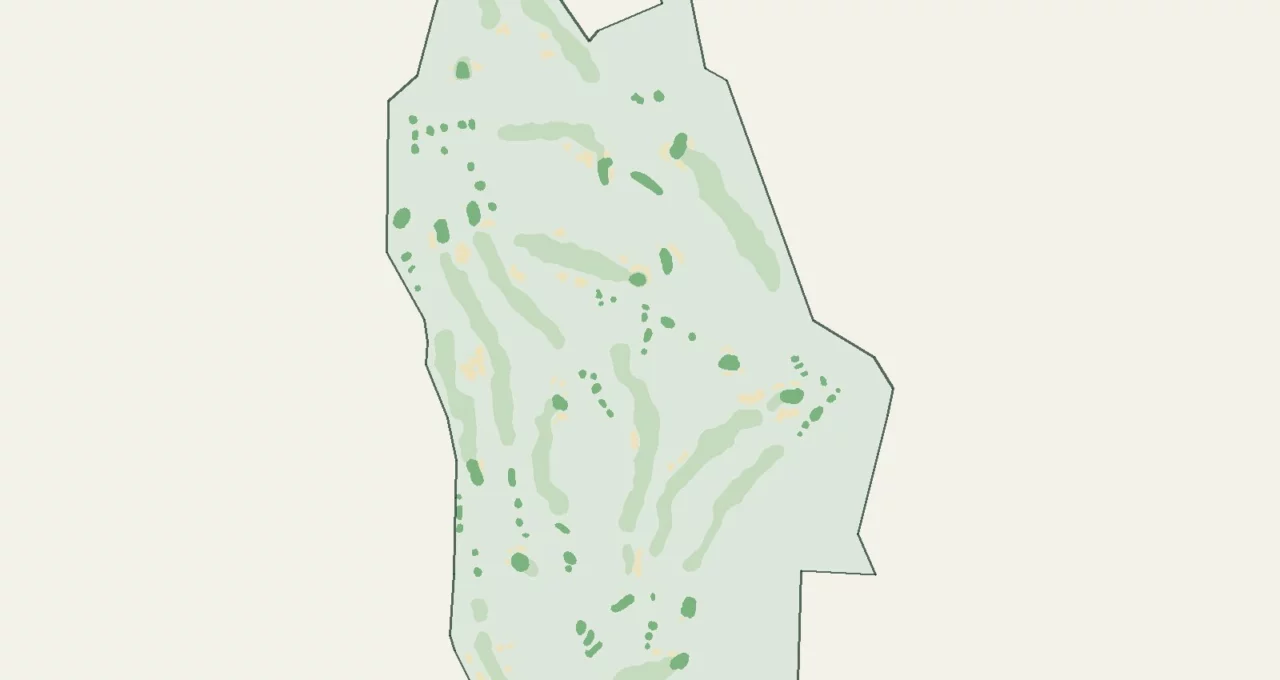
Layout of Fairview Mountain Golf Club from OpenStreetMap survey data (ODbL licence).
Fairview Mountain Golf Club
Holes
18
By
72 for men (36 out, 36 in; four par 3s, ten par 4s, four par 5s), 73 for women, the 18th being a par 5 (scorecard on Golfify; men's card also on 18Birdies)
Length
7,025 yards from the gold tees, 6,578 black, 6,167 blue, 5,683 white, 5,382 green; men's rating and slope 74.0/138 gold, 71.7/136 black, 69.9/133 blue, 67.9/121 white, 66.7/115 green; women's 76.3/138 blue, 73.5/129 white, 71.6/127 green (GolfNow, Golfify, 18Birdies)
Green fee
—
Best season
About eight months (club membership page): in 2026, opening day 21 March and final day 25 October (club events calendar)
Fairview Mountain Golf Club is an 18-hole course on the hillside west of Oliver, in the South Okanagan region of British Columbia, at 933 Old Golf Course Road. The scorecard published by golf directories (Golfify and 18Birdies, with tee totals matching GolfNow) gives it a par of 72 and a length of 7,025 yards from the gold tees, with four shorter sets of tees down to 5,382 yards from the green. The club dates its origins to 1925, and the present 18-hole layout is credited to the Canadian architect Les Furber, who expanded the original nine holes. The club describes itself as member-owned and open to the public, and its website is fairviewmountain.com.
The Regional District of Okanagan-Similkameen added it to its Community Heritage Register on 19 March 2009, noting its continuous use as a golf course since 1925 and its local nickname, “the people’s golf course”. It sits in dry, sloping country above the vineyards of the valley floor, and most of what is written about it turns on three things: the elevation changes, the greens and the views.
Which club is this?
This page is about the course at the coordinates shown on the map below, about 4 km west of the centre of Oliver in a straight line, by our measurement. The name can cause confusion in two ways. First, “Fairview” is a common name for golf courses in North America, and booking and review sites list several unrelated Fairview golf clubs in Canada and the United States; scorecards and ratings should be checked against the Oliver address. Second, the club itself has carried more than one name. Top 100 Golf Courses says it was originally called the Oliver Golf and Country Club, and the heritage register gives “Fairview Golf Course” as an alternative name. The “Fairview” in the current name refers to the old Fairview mining camp on the slopes above the course, not to a town of that name today.
The street address also varies between sources. The club, OpenStreetMap, Golf in British Columbia and Visit Penticton give 933 Old Golf Course Road, postal code V0H 1T1. GolfNow lists 13105 334th Avenue with postal code V0H 1T0; the heritage register uses the same civic number but gives the street as 334th Avenue in its title block and 344th Avenue in its description. 18Birdies gives an address on Tinhorn Creek Road. We use the club’s address, which is also the one on the OpenStreetMap outline of the course.
History: from sand greens to 18 holes
The land around the course has a mining past. According to Wikipedia, the Fairview area was first prospected in 1887, grew into a gold-mining camp in the 1890s that served as the original townsite for what is now Oliver, and had become a ghost town by 1919 once the gold ran out. Top 100 Golf Courses, which carries the most detailed history of the club we could find, says that in 1926 the provincial Minister of Lands granted about 200 acres of sloping land below the old Fairview mining camp to Sandy McPherson and other local residents. The land had until then been used by range animals and wildlife.
The founding year is given as 1925 by the club, by the heritage register and by most directories, while the land grant described by Top 100 Golf Courses is dated 1926. The two dates are not necessarily in conflict, since play may have begun before the grant was formalized, but no source we read explains the gap, and we report both. Top 100 Golf Courses also notes that the club celebrated its 75th anniversary in 2000, which fits the 1925 date, and the club’s own events page refers to its 100-year celebrations in 2025.
The first course was built by volunteers. Top 100 Golf Courses says early members turned the gullies of the hillside into nine holes, that nine members kept the course in shape, and that it had sand greens and no water supply; one member recalled smoothing the sand greens with a homemade broom, and in dry years the ground was hard enough to make it difficult to push a tee in. The same account says that by 1949 enough money had been raised to build a clubhouse, and that in 1970 an irrigation system was installed and the club had grass greens and fairways for the first time.
The heritage register adds a detail about water. It credits the green turf to the creative use of community grey water, an arrangement it attributes to the efforts of Emily Hall McLennan, who it says is the only person ever granted a lifelong honorary membership. The register lists the use of grey water among the site’s character-defining elements, along with the views of the mountains and lakes and “the ongoing location of the 18th tee with its associated view”. It does not date the grey-water arrangement, and we found no other source that does.
The expansion to 18 holes came after six decades as a nine-hole course. Top 100 Golf Courses says that in 1985 the club began a five-year plan to reach 18 holes: the existing layout was slightly reconfigured, nine new holes and a driving range were added, and the clubhouse was renovated, with a provincial grant covering about one-third of the cost. Golf Club Atlas, in a review we could read only as a search-engine excerpt, dates Les Furber’s design to 1990, which matches the end of that five-year plan. The club’s membership page says the course was “expanded under the watchful eye” of Furber. Visit Penticton describes Furber as based in Canmore, Alberta, founder in 1980 of the firm GDS Golf Design Services, and a designer whose courses are meant to be playable rather than penal. One booking listing, TeeOff, names Jack Reimer alongside Furber’s firm as architect; no other source we read mentions him, and we could not establish his role.
Work on the course has continued in recent years. The club says the green complex of the 4th hole was fully renovated in 2024. In July 2025 British Columbia Golf, the provincial association, reported a new irrigation system, a new teaching facility, a members-only practice area with a short-game zone, driving nets and a practice bunker, and a fitting centre equipped with TrackMan and GCQuad launch monitors. The club’s coaching page says that Lisa Deleo, named PGA of BC Apprentice Professional of the Year in 2025, is the first female golf professional in the club’s 100-year history.
What it asks of you
The directory scorecard lists five sets of tees: gold at 7,025 yards, black at 6,578, blue at 6,167, white at 5,683 and green at 5,382. Par is 72 for men, split 36 and 36, with four par 3s (the 3rd, 7th, 10th and 15th), ten par 4s and four par 5s (the 5th, 8th, 11th and 17th). For women, the 18th is played as a par 5, which brings par to 73, and the stroke index is different: the 8th, not the 1st, is the hardest hole on the women’s card.
Ratings and slopes are listed on GolfNow, Golfify and 18Birdies with the same figures. For men they are 74.0 and 138 from the gold tees, 71.7 and 136 from the black, 69.9 and 133 from the blue, 67.9 and 121 from the white, and 66.7 and 115 from the green. For women they are 76.3 and 138 from the blue, 73.5 and 129 from the white, and 71.6 and 127 from the green; 18Birdies alone also gives a women’s rating of 76.9 and slope of 136 from the black tees. We could not find a scorecard on the club’s own website, so these figures come from third parties and should be checked with the pro shop before they are used for handicap purposes.
The terrain does most of the work. Visit Penticton gives the course more than 200 feet of elevation change and says it has few forced carries, which is why it presents the layout as playable for golfers of all levels. The club’s head professional describes a layout shaped by elevation changes, strategic bunkering and fast greens, set above the valley floor. BC Golf Guide calls the fairways generous and says green speeds can reach 12 on the Stimpmeter in peak season. Golfscape says the greens are Poa annua. Out of bounds is a recurring theme of the club’s own hole notes: it is mentioned on the right of the 4th, 5th and 6th.
The spread between tees is wide. The gold tees play 1,643 yards longer than the green tees overall, and some holes change character completely: the 9th is 425 yards from the gold and 362 from the black, the 12th 365 from the gold and 297 from the black, and the 15th, a par 3, runs from 178 yards at the back to 80 at the front. On the other hand, the 6th and the 18th barely change, the 18th measuring 425 yards from the blue, white and green tees alike.
The course in sequences
The hole names and descriptions below come from the club’s hole-by-hole guide; yardages and stroke indexes come from the directory scorecard.
Holes 1 to 4
The round starts with the hardest hole on the men’s card. The 1st, which the club calls The Start, is a par 4 of 412 yards from the gold tees and 390 from the blue, stroke index 1. The club describes it as the toughest opening hole in the valley, suggests aiming at the second bunker in the distance, and advises taking an extra club for an approach that plays more uphill than it looks; Golf Club Atlas also calls the uphill 1st the hardest hole on the course. The 2nd, Blind Faith, is a par 4 of 382 yards with a blind tee shot to a landing area sloping right to left, and pot bunkers around the green. The 3rd, Short but Sharp, is the shortest hole from the back tees, a par 3 of 150 yards with a wide green that the club warns breaks more than it seems; Golf Club Atlas cites it as an example of poor visibility from the tee. The 4th, The Lookout, is a par 4 of 424 yards from the gold, stroke index 3, with bunkers on the left at driving distance, out of bounds on the right and the green rebuilt in 2024.
Holes 5 to 9
The 5th, which the club also calls The Edge, is the first par 5, 544 yards from the gold tees and 489 from the blue. It is the farthest point from the clubhouse, and the club says the 5th and 6th have the best views of the surrounding vineyards. It describes the hole as reachable in two for long hitters, with four bunkers at driving distance, out of bounds on the right and a well-guarded green. The 6th, Bender, is a par 4 of 384 yards from the gold and black tees with out of bounds on the right and one of the course’s original greens, heavily contoured. The 7th, Deception, is the longest par 3 at 227 yards from the gold and 174 from the blue, stroke index 5, with what the club calls an almost compulsory carry and trouble long. The 8th, Up the Hill, is a par 5 of 541 yards from the gold, stroke index 7 for men and 1 for women; the club mentions hazards throughout and the marmots that live on the course. The 9th, Vista, is a par 4 of 425 yards from the gold, narrower than it looks, with bunkers front right and a two-tier green. The club says the back tee gives the best view of the course and the valley, and there is a snack bar, the Cactus Shack, at the turn.
Holes 10 to 14
The back nine opens with a par 3, Bullseye, of 162 yards from the gold and 145 from the blue, where the club says everything is visible from the tee and every miss is punished; Golf Club Atlas calls the 10th perhaps the most beautiful hole on the course. The 11th, Dropoff, is a par 5 of 540 yards from the gold with a great deal of elevation change, which the club says long hitters can turn into a two-shot hole. The 12th, Stubby, is the shortest par 4 and stroke index 18, 365 yards from the gold but only 297 from the black, driveable for some, with a well-protected and sharply breaking green. The 13th, The Riser, climbs back towards the clubhouse: a par 4 of 420 yards from the gold, stroke index 4, with a fairway bunker whose position relative to the drive depends on the wind. The 14th, The Corner, is a par 4 of 412 yards from the gold with a wide fairway, a tree to avoid and bunkers around the green.
Holes 15 to 18
The 15th, Poké Bowl, is the last par 3, 178 yards from the gold, with a green that funnels towards a bowl when the pin is placed there. The 16th, again called The Edge, is a par 4 of 453 yards from the gold and 400 from the blue, stroke index 2, which the club says many players consider the hardest on the course: the drive needs to reach the edge of a slope to see the green, which has two levels. The 17th, Invisible, is a par 5 of 538 yards from the gold with a long carry from the tee, bunkers and a green that stays hidden until the last moment. The 18th, Elevated, is the club’s signature hole, a par 4 of 468 yards from the gold, with a heavily guarded green below the clubhouse patio, with views over the clubhouse and the surrounding vineyards. The club notes that a nearby racetrack can be heard on some days.
What golfers say
Fairview Mountain is reviewed mostly on general platforms and golf apps rather than in the golf press. In October 2026, Wanderlog reported an average of 4.3 out of 5 from 278 Google ratings, and 18Birdies showed 4.9 out of 5 from 48 reviews, with sub-scores of 4.6 for value and 4.8 for course condition, difficulty rated hard, green speed very fast and pace of play fast. Tripadvisor figures could not be checked directly and are reported differently by the sources that quote them. SCOREGolf, according to Visit Penticton, ranked the course 47th among Canada’s best public courses, and Golfscape says the PGA of BC named it Golf Facility of the Year twice, where Golf in British Columbia says three times. The points below are recurring themes from what we could read; they are other golfers’ opinions, not ours, and we quote and name no one.
What comes up in its favour
- Course condition is the most frequent compliment, above all the greens, which several reviewers rank among the best in the Okanagan.
- The views over the valley, the vineyards and the surrounding mountains are mentioned again and again.
- Reviewers describe the layout as varied and challenging, with no two holes alike; the Golf Club Atlas reviewer praises the routing over the natural slopes and calls it arguably Furber’s best work.
- Staff in the pro shop and the restaurant are generally described as friendly, and the restaurant and its patio are often praised in their own right.
- Range access and a cart included with the round, as well as the practice facilities, are counted among the good points.
What comes up against
- The greens that most reviewers praise are also called very fast, heavily contoured and hard to read, which some players find punishing.
- Blind shots and limited visibility from several tees are noted, by the Golf Club Atlas reviewer among others, who also felt that sharper mowing lines would help the course; he did not place it in Canada’s top 100.
- Some reviewers find the price high for what they got.
- A few reviews report poor experiences with particular staff, including a marshal and some pro shop attendants, and one criticized the snack bar at the turn.
Playing as a visitor
The course is open to the public. The club’s rates page says every booking must come with a phone number, an email address and a credit card to hold and confirm the tee time; bookings are made through the pro shop by phone, on 250-498-6050 or toll-free on 1-866-534-7264, or by email. The rates page lists separate rates for mornings, two twilight periods in the afternoon and evening, a full day of 36 holes, a replay, juniors and nine holes after 1 p.m., with a half-cart rate charged on top of each. GolfNow says walking is allowed, metal spikes are not, singles and fivesomes are not accepted, and proper golf attire is required. Rental clubs are available, according to GolfNow and 18Birdies.
The practice facilities are a point the club insists on. Its practice page describes a driving range 250 yards long, a grass chipping area, a large practice green and hitting nets, plus a short practice hole reserved for members. Visit Penticton says use of the practice facility is included with a green fee. The fitting bay opens onto the range and combines TrackMan and GCQuad monitors; fittings are run by the head professional, Rob Tadey, whom the club describes as a TaylorMade master fitter. Lessons are offered by the club’s PGA of Canada professionals, and the club runs junior, ladies’, mixed and group programs.
The clubhouse restaurant has a large patio overlooking the first tee, and a meeting room can be booked. In the season the club holds a ladies’ night on Tuesdays, a men’s night on Thursdays and a Sunday league, as well as charity tournaments and club championships; the 2026 calendar included an Interior PGA event at the end of August. The club also offers membership categories, including a “City Pass” for golfers who live outside the Okanagan Valley.
Getting there and when to go
The club is at 933 Old Golf Course Road, Oliver, BC V0H 1T1, on the slope west of the town. The club gives the drive as about 30 minutes south of Penticton along Highway 97, a little over an hour from Kelowna, and a few minutes from Oliver or Osoyoos. In a straight line, by our measurement on the map, the course lies about 4 km from central Oliver, 17 km from Osoyoos, 37 km from Penticton and about 20 km north of the United States border. The nearest airport, Penticton Regional, is about 34 km away in a straight line; Kelowna International is about 90 km. The club lists preferred accommodation partners in Oliver, Osoyoos and Penticton for golf trips, and points out that Oliver styles itself Canada’s wine capital, with more than 40 wineries in the surrounding area.
The season is long for Canada but not year-round. The club’s membership page speaks of an eight-month playing season. Its events calendar for 2026 shows opening day on 21 March and a final day of golf on 25 October, with the course closed for aeration on 12 and 13 October. GolfNow lists the season as year-round, which the club’s own calendar contradicts; we follow the club. The membership page describes the area as Canada’s only natural desert; summers are hot, and the club’s latest twilight rate is called “Beat the Heat”.
Green fees
Rates vary by time of day, with separate twilight, replay, junior and nine-hole rates and carts charged on top: see the club’s website for current prices.
How this page was made
The factual frame comes from public sources read in October 2026: OpenStreetMap for the location, outline, name and address of the course; the club’s website for the address, the hole names and hole-by-hole descriptions, the 2024 renovation of the 4th green, the practice facilities, the fitting bay, staff, the booking terms, membership, events and the 2026 season dates; the Regional District of Okanagan-Similkameen heritage register for the 1925 date, the grey water, Emily Hall McLennan and the character-defining elements; Top 100 Golf Courses for the history of the land grant, the volunteer-built nine holes, the 1949 clubhouse, the 1970 irrigation and the 1985 expansion plan; Wikipedia for the Fairview mining camp; Golfify and 18Birdies for the hole-by-hole scorecard, and these two with GolfNow for tee lengths, ratings and slopes; British Columbia Golf for the 2025 upgrades; Visit Penticton for the designer’s background, the elevation change and the SCOREGolf ranking; BC Golf Guide and Golfscape for the greens; Golf in British Columbia and Golfscape for awards; and Wanderlog, 18Birdies and search excerpts of GolfPass and Tripadvisor for ratings and review themes. Golf Club Atlas, GolfPass, Tripadvisor and Castanet could not be opened directly, so their contribution is limited to what search excerpts showed.
Where sources disagree, we say so. The founding is dated 1925 by the club and the heritage register, while Top 100 Golf Courses dates the land grant to 1926. The site is given as about 200 acres in the 1926 grant and over 160 acres by BC Golf Guide. The street address appears in four forms. The number of PGA of BC Golf Facility of the Year awards is two according to Golfscape and three according to Golf in British Columbia. GolfNow says the course is open all year, the club’s calendar says March to October. TeeOff names Jack Reimer as co-architect, no other source does. Top 100 Golf Courses describes the 4th as a 497-yard par 4 and the 5th as a 615-yard par 5, figures that match nothing on the current card (424 and 544 yards from the gold tees), and we do not use them; they may describe an earlier layout. Golf Club Atlas dates the Furber design to 1990, but we found no primary source for the exact year the 18 holes opened.
We did not find the club’s own scorecard, the exact opening date of the 18-hole layout or a primary source on Emily Hall McLennan. The opinion section summarizes reviews and descriptions read in October 2026. We report recurring themes rather than individual voices, and we reproduce no quotations. Nobody from Panxis has played or visited this course, and this page is no substitute for a round.
The club has not paid for this page, has not seen it before publication and has no say over its content. This page contains no commercial link and earns us no commission. If you know the course and something here is wrong or out of date, write to us and we will correct it.
Other courses nearby
Closest to this one in our Canadian directory:
- Predator Ridge Resort — 115 km
- Fraserglen Golf Course — 192 km
- Eighteen Pastures — 205 km
- Burnaby Mountain Golf Course — 243 km
The hole to know
Elevated, the club's signature hole: a par 4 of 468 yards from the gold tees and 425 from the blue, white and green, stroke index 8 (par 5 for women), with views over the clubhouse and vineyards and a heavily guarded green below the clubhouse patio (club website, directory scorecard).