Wind, Stableford and tucked flags: course management that turns British doubles into bogeys
Most club golfers lose their shots before the swing, not during it. Use the distance you really hit, read the wind first, aim at the middle of the green and chip out of the gorse, and the doubles on your card start becoming bogeys.

In brief
- Use the carry you hit most often, usually a club shorter than the one you quote.
- Into the wind take more club and swing more smoothly; forecast wind data is allowed under Rule 4.3a.
- Aim at the centre of the green: the cost is a putt, the saving is often two shots.
- From trouble, ask whether the shot works four times in ten; if not, chip out sideways.
- In Stableford, pick up once a hole cannot earn a point and save your energy for the next tee.
On the 18th at Carnoustie in 1999, Jean van de Velde needed a double bogey to win The Open. He took driver, then went for the green with a 2-iron, and after a ricochet off the grandstand, a visit to the Barry Burn and a greenside bunker, he made seven and lost the play-off. Club golfers rarely lose a Claret Jug, but they lose shots in exactly the same way every weekend: not through bad swings, but through choices made before the swing.
That is good news, because a choice costs nothing to change. A mid-handicapper who swaps two double bogeys a round for two bogeys has gained two shots without a lesson or a new driver. What follows is a short list of those choices, written for the conditions most of us actually play in: wind off the sea, soft parkland fairways in spring, firm and fast turf in a dry August.
Start with the number you really hit
Ask a golfer in the clubhouse bar how far they carry a 7-iron and you will hear about the best one: downwind, off a baked fairway, during a heatwave. The figure that matters is the one that turns up most often. Hit ten balls with each club and write down the typical carry rather than the longest.
For most club players the honest figure is about one club less than the one they quote, and the gap grows with the longer clubs. Correct it and a whole category of misses disappears, because shots stop landing ten yards short of where you aimed, which is where course architects tend to put the bunkers and the burns.
Get the numbers from a proper source. Ten swings each on a launch monitor, or a range session with your own ball and a rangefinder pointed at a flag, is enough for a season. Write the chart on a card for the bag. The Rules are on your side here: Rule 4.3a lets you use information gathered before the round, such as your own club distances, and lets you record your distances and statistics during a round for use afterwards.
Read the wind before you read the yardage
In Britain the flag is often a better guide to club selection than the sprinkler head. The Met Office’s Beaufort scale puts a Force 5 “fresh breeze” at a mean of 19 knots, a little over 20 mph, and that is an ordinary afternoon on many coastal courses.
Into the wind, take more club and swing more smoothly. Hitting harder adds spin, and extra spin makes the ball balloon upwards and drop short, which is the opposite of what you wanted. Downwind, the ball releases on landing, so plan for the roll rather than the carry. Uphill, allow roughly one extra club for every three metres or so of climb, and one less going down.
The Rules allow any weather information from a forecast, so checking the wind on your phone before you tee off is fine. What Rule 4.3a does not allow during a round is measuring wind speed at the course with a device, or using powder or a ribbon to read the direction. A pinch of grass tossed into the air has been the golfer’s anemometer for centuries.
Pick the middle of the green and mean it
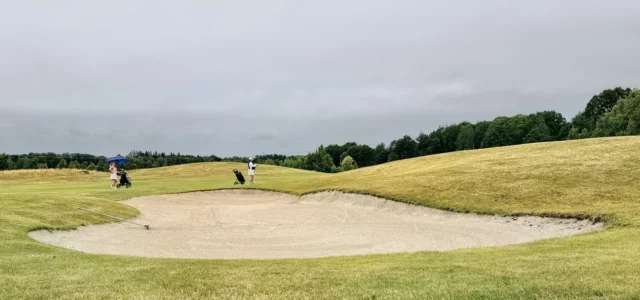
From 150 yards, a flag tucked five paces from the edge of a green is bait. A typical club golfer’s 7-iron shots land in a pattern around fifteen to twenty yards wide and about as deep. Centre that pattern on a tucked flag and a third of it misses the green on the short side, often in a pot bunker with no green to work with. Centre it on the middle of the green and nearly all of it finishes on the putting surface or on the side with room to chip.
The penalty for aiming at the middle is usually one more putt. The penalty for missing on the short side is often two shots. When the irons are working, the ball will finish near the flag anyway. Tour professionals attack pins because their shot pattern is a fraction of the size, not because it is the right thing for a 15-handicapper to do.
Plan holes backwards from a distance you like
Most golfers have a favourite approach: a full swing with a mid or short iron. A wedge from 40 yards, which needs a part swing, is statistically worse for many of them than a 9-iron from 130.
So stand on the tee and work backwards. On a 380-yard par 4, a hybrid that leaves 140 may beat a driver that leaves an awkward half-wedge, especially when the driver brings a fairway bunker or out of bounds into play. On a long par 4 or a par 5 you cannot reach, make it a three-shot hole on purpose: two controlled shots and a full wedge. Van de Velde’s driver on a hole where he needed only a six is the famous version of getting this wrong.
When you are in trouble, get out of it cheaply
The most expensive shot in club golf is the low punch through a gap in the gorse. Before you try it, ask one question: would this come off four times out of ten? If not, chip out sideways to the fairway, make bogey and move on. Losing one shot is irritating. Losing three turns a decent card into a bad one and sours the next hole too.
The same logic applies after two poor shots on any hole. The job is now damage limitation: play to the widest target, get a wedge on the green, take two putts. A card with fourteen bogeys and four pars is a solid mid-handicap round. Ten pars, four bogeys and four doubles adds up to more, and feels worse.
The format changes the maths
Much British club golf is Stableford, and it rewards this thinking directly. Under Rule 21.1, once your score on a hole can no longer earn a point, you are encouraged to pick up, and a net double bogey or worse scores nothing either way. A hopeless recovery attempt costs you nothing extra in points, but it does cost pace, patience and the next tee shot.
In a medal every stroke counts, so the conservative option is worth even more. For handicap purposes the World Handicap System caps the score on any hole at net double bogey, so one disaster will not wreck your index, but it will still wreck the medal.
Keep a record of the decisions, not the swings
For four rounds, note every penalty stroke and every double bogey, and next to each one write the decision that led to it. Most golfers see the same three entries again and again: driver on a hole that did not need it, a recovery through a gap, and a line at a flag tucked by a hazard.
Four rounds is enough to make the pattern impossible to ignore, and it is specific to you and to the courses you play, which no general lesson can be.
Where to work on course management in Britain
This is learned on grass, not on mats, so the cheapest classroom is a late tee time. At Hoebridge Golf Centre in Woking, for example, a visitor round on the main course was listed at £24 after 5pm in September, against £45 on a weekday morning. Play nine holes on a summer evening with one rule, such as aiming at the centre of every green, and count the difference.
For the numbers, a shot-tracking system records clubs and distances from your real rounds. A UK online golf retailer listed the Shot Scope V5 at £239 in September, with sixteen tags for your clubs and no subscription for course maps. A fitting bay does the same indoors: some golf retailers take custom fitting bookings on their websites, and one has a fitting studio in a store less than ten miles from London.
For a second opinion, book a playing lesson rather than a range lesson. The PGA’s PGA Play search at pgaplay.co.uk covers around 8,000 PGA Professionals, and nine holes with one of them will expose decisions no range session can. There is more on getting good value from a lesson in our separate guide. Panxis Golf has no commercial relationship with any of these businesses and earns no commission.
Four things to try next time out
- Aim at the middle of every green for a full round, then compare the score with your average.
- On each tee, choose the club by the approach you want to leave, not by habit.
- Check the forecast wind before you leave home and add a club into it, with a smoother swing.
- After two poor shots on a hole, play the third to the widest part of the course on purpose.
None of it asks for new clubs or a better swing. It asks you to make the decision before you stand over the ball, and then to trust it for the few seconds the swing takes.
How this page was put together
Shot Scope V5 price recorded in September 2026 at Clubhouse Golf (UK). Panxis has no commercial link with this retailer.