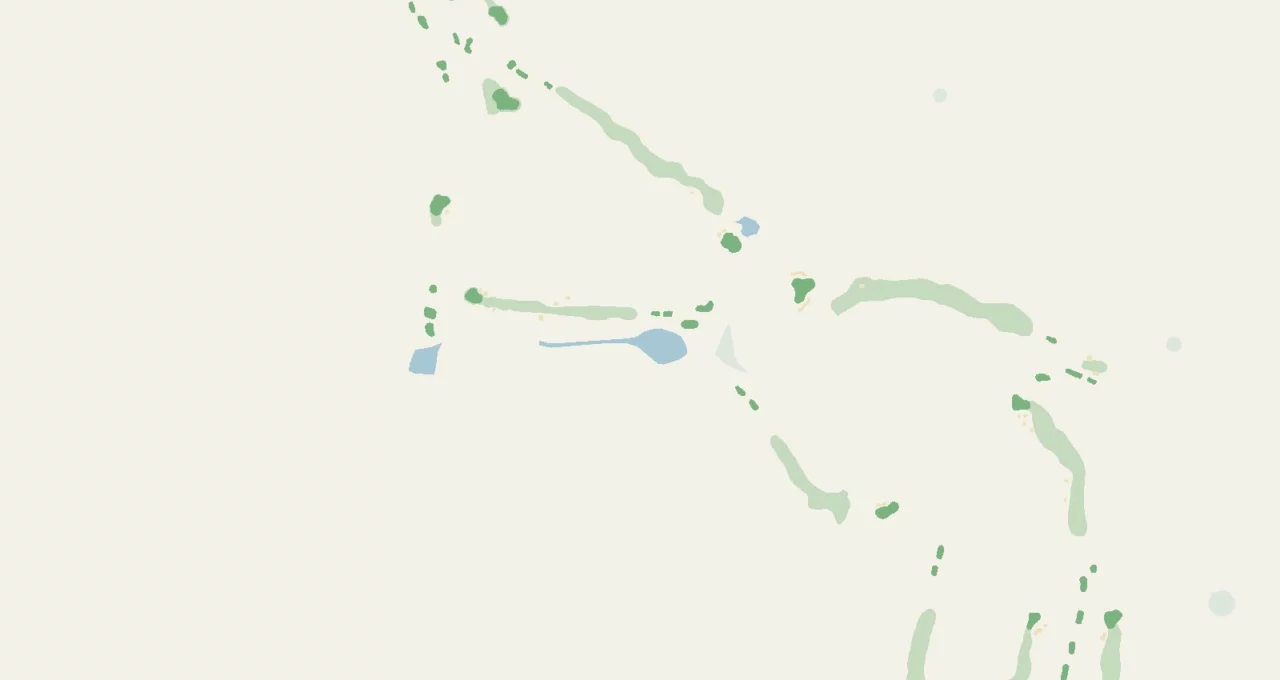
Layout of Collingtree Park Golf Club from OpenStreetMap survey data (ODbL licence).
Collingtree Park Golf Club
Holes
18 on the card; 16 in play while three new holes are built, expected to open in July 2027 (club website)
By
70
Length
—
Green fee
—
Best season
Year-round
Collingtree Park Golf Club is a members’ club on the southern edge of Northampton, in the district of Collingtree Park, between the A45 and junction 15 of the M1. The course was designed by Johnny Miller, winner of the 1973 US Open and the 1976 Open Championship, and opened in 1990. The club describes it as an 18-hole, par 70 course, a former European Tour venue, with water in play on ten holes and an island green at the par-5 18th that was, according to a greenkeeping trade report of 1990, probably the first of its kind in Britain.
It is also, at the time of writing, a course in the middle of being rebuilt. The club’s website says that three new holes are under construction as part of a new-look 18-hole layout, that sixteen holes are available for play while the work goes on, and that the new holes are expected to open in July 2027. Anyone booking a round before then should read that sentence twice: the round is sixteen holes, the signature 18th is still there, and the middle of the course is a building site. The reasons, which involve a thousand new homes next door and a proposal for three hundred more on the course itself, are set out below.
A course built with its houses
Collingtree Park was conceived as a golf and housing development, and the two have never been separable. The trade magazine Greenkeeping Management reported in February 1990 that the complex, developed by International Resort Holdings, a subsidiary of the Property Company of London, was on course for an Easter 1990 opening and already taking corporate and private members. The course had been designed by Johnny Miller in consultation with the Jack Nicklaus Organisation, the report said, on 150 landscaped acres with over six miles of drainage piping, fourteen miles of irrigation piping and eleven acres of lakes built to control a floodplain. Alongside it were a teaching academy with three practice holes, an indoor video teaching room and a club-fitting centre, free buggies for members on paths laid for year-round use, plans for a hundred-bedroom hotel, and more than two hundred executive homes going up on 64 acres around the course, most of them beside the fairways.
The hotel, as far as we can tell, was never built. The houses were, and the English Wikipedia article on the district notes that a number of large modern houses are an integral part of the golf course. The 1990 report gives the par as 72 and the site as 150 acres; the course guide Top 100 Golf Courses gives 275 acres of former meadowland reshaped by significant earthworks, calls the course Miller’s first signature design in the British Isles, and says it can stretch to almost 7,000 yards from the back tees. The club today publishes a par of 70. We give all of these figures because they are what the sources say, and because a course that has been reconfigured twice in five years is not the course that opened in 1990.
The ground itself has an older history. Collingtree Grange was built in 1875 for Pickering Phipps, a Northampton brewer, bought by the Sears family in 1913 and demolished in the 1960s; the entrance lodges, the gateway and a few sequoias from the original landscaping survive, according to Wikipedia.
The course’s moment in the sun came early. The British Masters was played at Collingtree Park in 1995 and 1996. Sam Torrance won the first, on 270, eighteen under par, by a stroke from Michael Campbell; Robert Allenby won the second in a play-off against Miguel Angel Martin, on 284, four under par, a score that says something about the weather, the water, or both. The club’s references to a past European Tour venue mean those two weeks.
What the course asks of you
Water, first and last. The club says it comes into play on ten holes on one page of its website and on eleven on another, and the 1990 figure of eleven acres of lakes explains why. Reviewers are consistent that the water punishes poor shots rather than good ones: from the forward tees, as Top 100 Golf Courses puts it, the course is very playable and most enjoyable for the average golfer, as long as the ball stays dry.
The holes that come up most often are the 5th, a tight par 5 with an intimidating tee shot where anything right finds a lake, the 6th, a difficult par 3 to a diagonal green, the 9th, a par 5 with a risk-and-reward approach over water, and the 18th. The last is a long par 5 played with water down the left and out of bounds on the right to a green that is an island, tiered, in front of the clubhouse. Top 100 Golf Courses calls it a touch of Sawgrass in the Midlands; one reviewer calls the approach one of the best in Northamptonshire; another makes the fair point that from the back tees it is a lay-up hole, and that it is from the forward tee, where the green can be reached in two, that it becomes a gamble worth taking.
On length we can give no single figure. The club publishes none, the course is being altered, and the directories disagree: Golf Monthly gives 6,227 yards for everyday play, Today’s Golfer 6,277, GolfPass 6,776, and a 2024 reviewer describes it as just over 6,000 yards from the tees played. What they agree on is that it is not long by modern standards and that most holes are tight, with narrow fairways and semi-rough that swallows a ball.
Practice facilities are modest for a course of this pedigree: the club lists warm-up nets and a putting green, reviewers note the absence of a driving range and that the practice greens are artificial, and the academy of 1990 is not mentioned on the club’s site today.
A course in transition
In 2022 outline planning permission was granted for a development of a thousand homes, a primary school, community facilities and sports pitches on land beside the course, together with what the developer’s newsletter called enhancements to Collingtree Park Golf Course. In plain terms, the housing needed part of the course, and the course had to be redrawn to make room. The golf architect’s practice engaged for the work, Gidman Golf, says that phase one, a partial reconfiguration, was completed in 2021 and 2022; a reviewer in July 2024 noted that the opening three holes had been redeveloped and that the course had improved for it.
Phase two, according to the same practice, affects holes 3 to 6, requires four new greens and tees, fairway shaping and the redesign of the large lake in the centre of the course, is environmentally sensitive because a nearby brook floods, and was to start in 2025 or 2026 for an opening in 2027. The club’s own wording is three new holes and sixteen in play until July 2027; we report both and cannot reconcile the three and the four. Reviewers in 2024 already mentioned the 4th and 5th under reconstruction, mats on the 17th tee, and a 10th tee out of play.
The second matter is larger. The draft West Northamptonshire Local Plan, at its Regulation 18 stage in early 2026, proposed allocating a site known as N19, which includes the golf course, for housing. The BBC reported that around three hundred properties could be built on part of the course, and gave the club’s membership as 600. The club lodged a formal objection, arguing that the course is a well-established and heavily used sports facility with no evidence that it is surplus to requirements, that no replacement has been proposed, and that the allocation conflicts with national policy on flood risk and infrastructure. Collingtree Parish Council objected in March 2026 on similar grounds, and a community fundraiser was set up to support the campaign. The club also states that a property company, Davidson Developments, has acquired the freehold of the land, that the club continues to operate under a long-term lease, and that there is no immediate impact on play, access or membership. The council has said it will review consultation responses before deciding which sites to keep, and the club expects a revised plan in October or November 2026, followed by an inspector’s examination. We will update this page when there is a decision.
What golfers say
Collingtree Park has been reviewed on the main course-rating platforms and on general review sites over many years. The points below summarise what recurs. They are other people’s opinions, not ours; nobody from Panxis has played the course, and we name no reviewer.
What comes up in its favour
- The 18th is the hole everyone talks about, and more than one reviewer says it justifies the green fee on its own.
- Value is a constant theme: the course is seen as inexpensive for a former Tour venue with a modern clubhouse.
- Greens are praised in most recent reviews, with a March 2026 report describing them as true and fast and crediting the greenkeepers, and a 2023 review calling them exceptional.
- The welcome is described as warm, the clubhouse and restaurant as modern and well run.
- The ease of access from the M1 comes up often, and the 2021 and 2022 changes to the opening holes are generally seen as an improvement.
What comes up against
- Condition has been inconsistent over the years. Older reviews describe poor tees and fairways and a course that is not what it was; more recent ones mention weeds in the fairways, mats on tees and a 17th tee that needs proper turf.
- The reconstruction is unavoidable: holes under construction, a shortened round and a layout some reviewers describe as compromised by the land given up for housing.
- The middle of the back nine is called average by more than one reviewer, with the course relying on its finish.
- Practice facilities disappoint: no driving range, artificial practice greens.
- The houses along the fairways give some visitors a holiday-course feeling rather than that of a traditional club.
Getting there and when to go
The club is in Collingtree Park, on the southern edge of Northampton. It says it is two miles from junction 15 of the M1, about twenty minutes from Milton Keynes and just under an hour from London, Oxford and Birmingham; Wikipedia places the junction within a mile of the district and the A45 nearby. Its postal address is on the club’s contact page.
Visitors book through the club’s online booking system, which is linked from its green fees page, and the club asks visitors and guests to show a handicap when they check in, on paper, in their home club’s app or in the England Golf app. Buggies can be hired for eighteen or nine holes, and the club asks players to report to the pro shop any ball that leaves the course towards the houses. There is a dress code page on the club’s site. Weekday and weekend rates differ, as do eighteen-hole, nine-hole and county card rates; until July 2027, remember that the round is sixteen holes.
The course is open year-round. With eleven acres of water on what was a floodplain, and a brook that the architect describes as prone to flooding, the drier months will show it at its best, and the new holes will need a season to settle once they open.
Green fees
Visitor rates by day and by number of holes are set by the club and published on its green fees page.
How this page was made
The factual frame comes from public sources: OpenStreetMap for the location; the club’s website for the designer, the 1990 opening, the par of 70, the water on ten or eleven holes, the sixteen holes in play, the three new holes and the July 2027 date, the booking arrangements, the handicap requirement, the buggies, the practice facilities, the distances from the M1 and the local plan objection; the February 1990 issue of Greenkeeping Management, held in the Michigan State University turfgrass archive, for the developer, the Nicklaus Organisation consultation, the acreage, the drainage, the lakes, the academy and the island green; Top 100 Golf Courses for the signature-course claim, the 275 acres, the back-tee length and the British Masters; the English Wikipedia articles on Collingtree Park and the British Masters for the district’s history, the 1995 and 1996 results, and the road links; Gidman Golf for the two phases of reconfiguration; a 2022 Vistry newsletter for the outline permission; the BBC, Collingtree Parish Council’s March 2026 objection and the Crowdfunder page for the local plan proposal and the membership figure; Golf Monthly, Today’s Golfer and GolfPass for the yardages; Wikidata for the identifiers.
Where sources disagree, we say so. The 1990 report gives par 72 and 150 acres, the club par 70 today, Top 100 Golf Courses 275 acres; the club gives water on ten holes on one page and eleven on another; the club speaks of three new holes and the architect of four new greens and tees; the yardages range from 6,227 to 6,776 depending on the directory and the tees. We give no length of our own. The hundred-bedroom hotel announced in 1990 does not appear in any later source, and we assume it was not built.
The opinion section summarises reviews on Top 100 Golf Courses and general review and travel sites, read in October 2026. We report recurring themes rather than individual voices, and we reproduce no quotations from reviewers. Nobody from Panxis has played or visited this course, and this page is no substitute for a round.
The club has not paid for this page, has not seen it before publication and has no say over its content. This page contains no commercial link and earns us no commission. If you know the club and something here is wrong or out of date, write to us and we will correct it.
Other courses nearby
Closest to this one in our British directory:
- Bedfordshire Golf Club — 16 mi
- Aspley Guise & Woburn Sands Golf Club — 17 mi
- Bedford & County Golf Club — 18 mi
- The Millbrook Golf Club — 19 mi
The hole to know
Long par 5 with water down the left and out of bounds on the right, finishing on a tiered island green in front of the clubhouse, described in 1990 as probably the first island green in Britain.