Frost on the car park, medal at 8.30: a winter warm-up routine for British club golfers
Most club golfers use the first three holes as their warm-up, and on a cold British morning it shows on the card. Twenty minutes of movement, short swings, one test club and long putts on the practice green gets you to the first tee ready.

In brief
- Move first: arm circles, trunk turns and lunges; keep held stretches for after the round.
- Wedge with feet together, then a mid iron, then no more than five drivers.
- Hit ten balls with one 150-yard club to learn today's shape, then aim for it.
- On a cold morning, take one more club for the opening holes.
- Before a medal you may practise on the range and putt or chip near the first tee, not on the course.
A winter medal with an 8.30 tee time looks the same at hundreds of British clubs. The car park is white, the pro shop kettle is on, and most of the field arrives with ten minutes to spare, pulls on a second layer, hits two practice swings on the tee and tops the opening drive. The first three holes then serve as the warm-up, and the card never recovers.
Twenty minutes before you play changes that. Nothing in the routine below is complicated, it costs nothing at most clubs, and it is built for the conditions you actually face from late October onwards, when the clocks go back (on 25 October in 2026, according to GOV.UK) and early starts mean cold hands, stiff backs and heavy dew.
Check whether the first holes are costing you
Before you change anything, look at the evidence. Take your last ten scorecards and add up holes one to three, then holes four to six. Plenty of mid-handicappers find the opening stretch costs close to a shot more. If that is you, a warm-up is the cheapest stroke you will ever save.
Five minutes to get warm, without a ball
A cold body makes a short, quick, jerky swing. The first job is to raise your temperature and get the joints moving, which on a frosty morning matters more than anything you do with a club.
- Arm circles, forwards and backwards, then gentle side bends.
- Trunk turns with a club held across your shoulders, building slowly to a full turn.
- Walking lunges and a few bodyweight squats along the edge of the car park.
- A handful of slow swings holding two clubs together, to feel weight in the hands.
Keep it moving. Held stretches, where you sit in one position for thirty seconds, are better saved for after the round, because they briefly reduce a muscle’s ability to produce speed, and speed is what you need on the first tee. If anything hurts, stop and speak to a health professional; this is general advice, not treatment for an injury.
Dress for the warm-up as well as the round. A thin base layer, a windproof and a hat you can take off after four holes will keep the warmth you have just built.
Ten minutes on the range: small swings first
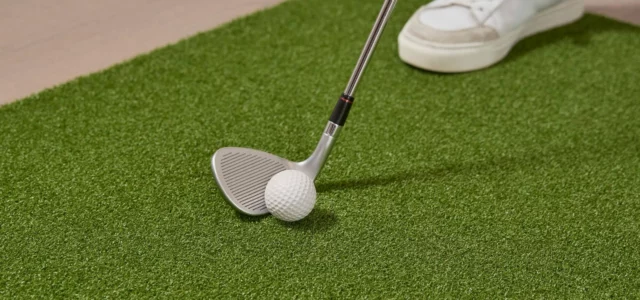
Start with a wedge, feet together, half swings. Standing with your feet together forces balance and centres the strike, which is why coaches use it as the opening drill. Ten balls.
Move to a mid iron and three-quarter swings for another ten. The driver comes last and gets five balls at most. The pre-round range is not a lesson, and trying to fix a fault twenty minutes before you tee off usually leaves you with two swings and no idea which one will appear.
Learn today’s ball flight, then play it
Pick one club you normally carry about 150 yards and hit ten shots with it every time you warm up, so the pattern means something from week to week. Watch the group of shots, not the best one.
If most start left and curl back, you have a draw today. Aim down the right side and let it work, rather than spending the round fighting it. Golfers who accept the day’s shape tend to play to their handicap; those who battle it tend to finish well above it.
Temperature matters too. On a cold morning the ball travels less far and your body turns less, and both push the same way. Take one more club than usual for the opening holes and go back to your normal numbers once you have warmed up properly.
The putting green is where the shots are
This is the part most club golfers leave out, and it is the most useful. Spend ten minutes rolling long putts across the practice green. Pace is the one thing that changes from course to course and from morning to afternoon, and the practice green tells you about it for nothing.
Early in the day, dew slows the greens noticeably. In the week or two after hollow-tining, a green runs slower and bumpier still. Three long putts will tell you which of those you are dealing with. If the club lets you, add a few chips from the fringe.
Finish by holing three or four short putts, so the last stroke you make before the first tee goes in.
What the Rules allow before and during a round
On the day of a stroke-play competition, Rule 5.2b says you must not practise on the course before your round. You may, however, practise putting or chipping on or near your first teeing area and practise on any practice area. Hitting a few balls down the first fairway before a medal breaks the Rule; a warm-up on the range or putting green does not.
Between holes, Rule 5.5b allows putting or chipping practice on or near the green you have just finished and the next teeing area, as long as it is not from a bunker and does not hold up play. That matters at the turn, as you will see below. The Rules are published by The R&A at randa.org.
Short of time or short of a range
With only ten minutes, keep three things:
- Three minutes of movement, no club.
- Two minutes of half-swing wedges, into a net or the air if there is no range.
- Five minutes of long putts.
Leave the driver in the bag. You will hit it on the first tee either way, and at least your body and your pace on the greens will be ready.
Many British courses, including a good share of municipals and nine-hole layouts, have no driving range at all. The warm-up still works: do the movement in the car park, make twenty swings with a wedge near the first tee without a ball, and spend the rest of the time on the putting green. A resistance band kept in the boot covers the movement part in three minutes.
Where to warm up in Britain
Facilities vary from club to club, so check before you book rather than finding out in the dark. Many courses with a range include balls in a visitor package or sell a bucket at the green fee counter. Some pay-and-play centres have large covered bays, which help on a wet morning. Hoebridge Golf Centre in Woking describes its range as 29 floodlit bays with Trackman in every one, and in September a small basket of 25 balls cost £5.50, enough for the wedge, iron and driver part of this routine. Trafford Golf in Manchester has 53 Toptracer bays, PGA coaching and a golf shop on site.
Standalone driving ranges are the fallback in most towns. Topgolf, which lists venues in Chigwell, Watford, Glasgow and Surrey, will sell you a bay by the hour, although the balls and targets are some way from a real course and are better suited to loosening up than to judging distance.
In winter it is also worth checking the weather beyond rain. From 1 November to 31 March, the UK Health Security Agency and the Met Office run their core cold-health alert season. A cold alert is aimed mainly at vulnerable people rather than golfers, but it is a reliable hint to give your body a longer warm-up. The practice green, meanwhile, is almost always there and almost always free. Panxis Golf has no commercial relationship with any venue named here.
Warming up again at the turn
Many groups stop for ten or fifteen minutes after nine holes. On a cold day that is long enough to stiffen up, especially for anyone over about forty.
Spend a minute moving before the tenth tee: a few trunk turns and some swings with two clubs, which takes less time than queuing for a bacon roll. Under Rule 5.5b you may also roll a few putts on or near the ninth green or chip near the tenth tee, as long as you do not hold anyone up. Then treat the tenth as a new start that needs a proper decision.
Your cards will show whether the break costs you. Compare holes ten to twelve with holes seven to nine over your last ten rounds.
After you finish
Two minutes of gentle, held stretches after the round is the right place for them, and it helps anyone who plays again the next day. The difference usually shows on the back nine of the second round.
Try it for a month
Arrive half an hour before your tee time for every round this winter and keep a note of your score on the first three holes. The numbers normally settle the matter, and very few golf improvements are this cheap.