Playing a links for the first time: wind, bump-and-run and club selection
Links land is sand, and sand behaves nothing like the clay most inland courses sit on. Everything else follows from that.
In brief
- A drive that finished at 200 yards inland finishes at 230 on firm links.
- Land approaches short of the flag and let them run.
- The putter from off the green has no disaster in it; the open wedge has two.
- Into the wind, three clubs more and a swing at eighty per cent.
- Play the first links round without counting, and keep the notes.
A links does not play like a parkland course. The ground is firm, the ball runs fifty yards after it lands, the wind decides everything, and the high ball you have spent years perfecting becomes your worst enemy. Here is how to play your first one without leaving ten shots on the course.
What actually changes
A links is built on sandy soil near the sea. That soil drains, which means the ground is firm most of the year, which means the ball behaves like a bowls ball rather than a dart. Your carry distance matters less than your total distance, and your total distance changes with every gust.
The second change is the ground itself. Fairways run into greens rather than stopping at them, so the ground game is not a novelty, it is the correct shot. Learning that on the first tee is expensive. Learning it on the practice ground the evening before is free.
The shot to learn before you go
The bump-and-run: a low, running approach played with a 7- or 8-iron from around the green, ball back, hands ahead, minimal wrist. It lands short and runs to the flag. On a links it is the percentage shot from anywhere inside forty yards where the ground is firm.
Practise it until you can control the first bounce. Most amateurs can hit it after twenty minutes; most amateurs never try because it looks unglamorous.
Playing with the wind, not against it
Into the wind, take more club and swing easier. That is not a cliché: a harder swing adds spin, spin makes the ball climb, and a climbing ball into wind falls short and left or right of where you aimed. Downwind, the ball flies further but stops less, so aim to land it short of the target.
Crosswind is the one that ruins scorecards. Aim into it rather than trying to hold a shot against it, and accept that the ball will finish somewhere in a twenty-yard window rather than at the flag.
Links bunkers
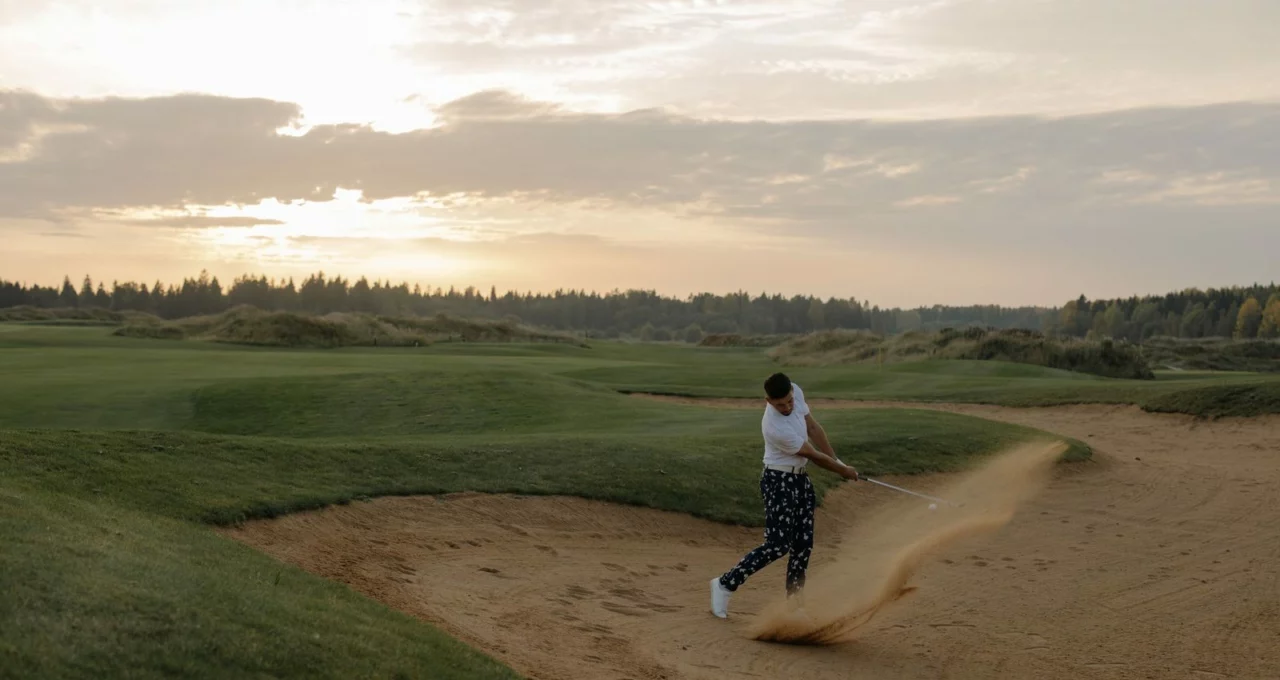
Revetted bunkers with stacked turf faces are hazards in the original sense. If the face is between you and the hole, play out sideways or backwards without hesitation. One shot lost is a bogey. Three shots trying to be a hero is an eight, and it will still be an eight next time.
The ground is the whole difference
Links land is sand, and sand behaves nothing like the clay most inland British courses sit on. Water drains in hours rather than days, the surface stays firm for most of the year, and the ball runs a long way after it lands.
Two consequences follow directly. A drive that finished at 200 yards inland finishes at 230 on a firm links, which puts bunkers into play that were never a consideration before. And an approach that pitched on the front of the green inland will finish over the back here, so you land the ball short and let it run.
The third consequence is around the greens. Tight lies on firm ground punish the open-faced lob wedge and reward the low runner: putter, 8-iron, anything that gets the ball on the ground quickly. The shot that looks least impressive is the one that works.
Reading a links green
Links greens are usually large, undulating and quicker than they look, because wind dries the surface through the day. A putt that appears flat from behind the ball frequently is not, and the general slope of the site is a better guide than the surface in front of you.
Walk the line and trust your feet rather than your eyes: the ankles register gradient long before the eyes do, and on exposed ground the eyes are being fooled by the horizon. Ten minutes on the practice green before you tee off is worth more here than anywhere else in golf.
Practical preparation
Waterproofs that let you swing, a spare glove, and shoes with grip: the weather changes in twenty minutes and wet grips end rounds. Take more balls than you think, because gorse eats them. And check the forecast for wind direction rather than rain, because wind is what will actually change your club selection.
What the wind actually does to the numbers
Wind is the variable that decides a links round, and the mistake is treating it as a small correction. Into a two-club wind, the answer is three clubs more and a swing at eighty per cent, because a hard swing adds spin, spin makes the ball climb, and a ball that climbs into a headwind falls out of the sky.
Downwind is the one people get wrong in the other direction. The ball flies further, lands flatter and runs a long way, so bunkers that were out of range become the exact landing area, and a green that held in the morning will not hold in the afternoon.
Crosswind matters most off the tee, because the driver keeps the ball in the air longest and the wind has the most time to work. On a hole with wind from the left and a slice already in the bag, the 3-wood is the sensible decision.
The right frame of mind
A links will produce two or three outcomes per round that feel unjust: a good drive kicking into a pot bunker, a decent approach running twenty yards past. That is the design, not misfortune. The player who argues with it plays worse over the next three holes than the player who shrugs.
The one club that changes everything
If you take one thing from this, take the putter from off the green. On tight, firm links turf, a putt from ten yards off the surface has no disaster in it, and an open-faced wedge from the same lie has two.
Watch a good links player around a green and count how often the ball is on the ground within a yard of being struck. It is almost always, and it is the exact opposite of what most inland golfers do.
What to take, and what to leave
Waterproofs regardless of the forecast, a second glove in a plastic bag, a hat that stays on in wind and a towel kept dry inside the bag rather than hanging off it. On exposed ground the weather changes inside an hour, and cold, wet hands destroy the short game faster than anything else.
Leave the lob wedge in the bag for most of the round. It is the club that gets links beginners into trouble, and the 8-iron along the ground does the same job with none of the risk.
Where to play a first links
Choose an accessible links rather than the most prestigious one. You will play more relaxed golf and keep the famous name for a time when you know what to do with it. East Lothian, the Fife coast beyond St Andrews, the Welsh coast at Aberdovey and Nefyn, and the Lancashire coast all offer this in abundance.
- St Andrews Links: seven courses, six of them bookable normally, including the shorter Strathtyrum and the nine-hole Balgove.
- Scottish Golf and Wales Golf for club directories and visitor conditions.
- iGolf if you need an official Handicap Index, which many links ask visitors to show.
None of this needs a lesson. It needs the decision to play the ball along the ground, to take one more club into the wind and swing at eighty per cent, and to accept that the wind is a partner rather than an insult.
One last piece of preparation: play the first links round without counting. Note the wind, note how far the ball ran, and keep the card for the second round.