The Melbourne Sandbelt explained, and which courses you can actually play
The Sandbelt is a geological feature, not a marketing term: a seam of deep sand that drains in hours and makes the courses firm almost all year.
In brief
- Firm ground means run: a drive that finished at 210 metres finishes at 230 here.
- Four ways onto a private course, and turning up is not one of them.
- Write to the secretary weeks ahead with handicap, club and free days.
- Public courses on the same sand take bookings from anyone.
- Greens are cored twice a year and stay bumpy for two or three weeks.
The Melbourne Sandbelt is the best concentration of golf courses in the southern hemisphere and the most misunderstood. Royal Melbourne, Kingston Heath, Victoria, Metropolitan and their neighbours sit on the same seam of sandy soil, and almost all of them are private. Here is what that means in practice, and which Sandbelt golf you can actually play.
What “Sandbelt” actually describes
It is a geological feature rather than a marketing term: a seam of deep sand running through Melbourne’s south-eastern suburbs, laid down by an ancient shoreline. The courses were built on it because it was cheap land nobody wanted for farming, and they became great because sand is the best surface in the world for golf.
Why the soil matters
The Sandbelt is a band of sandy country running south-east from Melbourne. Sand drains, which means firm ground all year, which means bunkers with steep faces, greens that run fast, and a ground game that works. It is the reason these courses play like nothing else in Australia and why they hold their condition through winter.
The private clubs, and how visitors get on
The famous Sandbelt clubs are private. Access for a visitor comes down to three routes: reciprocal arrangements through your own club overseas or interstate, an invitation from a member, or a golf tour operator that holds access and can meet the club’s requirements on your behalf.
None of those is a booking form. If a Sandbelt round matters to your trip, arrange it months ahead through one of those three channels rather than assuming you can ring on the day.
What to ask when you write
A letter or an email to the secretary is the mechanism, and what goes in it decides the answer. Give your handicap, your home club and its affiliation, the days you are free and the fact that you are flexible. Ask specifically whether the club accepts reciprocal visitors and on which days.
Write weeks ahead rather than days. Visitor slots at these clubs are limited and allocated in advance, and a request that arrives on Tuesday for Thursday is declined for reasons of logistics rather than snobbery.
And ask your own club secretary to make the introduction if there is any existing arrangement. A request that comes through a club carries considerably more weight than one that arrives cold, and secretaries know which arrangements exist.
What you can play without any of that
Sandy Golf Links, on the same soil, is a public-access course with no membership, no joining fee and no waiting list. It is the straightforward answer for a visitor who wants Sandbelt turf under the ball, and for a Melburnian who wants to play it every week.
Around it sit a series of public and semi-private courses on the same geology. They will not be ranked in the world top 100, and they will give you firm fairways, sandy bunkers and greens that behave the way Sandbelt greens behave.
Getting on: the honest hierarchy
There are four ways onto a Sandbelt private course, and they are not equally likely. An invitation from a member is the reliable one. A reciprocal arrangement through your own club overseas or interstate is the second, and it works more often than people expect if you ask your secretary to write.
The third is an organised group day, where a company, a charity or a golf tour operator has booked the course. And the fourth is the visitor window that some clubs publish for specific days, usually midweek, usually with a handicap limit and always booked well in advance.
What does not work is turning up. These are member clubs, the starter has heard every version of the request, and a polite no is the standard answer. Write to the secretary weeks ahead instead, with your handicap, your club and the days you are free.
How Sandbelt golf is played
Three adjustments. First, the ground game: approaches can be landed short and released, which is rarely the right shot on a wet Australian parkland course. Second, the bunkers: the faces are steep and close to the greens, so the safe miss is often long rather than short. Third, the greens: they are quick, and the first putt of the day will teach you more than any advice.
Take one extra club and land it short. That single change turns a lot of bogeys into pars on this soil.
What sandy soil does to your golf
The seam of sand under the Sandbelt drains in hours rather than days, which is why the courses stay firm through winter when clay-based courses in the same city are on temporary greens. It is also why the golf plays nothing like most Australian parkland.
Firm fairways mean run. A drive that finished at 210 metres on soft ground finishes at 230 here, and the bunkers were placed with that in mind. Approaches want to land short and release rather than pitch at the flag, and around the greens the low runner beats the lofted wedge on a tight lie almost every time.
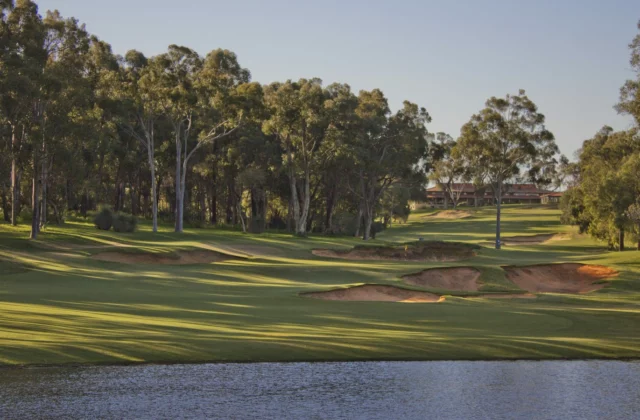
The bunkering is the other half. Sandbelt bunkers are cut close to the greens with steep faces and clean edges, and the ball that trickles into one from a putt-length miss is a genuine problem. Aiming at the fat side of a green is not timidity here; it is the design working as intended.
When to go
The Sandbelt is playable all year, which is unusual and is entirely down to the soil. Winter, from June to August, gives soft-ish greens, quiet tee sheets, lower rates and cold mornings. Summer, from December to February, gives the courses at their firmest and fastest and their most expensive, with early and twilight tee times the only comfortable ones.
Spring and autumn, September to November and March to May, are the best compromise: good surfaces, reasonable temperatures and availability. Ask about aeration when you book, because the greens are hollow-cored twice a year and stay bumpy for two or three weeks afterwards.
Planning a Melbourne golf trip
Base yourself once. The Sandbelt courses sit within about 20 km of each other and roughly half an hour from the city, so there is no reason to move hotels.
One round a day, and a short-game session in the afternoon. The bunkers here punish golfers who arrive without a sand technique, and the practice areas are where that gets fixed.
Book any private-club access first and build the rest of the trip around it. Public courses can be added a week out; a Sandbelt invitation cannot.
Where to book and what to ask
Book directly with the clubs. Their own pages carry the visitor conditions, the handicap limits where they apply and the days on which visitors are accepted, and the secretary knows what the website does not: whether a pennant match blocks the course on your day, when the greens were last cored, and whether there is a reduced rate for members of an affiliated club.
Golf Australia and Golf Victoria list affiliated clubs and their conditions, including the public-access courses that never appear in rankings. If you need a handicap to get on, a social or virtual club affiliated with Golf Australia issues the same GA Handicap a member holds.
The public and council courses of the Sandbelt and the bayside suburbs take bookings from anyone, charge modest green fees and are genuinely good. Several of them sit on the same sand as the famous names, and for a first visit they are the sensible place to start.
And if the private clubs are out of reach on your dates, the second tier of the Sandbelt is better than the first tier almost anywhere else in Australia, takes visitors at short notice and costs a fraction of the headline courses.
The public Sandbelt
The part of the story that gets lost is that public golf on the same sand exists, and it is very good. Council and public-access courses in the bayside and south-eastern suburbs sit on the same seam, drain the same way and play with the same firmness, and they take bookings from anyone at modest green fees.
For a visitor with three days in Melbourne and no member to call, that is the trip: two public Sandbelt courses and one attempt at a private one through a reciprocal arrangement. It is a better plan than four days spent writing letters.
The same logic applies to the practice facilities. Several public courses in the area have full short-game complexes with sand, which is where the Sandbelt actually teaches you something, and access costs a few dollars.
The short-game lesson the Sandbelt teaches
If you play one round here and take one thing home, take the bunkering. These courses punish the miss on the wrong side of a green and leave the miss on the fat side entirely playable, and good players aim accordingly.
Spend one round asking, before each approach, which side you would rather miss on. It is the cheapest lesson available and it works on every course you play afterwards.
Before you go
- Ask your home club whether it has reciprocal arrangements in Melbourne, and how far ahead a request must be made.
- Check whether a tour operator holds access to the specific courses you want, and what handicap limit applies.
- Book a public Sandbelt round as the fallback, so the trip is not dependent on an invitation that may not come.
Green fees vary widely between public and private access. Confirm the figure when you book, along with any caddie or cart requirement.
Where this shows up on a course
Three courses from our directory known for their sand.
- Kingston Heath Golf Club: Soutar routed it, MacKenzie bunkered it, and the short fifteenth is the result: the most admired sand on the Sandbelt, on a site smaller than any of its rivals.
- Huntingdale Golf Club: Alison’s only Australian course, home of the Australian Masters for thirty years, rebuilt by Ogilvy Cocking Mead: deep sand, brutal short holes, and a modern look purists resist.
- The Metropolitan Golf Club: The first club on the Sandbelt proper, and the one whose greens the rest of Australia is measured against: flat, fast, immaculate, and quietly overshadowed by its neighbours.
We have not played these courses; each page says what it is based on.