Which tees should you play? Slope, Scratch Rating and your Daily Handicap explained
Too many Australian golfers play tees built for longer hitters and spend the round hitting hybrids into par 4s. The GA Handicap system adjusts for every rated set of tees, so moving forward costs nothing on the card. Here is how the Daily Handicap formula works, a worked example, and a simple scorecard test to pick your markers.

In brief
- Every rated set of tees has a Scratch Rating and a Slope Rating from 55 to 155, with 113 as neutral.
- Daily Handicap = GA Handicap × Slope ÷ 113 + (Scratch Rating − Par), so 36 points means the same from any tees.
- If more than half your par 4 approaches are longer than your 7-iron, try the next tees forward.
- Competition conditions set the tees: GolfWA's public course pennant used back tees for men and red for women.
- Since CONNECT, 18-hole tees can be rated from 1,370 metres, so short sets can count for handicap.
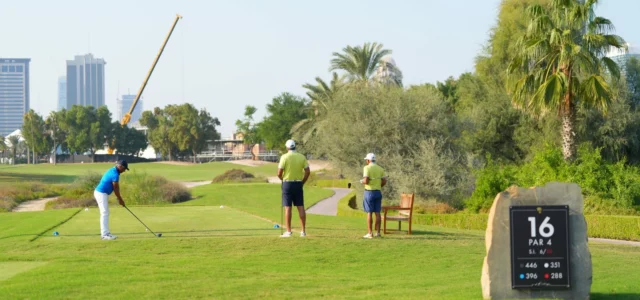
Look at the tee blocks on a Saturday morning and you will see golfers who carry the ball 180 metres lining up on the same markers as the club’s scratch players. Then they spend the next four and a half hours hitting hybrids into par 4s, wondering why the course feels brutal. Choosing the right tees is the cheapest improvement in golf, and in Australia the handicap system is built so that it costs you nothing on the card.
How Australian handicaps handle different tees
This is the part most golfers get wrong, so start here. Every set of tees on every rated course in Australia carries two numbers:
- A Scratch Rating: the score a scratch player (handicap 0) is expected to shoot from those tees.
- A Slope Rating: how much harder those tees play for a golfer who is not scratch. Golf Australia’s explanation puts the range from 55 (least difficult) to 155 (most difficult), with 113 as the neutral figure.
Your GA Handicap is a portable number standardised to that neutral slope. On the day, it is converted into a Daily Handicap for the tees you choose, using the formula Golf Australia published when the World Handicap System arrived:
Daily Handicap = (GA Handicap × Slope Rating ÷ 113) + (Scratch Rating − Par)
Golf Australia’s point was that this lets 36 Stableford points, or net par, mean you have played to your handicap from any set of tees, and that a score from one set can be compared directly with a score from another. Since the move to Golf Australia CONNECT in October 2025, the calculation has also included a Consistency Factor, which Golf Australia introduced to give women and girls fairer Daily Handicaps, and the club software does the arithmetic for you.
A worked example
Here is an illustration with round numbers, not a real course. Take a golfer with a GA Handicap of 18.0 on a par-72 course with two sets of tees:
| Back tees | Forward tees | |
|---|---|---|
| Scratch Rating | 72 | 69 |
| Slope Rating | 130 | 120 |
| 18 × Slope ÷ 113 | 20.7 | 19.1 |
| Plus (Scratch Rating − Par) | +0 | −3 |
| Daily Handicap (rounded, before any Consistency Factor) | 21 | 16 |
From the forward tees the golfer receives five fewer shots, because the course is shorter and easier for them. Their target is still 36 points either way. So moving up is not a shortcut to a trophy, and it is not “cheating your handicap”. What changes is the kind of golf you play to get there.
Too far back: what it does to your round
Courses are designed around the shots a player is expected to hit. Greens are shaped and bunkered to receive approach shots of a certain height, and fairway bunkers sit where a decent drive finishes. When your drive finishes well short of where the designer assumed, the whole hole changes shape.
Picture a golfer who carries driver about 180 metres and hits a 7-iron about 130, on a 370-metre par 4. From the back, even with some roll, the second shot is well over 150 metres: a hybrid or fairway wood into a green meant for a short iron. On a firm Australian summer green, that long, low approach rarely holds. The ball runs through, or finishes short and short-sided, which brings a tough chip, a long putt and a double bogey into play.
From a set of tees 40 metres forward, the same drive leaves something close to a 7 or 8-iron. The ball lands more steeply, the green holds it, and a par becomes realistic. Repeat that difference across ten or eleven par 4s and it changes the whole shape of the round, which is why the gain shows up mostly as fewer doubles rather than more birdies.
The long approach also drags other parts of your game. More shots from 150-plus metres means more fairway bunkers and greenside bunkers in play, and fewer full wedges into par 5s.
Find your number first
You cannot choose tees well without knowing how far you really hit it. Two measurements matter:
- Driver carry, averaged over ten decent swings, ignoring the two longest and two shortest. Use carry, not total: a drive that runs a long way on a baked February fairway will barely roll on a soft July one.
- The club you normally hit from 130 to 150 metres. If that is a hybrid or wood, you are probably playing tees that are too long.
A launch monitor bay gives you both in half an hour. Moore Park Golf in Sydney, for example, has Trackman in all 60 range bays, showing carry and total for every ball. On course, a rangefinder and a notebook over a few rounds works too.
A practical test for choosing tees
Rather than a magic formula, use the par 4s on your own course’s scorecard, which lists every set of tees with its length:
- For each par 4, subtract your average drive from the hole length. That is roughly your approach distance.
- Count how many of those approaches are longer than your 7-iron distance.
- If more than half of them are, try the next set forward.
- If almost none of them are and you regularly hit wedges into par 4s, the set behind may suit you better.
It is a rough guide, not a rule, and wind and firmness change it. A course with its prevailing summer sea breeze into your face on the long holes plays longer than the card says.
Competitions: check the conditions
The conditions of each event say which markers count, and they differ from club to club and from one competition to the next. In pennant, the conditions are usually fixed: GolfWA’s 2026 Public Course Pennants rules, for instance, required men to play from the back tees of the host club and women from the red tees.
So before a competition, read the tee instructions on the club notice board or website. If you have a choice, choose on the basis of the test above, not habit. In social rounds, pick whatever makes the golf enjoyable, and still enter your score so your GA Handicap reflects the golf you actually play.
The objection, and the proportion argument
The hardest part is not the arithmetic. It is walking past the markers you have always used.
Think in proportion. A tour player driving the ball close to 300 metres on a championship course is still hitting mid and short irons into most par 4s. A golfer carrying 180 metres who plays a course of similar length is playing a far longer game, relative to their own distance, than the professionals ever do. Moving forward is not a lesser version of golf; it is the same design, scaled to your swing.
Groups with a wide spread of ability
Nothing in the Rules of Golf requires everyone in a group to play the same tees, and in social golf it is usually better when they do not. A four-ball with a 5-marker and a 30-marker on the same markers often ends with one player enjoying the course and another grinding through it.
For juniors, beginners and people coming across from simulators, go further forward still. A course played from very short tees at first is a course that gets played again. Golf Australia’s CONNECT changes point the same way: tees on an 18-hole course can now be rated at as little as 1,370 metres, and on a nine-hole course at 685 metres, so short sets can still carry a Scratch Rating and Slope Rating.
Where to test it
A public course is the easiest place to try, because nobody is keeping an eye on which markers you use. Look up the course’s scorecard before you book, try one set forward for a full round, and time the round too. Collier Park Golf in South Perth, for example, lets anyone play without a membership and runs a social club for golfers who want a handicap; the Moore Park and Oakleigh courses also welcome public players.
Collier Park’s published fees show how cheap the experiment can be: from Friday to Sunday a nine-hole round cost A$36 and 18 holes A$50 in September 2026, and twilight golf was A$20. Bookings there are made online or through the app, opening eight days ahead, or two days ahead for twilight, so you can plan a test round for a quiet afternoon rather than a crowded Saturday morning. Play the first nine from your usual tees and the second from one set forward if the starter allows it, and compare the clubs you hit into the greens.
If you are chasing your carry numbers first, a launch monitor session or a fitting will give them to you.
Panxis Golf has no commercial relationship with any course, club, retailer or association mentioned here and earns no commission.
Try it for one round
- Measure your average driver carry and your 130 to 150-metre club.
- Use the scorecard to count par 4 approaches longer than your 7-iron from your usual tees.
- If it is more than half, play one full round from the next set forward.
- Write down your score, how many approaches you hit with a 7-iron or less, and how long the round took.
- Check your Daily Handicap for those tees in the Golf Australia App before you start, so 36 points means the same thing.
Plenty of golfers who try it once never go back. The course is not easier in any way the handicap system cares about. It just becomes the course the designer drew, for the shots you actually hit.