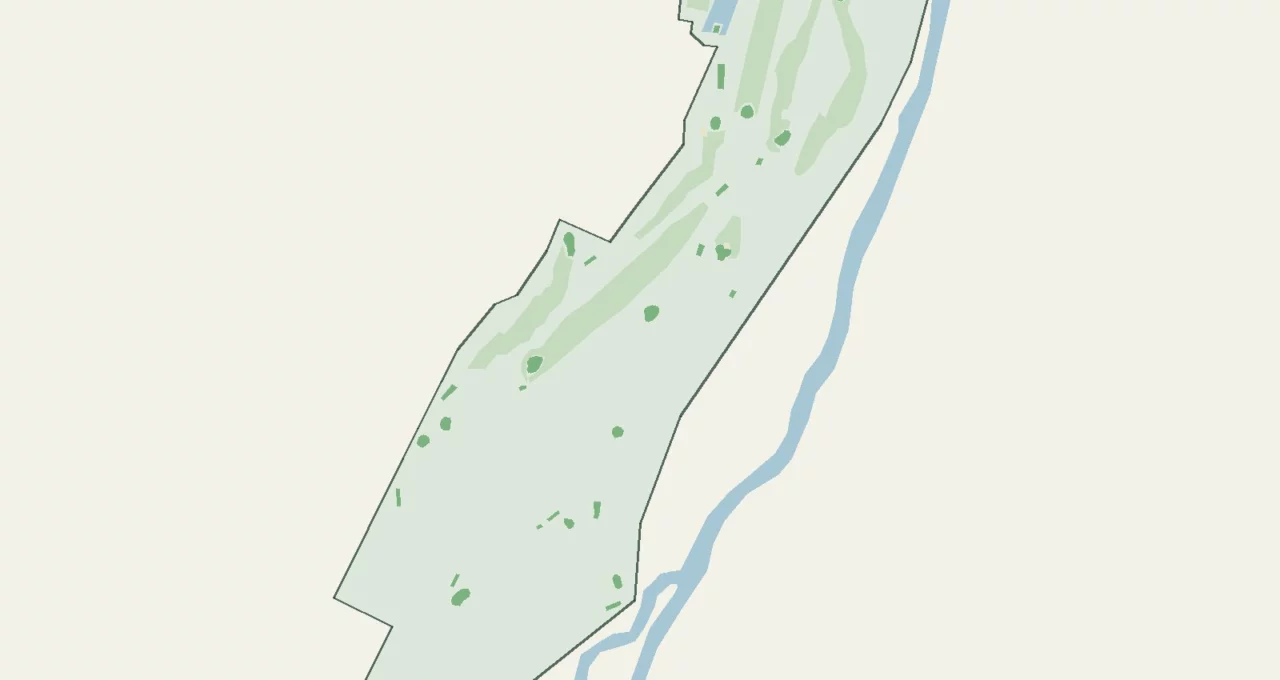
Layout of Emerald Golf Club from OpenStreetMap survey data (ODbL licence).
Emerald Golf Club
Holes
18 (club website; OpenStreetMap, 18 hole lines; Golf Finder; 18Birdies)
By
70 from every tee (club website; Golf Finder; 18Birdies; OpenStreetMap)
Length
5,779 metres from the blue tees, 5,492 from the white and 5,106 from the red (club website; Golf Finder); 18Birdies gives 6,327 or 6,335 yards (about 5,785 metres) and Golfshake 6,456 yards (about 5,900 metres)
Green fee
—
Best season
All year; course open 6am to 6pm daily (club website); hot summers, mild dry winters (Wikipedia)
Emerald Golf Club is an eighteen-hole course in Emerald, the main town of the Central Highlands of Queensland, about 271 kilometres west of Rockhampton according to Wikipedia. The club gives its address as the corner of Theresa and Opal Streets, Emerald QLD 4720, and describes its course as running along the Nogoa River, the river that flows through the town on its way to the Fitzroy. It is a community-owned, not-for-profit club run by volunteers, according to its own website, and it claims more than 500 members.
The club is active in 2026. Its new website carries a 2026 club program with competitions every weekend and monthly medals, a committee list, opening hours for the course, the pro shop and the bistro, and an online tee booking page for members and visitors. Golfers posted reviews of rounds played in March and May 2026 on a clubs directory and on 18Birdies, and a September 2026 review on the same directory mentions the course and the pro staff.
A word on the website itself. The address recorded in OpenStreetMap, a personal page on an old internet provider’s server, no longer leads to the club. The domain listed in most golf directories, emeraldgolfclub.com, now shows only a holding page announcing a new website, a phone number for the pro shop and an email address for membership enquiries. The current site, with the course, visitor information and the program, is emeraldgolfclub.com.au.
From sand greens on the edge of town to eighteen holes
The club’s own history page dates its foundation to 1928, which makes 2028 its centenary; the club says plans for it are still to come. According to that page, volunteers cleared the first course out of bush on the edge of town and played on sand greens. Through the 1930s, 1940s and 1950s the club was, in its own words, a social hub for the district, and play carried on through the war years with members doubling as greenkeepers. At some point the course grew from nine holes to eighteen and grass greens replaced the sand scrapes; the club does not give the year, and we have not found it elsewhere.
Not every source agrees on the date. A search-engine summary of the GolfPass listing for the course gave 1947 as the year it was built; we could not open the GolfPass page to check. That year could refer to a rebuilt or extended course rather than to the founding of the club, but we have no evidence either way. A general golf travel website describes the course as founded in the early twentieth century and names a designer, but gives no source and reads as generic text, so we have not used it. We found no reliable record of who laid out the present course.
The club’s timeline picks out a few more recent landmarks. Junior coaching grew between 2005 and 2008 under the PGA professional Matt Victorsen. The club also hosts an annual BUSHkids golf day, a fundraising event. In 2020, according to the club, a project with the Central Highlands Regional Council began using recycled water to keep the fairways green, which it calls drought-proofing. We have not found a council announcement on that project for Emerald; council news from the same period does describe recycled water irrigation installed at the golf course in nearby Blackwater. The club’s most prized trophy today, it says, is the Col Gill Memorial Shield.
The course in figures
The club, OpenStreetMap and every directory we read agree on eighteen holes and a par of 70. The club’s website says the par is 70 from every tee. It gives three sets of tees: the blue tees for experienced players at 5,779 metres, the white tees, where most members play and most weekend competitions are set, at 5,492 metres, and the red tees for beginners and shorter hitters at 5,106 metres. The Golf Finder directory repeats the same three lengths.
The only hole-by-hole card we could find is on 18Birdies, and it raises questions. It lists a single long tee, labelled white, at 6,327 yards, which is about 5,785 metres and therefore very close to the club’s blue tees; the same page gives 6,335 yards in its header. Its second tee, labelled red, measures 5,762 yards, about 5,270 metres, which matches none of the club’s three lengths. The Golfshake directory gives 6,456 yards, about 5,900 metres, from a social tee with a scratch score of 70. The club’s figures are the ones to trust; the hole lengths below come from the 18Birdies card, converted from yards and rounded, and should be read as a guide to the shape of the course rather than as the current card.
On that card, each nine is a par 35. The front nine opens with four par 4s of about 322, 301, 343 and 388 metres, followed by the par 3 5th at about 157 metres, the par 5 6th at about 525 metres, a short par 4 7th of about 261 metres, the 8th at about 403 metres and the par 3 9th at about 155 metres. The back nine starts with two long par 4s of about 374 and 362 metres, then the par 3 12th at about 199 metres and the par 5 13th, the longest hole on the card at about 538 metres. The 14th is a par 4 of about 315 metres, the 15th a short par 3 of about 115 metres, the 16th a par 5 of about 441 metres, the 17th a par 3 of about 172 metres and the 18th a par 4 of about 415 metres.
That gives five par 3s, ten par 4s and three par 5s, which is how the card reaches 70. The handicap index column on 18Birdies is empty, so we cannot say which holes the club rates hardest. 18Birdies also shows course ratings and slopes for its two tees, but they are hard to reconcile with each other and with the club’s tee names, and Golfshake gives a different figure again. We could not check Golf Australia’s official listing, so we give no course rating or slope here.
OpenStreetMap draws eighteen hole lines, numbered 1 to 18, inside the course boundary, along with a mapped water hazard. Golf Finder lists between ten and twenty bunkers, fairway watering, grass greens and undulating fairways.
What it asks of you
Accuracy over length
The club sums up its course in a phrase it repeats on several pages: not the longest track going around, but one that will make you think. At under 5,800 metres from the back tees, length alone will not trouble most club golfers. The club’s own emphasis is on accuracy over power, and on tree-lined fairways with shade on every hole and trees that punish a wayward drive. A member’s review quoted in search excerpts from Tripadvisor calls the course tight and demanding, while another reviewer on the same site found it fairly easy. Both can be true: the open lies are generous enough for a straight hitter, and the trees are close enough to cost shots for anyone who is not.
Water, the river and the odd kangaroo
The club mentions water hazards and a creek that keep golfers honest, and the course lies beside the Nogoa River. OpenStreetMap shows stormwater drains crossing the property and a water hazard inside it. The club also warns, with some humour, that kangaroos wander the fairways and have right of way, and that ducks live on the water. For a visitor from the coast or the south, the wildlife is part of the round.
Greens and fairways in a dry climate
Emerald has a hot semi-arid climate, with very hot summers, mild dry winters and most of its rain in summer, according to Wikipedia. Keeping fairways green is the course’s long-running challenge, which is why the club’s recycled water project matters. Older reviews describe bare patches on the fairways in drought, with greens and tees in better shape; a Hole19 reviewer in 2021 noted preferred lies on the fairways in the dry season. A long-time member quoted in Tripadvisor excerpts describes greens varying from large to very small, with a true roll when in good condition. 18Birdies users rate green speed as medium.
Holes to know
We cannot describe individual holes from first-hand notes: the club publishes no hole guide, and the reviews we read do not single out particular holes. The 18Birdies card nevertheless shows a few features worth knowing. The 13th, a par 5 of about 538 metres, is the longest hole and the one where three good shots are needed. The 12th, a par 3 of close to 200 metres, is the longest of the short holes and may call for a wood from the back tees. The 15th, at about 115 metres, is the shortest hole on the card and the clearest scoring chance. The 7th, a par 4 of about 261 metres, may tempt longer hitters to go for the green. The 18th, a par 4 of about 415 metres, is a stiff finish.
What that means for your game
Keep the ball in play: with five par 3s and a short total length, the score is made by avoiding the trees and the water rather than by long driving. Ask at the pro shop which tee suits you; a reviewer playing off a 15 handicap in March 2026 chose the white tees and judged the blues too hard for his game. In summer, play early. The course opens at 6am, and Wikipedia gives a mean maximum of nearly 35 degrees in January. After heavy rain, expect some soft and muddy patches, which one 2026 reviewer mentions.
What golfers say
Written comment on the course is scarce. Tripadvisor lists about a dozen reviews, most of them from 2018 and 2019, and we could read them only through search excerpts because the site refused our requests. Hole19 shows a rating from ten reviews but only one written comment. 18Birdies shows fourteen ratings with category scores but no written text. A clubs directory shows more than a hundred ratings and a handful of recent written reviews, several of which are about the bistro rather than the golf. The points below are what recurs. They are other people’s opinions, not ours: we have not played the course, and we name and quote no one.
What comes up in its favour
- Recent reviews on the clubs directory describe the course in good condition in 2026, even after heavy rain.
- Staff in the pro shop draw consistent praise for being helpful with bookings, hire, merchandise and repairs; one reviewer mentions new pro shop owners in 2025.
- Booking a tee time is described as easy, and buggy hire as simple.
- Greens and tees are described as well grassed, even in dry periods when the fairways suffer.
- The trees and the river setting make the course pleasant to look at, and an RvTrips review from 2017 mentions attractive fairways and plenty of trees.
- Several diners describe the bistro meals and drinks as good value, with friendly staff, and the club as a relaxed place for visitors.
- On 18Birdies, the pace of play is rated fast.
What comes up against, or should be weighed
- Fairway condition in drought is the most common complaint in older reviews, with bare and dry patches; one Tripadvisor review regretted the decline of what it saw as a once great course. Those reviews predate the club’s recycled water project, so they may no longer reflect the course.
- On 18Birdies, course condition and value are rated lower than the overall score.
- The course can be muddy in places after heavy rain.
- The bistro gets mixed comments: praised by some, while a September 2026 reviewer received a cold meal and the wrong order.
- Opinions on difficulty differ, from fairly easy to tight and demanding, and the blue tees are described as hard for mid handicappers.
- Reviews do not agree on the terrain: an RvTrips reviewer found the course not very hilly, while a Tripadvisor excerpt describes a walkable front nine and a hillier back nine.
Eating, drinking and practising
The clubhouse has a fully stocked bar and a bistro, open seven days, according to the club. The bistro is run independently by a local business, Cheeky Gecko, which publishes its menus and daily hours itself; the club suggests checking times before coming, and the bistro can be reached on 0405 903 941. A clubs directory lists bistro hours from early afternoon on Mondays and Tuesdays and from late morning on other days, but these are not confirmed by the club. The clubhouse can be booked for private functions such as birthdays, work drinks and presentation nights. An RvTrips reviewer in 2017 described a large outdoor area overlooking the course and live music after the Friday night raffles; we do not know whether these continue.
The pro shop, run by Gav according to the club, is open from 7am to 5pm every day and sells clubs, balls and accessories, hires out sets of clubs and buggies, and gives advice on how to play the course. If you plan to tee off before 7am, the club asks you to call ahead to organise hire. The club also has an indoor golf simulator, booked through the pro shop. Golf Finder lists a putting green; we did not find a driving range on the club’s own site, and do not claim one. Golf Finder also mentions junior clinics on Saturday mornings in school terms.
The club has no accommodation of its own. The nearest option mentioned in reviews is the Emerald Cabin and Caravan Village, a few blocks’ walk from the course according to RvTrips, and Emerald has a range of motels.
Who it suits
Emerald Golf Club suits golfers working in or passing through the Central Highlands who want a relaxed eighteen holes with a bar and meal afterwards. Visitors are welcome every day, and the club says the course suits every level, from scratch players to people who have never swung a club. Mid and high handicappers will find the white or red tees a fair test, and the five par 3s give plenty of scoring chances. Better players should not expect length, but the trees and water will demand control. Travellers in caravans and motorhomes staying in town will find it within walking distance of at least one park.
Getting there and when to go
Emerald sits at the junction of the Capricorn and Gregory highways, about 271 kilometres west of Rockhampton and 832 kilometres north-west of Brisbane, according to Wikipedia. Emerald Airport, about six kilometres south of the town centre, has flights to Brisbane with QantasLink, Virgin Australia and Alliance Airlines, and Alliance also flies to the Sunshine Coast. Queensland Rail’s Spirit of the Outback, running twice a week between Brisbane and Longreach, stops at Emerald. We have not checked local bus or taxi services and give none.
Visitors book tee times online through the club’s MiClub booking page and check in at the pro shop before teeing off. The club lists two numbers: (07) 4982 1274 for general enquiries and functions, and (07) 4877 4498 for the pro shop. The course and grounds are open from 6am to 6pm every day. Weekend competitions usually tee off between 7am and 12.30pm, and the club says visitors can play in them. Golf Finder asks for golf attire and covered shoes; we did not find a dress code on the club’s own site. Public holiday hours may vary, and the club asks golfers to call ahead.
The course is open all year. Wikipedia gives mean maximum temperatures of about 34.6 degrees in January and 23.4 degrees in July, with nights cooling to around 9 degrees in July and most rain falling in summer. For most visitors, the mild, dry months from May to September are the most comfortable time to play, though fairways may be at their driest then. In summer, the early morning start is the one to book.
How this page was made
The factual frame comes from public sources read on 5 November 2026. The club’s website, emeraldgolfclub.com.au, provided the address, telephone numbers, founding date and history, the committee, tee lengths and par, course description, opening hours, pro shop, hire, simulator, bistro and functions, visitor and booking information, the 2026 program and the evidence that the club is operating. The club’s older domain, emeraldgolfclub.com, now shows a holding page. Its MiClub page confirmed the online booking. OpenStreetMap provided the coordinates, the eighteen hole lines and the water features. Wikipedia’s articles on Emerald, Emerald Airport and the Spirit of the Outback provided distances, transport and climate. Golf Finder provided tee lengths, bunkers, grasses, dress and junior clinics; 18Birdies the only hole-by-hole card and category ratings; Golfshake an alternative length; Hole19, RvTrips and a clubs directory the reviews and some facilities. Tripadvisor and GolfPass refused our requests and were read only through search excerpts. Council news on recycled water irrigation was read only through search excerpts and concerns Blackwater, not Emerald.
Several sources disagree, and we have said so in the text. The club dates its foundation to 1928, while a GolfPass excerpt gives 1947 as the year the course was built. The club’s back tees measure 5,779 metres; 18Birdies gives about 5,785 metres from a tee it calls white, plus a red tee of about 5,270 metres that matches none of the club’s, and Golfshake about 5,900 metres. 18Birdies gives two totals, 6,327 and 6,335 yards, on the same page. Course ratings and slopes on 18Birdies do not tally with Golfshake’s scratch score, and we have used neither. The address appears as the corner of Theresa and Opal Streets, 79 Theresa Street, Opal Street, or 52 Opal Street depending on the listing. One golf brand’s directory gives a different club phone number from the one the club publishes. Reviewers disagree on whether the course is easy or demanding, and on whether it is flat or hilly. Golfshake says it knows of no clubhouse, bar or pro shop, which the club’s own site contradicts. The website recorded in OpenStreetMap is obsolete.
We could not open the GolfPass, Tripadvisor or MScorecard pages, which refused our requests, nor Golf Australia’s official course listing, so no course rating or slope is confirmed and no hole-by-hole index is given. We found no reliable record of the course designer or of the year the course went to eighteen holes. A general golf travel website naming a designer was set aside as unsourced. We have not confirmed a driving range. We give no green fees or membership prices.
We have not played this course, and this page is no substitute for a round. The club has not paid for this page, has not seen it before publication and has no say over its content. If you know the course and something here is wrong or out of date, write to us and we will correct it.
Other courses nearby
Closest to this one in our Australian directory:
- Emu Park Golf Club — 271 km
- Bundaberg Golf Club — 447 km
- Bargara Golf Club — 459 km
- Coral Cove Golf Course — 462 km
The hole to know
The longest hole on the only published hole-by-hole card, a par 5 of 588 yards, about 538 metres (18Birdies); the club publishes no hole guide, so this length is not confirmed by the club.