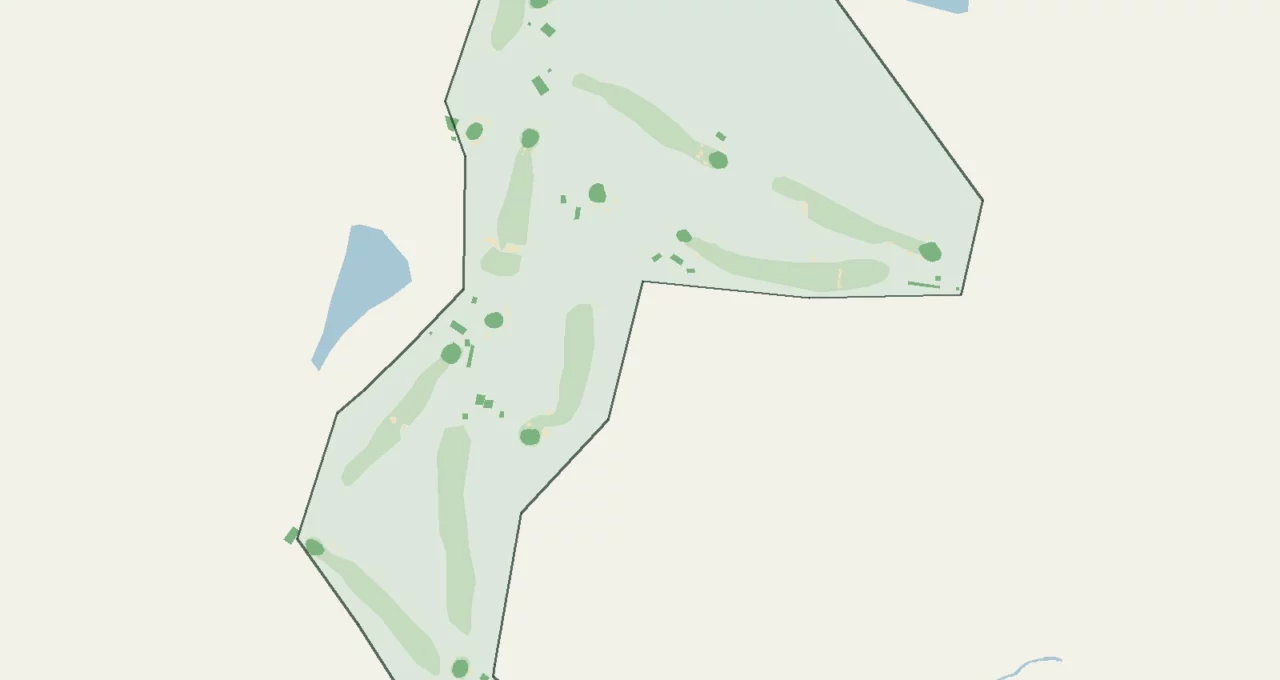
Layout of Royal North Devon Golf Club from OpenStreetMap survey data (ODbL licence).
Royal North Devon Golf Club
Holes
18 on the Championship Course, plus Taylor's Course, a nine-hole par 3 course opened in 2018 (club website)
By
72 from the championship, white and yellow tees; 72 for men and 73 for women from the red and blue tees (club rating tables, April 2024; the scorecard gives 73 for the red, blue and green tees)
Length
7,085 yards championship, 6,765 white, 6,501 yellow, 6,050 green, 5,685 red, 4,572 blue (club scorecard); GolfPass gives 7,044 from the black tees
Green fee
—
Best season
—
Royal North Devon Golf Club, known to golfers as RND or simply as Westward Ho!, plays across Northam Burrows, an expanse of common land between the village of Northam and the sea on the north coast of Devon. It was formed in 1864 as the North Devon and West of England Golf Club, and it calls itself the oldest golf course in England, a claim repeated by Wikipedia. The Championship Course is a links of 18 holes, par 72, which measures 7,085 yards from its longest tees on the club’s scorecard. There is no fence between the golf and the common: sheep and horses graze the Burrows, walkers cross it, and the club says the course occupies 170 of the common’s 650 acres. Beside it lies Taylor’s Course, a nine-hole par 3 course opened in 2018 and named after J. H. Taylor, the five-time Open champion who began his golfing life here as a caddie.
This page sets out what the public record says about the club, what the Championship Course asks of a golfer, what published reviews report, and how a visitor gets a game. It draws on the club’s own pages, Wikipedia and Wikidata, and published reviews, read in November 2026.
Which club is this?
OpenStreetMap maps the course on Northam Burrows and links it to the Wikidata item Q7374596 and the English Wikipedia article Royal North Devon Golf Club. Wikidata gives 1864 as the year of foundation. The club’s postal address is Golf Links Road, Westward Ho!, Bideford, Devon, EX39 1HD, and its telephone number is 01237 473817. Westward Ho! is the seaside village; Northam is the older village on the hill above, from which the course takes the name of the ground it plays over, and Bideford is the nearest town and post town.
Royal North Devon should not be confused with Saunton Golf Club, across the estuary of the Taw and Torridge, with which it alternates as host of the West of England Amateur Championship. The two are separate clubs on separate ground.
History: the cradle of English golf
The club’s history page, written by a member, calls Westward Ho! the cradle of English golf, and the sequence it gives is unusually well documented, thanks to a letter written in September 1909 by George Gosset to J. H. Taylor, which the club reproduces in full. According to that letter, golf began on the Burrows in 1853, when William Driscoll Gosset, an officer of the Royal Engineers who had played in Scotland, pointed out the suitability of the ground to his brother-in-law, the Reverend Isaac Henry Gosset, Vicar of Northam. The club credits General George Moncreiffe, another brother-in-law and a member of the R&A, with the remark that providence had obviously designed the place for a golf links, while the letter leaves open whether it was Moncreiffe or William Gosset who said it. In 1858 the vicar ordered clubs from Tom Morris in St Andrews.
The club records that Old Tom Morris came south in 1860 to lay out a rudimentary course, and returned in August 1864 to establish the first 18-hole course. The letter dates a meeting about founding a golf club to 4 April 1864 and the appointment of a captain to 3 May, and says Morris stayed from 8 to 19 August. George Gosset’s own note in the letter adds that a course was already laid out by then and that Morris may only have suggested improvements, which sits a little awkwardly with the club’s statement elsewhere that Morris designed the course. The club names Isaac Gosset as its founder. In 1866 the Prince of Wales, later Edward VII, became patron, and in 1867 he gave the club the royal title; it became Royal North Devon and West of England Golf Club, and took its present name in 1910. A ladies’ club, the Westward Ho! Ladies Golf Club, was formed in 1868; Top 100 Golf Courses describes it as the second oldest ladies’ golf club in the world.
The first clubhouse, the Iron Hut, stood close to the pebble ridge. Storms and flooding in the late 1870s and early 1880s moved the club inland, where it leased three fields bordering the Burrows, re-routed the course and built the pavilion that remains its clubhouse. Inside are a golf museum, honours boards from 1864, racks of hickory-shafted clubs, a portrait of Taylor with some of the clubs he used to win his Open titles, and, in the men’s changing room, a locker bearing his signature.
Several of the founding figures of English golf learned the game here. Horace Hutchinson grew up in Bideford and, according to Wikipedia, won the Amateur Championship in 1886 and 1887. J. H. Taylor was born in Northam, began as a caddie boy, and went on to win five Open Championships as one of the Great Triumvirate with Harry Vardon and James Braid; the club made him its President in 1957. The club has a President rather than a Captain, which it says makes it almost unique. Herbert Fowler made the subtle changes between 1908 and 1911 that produced the layout largely played today, according to the club; Top 100 Golf Courses dates his revision to 1908. The club says only three of Morris’s 1864 greens remain in play: the 3rd, 4th and 16th.
The Amateur Championship has been held here three times, according to the club’s history page and Wikipedia, which gives the years as 1912, 1925 and 1931. Published records of the championship name the winners as John Ball in 1912, the last of his eight titles, Robert Harris in 1925 and Eric Martin-Smith in 1931. The club also hosted the Martini professional tournament in 1975 and the Varsity Match between Oxford and Cambridge in 2025.
The sea and the course
The whole links depends on the pebble ridge, a natural bank of stones that shelters the Burrows from Bideford Bay. The club says rising sea levels are pushing the ridge backwards by about one and a half metres a year. Over the winter of 2017 to 2018, and in particular during Storm Eleanor in January 2018, the club lost more than 20 feet of dune beside the 7th green, along with half of the 8th championship tee. The old 7th, a doglegged par 4, was abandoned. The club rebuilt the 7th further inland as a par 5 and shortened the 9th into a par 4 so that the course kept its par of 72. A new par 3 8th, built in 2021 with turf from the old 7th green and trialled by members in 2022, came into play in 2023; the club says the tee has a view of water through about 280 degrees. The club adds that Natural England has declined to reinforce the ridge, and that the 6th and 10th holes may be the next to be threatened.
The Burrows were notified as a Site of Special Scientific Interest in 1988, according to the club and Wikipedia, and the course is managed under an ecology agreement with Natural England. The fairways receive no fertiliser and, outside drought, no water; the greens and tees get only light feeding. Since 1 January 2020 the club has banned plastic tees on the course. The intention, in the club’s words, is firm, fast-running ground that rewards the bump and run.
What it asks of the golfer
The club publishes a scorecard for seven sets of tees and, separately, rating tables in force from 1 April 2024. The longest tees on the card, labelled Championship, measure 7,085 yards; the rating table, which labels its longest tees Black, gives a course rating of 74.2 and a slope of 135, the same figures Wikipedia gives with the 7,085-yard length.
- Championship (Black in the rating table): 7,085 yards, par 72 (36 out, 36 home), course rating 74.2, slope 135.
- White: 6,765 yards, par 72, rating 72.6, slope 132.
- Yellow: 6,501 yards, par 72, rating 71.4, slope 128.
- Green: 6,050 yards, par 73 on the scorecard.
- Red: 5,685 yards; men’s par 72, rating 67.5, slope 119; women’s par 73, rating 73.1, slope 133.
- Blue: 4,572 yards; men’s par 72, rating 62.4, slope 104; women’s par 73, rating 66.2, slope 116.
The scorecard lists the Red and Blue tees at par 73 and an Orange tee at the same 5,685 yards as the Red at par 72; the rating tables give par 72 for men and 73 for women from the Red and Blue. We take the difference to reflect the par of the 2nd, a par 5 from the forward tees, but the club does not say so.
The challenge is not length for its own sake. The Burrows are open, almost treeless and exposed to the wind off the Atlantic, and the main hazards are the great sea rushes, tall, spiky clumps in which a ball is easily lost, along with ditches, burns, roads and deep bunkers. The club’s Championship Course tour, written by its professional, makes the same points hole after hole.
The Championship Course, hole by hole
- The 1st is a par 5 of 521 yards from the championship tees: the drive must carry ditches and water in front of the tee, and a burn cuts across the front of the green about 40 yards short.
- The 2nd, a par 4 of 447 yards, turns right to left, with a ditch and out of bounds down the right and sea rushes to the left; the fairway narrows beyond 250 yards.
- The 4th, a par 4 of 382 yards, begins with a blind drive over the large bunker 180 yards in front of the tee, aimed at a marker post above it, then an approach over four bunkers short of the green. Reviewers single out the towering faces of some of the bunkers as one of the sights of the course.
- The 5th, at 163 yards the first of the short holes, has a raised green ringed by eight bunkers.
- The 6th, which the club calls a signature hole, is stroke index 1.
- The 7th is the new par 5 of 553 yards, with sea rushes in front of a shallow green; the 8th the new par 3 of 194 yards; the 9th a par 4 of 478 yards from an elevated tee, stroke index 3, to a green with a ridge through it.
- The 10th and 11th both ask for a drive over or between rushes; the club’s tip for the 10th is to aim at a black-and-white post.
- The 12th, a par 4 of 458 yards, is stroke index 2.
- The 14th is a par 3 of 207 yards from both the championship and white tees, which the club says always plays over 200 yards and often into the wind.
- The 17th, at 555 yards, is the longest hole, usually a three-shot par 5 with an approach over a road and a ditch, in a part of the course the club says stays wetter.
- The 18th, a par 4 of 415 yards, has a ditch down the right, rushes on the left and a burn in front of a two-tier green. The club suggests taking the church in the distance as the line from the tee; its ladies’ history identifies it as St Margaret’s, Northam.
The outward half measures 3,572 yards and the inward half 3,513 from the championship tees. There are four par 5s (the 1st, 7th, 13th and 17th) and four par 3s (the 5th, 8th, 14th and 16th).
The 6th
The club describes the 6th as a signature hole with views over the bay, and rates it the hardest on the card, stroke index 1, at 411 yards from both the championship and white tees. Out of bounds runs the full length of the left side, and deep fairway bunkers are hidden in the dunes on the same side. The club’s advice is a tee shot of about 250 yards that stays short of the bunker, leaving 150 to 160 yards to a narrow, raised green that slopes from back to front. A miss to the right leaves a steep pitch from a tight lie. The 6th is also one of the two holes the club names as the next at risk from the sea.
Practice and the short course
Taylor’s Course, a nine-hole par 3 course opened in 2018, can be played as 18 holes by going round twice. The club says non-members need not book: they register at the pro shop, which also hires clubs. The academy page lists a large putting and chipping green, indoor coaching bays and an outdoor grass practice range. The club does not give the length of the range.
What golfers say
We read the Golfshake summary and reviews, the Top 100 Golf Courses page and its reviews, the visitor comments the club publishes, and search summaries of other review sites, including Golf Monthly’s review, whose page did not load in full. The points below summarise what recurs. They are other people’s opinions, not ours; nobody from Panxis has played the course, and we name and quote no one.
What comes up in its favour
- The history: playing the oldest course in England, and the clubhouse with its museum and memorabilia, which some reviewers say is worth the trip on its own.
- The raw, natural character of the links, unmanicured and played among grazing sheep and horses, which many describe as unlike anywhere else.
- The test itself, especially in wind, and the variety of hazards, with the sea rushes and the tall bunker faces the most often mentioned.
- The condition of the greens, often described as firm and true.
- The welcome from staff, the pro shop and members.
- The views over the pebble ridge and the bay.
What comes up against
- Some reviewers consider it charming and historic but not in the very top rank of English links, and find a few holes, especially some of the inland and opening ones, ordinary by comparison with the best stretches.
- Condition can be patchy, which some put down to the common land, the animals and the weather; others found it wetter than expected after rain.
- Blind shots and lost balls in the rushes can be frustrating, especially on a first visit and in a strong wind.
- Value for money and the practice facilities score lowest among Golfshake’s categories.
Playing as a visitor
Royal North Devon is a members’ club that welcomes visitors, and says it has done so for more than 150 years. Visitors may book tee times online through the club’s tee time booking page, or call the club on 01237 473817. Competitions open to visitors are listed on the club’s opens page.
The club says only six buggies are allowed on the Burrows and that they may be booked only with a medical exemption, through the pro shop on 01237 477598. Full sets of clubs, pull trolleys and electric trolleys can be hired. A caddie master arranges member volunteers as caddies, for one player or shared, and offers visitors a tour of the clubhouse, museum and Taylor’s locker.
The dress code asks for a neat, clean standard: no T-shirts, sleeveless shirts for men, vests or football and rugby tops on the course, tailored or cargo shorts only, and no hats in the clubhouse. The club notes that white socks with shorts are not required. In the clubhouse the normal hours are 7am to 30 minutes after sunset, and the bar opens at 11am.
Getting there and when to go
The club is on Golf Links Road, Westward Ho!, EX39 1HD. Its directions are to leave the M5 at junction 27 and follow the A361 towards North Devon, or, from the west, to follow the A39 Atlantic Highway towards Bideford and then Westward Ho! The club is signposted. We did not verify public transport or parking arrangements and leave them out.
The club does not publish a season on the pages we read. At the start of November 2026, the club’s course status required players to hit from mats for every shot except putts and shots from hazards, bunkers and near the rushes. Because the Burrows are low-lying and the club says the area of the 17th stays wetter, it is worth checking the course status and the club’s webcam before travelling in winter. In summer the fairways firm up and the ball runs, which is what the club intends.
Green fees
Rates vary with the season and the day of the week: see the club’s green fees page.
How this page was made
The factual frame comes from public sources: OpenStreetMap for the location and name; Wikidata for the year of foundation; the club’s website for the address, history, the 1909 Gosset letter, the ladies’ history, the scorecard, the rating tables from 1 April 2024, the hole-by-hole course tour, the changes to the 7th, 8th and 9th, the environment policy, the short course, the visitor arrangements, the dress code and the opening hours; Wikipedia for the Amateur Championship years, the course rating, Hutchinson’s titles and the SSSI; published championship records for the winners of 1912, 1925 and 1931; and Top 100 Golf Courses for Fowler’s revision and the ladies’ club. The opinions summarised above come from Golfshake, Top 100 Golf Courses, the club’s published visitor comments and search summaries of other review sites.
Where sources disagree, we say so. The club’s history page and Wikipedia say the Amateur Championship has been held here three times; the club’s welcome page says twice. The club’s history page dates John Ball’s last Amateur title at Westward Ho! to 1913; the championship records give 1912. The club says Old Tom Morris designed the course in 1864, while the 1909 letter it publishes suggests a course was already laid out and that Morris may only have suggested improvements. The club dates Fowler’s work to 1908 to 1911, Top 100 Golf Courses to 1908. The common is given as 650 acres on the course pages and about 600 acres in the history page. GolfPass gives 7,044 yards from the black tees, against 7,085 on the club’s card and on Wikipedia. The scorecard and the rating tables differ on the par from the Red and Blue tees, as explained above. Wikipedia records a course record of 64, set in 2007; we found no confirmation on the club’s site and leave it out of the facts above.
Golf Monthly’s review and the GolfPass reviews could not be read in full and have not been used for any figure. We found no length for the practice range and no published season. Green fee and hire amounts are deliberately left out.
The opinion section summarises reviews read in November 2026. We report recurring themes rather than individual voices, and we reproduce no quotations from reviewers. Nobody from Panxis has played or visited this course, and this page is no substitute for a round.
The club has not paid for this page, has not seen it before publication and has no say over its content. This page contains no commercial link and earns us no commission. If you know the course and something here is wrong or out of date, write to us and we will correct it.
Other courses nearby
Closest to this one in our British directory:
- Langland Bay Golf Club — 37 mi
- Fairwood Park Golf Club — 39 mi
- Exeter Golf and Country Club — 41 mi
- Earlswood Golf Club — 43 mi
The hole to know
The hole the club calls a signature hole, stroke index 1: a par 4 of 411 yards with out of bounds all along the left, bunkers hidden in the dunes and a narrow, raised green sloping from back to front (club scorecard and course tour).