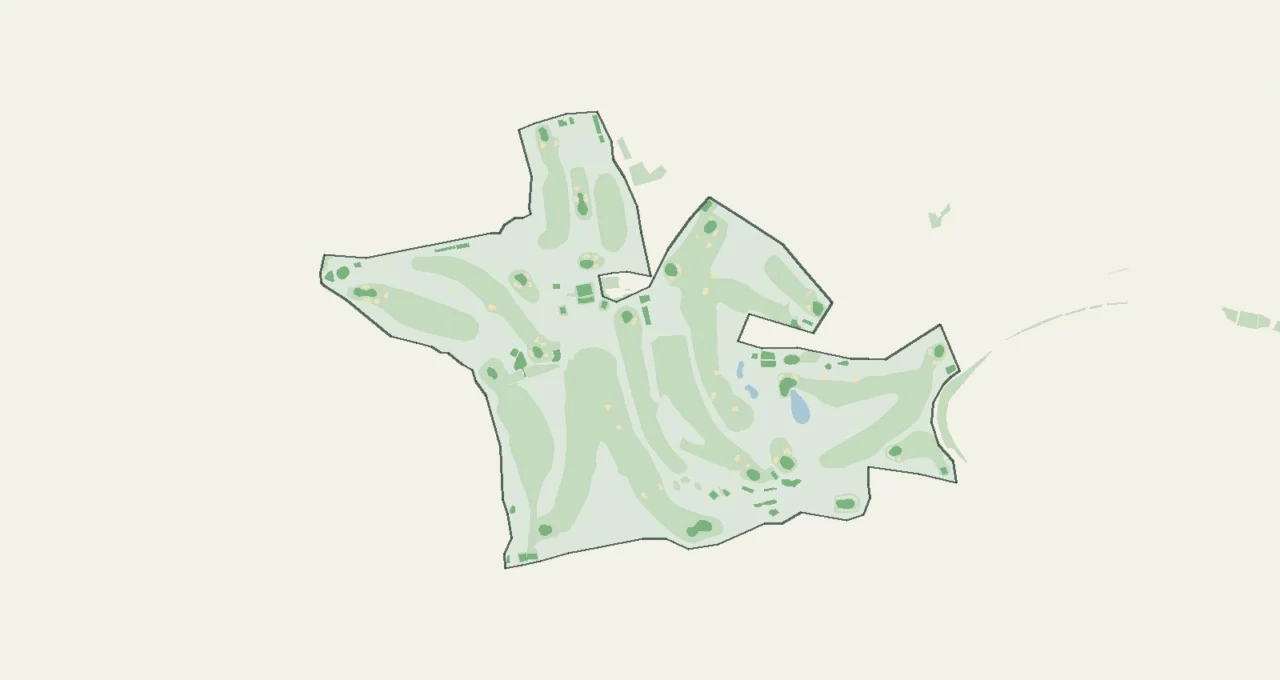
Layout of Langland Bay Golf Club from OpenStreetMap survey data (ODbL licence).
Langland Bay Golf Club
Holes
18 (club website)
By
70 for men from the white and yellow tees, 73 for women from the red tees (club scorecard and Wales Golf rating table)
Length
5,919 yards from the white tees, 5,690 yellow, 5,283 red (club scorecard); directories give older figures from 5,857 to 6,026 yards
Green fee
—
Best season
The club's visitor and society rates distinguish a summer season (30 March to 23 October) from a winter season (24 October to 29 March), with winter tees on the rating table (club website)
Langland Bay Golf Club is an 18-hole clifftop course on the Gower Peninsula, on the western edge of Mumbles, about five miles from the centre of Swansea. It occupies the headland of Newton Cliffs between Langland Bay and Caswell Bay, above the coast path, and the club says the sea is in view from 15 of its 18 holes. The club traces its first written mention of golf to a minute book dated 24 September 1901, and the course was opened on 10 September 1904. James Braid was consulted in 1936 and one hole, the 8th, carries his name. On the club’s current scorecard the course measures 5,919 yards from the white tees and 5,690 from the yellows, par 70 for men, and 5,283 yards, par 73, from the red tees for women. The club’s website is langlandbaygolfclub.com.
It is a short course by modern standards, but not an easy one on paper: the Wales Golf course rating from the white tees is 71.3, more than a stroke above par, with a slope of 131. The club markets itself heavily on its setting, calling itself the Pebble Beach of Wales, and in recent years it has collected the governing body’s awards more often than its course rankings would suggest: Wales Golf Club of the Year in 2013 and the first Club of the Decade award in 2020. It is a members’ club that takes visitors, societies and golf-break groups, with an online visitor tee sheet.
Name and location
The club, its scorecard and its Wales Golf rating table all use the name Langland Bay Golf Club. OpenStreetMap draws the course under the same name and links it to Wikidata item Q24182034 and to an English Wikipedia article. The postal address is Langland Bay Road, Mumbles, Swansea, SA3 4QR. Mumbles is part of the City and County of Swansea; the course lies within the Gower Area of Outstanding Natural Beauty, the first area in the United Kingdom to be given that designation, in 1956, according to Wikipedia.
The coordinates carried by Wikidata and by the Wikipedia article sit about 700 metres west of the centre of the course as OpenStreetMap draws it, towards Caswell Bay. The Visit Wales listing, supplied by the club, gives a point close to the OpenStreetMap outline, and the map at the foot of this page uses the OpenStreetMap position. Wikipedia’s article on Langland Bay places the club on the bay’s western side, overlooking the beach, which is where the clubhouse stands.
History: from a cliff-top pastime to a club
The club’s history page starts with the land rather than the golf. Maps it dates provisionally to 1842 and 1852 show a patchwork of small fields between Newton village and Langland Bay, later merged into larger units; the ground around Newton Cliffs had been farmed for many years. The Crawshay family, the Merthyr Tydfil ironmasters, built the house called Llan-y-Llan as a summer residence, together with coach houses and outbuildings, and Langland Farm, later Langland House Farm, lay further west. The club suggests, as a possibility rather than an established fact, that its main clubhouse buildings and the outbuildings along the line of the newer locker room date from the same nineteenth-century period. The limestone for them, it says, came from quarries beside the present 14th tee and from the larger quarries at Coltshill and Oystermouth. Llan-y-Llan itself, according to Wikipedia, later became part of the Langland Bay Hotel and then a convalescent home for coal miners, and is now divided into apartments.
Older residents of Newton, the club records, said golf was played on the cliff top in the nineteenth century. The first written evidence is the club’s first minute book, dated 24 September 1901, recording a meeting at the Langland Bay Hotel at which the founders formed a committee and chose the name Langland Bay Golf Club. The course was due to open on Saturday 10 September 1904, with the club president, Sir John Jones Jenkins, later Lord Glantawe, invited to drive off, weather permitting. The 1904 layout lay entirely in front of the farmhouse, and the club keeps its plan on a scorecard in the original minute book. The club has published two histories as e-books, The First 75 Years and 100 Years of Golf at Langland Bay Golf Club; we have not read them.
Who laid out the first course is not stated by the club or by any source we found. James Braid’s involvement came later. The Top 100 Golf Courses website quotes the book James Braid and his Four Hundred Golf Courses, by John F. Moreton and Iain Cumming, as saying that the club called Braid in in 1936, that he charged eight guineas plus a day’s expenses, that all his suggestions were adopted though they were mostly minor, and that his bunkers were severe. Directories that simply list Braid as the course architect, such as Where2Golf and Top 100 Golf Courses itself, therefore credit him with more than the book does. The 8th hole is called Braids Choice on the club’s card; Top 100 Golf Courses says it was named in his honour.
The centenary in 2004 was marked with special events and a visit from Prince Andrew, then Duke of York, according to Wikipedia’s article on the club. Wikipedia also says, citing a 2015 report, that the club hosts the Gwalia PGA Pro-Am each year to raise money for the Gwalia housing trust; we found no current confirmation that the event still runs.
A club that collects awards
Much of what has been written about Langland Bay in the last fifteen years concerns the club rather than the course. In 2013 it was named Welsh Golf Club of the Year, an award the club’s own page says it won from 176 clubs in Wales, presented at Celtic Manor; it describes itself as the first club in South Wales to win it and credits a membership drive run with Golf Development Wales, along with television filming by Sky Sports and the BBC that year. In 2020 Wales Golf gave Langland Bay its first Club of the Decade award. The Golf Business, reporting it in May 2020, said the club had introduced more than 300 new golfers over the decade, had a waiting list for membership and had had the largest ladies’ section of any Welsh club for more than five years, and that rising visitor numbers had paid for a new irrigation system and other course work.
The club’s manager and Director of Golf, Andrew Minty, who the club says took over in 2010, has also been honoured: the club’s page reports his title as UK Golf Club Manager of the Year from the Golf Club Managers’ Association, which The Golf Business dates to 2016, and Golf Business News reported in March 2024 that he had been named Welsh Golf Club Manager of the Year, citing junior membership rising from 48 to 76 in seven months, a waiting list of about 130 and a 2023 profit reinvested in machinery and the course. The club’s page also mentions a beginners’ scheme in which 120 people tried the game and 85 joined, and a restructuring of the course over the preceding four years, without saying what changed.
What it asks of you
The figures below come from the club’s scorecard and its World Handicap System course and slope rating table, which carries the Wales Golf logo:
- White tees, men: 5,919 yards, par 70, course rating 71.3, slope 131.
- Yellow tees, men: 5,690 yards, par 70, course rating 69.8, slope 128.
- Winter tees, men: par 70, course rating 67.3, slope 125; no length is given.
- Red tees, women: 5,283 yards, par 73, course rating 73.0, slope 136.
For a course under 6,000 yards these are demanding numbers. A rating above par and a slope of 131 from the whites say that the rating panel found the course harder than its length implies, and the women’s slope of 136 is high by any standard. The likely reasons are the ones every description of the course repeats: small greens, a great deal of rough, bunkering, steep slopes and wind off the exposed headland.
The par of 70 for men is made of 36 out and 34 home. The front nine opens with a par 3 of 192 yards from the whites, called Bridge Too Far, followed by a par 5 of 496 yards, then runs through seven par 4s. Two of them are very short: the 3rd, Wicked Well, at 259 yards and the 4th, Ytwmpyn, at 255. The 6th, Stroud’s Revenge, a par 4 of 435 yards, is stroke index 1 on all three cards; Wikipedia records that members consider it the hardest hole in Wales, and Top 100 Golf Courses describes it as uphill and one of the hardest on the Gower coast. The 7th, Lundy, is another 435-yard par 4, and the names of several holes point across the Bristol Channel: Lundy is the island off the north Devon coast, and the 15th is called Devon View.
The home nine has three par 3s, the 11th (Windy Copse, 156 yards), the 13th (Pressdee’s, 148) and the 16th, and a single par 5, the 15th at 504 yards. The 10th, Shellard’s Rise, is a 420-yard par 4 and stroke index 2. The round finishes with two par 4s: the 17th, The Bays, at 432 yards, and the 18th, a short par 4 of 290 yards called A Drop O’Beer, which plays up towards the clubhouse.
The 16th, Death or Glory, is the hole the club and almost every guide single out. It measures 150 yards from the whites, 133 from the yellows and 130 from the reds, and is stroke index 8. Wikipedia, citing Trudy Carradice’s Golf in Wales: A Pictorial History, describes it as having the sea on one side and a steep drop of about 100 feet on the other; Top 100 Golf Courses places it close to the coast path on the top of the cliffs, and Where2Golf calls it a downhill par 3. The club’s course map shows it on the southern edge of the property, the farthest point from the clubhouse.
The red-tee card is a different course in shape as well as length. Three holes that are par 4s for men become par 5s for women (the 7th, 10th and 17th), giving par 37 out and 36 home, and the stroke indexes are reallocated. The par 5 2nd is stroke index 3 for women, against 11 for men.
The course map shows how tightly the 18 holes are fitted onto the headland. The 7th and 15th start from the same area and cross each other in an X; the 4th runs across the line of the 2nd; ponds sit beside the 18th, near the clubhouse. The local rules printed on the club’s website follow from that: where holes cross, players further round the course have priority, except that players on the 1st tee have priority over those on the 18th green; there is internal out of bounds, marked by white posts, on the 5th, 10th, 14th and 15th; and on the 6th a ball on or to the right of the 5th fairway is out of bounds. Protective netting is listed among the immovable obstructions. Public footpaths add another element: one visiting reviewer described walkers crossing fairways on rights of way.
As of late October 2026 the club’s course news reports the course open, with a temporary green in use on the 14th.
What golfers say
The fullest body of public opinion we found is on Top 100 Golf Courses, which shows 18 reviews from 2008 to October 2026 with an overall rating of 4.0 out of 5, and ranks the course 27th in Wales and 11th in South Wales. Where2Golf reports a Golf World ranking of 25th in Wales in 2025. Golfbreaks shows 11 reviews without readable text. Today’s Golfer refused our reading tool, and Leading Courses and 1golf returned nothing we could read, so their ratings are not used here. The club’s own testimonials page, with endorsements from celebrities and society captains, is promotional material and we have not counted it as review evidence. The points below summarise what recurs among independent reviewers; they are other people’s opinions, not ours. Nobody from Panxis has played the course, and we name and quote no one.
What comes up in its favour
- The views. Reviewers who rate the course highly and those who rate it modestly agree that the sea and cliff views, over Langland, Caswell and the Bristol Channel, are outstanding.
- A handful of exceptional holes. The 16th is named most often, followed by the 7th, 8th, 15th and 17th, the stretch where the course reaches the cliff edge.
- Condition. Several reviewers across the years describe tees, fairways and greens as well kept, including after dry spells and wet autumns, and describe small, fast greens that reward accuracy.
- The welcome. Friendly members, bar staff and professionals come up in several accounts, and one recent reviewer singles out the compact clubhouse for praise.
What comes up against
- Lack of space. The most frequent criticism, from 2008 to 2023, is that 18 holes are squeezed onto too little ground, with crossing fairways and internal out of bounds that some players dislike.
- Uneven quality. Several reviewers find the holes away from the cliff edge ordinary, describing the run from the 2nd to the 6th in particular as an acquired taste, and the 6th as a slog.
- Short holes. Some find the short par 4s at the 3rd and 4th and the short par 3s too easy; others see the same holes as genuine birdie chances.
- Rough and bunkers. One recent reviewer found the rough so lush that balls were lost close to the line and the bunkers inconsistent in sand depth; others praise the bunkers.
- The Pebble Beach label. Several reviewers think the comparison overstates the course, while conceding brief similarities on the cliff-top holes.
Opinion is genuinely divided: individual Top 100 ratings run from 2 to 6 on their scale, and the more critical reviewers tend to compare it unfavourably with Pennard, a few miles to the west.
Facilities and how to play it
The club welcomes visitors and offers packages for individuals, small groups, societies and competitions. Visitor tee times are booked online through the club’s BRS visitor booking system, and the club warns that visitor times can change around club competitions, so booking ahead is advised. The green fees page lists visitor rates for groups of one to eleven players, with a summer season from 30 March to 23 October and a winter season from 24 October to 29 March, and separate prices for Monday, Wednesday and Thursday and for Friday, Sunday and bank holidays. It lists no visitor rates for Tuesdays or Saturdays; ask the club before planning a round on those days. Golf-break packages of two, three, five and seven nights are offered through a Gower golf cluster brochure.
The societies page offers a winter package from October to March and two summer packages for groups of twelve or more, combining a round with a meal and, in the higher package, a bacon roll on arrival, again on Mondays, Wednesdays, Thursdays, Fridays and Sundays. Societies are handled by the Director of Golf. The club says it can host charity days and open competitions.
The clubhouse has a patio facing Langland Bay, bars, a kitchen and men’s and ladies’ changing rooms, according to the club. The professional’s shop is run by a head PGA professional, with a PGA coach and a trainee professional, and houses a custom club-fitting studio. The club’s website does not mention buggy or trolley hire, a driving range or a handicap requirement for visitors. Where2Golf says a handicap certificate is required and that weekend access is restricted, and names a head professional who no longer appears on the club’s staff page, so its details look dated. One reviewer described the course as buggy-friendly, but the club does not say whether buggies can be hired; ask when booking. The club asks for a reasonable standard of dress and publishes its dress code as a notice on its website.
Green fees
Langland Bay sets visitor rates by season and by day of the week, with separate society packages: see the club’s website for current prices.
Getting there and when to go
The club’s directions are to leave the M4 at junction 42 for Swansea, follow the coast road into Mumbles, turn right at the White Rose roundabout and follow the signs for Langland Bay. The club is on Langland Bay Road, about five miles from Swansea city centre, and the club says there are hotels, guest houses and bed and breakfasts nearby. Its telephone number is 01792 361721 and its email address is info@langlandbaygolfclub.com. The beach below the clubhouse is one of Swansea’s Blue Flag beaches and a surfing spot, according to Wikipedia, and the coast path runs from Langland to Caswell Bay along the edge of the course, so the area is busy in summer.
The club publishes no opening calendar, and its seasons exist only as price bands. Its rating table includes a set of winter tees, and the temporary green on the 14th in October 2026 is the kind of seasonal measure to expect between autumn and spring; the course news on the club’s homepage is the place to check before setting out. The cliff-top holes are the most exposed on the course, and on a clear day the views reach across the Bristol Channel to Devon.
How this page was made
The factual frame comes from public sources: OpenStreetMap for the location, outline and name of the course; Wikidata for the item linked to it; the club’s website for its history, the 1901 minute book and 1904 opening, the scorecard and hole names, the course map, local rules, course news, visitor and society arrangements, clubhouse, staff, directions and contact details; the club’s Wales Golf course and slope rating table for ratings and slopes; Top 100 Golf Courses for the quotation from Moreton and Cumming’s book on Braid’s 1936 visit, its description of the holes, its rankings and its 18 player reviews; Wikipedia’s articles on Langland Bay Golf Club, Langland Bay and the Gower Peninsula; The Golf Business, Golf Business News and the club’s awards page for the awards and club figures; Where2Golf, Golfbreaks and Visit Wales for directory details.
Where sources disagree, we say so. The club dates its first minute book to 1901 and the opening to 1904; Where2Golf gives 1901 as the year of establishment. Braid is listed as the architect by Where2Golf and Top 100 Golf Courses, while the book Top 100 Golf Courses quotes describes only minor alterations made on his advice in 1936; no source names the designer of the 1904 course. Lengths vary widely: the club’s current card gives 5,919 yards from the whites; Top 100 Golf Courses gives 6,026 yards in its text and 5,857 in its summary; Where2Golf gives 5,857, 5,717 and 5,337 yards for three sets of tees; Golfbreaks says more than 6,000 yards. Top 100 Golf Courses and Where2Golf report a standard scratch score below par, from before the World Handicap System; the current course rating from the whites is above par. Top 100 gives the 8th as 343 yards, the club’s card 352 from the whites and 344 from the yellows. Where2Golf calls the 16th a downhill par 3, Golfbreaks speaks of an uphill approach. On the club’s card, the nine-hole subtotals printed under the front nine (2,760 and 2,629 yards, par 34) are those of the back nine, and vice versa; adding the holes gives 3,159 yards out and 2,760 home from the whites, which matches the printed total. Wikidata and Wikipedia place the course about 700 metres west of its OpenStreetMap outline. The club’s website speaks of an affiliation with Pebble Beach Resorts in California without explaining it; we found no source describing what that affiliation consists of.
Today’s Golfer returned a payment wall, and Leading Courses, 1golf, the Dragon Sports report on the 2020 award, Coflein and the Story of Mumbles archive refused our requests or returned no content, so we have not relied on them for any figure. The scorecard and rating table are images on the club’s website, read directly; the rating table carries no date. We found no hole-by-hole description from the club, no designer for the 1904 course, no details of the course restructuring of the 2010s and no information on buggy hire, and we have not invented them. Green fee amounts are deliberately left out.
The opinion section summarises reviews read in October 2026. We report recurring themes rather than individual voices, and we reproduce no quotations from reviewers. Nobody from Panxis has played or visited this course, and this page is no substitute for a round.
The club has not paid for this page, has not seen it before publication and has no say over its content. This page contains no commercial link and earns us no commission. If you know the course and something here is wrong or out of date, write to us and we will correct it.
Other courses nearby
Closest to this one in our British directory:
- Fairwood Park Golf Club — 3 mi
- Earlswood Golf Club — 9 mi
- Llanishen Golf Club — 36 mi
- Cardiff Golf Club — 37 mi
The hole to know
Death or Glory: a par 3 of 150 yards from the white tees, 133 yellow, 130 red, stroke index 8 (club scorecard), on the cliff top by the coast path, with the sea on one side and a drop of about 100 feet on the other (Wikipedia, citing Trudy Carradice).