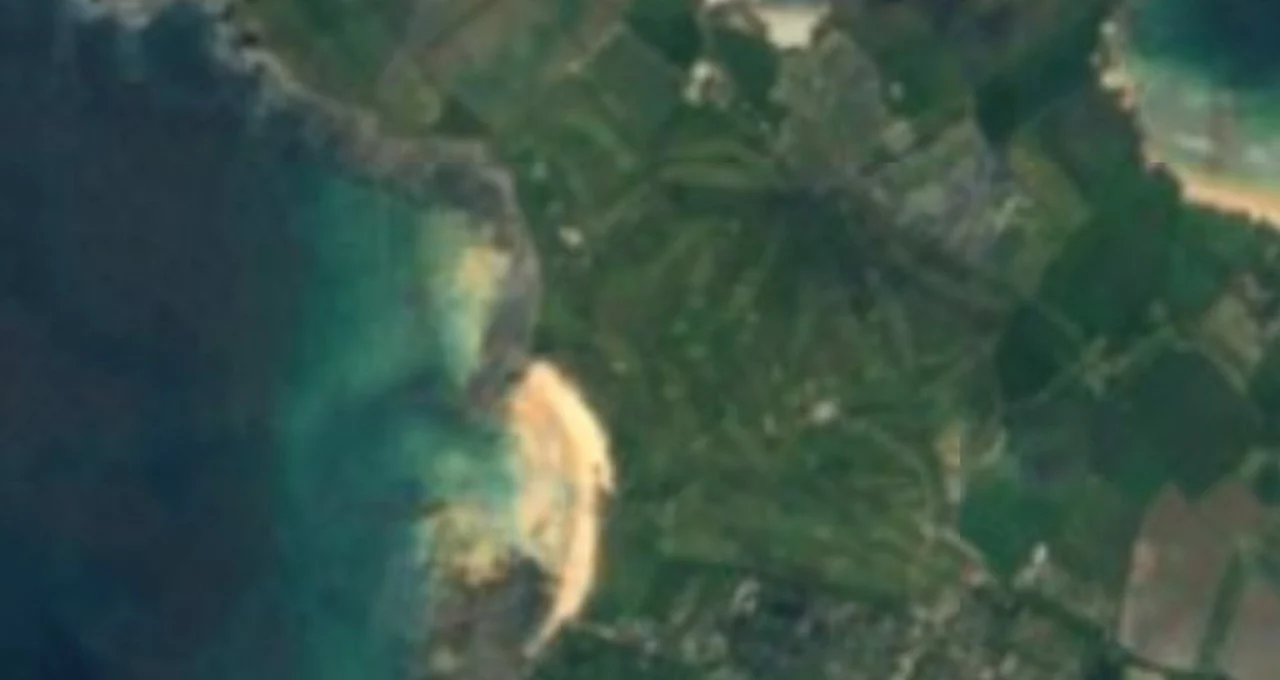
Trevose Golf & Country Club from space. Sentinel-2 cloudless 2016 by EOX IT Services GmbH (contains modified Copernicus Sentinel data), CC BY 4.0.
Trevose Golf & Country Club
Holes
36 (Championship Course, 18 holes; Headland Course, 9 holes; Short Course, 9 holes)
By
Championship: 72; Headland: 35 for nine holes; Short Course: 29 (club, Wikipedia, OpenStreetMap)
Length
Championship: 6,948 yards from the black tees, 6,789 blue, 6,491 white, 6,163 yellow, 5,782 green, 5,466 orange (club scorecard); Headland: 3,031 yards from the blue tees (club scorecard); Short Course: 1,360 yards (club scorecard)
Green fee
—
Best season
Open all year according to the club, with lower green fee rates from January to March and in November and December
Trevose Golf & Country Club lies at Constantine Bay on the north coast of Cornwall, a few miles west of Padstow, on open links ground between the Atlantic beaches of Constantine Bay and Booby’s Bay and the headland of Trevose Head. The club gives its location as Constantine Bay, Padstow, PL28 8JB. It is a family-owned golf resort with three courses: the eighteen-hole Championship Course, laid out by Harry Colt and opened in 1925; the nine-hole Headland Course, which the club credits to Peter Alliss and dates to 1993; and a nine-hole Short Course. Accommodation, a restaurant and a gym sit on the same site.
The Championship Course is the reason most golfers know the name. On the club’s current scorecard it is a par 72 that measures 6,948 yards from the black tees, with five further sets of tees down to 5,466 yards. It has hosted national amateur championships, the Brabazon Trophy in 2008 and the McGregor Trophy in 2012 among them, and the English Men’s County Finals in 2017, according to the club. Top 100 Golf Courses ranks it second in Cornwall, tenth in South West England and sixty-second in England. The club celebrated its centenary in 2025.
A holy well, a bell tent and a family that stayed
The story of Trevose begins with archaeology rather than golf. According to a history of the club published by the Legends Tour, Dr Penrose Williams, an archaeologist, uncovered a holy well near Constantine Bay in 1911 and had to fill the excavation in again. In the 1920s he bought the land, which allowed him to resume the dig. Wikipedia records the same well, which it says is claimed to date from the third century, beside the remains of St Constantine’s Chapel. (Wikipedia spells the doctor’s first name Pension; the Legends Tour history gives Penrose.)
Williams then commissioned Harry Colt, the most sought-after British architect of the period, and the Championship Course opened in 1925. The Legends Tour history says Colt’s plan was for a course of 6,220 yards with a bogey of 75, the old name for par, and that the course actually built in 1925 measured 5,765 yards, still with a bogey of 75. The first clubhouse was a bell tent, soon replaced by a timber building. The cost of building and maintaining the course led Williams’s solicitor to advise forming a limited company, Trevose Ltd. The same source records the first honorary member, the manageress of the Metropole Hotel in Padstow, on 25 April 1927, and the first official general meeting on 24 August 1928, at which Williams became secretary. Top 100 Golf Courses adds that Sir Guy Campbell made minor revisions to Colt’s layout just before the Second World War.
The family that has run Trevose ever since arrived as guests. According to the Legends Tour history, John C. Gammon, a civil engineer, joined in 1936 after staying in a cottage beside the course. In 1941 he and another member, G.D. Lyell, bought Trevose Ltd, and in 1955 he became sole owner. His son Peter took over the management in 1961 and ran the club for about forty years; Peter’s son Nick took on responsibility in 2002. The club’s own history describes the same succession and says Nick Gammon has led the business since 2015, which suggests different milestones rather than a disagreement about who is in charge. In 2012 the club published a history book, Trevose Golf & Country Club: A Golfing Gem on the North Cornwall Coast, with a foreword by Peter Alliss, according to Wikipedia.
Over the last two decades the Championship Course has been reworked to keep pace with the game. The Legends Tour history says changes were made in 2005 to suit modern equipment, and that the announcement in January 2006 that the Brabazon Trophy, the English Open Amateur Stroke Play Championship, would come to Trevose prompted substantial work on the course. Wikipedia reports that the 2008 Brabazon was cut to 54 holes because of bad weather. In 2019 the club was announced as host of the inaugural Farmfoods European Legends Links Championship, an event on the senior professional tour.
The most recent programme is the work of Mackenzie & Ebert. Golf Course Architecture reported on 21 March 2016 that the firm had completed the first phase of upgrades to the Championship Course, begun in autumn 2015 and concentrated on the 2nd, 9th and 13th holes, with a consistent bunkering style, new greens and the reshaping of more than half of the green surrounds. The 4th was to follow. Top 100 Golf Courses says that in 2016 the 4th was overhauled with new tees, bunkers and a large, undulating new green, that the 14th, 15th and 16th were reworked in 2018 with changes to bunkers and green surrounds and areas of bare sand opened up, and that seven holes in all have been extensively reworked. The club itself says the improvements have modernised the course without changing Colt’s original layout.
What the course asks of you
The Championship Course
All yardages in this section come from the scorecard on the club’s website. From the black tees the Championship Course is 6,948 yards, par 72, with an outward nine of 3,383 yards and an inward nine of 3,565. The other tees measure 6,789 yards (blue), 6,491 (white), 6,163 (yellow), 5,782 (green) and 5,466 (orange). The routing follows a pattern Colt used often: the club describes a front nine that hugs the dunes and the coastline and a back nine that moves inland before returning to the clubhouse. There are four par 5s, at the 4th, 9th, 10th and 13th, and four par 3s, at the 3rd, 8th, 11th and 16th.
The club is candid that the main defence is the wind rather than narrowness. It describes generous fairways and wide greens, with penal rough and bunkers for those who miss them, and Top 100 Golf Courses adds that the rough is kept short to help the pace of play and calls the course a stern test when the wind blows. That source also notes three short par 5s that offer chances of birdie, and five par 4s of more than 400 yards.
The opening is one of the strongest starts in the county. The 1st is a par 4 of 437 yards from the black tees and stroke index 4, a tee shot the club calls formidable; reviewers describe it as a long, downhill hole that narrows between the dunes to a two-tier green. The 3rd, at 166 yards, is the first short hole and one of the most praised: reviewers describe a shot across a deep valley running parallel to the beach to a heavily guarded green, where missing short or right finds sand.
Then comes the 4th, the hole the club has long treated as its signature. It is a par 5 of only 487 yards from the black tees and stroke index 18, so it is a birdie chance on paper, but the green sits against Booby’s Bay. Reviewers describe an elevated tee and a dogleg to the left that brings players down towards the rocks and the waves, with a risk and reward choice on the second shot. Top 100 Golf Courses says that many felt the old green did not live up to its setting, which is why the 2016 rebuild began there.
The 5th, a par 4 of 451 yards, is stroke index 2. The 7th, 420 yards from the back, finishes on a green on top of a dune that slopes from back to front. The front nine closes with the short 8th, 155 yards, and the par 5 9th, 492 yards, with a raised and well-bunkered green according to reviewers.
The back nine starts with another par 5, the 10th, 523 yards from the black tees, which reviewers describe as downhill with a brook across the fairway. The 11th is a long par 3 of 221 yards from the black tees (196 from the blue and white), which Top 100 Golf Courses says has a two-tiered plateau green and reviewers say usually plays into the prevailing wind. The 12th, a par 4 of 460 yards, is stroke index 1. The 13th is the longest hole on the course at 569 yards, stroke index 3, and the hole that divides opinion most: one detailed review finds its open landing area poorly defined, and notes out of bounds on the left and a ditch near the approach.
The 14th and 15th are short par 4s, 326 and 323 yards from the back, both part of the 2018 work; reviewers describe the 14th green as ringed by bunkers with a narrow entrance. The 16th is a par 3 that stretches to 247 yards from the black tees, with the green tucked between dunes. The 17th, 428 yards and stroke index 5, plays uphill to an elevated, two-tier green with a burn in front, a deep bunker front right and a steep bank behind, and three big fairway bunkers between 260 and 305 yards from the back tees according to one review. The 18th, 468 yards from the black tees, is an uphill dogleg to the left back to the clubhouse.
The club’s scorecard does not publish course or slope ratings on the page we read. Wikipedia gives a course rating of 74.3 and a slope of 128 from the back tees, but for a longer, older set of yardages, so those figures should not be read against the current card.
The Headland Course
The Headland Course is a nine-hole links on the headland above Constantine Bay, with wide fairways, gentle contours, subtle bunkering and views of the sea, as the club describes it. It is a par 35 of a little over 3,000 yards, 3,031 yards from the blue tees on the club’s card, and the club’s figures of par 70 and 6,062 yards are for two loops. The longest hole is the 8th, a par 5 of 511 yards from the blue tees, and the shortest the 2nd, a par 3 of 182 yards. GolfPass gives 2,651 yards from the red tees. Wikipedia records a course rating of 34.6 and a slope of 114 for the nine holes. The club says a round takes less than two hours, that no tee booking is needed, and that players simply pay at the golf shop. It markets the Headland to relaxed golfers, families and groups of mixed ability, and it is also used as a warm-up before the Championship Course.
The sources disagree on its origins. The club’s course page, Top 100 Golf Courses and GolfPass credit the design to Peter Alliss and date the opening to 1993. The club’s own history page, however, says that John Gammon’s son Peter introduced the Headland and Short Courses in the early 1960s. The two are not necessarily incompatible, since a course can be laid out on the headland and later redesigned, but we found no source that explains the gap. Some golfers will know it under another name: we found no current source that calls it the New Course, and the club uses only the name Headland.
The Short Course
The third course is a nine-hole short course of 1,360 yards, which the club presents as suitable for everyone, with coastal views, clever bunkering, coastal winds and subtle undulations. Holes on the club’s card range from 85 yards (the 5th) to 200 yards (the 7th). The club, Wikipedia and OpenStreetMap all give a par of 29, but the hole-by-hole pars on the club’s card add up to more than that, because the 2nd, a hole of 120 yards, is shown as a par 5; it looks like an error on the card, and we report the total of 29 that every source agrees on. As on the Headland, there is no tee booking: golfers pay at the shop and play. The club names no architect for it.
What golfers say
The points below summarise the golfer reviews published on Top 100 Golf Courses, which lists 68 reviews of the Championship Course with an average of 4.5 out of 5; we read those visible to us, dated from September 2023 to July 2026. For the Headland we add the themes of a public discussion on the Golf Monthly forum from early 2018. These are other people’s opinions, not ours. Nobody from Panxis has played the courses, and we name no reviewer.
What comes up in its favour
- The setting. Reviewers return again and again to the Atlantic views, the sandy bays and the dunes, and to the sight of the whole links from the clubhouse.
- Playability with bite. The course is described as open and forgiving off the tee, with few lost balls, yet a real test for good players, especially in wind.
- The renovation. Several reviewers say the Mackenzie & Ebert work has added strategy around the greens and in the bunkering, and the rebuilt 4th green is called the highlight. One commentator quoted by Top 100 Golf Courses argued that the work justifies a higher ranking than its neighbour St Enodoc.
- Greens and par 5s. The green complexes, many of them on dunes or in tiers, score the top mark in the site’s ratings, and the par 5s are singled out. The 3rd, 4th, 7th, 17th and 18th recur among favourite holes.
- Condition and welcome. Reviewers praise the maintenance from tee to green, the friendly staff, the family atmosphere and the convenience of staying on site.
What comes up against
- The 13th. The long par 5 is the hole most often criticised, as poorly framed and out of character with the rest of the course.
- Tempo. One detailed review finds the middle of the round flatter after the strong opening holes, and older commentary described several holes as dull before the 2018 work.
- Holiday golf. Top 100 Golf Courses notes that some have dismissed Trevose as holiday golf, and some forum contributors find it flatter and less dramatic than other links in the South West.
- Strategy. In the Top 100 Golf Courses ratings, strategy is the weakest category, though no reviewer explains this in detail.
- The Headland. Forum contributors describe the nine-hole course as pleasant but ordinary, worth playing if you are already there rather than a reason to travel, with one memorable green by the sea and an uphill walk back to the clubhouse.
Getting there and when to go
Trevose is on the north Cornish coast at Constantine Bay, a little east of Trevose Head. Padstow is about three and a half miles to the east in a straight line by our measurement on the map, and Cornwall Airport Newquay about seven miles to the south. The nearest railway station we found is Newquay, roughly nine miles away in a straight line, at the end of the branch line from Par; all of these are further by road. The beaches of Constantine Bay and Booby’s Bay lie beside the course, and the South West Coast Path runs along the shore.
Tee times on the Championship Course are booked through the club’s online booking page; the club says a handicap certificate is required, metal spikes are not allowed and a respectable standard of dress is expected at all times. The Headland and Short Courses need no booking. The club’s shop hires out pull trolleys, electric trolleys and electric buggies, as well as sets of clubs. On site are the Constantine Restaurant, apartments, lodges, bungalows and cottages, and a new gym and fitness studio. More details are on the club’s website.
The club advertises year-round golf, and its green fee page says rates are lower from January to March and in November and December. Summer is the obvious time for the beaches and long evenings, but it is also the busy holiday season in north Cornwall, and the club is a resort as well as a members’ club. Spring and autumn bring quieter roads. At any time of year, expect wind: every source we read agrees that it is what decides how hard Trevose plays. The club also publishes an adverse weather policy for 2026.
How this page was made
The factual frame comes from public sources: OpenStreetMap for the location, the description of the three courses and our distance measurements; the club’s website, read in October 2026, for the address, the Championship Course scorecard, the Headland and Short Course pages and cards, the club history, the tournaments, the equipment hire, the dress code and the booking arrangements (without prices); the history of the club published by the Legends Tour; the English Wikipedia article on the club; Golf Course Architecture for the first phase of the Mackenzie & Ebert work in 2016; Top 100 Golf Courses for its description, rankings and golfer reviews; GolfPass for the Headland scorecard; and the Golf Monthly forum for opinions on the Headland. Wikidata identifies the club as Q96410792.
Where sources disagree, we say so. The club, Wikipedia and the Legends Tour give 1925 as the year the club was founded and the course opened; Top 100 Golf Courses gives 1926. For the length of the Championship Course, the club’s current scorecard gives 6,948 yards from the black tees, while Wikipedia and the Legends Tour give 7,147 yards and Top 100 Golf Courses 7,172; we use the club’s card. Wikipedia and Top 100 Golf Courses give a par of 73 for women, which the club’s card does not show. The origins of the Headland Course (Peter Alliss in 1993, or Peter Gammon in the early 1960s) are covered above, as is the par of the Short Course. The two published spellings of the founder’s name, Penrose and Pension, differ; we use Penrose, as in the Legends Tour history. You may have seen the club’s courses listed as Championship, New and Short; we found no current source for a New Course, and the club today names its three courses Championship, Headland and Short.
Some sources were out of reach: the Today’s Golfer page on the club asked for payment, the Golf Monthly course review did not load in full, and the page of the European Institute of Golf Course Architects on the renovation refused access. None of them has been used.
The opinion section summarises the golfer reviews on Top 100 Golf Courses and a discussion on the Golf Monthly forum, read in October 2026. We report recurring themes rather than individual voices, and we reproduce no quotations from reviewers. Nobody from Panxis has played or visited these courses, and this page is no substitute for a round.
The club has not paid for this page, has not seen it before publication and has no say over its content. This page contains no commercial link and earns us no commission. If you know the club and something here is wrong or out of date, write to us and we will correct it.
Other courses nearby
Closest to this one in our British directory:
- Fairwood Park Golf Club — 85 mi
- Glamorganshire Golf Club — 100 mi
- Burnham & Berrow Golf Club — 101 mi
- Cardiff Golf Club — 106 mi
The hole to know
A par 5 of 487 yards from the black tees on the Championship Course, played from an elevated tee as a dogleg left to a green set against Booby's Bay, rebuilt with new tees, bunkers and a large undulating green in 2016 as part of Mackenzie & Ebert's masterplan.